3D0X2 Cyber Systems Operations
The Air Force runs its networks on Airmen who know how to build, defend, and recover them. That’s the 3D0X2 Cyber Systems Operations career field. These Airmen manage server infrastructure, harden Air Force systems against intrusion, monitor networks for threats, and respond when something breaks or gets breached. The work is technical, the stakes are real, and the training the Air Force provides translates almost directly into the civilian cybersecurity job market.
The ASVAB requirement has two paths: MECH 45 and ELEC 60, or an alternative combination that includes a cyber-specific qualifying test. Either way, you need to demonstrate solid technical aptitude. A Top Secret clearance based on a Single Scope Background Investigation is also required, which means your background matters as much as your test score.
If you’re looking for an Air Force career that sets you up for a high-paying civilian job after service, this is one of the clearest paths available. Cybersecurity professionals with government clearances are among the most sought-after workers in the tech sector, and 3D0X2 Airmen leave service with both. Strong ASVAB electronics and general scores matter, solid test prep can make the difference between qualifying and not.
Qualifying requires specific ASVAB line scores. Our ASVAB study guide covers what to target and how to prepare.
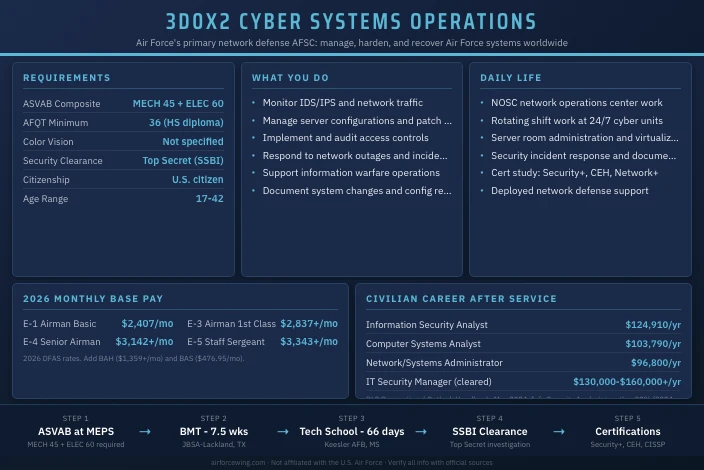
Job Role
Cyber Systems Operations specialists install, configure, and defend Air Force computer systems and networks. They manage servers, monitor network security, respond to cyber incidents, and implement defensive measures to protect mission-critical Air Force infrastructure from adversarial threats. The 3D0X2 AFSC is the Air Force’s primary network defense and systems management career field.
What the Work Actually Looks Like
Day-to-day work for a 3D0X2 Airman centers on keeping Air Force networks secure and operational. That means monitoring network traffic for anomalies, patching systems, managing user accounts and access controls, and responding to security incidents when they occur. At larger installations, this work happens inside a Network Operations and Security Center (NOSC), a 24/7 operations environment where Airmen track network health in real time.
The job also covers server administration. Airmen build and maintain virtualized server environments, manage storage systems, and keep software current. When a system goes down or behaves unexpectedly, 3D0X2 Airmen are the ones diagnosing and fixing it.
Typical daily tasks include:
- Monitoring intrusion detection and prevention systems
- Managing server configurations and patching cycles
- Implementing and auditing access controls
- Responding to network outages and security incidents
- Documenting system changes and maintaining configuration records
- Supporting information warfare operations within authorized parameters
Specialization and Codes
| Code | Description |
|---|---|
| 3D0X2 | Cyber Systems Operations (primary AFSC) |
| SEI 060 | Cybersecurity Service Provider, adds defensive cyber operations qualification |
| SEI 346 | Information Assurance Officer (enlisted) |
The SEI codes above are earned through additional training and experience after reaching the 5-skill level.
Mission Contribution
Air Force networks carry everything: command communications, intelligence feeds, logistics data, weapons systems connectivity. When those networks go down or get compromised, operations stop. 3D0X2 Airmen are the reason adversaries have a much harder time making that happen. The career field directly supports the 16th Air Force’s information warfare mission and the broader Air Force mission by ensuring the digital backbone of the service stays intact.
Technology and Equipment
The tools shift as technology does, but 3D0X2 Airmen routinely work with enterprise network equipment (routers, switches, firewalls), Windows and Linux server environments, virtualization platforms, security information and event management (SIEM) tools, and endpoint detection software. Cleared contractors at many installations use the same platforms 3D0X2 Airmen operate, which is part of why the skills transfer so cleanly to civilian defense work.
Salary
Base Pay
Pay is based on grade and time in service, set by DFAS and universal across all branches. Allowances stack on top.
| Grade | Rank | Monthly Base Pay (entry) |
|---|---|---|
| E-1 | Airman Basic | $2,407 |
| E-2 | Airman | $2,698 |
| E-3 | Airman First Class | $2,837 |
| E-4 | Senior Airman | $3,142 |
| E-5 | Staff Sergeant | $3,343 |
| E-6 | Technical Sergeant | $3,401 |
All figures are 2026 DFAS pay tables. Pay increases with time in service at each grade, an E-5 with 10 years earns $4,395/month in base pay alone.
Allowances
Housing and food allowances are separate from base pay and not taxable.
- BAH (Basic Allowance for Housing): Varies by installation, pay grade, and dependency status. An E-4 without dependents at a major CONUS installation typically receives $1,359 to $1,700+ monthly.
- BAS (Basic Allowance for Subsistence): $476.95/month flat rate for all enlisted Airmen in 2026.
Other Benefits
Active-duty Airmen receive TRICARE Prime at no cost, no enrollment fees, no copays, with coverage for medical, dental, vision, and prescriptions. Education benefits include Tuition Assistance (up to $4,500/year for classes during service) and the Post-9/11 GI Bill after separation, covering full in-state tuition at public schools or up to $29,920.95 annually at private schools, plus a monthly housing stipend.
Retirement under the Blended Retirement System includes a pension at 20 years (40% of high-36 average basic pay) plus automatic TSP contributions and government matching of up to 4% of basic pay.
Leave
Airmen earn 30 days of paid leave per year and can carry up to 60 days.
Qualifications
Qualification Requirements
| Requirement | Standard |
|---|---|
| ASVAB Composite | MECH 45 + ELEC 60 (primary path); alternate path with MECH 45, ELEC 55, and Cyber Test score of 60 |
| AFQT Minimum | 36 (high school diploma) |
| Security Clearance | Top Secret (SSBI required) |
| Citizenship | U.S. citizen |
| Education | High school diploma or GED |
| Age | 17-42 at time of enlistment |
| IA Certification | Information Assurance Technical Level II required for 3-skill level award and retention |
The ASVAB composites used by the Air Force break down as follows: ELEC draws from General Science, Arithmetic Reasoning, Mathematics Knowledge, and Electronics information subtests. MECH draws from General Science, Auto/Shop Information, Mathematics Knowledge, and Mechanical Comprehension. Airmen who score strongly on both have two routes to qualify; the alternate path substitutes a slightly lower electronics score for the cyber-specific test.
The Top Secret clearance investigation (SSBI) examines your financial history, foreign contacts, travel, and personal conduct in detail. Significant debt, foreign national relatives, or a history of drug use can delay or disqualify an application. Talk to a recruiter honestly about your background before committing to this AFSC.
Application Process
Competitiveness
3D0X2 is one of the Air Force’s higher-volume cyber AFSCs and regularly has open slots. The ASVAB is the first gate, review what the ASVAB electronics and mechanical composites test before you walk into MEPS. Strong scores help, but the clearance investigation is the longer timeline factor. Airmen who have clean financial and legal records and limited foreign contacts clear faster. Prior IT experience or relevant certifications (CompTIA A+, Network+) aren’t required but demonstrate aptitude that recruiters note.
Service Obligation
The standard enlisted commitment for 3D0X2 is a four-year active-duty contract, though six-year contracts are available and may come with an enlistment bonus. Airmen enter service at E-1 (Airman Basic) and promote to E-2 after six months of service.
Work Environment
3D0X2 Airmen work primarily indoors, server rooms, network operations centers, or office spaces with classified terminals. The environment is air-conditioned, desk-oriented, and technically intensive. Physical labor is minimal outside of occasional equipment installation or cabling work.
Schedule
Schedule depends heavily on the assignment. Many cyber units run 24/7 operations, which means rotating shifts including nights, weekends, and holidays. Network Operations and Security Centers don’t pause when the duty day ends. At other assignments, standard day-shift hours apply with on-call requirements. Expect at least some shift work during a career in this AFSC.
Team Dynamics
Most 3D0X2 Airmen work in communications squadrons or cyber units attached to an installation or wing. The team structure is collaborative. Airmen troubleshoot problems together, document changes in shared systems, and pass responsibilities across shifts in a formal handoff process. Individual accountability matters because configuration errors affect the whole network.
Leadership and Feedback
Performance is evaluated through the Enlisted Performance Report (EPR). At the SSgt level and above, EPR scores directly affect promotion board outcomes. Supervisors provide quarterly feedback at minimum, and the technical nature of the work means performance is often clearly measurable, systems either work or they don’t.
Job Satisfaction
Cyber Airmen who thrive in this field generally cite the technical depth, the direct civilian applicability of their skills, and the relative comfort of the work environment. The clearance requirement locks in some assignments to specific installations, which limits flexibility for Airmen who want choice in where they’re stationed.
Training
Training Pipeline
| Phase | Location | Duration | Focus |
|---|---|---|---|
| Basic Military Training (BMT) | JBSA-Lackland, TX | 7.5 weeks | Military foundations, fitness, discipline |
| Technical School | Keesler AFB, MS | 66 days (~9.5 weeks) | Systems administration, network security, server management |
Tech School at Keesler AFB covers server infrastructure, network fundamentals, access control, and the foundational security concepts that underpin the IA Technical Level II certification requirement. The ELEC and MECH ASVAB composites tested at MEPS directly reflect the technical content covered in training, see the ASVAB prep guide if you want to understand what’s on those subtests. Instruction mixes classroom learning with hands-on lab work.
Advanced Training
After reaching the 5-skill level, Airmen can pursue advanced courses, including Cyber Security Service Provider (CSSP) training that qualifies them for SEI 060. Many units also fund or encourage commercial certifications, CompTIA Security+, Network+, and Certified Ethical Hacker (CEH) are common at mid-career. The 7-skill level (craftsman) and eventual 9-skill level (superintendent) unlock supervisory and staff roles.
CompTIA Security+ satisfies the DoD 8570 / DoD 8140 Information Assurance Technical Level II requirement, the same standard required to award and retain the 3D0X2 AFSC. Many Airmen earn it during or shortly after Tech School.
The Air Force also supports degree completion through Tuition Assistance. Some 3D0X2 assignments have direct partnerships with online programs that offer credit for military training, allowing Airmen to work toward an Information Systems Technology or Cybersecurity degree while on active duty.
Career Progression
Rank Progression
| Grade | Rank | Typical Time at Grade |
|---|---|---|
| E-1 | Airman Basic (AB) | 0-6 months |
| E-2 | Airman (Amn) | 6-12 months |
| E-3 | Airman First Class (A1C) | 12-28 months |
| E-4 | Senior Airman (SrA) | 28-48 months |
| E-5 | Staff Sergeant (SSgt) | 4-7 years (test-based) |
| E-6 | Technical Sergeant (TSgt) | 7-12 years (test-based) |
| E-7 | Master Sergeant (MSgt) | 12+ years (board-based) |
Promotion to E-5 and above is competitive. It requires passing the Weighted Airman Promotion System (WAPS) test, which includes Specialty Knowledge Tests specific to the AFSC. EPR scores, decorations, and professional military education (PME) completion factor into the score.
Role Flexibility
Airmen who want to broaden their cyber focus can apply for retraining into 1B4X1 (Cyber Warfare Operations) or 3D0X4 (Computer Systems Programming) at the mid-career point, depending on Air Force needs. The 3D0X2 technical foundation makes either transition a reasonable goal for a motivated Airman. Officers in the cyber career field often seek out 3D0X2 NCOs for key staff positions because of their systems-level expertise.
Performance Evaluation
The EPR system rates Airmen on duty performance, leadership, and professional qualities on a five-point scale. Raters and senior raters have limited distribution requirements for the top score (“5”), which keeps promotion competition meaningful. Airmen who earn regular top ratings and complete PME (Airman Leadership School, NCO Academy) typically promote ahead of their peers.
Succeeding in This Career
Technical depth matters most at the junior level, know your systems cold, earn your certifications early, and document your work well. At the SSgt level, leadership and mentorship weigh as heavily as technical performance in EPR ratings. Airmen who pursue certifications, stay current on evolving threats, and take on additional duties (unit security manager, equipment custodian) build the record that sustains a competitive promotion record.
Physical Demands
Daily Physical Demands
The 3D0X2 AFSC is sedentary by military standards. Most of the work is at a terminal. Occasional physical demands include lifting server equipment (up to 50 lbs), running cable, and working in tight server room environments. This is not a physically intensive career field, but all Airmen must maintain fitness standards regardless of AFSC. Extended shift work, particularly 12-hour rotations in a Network Operations and Security Center, creates ergonomic demands. Prolonged sitting, extended screen exposure, and repetitive hand movements are routine. Airmen who invest in proper workstation ergonomics and take regular breaks reduce long-term strain from this kind of work.
Air Force Fitness Assessment
All Airmen, regardless of AFSC, take the Air Force Fitness Assessment annually. It is scored on a 100-point scale with a minimum passing composite of 75. Every component must meet a minimum standard.
| Component | Max Points |
|---|---|
| 1.5-Mile Run | 60 |
| Waist Circumference | 20 |
| Push-Ups (1 minute) | 10 |
| Sit-Ups (1 minute) | 10 |
Standards are age- and gender-normed. Airmen who score below 75 overall or fail any single component enter a Fitness Improvement Program (FIP). Participation in FIP affects promotion eligibility. Airmen on FIP are ineligible to test for promotion until the issue is resolved. Repeated failures can result in separation action. Because 3D0X2 work is not physically demanding in the traditional sense, Airmen need to maintain a deliberate fitness routine outside of duty hours. Most cyber units do not incorporate shift-long physical training the way some other career fields do.
Medical Standards
Applicants must meet standard Air Force medical accession standards at MEPS. There are no flight physical requirements or special medical certifications for this AFSC. Normal corrected vision and hearing are standard requirements, confirm current standards with your recruiter, as they can vary with accession cohort. Periodic medical evaluations during service follow standard Air Force enlisted procedures and are not AFSC-specific. Airmen who develop medical conditions that affect their ability to operate on shift rotations or handle the demands of a cleared, 24/7 cyber environment may require a medical review through AFPC.
Deployment
Deployment Likelihood
3D0X2 Airmen do deploy, but not at the same frequency as combat support AFSCs. Cyber units have deployed to support Air Operations Centers and joint task forces in various theaters. Deployment lengths typically run 4-6 months, and the work in theater mirrors home-station duties: maintaining the network, responding to incidents, and keeping communications secure. In deployed locations, 3D0X2 Airmen often work inside hardened communications facilities supporting the Air Operations Center, managing secure data links, and troubleshooting classified network infrastructure that the mission depends on. Dwell ratios for most cyber billets allow for significant home-station time between rotations, though this varies by unit and operational demand. Some Airmen complete a full four-year contract without deploying; others may rotate more frequently depending on their unit’s assigned mission.
Major Duty Stations
The Air Force places 3D0X2 Airmen at installations with significant network infrastructure or cyber missions. Common duty stations include:
- Joint Base San Antonio, TX (large communications and cyber presence)
- Keesler AFB, MS (training and follow-on assignments)
- Scott AFB, IL (AMC communications hub)
- Peterson SFB, CO (NORAD/USNORTHCOM network support)
- Ramstein AB, Germany (USAFE installations)
- Kadena AB, Japan (PACAF communications)
- Fort Meade, MD (joint cyber mission support)
- Hurlburt Field, FL (Special Operations Command communications)
Overseas and CONUS assignments both appear regularly in 3D0X2 assignment cycles. Preference can be submitted through the Air Force assignment preference system, but actual placement depends on Air Force needs and available billets at each installation. Most 3D0X2 Airmen complete at least one overseas assignment during a career, which adds an overseas cost-of-living allowance (COLA) on top of standard pay and allowances.
Risk/Safety
Job Hazards
Physical risks for 3D0X2 Airmen are low compared to most military career fields. Ergonomic strain from extended desk work and exposure to electrical equipment are the primary occupational hazards in garrison. Server rooms carry minor electrical risk and require awareness of safe cable and rack management practices. Deployed environments introduce standard hazards of forward-operating locations, including base defense situations, indirect fire, and the general stress of operating in an austere theater.
Security and Legal Requirements
The Top Secret clearance comes with lifelong obligations that do not end when a service member separates. Airmen must report foreign contacts, significant financial changes, foreign travel, and certain personal events to their security officer promptly, the reporting requirement is continuous, not just at the time of the original investigation. Failing to report can result in clearance suspension or revocation, and loss of clearance means immediate loss of the ability to perform the AFSC. Clearance revocation typically triggers reassignment or, in some cases, involuntary separation.
Access to sensitive networks also means strict rules on authorized use. Unauthorized access to systems, even Air Force systems the Airman already has authorized access to, carries serious legal consequences under the Uniform Code of Military Justice (UCMJ). Intentional data exfiltration, misuse of privileged access, or sharing classified information with unauthorized individuals can result in court-martial, federal criminal charges, and imprisonment. Supervisors brief Airmen on acceptable use policies during initial assignment and annually thereafter. Security incidents are never treated as minor administrative matters.
Conflict Zone Operations
Cyber units supporting combat operations work inside hardened communications facilities in deployed locations. The mission requires continuity, networks don’t pause during hostile action. 3D0X2 Airmen operating in deployed environments are expected to maintain mission readiness throughout the deployment cycle, including during force protection contingencies.
Impact on Family
Living in a 24/7 operational environment affects personal schedules in ways that vary by assignment. Shift rotations at a Network Operations and Security Center mean some weekends and holidays on duty, the schedule does not align with civilian norms, and family planning needs to account for that. Deployments of 4-6 months are a real factor for families, and the communication blackout that sometimes accompanies the first week or two of a new deployment can be stressful.
The Air Force supports military families through the Airman and Family Readiness Center (AFRC) at each installation, which offers financial counseling, deployment preparation programs, spouse employment assistance, and referrals to community support services. Military OneSource provides 24/7 counseling and support at no cost, including help with legal, financial, and personal challenges that arise during separations.
The clearance requirement does not significantly restrict where 3D0X2 Airmen are assigned, most Air Force installations have a cyber or communications mission that requires Top Secret cleared personnel. In practice, having a clearance opens more assignment options, not fewer.
BAH makes off-base housing feasible at most installations, and rates are tied to actual local housing costs, not a flat number. Families can choose to remain in a stable location, particularly for school continuity, while the Airman PCSs unaccompanied to a short-tour overseas location. The standard PCS cycle runs every 2-3 years on average. Repeated moves are stressful for families with school-age children, and many Airmen use the assignment preference system to request stabilized assignments or follow-on tours at the same installation when possible. The Air Force’s school liaison program assists families in managing school transitions when moves are unavoidable.
Reserve and Air National Guard
Component Availability
The 3D0X2 AFSC is available in both the Air Force Reserve and the Air National Guard. The Air National Guard has a particularly strong cyber presence, many states have dedicated cyber units, and some ANG cyber units have received high-profile national missions under the National Guard Bureau’s Cyber Initiatives program.
Drill Schedule and Training Commitment
The standard commitment is one weekend per month (Unit Training Assembly, or UTA) plus two weeks of Annual Tour. Cyber units often require additional training days for certification maintenance, exercise participation, and unit readiness events. Plan for more than the minimum in an active cyber unit.
Part-Time Pay
A drilling E-4 (Senior Airman) with this AFSC earns approximately $563/month for a standard drill weekend (four drill periods at the E-4 less-than-2-years base pay rate). Active-duty E-4 base pay for comparison is $3,142/month.
Reserve and Guard Benefits Comparison
| Factor | Active Duty | Air Force Reserve | Air National Guard |
|---|---|---|---|
| Commitment | Full-time | 1 UTA/mo + 2 wks/yr | 1 UTA/mo + 2 wks/yr |
| Monthly Pay (E-4) | $3,142 | ~$563 (drill days only) | ~$563 (drill days only) |
| Healthcare | TRICARE Prime (free) | TRICARE Reserve Select (premium) | TRICARE Reserve Select (premium) |
| Education | Tuition Assistance + GI Bill | Federal TA + GI Bill (pro-rated) | Federal TA + state tuition waivers (varies) |
| Retirement | 20-yr pension (BRS) | Points-based (age 60 draw) | Points-based (age 60 draw) |
| Deployment Tempo | Frequent | Moderate (unit dependent) | Moderate (mission dependent) |
Air National Guard members may qualify for state tuition benefits, many states offer free or reduced tuition at public universities for ANG members. These benefits vary significantly by state.
Civilian Career Integration
3D0X2 pairs exceptionally well with a civilian IT or cybersecurity career. Network security, systems administration, and security operations roles in the private sector require the same skills Airmen build on active duty. Many part-time 3D0X2 Airmen work full-time for defense contractors, federal agencies, or tech firms, employers who value both the cleared status and the operational experience.
USERRA protections require civilian employers to grant leave for military service and guarantee reemployment in the same or comparable position upon return. Most employers in the defense tech sector actively support Guard and Reserve service.
Post-Service
Civilian Career Transition
3D0X2 Airmen leave service with a verified technical skill set, an active clearance, and documented operational experience, a combination civilian employers in the defense and tech sectors pay well for. The clearance alone saves employers months of investigation time and cost, which translates directly into higher starting salaries for separated Airmen.
The DoD SkillBridge program allows Airmen within 180 days of separation to work for a civilian employer full-time while still receiving military pay and benefits. Many tech companies and defense contractors participate, making this one of the cleanest off-ramps available.
Civilian Career Prospects
| Civilian Job Title | Median Annual Salary | Job Outlook (2024-2034) |
|---|---|---|
| Information Security Analyst | $124,910 | +29% (much faster than average) |
| Computer Systems Analyst | $103,790 | +9% (faster than average) |
| Network and Computer Systems Administrator | $96,800 | -4% (declining, but ~14,300 annual openings) |
| IT Security Manager (cleared, defense) | $130,000-$160,000+ | High demand |
Data from BLS Occupational Outlook Handbook, May 2024. The information security analyst projection reflects strong and growing demand across industries. Cleared candidates consistently command a premium above published medians.
Relevant certifications that help at separation: CompTIA Security+ (often already earned during service), CISSP (for senior roles), CEH, and Microsoft/AWS cloud certifications for infrastructure roles.
Separation Policies
Airmen who complete their service commitment can separate voluntarily at contract end. Early separation requires Air Force approval and may require partial bonus repayment if an enlistment bonus was received. The Transition Assistance Program (TAP) is mandatory for separating Airmen and includes resume writing, job placement resources, and VA benefits counseling.
Is This a Good Job
Who Fits This Career
The 3D0X2 Airman who succeeds is genuinely interested in how systems work. Not just casually interested, curious enough to spend time outside of work reading about network security, testing things, and learning new tools. The Air Force provides excellent training, but Airmen who treat it as a floor rather than a ceiling outperform their peers and leave with stronger credentials.
Clean background matters. If you have significant debt, extensive foreign contacts, or a complicated personal history, the clearance process will be slower and could disqualify you entirely. Being honest with a recruiter early is better than investing months in the process and washing out.
Shift work is real. If you need a strict 8-to-5 schedule, this career field will test your patience at most assignments.
Who Should Look Elsewhere
If you’re looking for an Air Force career with a lot of physical activity, outdoor work, or frequent variety in your physical environment, 3D0X2 will feel confining. The work is desk-based, indoors, and often repetitive at the junior level, monitoring dashboards, running updates, working tickets.
The clearance process takes time. If you need to be in your AFSC immediately after Tech School, be aware that interim clearances are available but the full SSBI can take months. Some assignments require the full clearance before you can work on certain systems.
Career and Lifestyle Fit
This AFSC is one of the strongest options available if your goal is to use military service as a launchpad into a well-paying technical career. The combination of operational experience, a government clearance, and commercial certifications earned on the Air Force’s dime creates a resume that gets attention in the defense tech job market. Airmen who are patient with the initial clearance process, willing to work shifts, and genuinely engaged with the technical work tend to look back on this career choice favorably.
More Information
Talk to an Air Force recruiter to confirm current ASVAB score requirements, bonus availability, and open slots for 3D0X2. Bonus amounts and slot availability change with Air Force manning needs, and a recruiter has access to current accession data that isn’t published online. Before you visit MEPS, the ASVAB study guide covers what the electronics and mechanical subtests require and how to prepare. Understanding the ELEC and MECH composites before you walk into MEPS gives you a concrete target to train toward. You can find a recruiter at airforce.com.
For official occupational information on this AFSC, the Air Force Personnel Center at afpc.af.mil publishes career field education and training plans (CFETPs) and enlisted classification data. The AFSC classification document lists formal training requirements, mandatory certifications, and the competency benchmarks at each skill level. The Bureau of Labor Statistics Occupational Outlook Handbook entry for Information Security Analysts provides civilian salary and job outlook data that gives context to what 3D0X2 experience is worth after service.
Airmen already in the Air Force who are interested in retraining into 3D0X2 from another AFSC should speak with their Career Development section and check retraining eligibility through the vMPF portal. Retraining windows open periodically and are competitive, a clean record and relevant prior experience (especially any existing IT or network certifications) strengthen a retraining application.
This site is not affiliated with the U.S. Air Force or any government agency. Verify all information with official Air Force sources before making enlistment or career decisions.
Explore more Air Force cyber careers such as 1B4X1 Cyber Warfare Operations and the upcoming 3D0X4 Computer Systems Programming profile.