1D7X1Q Enterprise Operations
Air Force missions run on servers. Every classified network, every weapon system data link, every base communications platform depends on enterprise infrastructure that someone has to build, configure, and keep running. The 1D7X1Q Enterprise Operations shredout is where that work lives.
These Airmen manage physical and virtual servers, administer cloud-based systems, run enterprise account management, and sustain the information infrastructure that the Department of the Air Force depends on daily. It’s a desk-heavy, technically demanding career field with one of the clearest paths from military service into civilian IT that the Air Force offers.
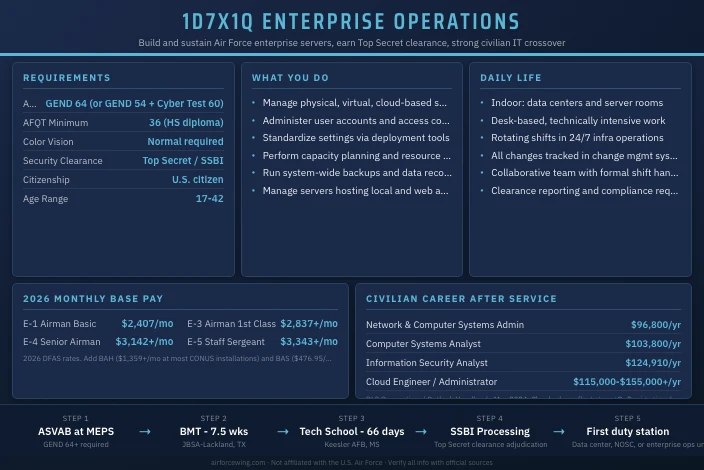
The ASVAB minimum is GEND 64: the same General composite that governs all 1D7X1 Cyber Defense Operations shredouts. Solid test prep pays off here, and the General composite measures Word Knowledge, Paragraph Comprehension, and Arithmetic Reasoning, the same subtests you should focus on before MEPS.
Job Role and Responsibilities
1D7X1Q Enterprise Operations specialists design, build, provision, maintain, and sustain Air Force information systems and enterprise IT infrastructure. They manage physical, virtual, and cloud-based server hardware; administer user accounts and system settings; perform load and capacity planning; and ensure that Air Force enterprise networks remain available, secure, and recoverable. This shredout is the Air Force’s primary role for enterprise server administration and IT infrastructure sustainment.
What the Work Actually Looks Like
The job is technical and methodical. A typical shift involves monitoring server health dashboards, responding to system alerts, provisioning new accounts, running scheduled backups, and applying software or firmware updates to managed infrastructure. At larger installations, this work happens in data centers or server rooms tied into enterprise operations centers. At smaller bases, an Enterprise Operations Airman may be responsible for the full stack of local infrastructure with a smaller team.
Day-to-day tasks include:
- Managing physical, virtual, and cloud-based server and client hardware
- Provisioning and administering user accounts and system-level access controls
- Standardizing system settings using automated deployment tools
- Performing system resource management, including load and capacity planning
- Running system-wide backups and executing data recovery procedures
- Managing servers that host local and web-based applications
- Maintaining configuration baselines and documenting all changes
- Applying security patches and enforcing DoD hardening requirements
Specializations and Codes
The 1D7X1 career field uses an alphabetic suffix to designate specialty within the broader Cyber Defense Operations mission. The Q-suffix identifies Enterprise Operations within that structure.
| Code | Skill Level | Description |
|---|---|---|
| 1D731Q | Apprentice (3-level) | Initial award upon Tech School completion |
| 1D751Q | Journeyman (5-level) | Awarded after on-the-job training and upgrade |
| 1D771Q | Craftsman (7-level) | Senior technician; NCO leadership roles |
| 1D791Q | Superintendent (9-level) | Senior NCO; career field and unit management |
Special Experience Identifiers (SEIs) can be earned by Airmen who demonstrate expertise in cloud platforms, enterprise virtualization, or specific DoD compliance frameworks beyond baseline qualification.
Mission Contribution
Enterprise infrastructure is the foundation that every other Air Force mission runs on. Command and control networks, intelligence sharing platforms, logistics systems, and classified communication links all depend on the servers and infrastructure that 1D7X1Q Airmen sustain. When a server fails or a configuration error creates a gap, operational capability degrades, sometimes mission-critically.
These Airmen support the Department of the Air Force Information Network (DoDIN) and the broader 16th Air Force information warfare enterprise. At the installation level, they keep the IT fabric running that every unit on base depends on, from flying squadrons to medical groups to administrative functions. The work isn’t visible when it’s done right. When it isn’t done right, every Airman on the installation notices.
Technology and Equipment
The toolset centers on enterprise IT infrastructure: Windows Server and Linux environments, VMware and Hyper-V virtualization platforms, Microsoft Active Directory and Azure Active Directory, enterprise backup platforms, and configuration management tools. Airmen working in classified environments also operate on systems that aren’t publicly documented. Cloud migration is a growing part of the mission. DoD’s shift toward cloud-based infrastructure means 1D7X1Q Airmen increasingly work in hybrid on-premises and cloud environments using platforms like Microsoft Azure Government and similar authorized services.
Salary and Benefits
Base Pay
Basic pay is set by DFAS and is the same across all branches and AFSCs at the same grade and time in service. The table below shows 2026 rates for the most relevant enlisted grades. Getting to these pay grades starts with the ASVAB, and a study guide targeting the General composite is the most efficient preparation before MEPS.
| Grade | Rank | Monthly Base Pay (entry) |
|---|---|---|
| E-1 | Airman Basic | $2,407 |
| E-2 | Airman | $2,698 |
| E-3 | Airman First Class | $2,837 |
| E-4 | Senior Airman | $3,142 |
| E-5 | Staff Sergeant | $3,343 |
| E-6 | Technical Sergeant | $3,401 |
Pay increases with time in service within each grade. An E-5 with 10 years of service earns $4,395/month in base pay alone. Current figures from DFAS pay tables.
Allowances
Housing and food allowances are non-taxable and add significantly to total compensation.
- BAH (Basic Allowance for Housing): Varies by duty station, grade, and whether you have dependents. An E-4 without dependents at Joint Base San Antonio typically receives $1,359/month. Rates at tech-heavy installations like Keesler AFB, Scott AFB, or Peterson SFB vary, use the DoD BAH Rate Lookup tool for exact figures at your duty station.
- BAS (Basic Allowance for Subsistence): $476.95/month flat rate for all enlisted Airmen in 2026.
Other Benefits
Active-duty Airmen receive TRICARE Prime at zero cost, no enrollment fee, no deductible, no copays for medical, dental, vision, and prescriptions. Education benefits include Tuition Assistance while on active duty ($4,500/year toward tuition) and the Post-9/11 GI Bill after separation, which covers full in-state tuition at public schools or up to $29,920.95 per year at private institutions, plus a monthly housing stipend tied to E-5 BAH rates at the school’s ZIP code.
Retirement under the Blended Retirement System pays 40% of your average highest-36-months basic pay at 20 years. The government also contributes up to 5% of basic pay to your Thrift Savings Plan account, automatic contributions begin at 60 days of service.
Leave
Airmen accrue 30 days of paid leave per year (2.5 days per month), with up to 60 days carryover allowed.
Qualifications and Eligibility
Qualification Requirements
All 1D7X1 shredouts share the same qualifying standard: GEND 64, or GEND 54 combined with a minimum Cyber Test score of 60. The shredout assigned (Q, A, B, D, etc.) is determined during accession based on Air Force needs and individual aptitude.
| Requirement | Standard |
|---|---|
| ASVAB Composite (primary) | GEND 64 |
| ASVAB Composite (alternate) | GEND 54 + Cyber Test 60 |
| AFQT Minimum | 36 (high school diploma) |
| Security Clearance | Top Secret (SSBI required) |
| Citizenship | U.S. citizen |
| Education | High school diploma or GED (GED requires AFQT 65+) |
| Age | 17-42 at time of enlistment |
| Physical | Minimum 40 lbs. lifting requirement |
| Color Vision | Normal color vision required |
The GEND composite draws from four ASVAB subtests: Word Knowledge, Paragraph Comprehension, Arithmetic Reasoning, and Mathematics Knowledge. Focused study on those areas gives you the best return before MEPS. The PiCAT practice test is a good early check, it mirrors MEPS conditions and shows you where your scores land before it counts.
The Top Secret SSBI examines your financial history, foreign contacts, prior drug use, and personal conduct in detail. Significant debt, foreign national family members, or a history of recent drug use can delay or derail the investigation. Have a direct conversation with your recruiter about your background before committing to this AFSC.
Application Process
Competitiveness
The 1D7X1 career field opens accession slots regularly, but availability varies by shredout and Air Force manning. Enterprise Operations (Q shredout) billets reflect DoD’s growing investment in IT infrastructure modernization. The clearance investigation is the longest variable in the timeline. Applicants with clean financial histories, limited foreign contacts, and no recent drug use move through the SSBI faster. Civilian IT certifications like CompTIA A+, Network+, or Server+ aren’t required but show technical aptitude that can help your application stand out.
Service Obligation
The standard enlisted contract for this AFSC is four years of active duty. Six-year options may be available and could include an enlistment bonus depending on current Air Force needs. New Airmen enter at E-1 (Airman Basic) and promote to E-2 after six months of satisfactory service.
Work Environment
Enterprise Operations Airmen work indoors almost exclusively. The physical setting is data centers, server rooms, base operations centers, or office spaces with classified workstations. The environment is climate-controlled and technically focused. Physical labor is limited to occasional equipment installation, rack mounting, or cable management, the primary job demands are cognitive.
Schedule
Shift structure depends on the assignment:
| Billet Type | Typical Schedule | Notes |
|---|---|---|
| 24/7 ops center / data center | Rotating shifts (Panama or 12-hour) | Nights, weekends, holidays included |
| Standard day billet | 0730-1630, M-F | On-call rotation for after-hours outages |
| Small installation / detachment | Flex schedule with on-call | One or two Airmen covering all enterprise systems |
Units with 24/7 infrastructure monitoring responsibilities run rotating shifts continuously. Other billets run standard day-shift schedules with on-call availability. Most Airmen in this field encounter shift work at some assignment during their career.
Team Dynamics
Enterprise Operations Airmen work in communications squadrons, cyber units, or installation-level network operations centers. Work follows formal change-management processes, nothing touches a production system without documentation, approval, and a rollback plan. Shift handoffs follow a structured format because configuration state that doesn’t transfer creates operational gaps. The team environment is collaborative and the technical work is shared, but individual accountability for your assigned systems is high.
Leadership and Feedback
Performance is evaluated through the Enlisted Performance Report (EPR). At E-5 and above, EPR stratification against peers directly affects promotion outcomes. Supervisors are expected to provide performance feedback at least quarterly. The nature of the work makes performance measurable, systems are either up, secure, and compliant, or they aren’t. Airmen who document their work well and demonstrate initiative in pursuing certifications build stronger EPR records.
Job Satisfaction
Enterprise IT is one of the more in-demand technical skills in the Air Force, and 1D7X1Q Airmen consistently cite the direct civilian applicability of their training as a positive. The environment is indoor and physically comfortable. The downside most Airmen mention is shift work at larger units and the pace of bureaucratic change management, which can feel slow when you’re waiting on approval chains to make routine system changes.
Training and Skill Development
Initial Training
| Phase | Location | Length | Focus |
|---|---|---|---|
| Basic Military Training (BMT) | JBSA-Lackland, TX | 7.5 weeks | Military fundamentals, fitness, discipline |
| Technical School (1D7X1Q) | Keesler AFB, MS | 66 days | Enterprise systems, server administration, DoDIN operations |
BMT is the same for every enlisted Airman: 7.5 weeks at Joint Base San Antonio-Lackland covering fitness standards, weapons qualification, Air Force customs and courtesies, and core military skills. No AFSC shortcuts BMT.
Tech School is 66 days at Keesler AFB, Mississippi, home of the 81st Training Wing. The curriculum covers enterprise server platforms, virtualization technologies, account management, system hardening, backup and recovery procedures, and DoDIN operational standards. The 1D7X1Q track within the Keesler pipeline focuses on the infrastructure sustainment mission, building and maintaining the systems that other Airmen operate on. Graduates finish Tech School with coursework applicable toward information technology degree programs.
Advanced Training
After reaching the 5-level (Journeyman), Airmen become eligible for advanced courses aligned to specific enterprise platforms or mission sets. DoD 8570/8140 compliance requirements mean many billets require active cybersecurity certifications. CompTIA Security+, CompTIA Server+, or equivalent credentials. The Air Force funds approved certification exams as part of the professional development process. Airmen pursuing the 7-level complete an Airman Leadership School course and a supervised upgrade program with a documented skills evaluation.
Cloud platform training is a growing pathway in this field. As the Air Force migrates workloads to authorized cloud environments, Airmen with hands-on cloud administration experience are increasingly competitive for high-visibility assignments and post-service civilian roles. Before you get to Tech School, the ASVAB is the first gate, brush up on the General composite subtests with the ASVAB study guide before your MEPS date.
Career Progression and Advancement
Career Path
| Grade | Rank | Typical Time at Grade | Role |
|---|---|---|---|
| E-1 | Airman Basic | 0-6 months | Initial entry |
| E-2 | Airman | 6 months | Entry-level technician |
| E-3 | Airman First Class | ~16 months | Developing technician |
| E-4 | Senior Airman | ~36 months | Skilled systems tech; mentoring junior Airmen |
| E-5 | Staff Sergeant | ~6 years (competitive) | NCO; section lead responsibilities |
| E-6 | Technical Sergeant | ~11 years (competitive) | Senior NCO; flight or element leadership |
| E-7 | Master Sergeant | ~17 years (competitive) | Superintendent; career field management |
Promotion to E-5 and above is competitive Air Force-wide, based on EPR scores, the Professional Military Knowledge Examination, and time in grade. Cyber career fields have maintained competitive promotion rates at mid-career grades because the Air Force has more experienced-operator requirements than it can fill from within.
Role Flexibility
Airmen who want to retrain after their initial obligation submit requests through Airman Classification Offices. Approval depends on Air Force manning in both the gaining and losing specialties. Airmen holding Top Secret clearances are high-value personnel in their current field, which can make retraining requests less straightforward. That said, Airmen with strong EPRs and a clearly stated case for retraining to a shortage AFSC do get approved.
Officer commission paths include Officer Training School (OTS) at Maxwell AFB, AL. A bachelor’s degree, strong EPR stratifications, and letters from the chain of command are the foundation of a competitive OTS application. Cyber-background enlisted Airmen who commission often move into 17D Cyberspace Operations Officer or related acquisition paths.
Performance Evaluation
The Enlisted Performance Report documents performance in narrative and stratification format. At SSgt and above, how supervisors rank you against peers is the single most important factor in promotion board outcomes. In Enterprise Operations billets, technical accomplishments translate directly into concrete bullet language, servers migrated, uptime percentages maintained, incidents resolved, certifications earned. Airmen who document their work and understand how to translate technical work into impact statements on the EPR advance faster.
Physical Demands and Medical Evaluations
Physical Requirements
The 1D7X1Q career field is not physically demanding day-to-day. The minimum specific requirement is the ability to lift 40 lbs., applicable to server rack equipment and cable management. Most of the job involves sitting at workstations for extended periods, requiring sustained cognitive focus more than physical endurance.
All Airmen regardless of AFSC must pass the Air Force Fitness Assessment annually. The FA is a 100-point composite scored across four components, with a minimum passing score of 75. Every component also carries its own minimum.
| FA Component | Max Points | Notes |
|---|---|---|
| 1.5-Mile Run | 60 | Primary aerobic component; age and gender normed |
| Waist Circumference | 20 | Body composition component |
| Push-Ups (1 minute) | 10 | Muscular endurance; age and gender normed |
| Sit-Ups (1 minute) | 10 | Core endurance; age and gender normed |
Scoring standards are age- and gender-normed. Confirm current minimums for your age bracket at af.mil.
Medical Evaluations
Normal color vision is required at accession. The SSBI clearance process includes a review of mental health history and treatment records. Airmen must report new medical conditions or medications that could affect clearance eligibility to their security manager throughout their career. Overseas and contingency assignments may require additional immunizations and medical readiness documentation.
Deployment and Duty Stations
Deployment
Deployment tempo for 1D7X1Q Airmen is low compared to operations or maintenance AFSCs. Enterprise IT infrastructure is a sustained garrison mission, servers and networks require consistent administration, not episodic deployment surges. Expeditionary IT support billets do exist, and some Airmen rotate through deployed assignments that support contingency communications, but these are not the norm.
When deployments occur, they typically involve:
- Duration: 90 to 180 days per rotation
- Mission: Standing up or sustaining network infrastructure at contingency bases, supporting forward-deployed communications requirements, or augmenting theater cyber operations
- Location: Deployments have historically sent Enterprise Operations Airmen to Al Udeid AB (Qatar), Al Dhafra AB (UAE), and other CENTCOM and EUCOM locations
- Frequency: Most Airmen deploy once or twice across a six-year enlistment; some complete an entire first enlistment without a deployment
Reserve and Guard activations follow a similar low-tempo pattern, with occasional mobilization for exercises, network modernization projects, or real-world contingency support. Federal mobilization for Guard and Reserve cyber Airmen typically lasts 6 to 12 months when it occurs.
Duty Stations
Enterprise Operations Airmen are assigned across the Air Force. Installations with large cyber workforces tend to concentrate more billets. Common assignment areas include:
- Keesler AFB, MS: training base with substantial follow-on assignment billets in cyber units
- Joint Base San Antonio-Lackland, TX: large cyber workforce under 16th Air Force
- Scott AFB, IL: Air Mobility Command communications and enterprise IT
- Langley-Eustis AFB, VA: Air Combat Command cyber and network operations
- Peterson Space Force Base, CO: NORAD/USNORTHCOM enterprise support
- Air National Guard and Reserve units at bases across all 50 states
Risk, Safety, and Legal Considerations
Job Hazards
Physical hazards are minimal. The work is predominantly sedentary and indoor. Primary risks fall into three categories:
- Ergonomic: Repetitive strain from keyboard and mouse use over long shifts, particularly during 12-hour Panama schedules at 24/7 operations centers
- Electrical: Server room and data center work carries standard electrical safety considerations, including rack-mounted power distribution and UPS systems
- Cognitive: Sustained attention demands in high-stakes infrastructure environments where a misconfigured change can cascade across an entire installation network
Safety Protocols
Air Force occupational safety requirements apply in all work settings:
| Environment | Key Protocols |
|---|---|
| Server rooms / data centers | Electrical lockout-tagout, proper rack-mounting, environmental monitoring (temp, humidity) |
| SCIF environments | Access control, device restrictions, no personal electronics, visitor escort requirements |
| General work areas | Ergonomic workstation setup, scheduled rest breaks during extended shifts |
Security and Legal Requirements
The 1D7X1Q AFSC requires a Top Secret security clearance based on a Single Scope Background Investigation. Airmen must report changes in financial status, foreign travel, and new foreign contacts to their security manager. Classified system access comes with user activity monitoring, insider threat programs are active in the cyber career field.
Mishandling classified information, unauthorized access to systems, or computer fraud carry serious consequences under the Uniform Code of Military Justice and federal law. Enlistment contracts include a service obligation, and early separation may result in training cost recoupment with downstream effects on federal employment prospects.
Impact on Family and Personal Life
Family Considerations
Shift work is the primary lifestyle friction point in Enterprise Operations billets. Units with 24/7 infrastructure requirements run rotating schedules that include nights, weekends, and holiday coverage. Families who plan around this reality adjust better than those expecting consistent evening availability.
| Lifestyle Factor | Enterprise Operations Reality |
|---|---|
| Schedule | Rotating shifts at 24/7 units; some billets follow standard day schedules |
| Deployment tempo | Low; garrison-focused mission with rare 90-180 day rotations |
| Home presence | More consistent than operations or maintenance AFSCs |
| Holiday coverage | Expected at units with continuous operations requirements |
The upside is deployment tempo. Enterprise Operations Airmen are rarely away from home for extended periods. Most infrastructure management is a garrison mission, which means more consistent presence at home compared to career fields with frequent overseas assignments. Airman and Family Readiness Centers, Military OneSource, and TRICARE support resources are available at every installation.
Families who adjust best to this career field tend to build routines that accommodate shift rotation rather than fighting it. Airmen who communicate their schedule early and protect off-shift rest time report better household stability than those who try to keep a conventional social calendar on a rotating shift.
Relocation
Permanent Change of Station moves happen every two to four years, driven by Air Force manning rather than personal preference. Airmen can submit assignment preference sheets, but approval is not guaranteed. Major cyber hubs. JBSA-Lackland, Keesler, Scott, and Langley-Eustis, tend to concentrate 1D7X1Q billets, so multiple consecutive assignments near those installations is a realistic outcome for many Airmen in this field.
Reserve and Air National Guard
Both the Air Force Reserve and Air National Guard carry 1D7X1Q billets. The Guard in particular has invested heavily in cyber capacity, with enterprise IT and cyber defense units at Guard installations across the country.
Component Comparison
| Factor | Active Duty | Air Force Reserve | Air National Guard |
|---|---|---|---|
| Commitment | Full-time, 4-yr+ contract | 1 UTA weekend/mo + 2-wk Annual Tour | 1 UTA weekend/mo + 2-wk Annual Tour |
| Monthly Pay (E-4 drill) | $3,142+/mo | ~$785/weekend (4 drill periods) | ~$785/weekend (4 drill periods) |
| Healthcare | TRICARE Prime (no cost) | TRICARE Reserve Select (premium required) | TRICARE Reserve Select or state plan |
| Education | TA ($4,500/yr) + Post-9/11 GI Bill | Federal TA + partial GI Bill based on activation | Federal TA + state tuition waivers (varies by state) |
| Deployment Tempo | Low; garrison-focused | Low; exercises and contingency activations | Low; state and federal mission activations |
| Retirement | 20-yr pension (BRS) | Points-based Reserve retirement | Points-based Reserve retirement |
Civilian Career Integration
1D7X1Q is one of the strongest part-time service options for IT professionals. Guard and Reserve Airmen who work as systems administrators, cloud engineers, or IT infrastructure specialists in their civilian jobs find that drill weekends reinforce and extend civilian skills. The clearance maintained through Reserve or Guard service is valuable in the government contracting market, employers in defense IT actively seek candidates with active Top Secret clearances and hands-on DoD system experience.
USERRA protections prevent civilian employers from discriminating against Reserve or Guard members and require restoration of position and seniority after a mobilization.
Post-Service Opportunities
The skills built in 1D7X1Q translate directly into civilian IT. Server administration, virtualization, cloud platform management, and enterprise account administration are in demand across government, defense contracting, healthcare, financial services, and tech. The Top Secret clearance accelerates access to the highest-paying segment of that market.
Civilian Career Prospects
| Civilian Job Title | BLS Median Salary | Job Outlook (2024-2034) |
|---|---|---|
| Network and Computer Systems Administrator | $96,800/yr | -4% (declining, but ~14,300 openings/yr) |
| Computer Systems Analyst | $103,800/yr | +11% (faster than average) |
| Information Security Analyst | $124,910/yr | +29% (much faster than average) |
| Cloud Engineer / Cloud Administrator | $115,000-$155,000+/yr | Strong demand; growing DoD cloud adoption |
Data from the Bureau of Labor Statistics Occupational Outlook Handbook. The declining projection for systems administrator roles reflects automation of routine tasks, not a collapse in demand, annual openings remain high, and roles that require clearances command a significant salary premium above BLS medians.
Transition Programs
The Transition Assistance Program (TAP) is mandatory before separation. It covers resume development, interview preparation, and federal job applications through USAJOBS, where veterans’ preference points apply. Airmen separating with an active Top Secret clearance have access to a large pool of defense contractor roles that civilian candidates cannot touch. Certifications earned during service. Security+, Server+, Azure Administrator, CompTIA Cloud+, hold direct weight in civilian hiring without additional testing or verification.
Is This a Good Job for You?
Ideal Candidate Profile
Enterprise Operations fits Airmen who think in systems. The work rewards people who understand how components connect, how a misconfigured account setting can cascade into a network access failure, or how a capacity planning error creates performance problems months later. You need to be comfortable with documentation and change management processes that can feel slow when you’re confident the fix is right.
Strong candidates typically have:
- High scores on math, reading, and vocabulary subtests (which drive the GEND composite)
- A background or strong interest in IT, whether from self-study, coursework, or prior work experience
- Clean financial and legal history (the SSBI goes deep on both)
- Methodical work habits, this job requires tracking changes and maintaining baselines, not improvising
Potential Challenges
The biggest friction points are shift work and the pace of bureaucratic IT. If rotating nights and weekends are difficult for your household, units with 24/7 requirements will create strain. And unlike civilian IT roles where you can often push a fix directly to production, military change management processes add layers of approval between identifying a problem and resolving it. Airmen who struggle with that structure find it frustrating.
The clearance investigation is also a real variable. If your background has complications, significant debt, foreign national family members, or prior drug use, the TS investigation can take a year or more and may not result in a favorable outcome. Talk to your recruiter honestly before choosing this path.
Long-Term Fit
If your goal after service is a civilian IT career in government contracting, cloud operations, or enterprise infrastructure, 1D7X1Q positions you well. The clearance itself is worth tens of thousands in annual salary premium in the government contracting market. The technical skills are portable and in demand. Airmen who serve four to six years in this field typically have enough hands-on experience to land systems administrator, cloud operations, or IT infrastructure roles without needing additional degrees, though many pursue one while still on active duty.
More Information
Talk to an Air Force recruiter to confirm whether 1D7X1Q Enterprise Operations slots are open in your enlistment window. Recruiters at airforce.com can walk you through current bonus availability, clearance timelines, and how to specify this shredout in your contract. If you haven’t started ASVAB prep yet, the PiCAT practice test is a low-pressure way to gauge where your General composite scores land before you walk into MEPS.
This site is not affiliated with the U.S. Air Force or any government agency. Verify all information with official Air Force sources before making enlistment or career decisions.
Explore more Air Force cyber careers such as 1D7X1B Cyber Defense Operations and 3D0X2 Cyber Systems Operations.