1D7X1B Cyber Defense Operations
Every Air Force network that carries command communications, weapon system data, or classified information needs someone watching it around the clock. That job belongs to the 1D7X1B Cyber Defense Operations career field. These Airmen manage enterprise systems, defend Air Force networks from intrusion, and respond when adversaries push through the perimeter. The work is technical, the clearance is Top Secret, and the demand for people with these skills, inside the military and out, is not slowing down.
The 1D7X1B shredout sits inside the broader 1D7X1 Cyber Defense Operations AFSC, which replaced the legacy 3D0XX series in 2021. The B-suffix marks the Systems Operations specialty: building and sustaining the enterprise infrastructure that Air Force missions depend on, then defending it. If you want an Air Force career that translates cleanly into civilian systems security or network defense roles, this is one of the most direct paths available to an enlisted Airman.
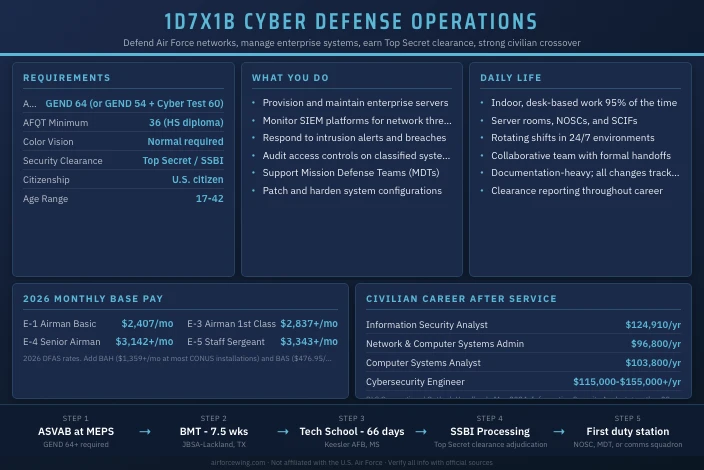
The minimum ASVAB requirement is GEND 64, or GEND 54 paired with a qualifying Cyber Test score. Solid test prep on the General composite subtests makes a real difference here.
Job Role and Responsibilities
1D7X1B Cyber Defense Operations specialists install, configure, and defend Air Force enterprise systems and networks. They manage server infrastructure, monitor for cyber threats, respond to security incidents, and support Department of the Air Force Information Network (DoDIN) operations. The 1D7X1B shredout focuses on systems-level work, building the platforms other Airmen operate on and keeping those platforms secure against adversarial activity.
What the Work Actually Looks Like
The job is desk-based and technically intensive. Most of the day involves managing systems configurations, reviewing security alerts, and working through incidents that come in from automated monitoring tools. At installations with a Network Operations and Security Center (NOSC), that work happens in a 24/7 ops environment with shift rotations.
Typical daily tasks include:
- Provisioning, configuring, and maintaining enterprise servers and virtualized environments
- Monitoring security information and event management (SIEM) systems for anomalies
- Responding to intrusion alerts and investigating potential breaches
- Implementing and auditing access controls across classified and unclassified systems
- Supporting Mission Defense Teams (MDTs) in defending Air Force weapon systems from cyber threats
- Documenting system changes and maintaining configuration baselines
- Applying security patches and hardening system configurations against known vulnerabilities
Specializations and Codes
The 1D7X1 career field uses an alphabetic shredout suffix to mark specialization within the broader cyber defense mission. The B-suffix specifically covers systems operations.
| Code | Skill Level | Description |
|---|---|---|
| 1D731B | Apprentice (3-level) | Initial award upon Tech School completion |
| 1D751B | Journeyman (5-level) | Awarded after on-the-job training and upgrade |
| 1D771B | Craftsman (7-level) | Senior technician; NCO leadership roles |
| 1D791B | Superintendent (9-level) | Senior NCO; career field and unit management |
Special Experience Identifiers (SEIs) can be earned by Airmen who complete additional training or demonstrate expertise in specific domains such as cloud security, virtualization, or defensive cyber operations certifications.
Mission Contribution
Air Force missions depend on networks that function reliably under pressure and resist adversarial access. 1D7X1B Airmen are a core part of making that happen. They support the 16th Air Force information warfare mission by keeping the DoDIN operational and secure. At the base level, they staff Mission Defense Teams, small, specialized units responsible for identifying cyber vulnerabilities in weapons systems and developing defenses against exploitation. This mission expanded significantly after the Air Force’s Cyber Squadron Initiative stood up MDTs at installations across the force.
Technology and Equipment
Day-to-day tools include Windows and Linux server environments, enterprise virtualization platforms (VMware, Hyper-V), network routing and switching hardware, endpoint detection and response (EDR) software, SIEM platforms such as Splunk, and vulnerability scanning tools. Airmen working in classified environments use specialized hardware and software not publicly listed. The toolset evolves with the threat, which means continuous learning is built into the job.
Salary and Benefits
Base Pay
Base pay is set by DFAS and applies uniformly across all branches. The table below shows 2026 entry-level rates for the most relevant grades. Getting to these pay grades starts with the ASVAB, and a study guide targeting the General composite is the most efficient preparation before MEPS.
| Grade | Rank | Monthly Base Pay (entry) |
|---|---|---|
| E-1 | Airman Basic | $2,407 |
| E-2 | Airman | $2,698 |
| E-3 | Airman First Class | $2,837 |
| E-4 | Senior Airman | $3,142 |
| E-5 | Staff Sergeant | $3,343 |
| E-6 | Technical Sergeant | $3,401 |
Pay increases with time in service at each grade. An E-5 with 10 years earns $4,395/month in base pay. All 2026 figures from DFAS pay tables.
Allowances
Housing and food allowances are non-taxable and stack on top of base pay.
- BAH (Basic Allowance for Housing): Varies by installation, grade, and dependency status. An E-4 without dependents at a major CONUS installation typically receives $1,359 to $1,700+ per month. Use the DoD BAH Rate Lookup for exact figures by location.
- BAS (Basic Allowance for Subsistence): $476.95/month flat rate for all enlisted Airmen in 2026.
Other Benefits
TRICARE Prime covers medical, dental, vision, and prescriptions for active-duty Airmen at zero cost, no enrollment fee, no deductible, no copay. Education benefits include Tuition Assistance (up to $4,500/year while on active duty) and the Post-9/11 GI Bill after separation, covering full in-state tuition at public schools or up to $29,920.95 per year at private schools, plus a monthly housing stipend.
Retirement under the Blended Retirement System (BRS) pays 40% of your high-36 average basic pay at 20 years, with automatic TSP contributions starting at 60 days of service and government matching up to 4% of basic pay.
Leave
Airmen accrue 30 days of paid leave per year at a rate of 2.5 days per month, with a maximum carryover of 60 days.
Qualifications and Eligibility
Qualification Requirements
The 1D7X1 AFSC has two qualifying paths: a GEND 64 score alone, or a lower GEND 54 combined with a minimum Cyber Test score of 60. Either path leads to the same Tech School and career field.
| Requirement | Standard |
|---|---|
| ASVAB Composite (primary) | GEND 64 |
| ASVAB Composite (alternate) | GEND 54 + Cyber Test 60 |
| AFQT Minimum | 36 (high school diploma) |
| Security Clearance | Top Secret (SSBI required) |
| Citizenship | U.S. citizen |
| Education | High school diploma or GED (GED requires AFQT 65+) |
| Age | 17-42 at time of enlistment |
| Physical | Minimum 40 lbs. lifting requirement |
| Color Vision | Normal color vision required |
The GEND composite draws from Word Knowledge, Paragraph Comprehension, Arithmetic Reasoning, and Mathematics Knowledge subtests. An ASVAB study guide that targets those four areas raises this score more efficiently than general study. The PiCAT practice test lets you test conditions before MEPS, a useful first check on where you stand.
The Top Secret SSBI examines your finances, foreign contacts, prior drug use, and personal conduct in detail. Significant debt, foreign national family members, or recent drug use can delay or disqualify the investigation. Be honest with your recruiter before committing to this AFSC.
Application Process
Competitiveness
The 1D7X1 career field has open accession slots regularly, but availability fluctuates with Air Force manning. The ASVAB is the first gate, the GEND composite rewards vocabulary, reading comprehension, and arithmetic. The clearance investigation is the longer timeline factor. Airmen with clean financial and legal records, limited foreign contacts, and no significant drug history clear faster. Relevant certifications (CompTIA A+, Network+, Security+) are not required at accession but show technical aptitude that recruiters notice.
Service Obligation
The standard enlisted contract for 1D7X1B is four years of active duty. Six-year contracts are available and may come with an enlistment bonus depending on current Air Force needs. New accessions enter at E-1 (Airman Basic) and promote to E-2 after six months of satisfactory service.
Work Environment
1D7X1B Airmen work indoors roughly 95% of the time. The job setting is server rooms, operations centers, or office spaces with classified terminals, controlled, climate-conditioned, and technically focused. Physical labor is minimal. Occasional equipment installation or cabling work is part of the job, but the primary demands are cognitive.
Schedule
Schedule depends on the assignment:
- NOSC / 24-7 ops center billets: Rotating shifts (Panama or 12-hour), including nights, weekends, and holidays
- Standard day-shift billets: 0730-1630 Monday through Friday, with on-call rotation for after-hours incidents
- Small installation / detachment billets: Flexible hours with on-call duties covering all enterprise systems
Expect some shift work at some point during a career in this field.
Team Dynamics
1D7X1B Airmen typically serve in communications squadrons or cyber units assigned to an installation or wing. Work is collaborative by design. Configuration changes get documented in shared systems. Shift handoffs follow a formal process because information that doesn’t transfer between teams creates security gaps. The team depends on each member holding their part of the baseline.
Leadership and Feedback
Performance is formally evaluated through the Enlisted Performance Report (EPR). At the Staff Sergeant (E-5) level and above, EPR scores factor directly into promotion board outcomes. Supervisors provide feedback at minimum quarterly. The technical nature of the job makes performance more objectively visible than in many other career fields, systems are either healthy and secure or they aren’t.
Job Satisfaction
Airmen in cyber defense roles consistently cite the direct civilian applicability of their training, the relative comfort of the work environment, and the intellectual depth of the mission as positives. The Top Secret clearance restricts assignment options, which can frustrate Airmen who want maximum flexibility in duty station choices.
Training and Skill Development
Initial Training
| Phase | Location | Length | Focus |
|---|---|---|---|
| Basic Military Training (BMT) | JBSA-Lackland, TX | 7.5 weeks | Military fundamentals, fitness, discipline |
| Technical School (1D7X1B) | Keesler AFB, MS | 66 days | Enterprise systems, network defense, cybersecurity operations |
BMT is 7.5 weeks at Joint Base San Antonio-Lackland and covers the military basics: fitness standards, customs and courtesies, weapons qualification, and core Airman skills. Every enlisted Airman in every career field completes BMT first.
Tech School is 66 classroom days at Keesler AFB, Mississippi, home of the 81st Training Wing and the Air Force’s primary cyber and communications training hub. The curriculum covers enterprise IT systems, DoDIN operations, network security fundamentals, and the defensive cyber mission. Airmen finish Tech School with credits applicable toward an Information Systems Technology degree. The math and reading comprehension skills tested by the GEND composite carry directly into the technical coursework, so candidates who invest in ASVAB preparation before shipping tend to start stronger.
Advanced Training
After reaching the 5-skill level (Journeyman), Airmen become eligible for additional training aligned to specific mission sets. Mission Defense Team qualification is one path. MDTs receive specialized training focused on defending Air Force weapons systems from cyber exploitation. Airmen pursuing the Craftsman (7-level) complete an Airman Leadership School course and a supervised upgrade program.
The Air Force supports ongoing professional development through professional military education, formal courses at Keesler and other training centers, and certification pursuit. DoD 8570/8140 compliance requirements mean many billets require Airmen to hold and maintain certifications like CompTIA Security+, CySA+, or equivalent credentials. The Air Force funds approved certification exams through the professional development process.
Career Progression and Advancement
Career Path
| Grade | Rank | Typical Time at Grade | Role |
|---|---|---|---|
| E-1 | Airman Basic | 0-6 months | Initial entry |
| E-2 | Airman | 6 months | Entry-level technician |
| E-3 | Airman First Class | ~16 months | Developing technician |
| E-4 | Senior Airman | ~36 months | Skilled technician; mentoring junior Airmen |
| E-5 | Staff Sergeant | ~6 years (competitive) | NCO; team lead responsibilities |
| E-6 | Technical Sergeant | ~11 years (competitive) | Senior NCO; flight or section leadership |
| E-7 | Master Sergeant | ~17 years (competitive) | Superintendent; career field management |
Promotion to E-5 and above is competitive across the Air Force, scored by EPR ratings, testing, and time-in-grade. The cyber career field has historically maintained strong promotion rates at the mid-enlisted grades because demand for experienced operators exceeds supply.
Role Flexibility
Airmen who want to change career fields after their initial obligation can apply for retraining. The process goes through Airman Classification Offices, and approval depends on Air Force manning needs in both the gaining and losing AFSCs. Cyber Airmen with Top Secret clearances are considered high-value personnel in their current field, which can make retraining approval less certain.
Officers can cross-commission from enlisted cyber backgrounds through several paths, including Officer Training School (OTS). A degree, strong EPRs, and letters of recommendation from the chain of command support a competitive OTS application.
Performance Evaluation
The Enlisted Performance Report is the primary tool for documenting performance. EPRs are written by the immediate supervisor and reviewed by the rating chain. At SSgt and above, EPR stratification (ranking against peers) matters heavily for promotion board outcomes. In cyber units, technical accomplishments, systems defended, incidents resolved, certifications earned, translate directly into concrete bullet language that EPRs reward.
Physical Demands and Medical Evaluations
Physical Requirements
The 1D7X1B career field is not physically demanding day-to-day. The primary physical requirement is a minimum 40 lbs. lifting capacity for handling server equipment and cabling. The job otherwise involves sitting at workstations for extended periods and requires strong attention to detail and sustained concentration.
All Airmen, regardless of AFSC, must pass the Air Force Fitness Assessment annually. The FA tests aerobic fitness and muscular endurance on a 100-point scale with a minimum passing composite score of 75. Each component also carries its own minimum.
| FA Component | Max Points | Notes |
|---|---|---|
| 1.5-Mile Run | 60 | Primary aerobic component; age/gender normed |
| Waist Circumference | 20 | Body composition component |
| Push-Ups (1 minute) | 10 | Muscular endurance; age/gender normed |
| Sit-Ups (1 minute) | 10 | Core endurance; age/gender normed |
Standards are age- and gender-normed. Verify current minimums for your age bracket with official Air Force fitness standards.
Medical Evaluations
Beyond the initial MEPS physical, Airmen undergo periodic health assessments throughout their career. Normal color vision is required at accession. The Top Secret clearance investigation includes a review of mental health history, and Airmen must report new medical conditions or medications that could affect clearance eligibility. Overseas deployments may require additional immunizations and medical readiness certifications.
Deployment and Duty Stations
Deployment
Deployment rates for 1D7X1B Airmen are low compared to operations or maintenance AFSCs. Cyber defense is predominantly a garrison mission: networks require consistent, sustained management rather than episodic deployments. That said, cyber support to deployed forces exists and some Airmen rotate through expeditionary assignments. Individual deployments typically run 90 to 180 days.
When a 1D7X1B Airman does deploy, the mission usually involves standing up or sustaining network defense at a forward operating location. Common deployed taskings include:
- Operating defensive cyber systems at a Combined Air Operations Center (CAOC) or regional hub
- Providing network security monitoring for expeditionary communications squadrons
- Augmenting joint cyber defense teams supporting combatant command operations
- Building or hardening enterprise infrastructure at locations without permanent cyber staffing
Deployed living conditions vary by location. Large established bases offer standard dormitory housing and recreation facilities. Smaller forward sites may involve austere accommodations and limited connectivity, which is notable for a career field that depends on stable, high-bandwidth network infrastructure to function.
Mobilizations through Air National Guard or Reserve components follow a similar pattern: lower tempo than combat support AFSCs, with occasional activation for exercises, cyber defense support missions, or real-world contingencies. Guard and Reserve cyber units have seen increased activation frequency as the Air Force expands its cyber mission force, but the deployments remain shorter and less frequent than those in most combat support career fields.
Duty Stations
1D7X1B Airmen are assigned across the Air Force, from large bases with major cyber units to smaller installations that need embedded defensive capability. Common assignment areas include:
- Keesler AFB, MS: training hub with follow-on assignment billets
- Joint Base San Antonio-Lackland, TX: large cyber workforce concentration under 16th Air Force
- Peterson Space Force Base, CO: NORAD/USNORTHCOM cyber support
- Scott AFB, IL: AMC communications and cyber
- Langley-Eustis AFB, VA: ACC cyber and network operations
- Air National Guard and Reserve units at bases across all 50 states
Risk, Safety, and Legal Considerations
Job Hazards
The 1D7X1B career field carries few physical hazards. Work is predominantly sedentary and indoor. The primary risks are ergonomic (repetitive stress from extended keyboard and mouse use) and cognitive (sustained mental concentration in high-tempo security environments).
Safety Protocols
Standard Air Force occupational safety requirements apply. Server room environments require awareness of electrical hazards and proper rack-mounting procedures. Work involving classified systems occurs in Sensitive Compartmented Information Facilities (SCIFs) with strict physical security protocols.
Security and Legal Requirements
The 1D7X1B AFSC requires a Top Secret security clearance based on a Single Scope Background Investigation. The SSBI is one of the most thorough background checks the federal government conducts. Airmen must report foreign travel, significant financial changes, and new foreign contacts to their security manager throughout their career.
Key legal obligations and consequences for Airmen in this career field:
- Computer fraud / unauthorized access: Prosecutable under the UCMJ and federal computer fraud statutes, with penalties including confinement and dishonorable discharge
- Mishandling classified information: Federal criminal liability regardless of intent, plus permanent clearance revocation
- Insider threat monitoring: Airmen on classified systems are subject to continuous user activity monitoring
- Continuous Evaluation reporting: Foreign travel, significant financial changes, and new foreign contacts must be reported to the security manager throughout your career
- Service obligation: Breaking an enlistment contract early may result in recoupment of training costs and adversely affects career prospects including civilian federal employment with a clearance
Impact on Family and Personal Life
Family Considerations
The shift work schedule in NOSC billets affects family life more than a standard 9-to-5 would. Nights, weekends, and holiday rotations are a normal part of the job at cyber units with 24/7 requirements. Spouses and families who adapt to variable schedules fare better than those expecting consistent evening hours. Some Airmen find that rotating shifts actually free up weekday time for errands, childcare, or appointments that standard-schedule workers cannot attend, but the adjustment period is real.
On the positive side, 1D7X1B Airmen are rarely on extended deployments. Most cyber defense missions are garrison-based, which means more time at home compared to career fields with frequent or prolonged overseas assignments. The TS clearance restricts what you can discuss about your work, though the nature of cyber defense is less operationally sensitive in conversation than fields like HUMINT or special operations.
Family support resources available at every installation include:
- Airman and Family Readiness Center: relocation assistance, employment help for spouses, financial counseling, and deployment support programs
- Military OneSource: 24/7 access to confidential counseling, legal consultations, and family crisis support
- TRICARE: full medical and dental coverage for dependents, including mental health services
- Child Development Centers: on-base childcare with hours that accommodate shift workers at most major installations
- Spouse employment programs: SECO (Spouse Education and Career Opportunities) and MyCAA scholarships for portable career credentials
Relocation
Permanent Change of Station (PCS) moves typically happen every two to four years. The Air Force drives assignment timing and location based on manning requirements. Airmen can submit preference sheets through the assignment system, but approval is not guaranteed. Major cyber hubs. JBSA, Keesler, and Langley-Eustis among them, tend to concentrate 1D7X1B billets, so multiple assignments at or near the same installations is a realistic outcome for many Airmen in this field.
Reserve and Air National Guard
Both the Air Force Reserve and Air National Guard carry 1D7X1B billets, making part-time service in this career field a real option. The Air National Guard in particular has built significant cyber capacity, with Cyber Wings and cyber units at Guard facilities across the country.
Component Comparison
| Factor | Active Duty | Air Force Reserve | Air National Guard |
|---|---|---|---|
| Commitment | Full-time, 4-yr+ contract | 1 UTA weekend/mo + 2-wk Annual Tour | 1 UTA weekend/mo + 2-wk Annual Tour |
| Monthly Pay (E-4 drill) | $3,142+/mo | ~$785/weekend (4 drill periods) | ~$785/weekend (4 drill periods) |
| Healthcare | TRICARE Prime (no cost) | TRICARE Reserve Select (premium required) | TRICARE Reserve Select or state plan |
| Education | TA ($4,500/yr) + Post-9/11 GI Bill | Federal TA + partial GI Bill based on activation | Federal TA + state tuition waivers (varies by state) |
| Deployment Tempo | Low; garrison-focused | Low; mobilized for exercises or real-world events | Low; activated for state and federal missions |
| Retirement | 20-yr pension (BRS) | Points-based Reserve retirement | Points-based Reserve retirement |
Civilian Career Integration
The 1D7X1B skill set pairs exceptionally well with civilian careers in IT security and systems administration. Guard and Reserve Airmen who work in IT, cybersecurity, or government contracting find that drill weekends reinforce and complement civilian work rather than conflicting with it. Employers in the defense contracting space, where a Top Secret clearance and hands-on government system experience are highly valued, often view Guard or Reserve service as a hiring asset.
USERRA protections apply: civilian employers cannot discriminate against Reserve or Guard members and must restore returning service members to their previous position after a mobilization.
Post-Service Opportunities
The skills built in 1D7X1B translate directly into the civilian job market. A Top Secret clearance, hands-on experience with enterprise security systems, and familiarity with DoDIN operations are exactly what defense contractors and federal agencies pay significant salaries to find.
Civilian Career Prospects
| Civilian Job Title | BLS Median Salary (2024) | Job Outlook (2024-2034) |
|---|---|---|
| Information Security Analyst | $124,910/yr | +29% (much faster than average) |
| Network and Computer Systems Administrator | $96,800/yr | -4% (declining, but ~14,300 openings/yr) |
| Computer Systems Analyst | $103,800/yr | +11% (faster than average) |
| Cybersecurity Engineer | $115,000-$155,000+/yr | Strong demand; no dedicated BLS code |
Data from the Bureau of Labor Statistics Occupational Outlook Handbook.
Transition Programs
The Transition Assistance Program (TAP) is mandatory before separation. TAP includes resume writing, interview prep, and federal job application assistance. Airmen separating with a clearance have strong options in government contracting and can pursue federal civilian positions through USAJOBS, where veterans’ preference points apply.
Professional certifications earned during service. Security+, CySA+, Certified Ethical Hacker (CEH), Certified Information Systems Security Professional (CISSP), carry significant weight in civilian hiring. Many Airmen pursue these during their enlistment while the Air Force covers exam fees.
Is This a Good Job for You?
Ideal Candidate Profile
This AFSC fits Airmen who enjoy working through complex technical problems methodically. The work is detail-oriented, documentation-heavy, and intellectually demanding. You’ll spend significant time reading logs, analyzing system states, and making configuration decisions that affect the whole network. People who find that kind of puzzle-solving satisfying do well here.
Strong candidates typically have:
- High scores on math and reading comprehension subtests (which the GEND composite tests)
- An interest in computers, networking, or information security that predates military service
- Clean financial and legal history (essential for the clearance)
- Patience for procedural work, changes happen through change management processes, not on impulse
Potential Challenges
The shift work is the biggest lifestyle friction point. If rotating nights and weekends are difficult for your family situation, the NOSC assignments in this career field will create strain. The clearance investigation timeline also surprises some new Airmen, if your background has complications, the full TS investigation can take a year or more before you’re fully cleared and assignable to all billets.
The work is also cognitively demanding in a way that accumulates. Sustained attention on security alerts and system logs for eight-hour shifts takes a certain kind of focus that not everyone enjoys or can sustain long-term.
Long-Term Fit
If your goal after service is a high-paying civilian cybersecurity or IT career, 1D7X1B is a strong choice. The clearance alone is worth tens of thousands of dollars per year in salary premium in the government contracting market. The technical skills are directly portable. Airmen who serve four to six years in this field typically leave with enough experience to land mid-level cybersecurity analyst or systems administrator roles without additional degrees, though many pursue one while on active duty.
More Information
Talk to an Air Force recruiter to find out whether 1D7X1B slots are open in your enlistment window and what scores you need to qualify. Recruiters at airforce.com can walk you through current bonus availability, clearance timelines, and how to list this AFSC in your contract. If you haven’t tested yet, the PiCAT practice test lets you gauge your General composite score before committing to a MEPS appointment.
This site is not affiliated with the U.S. Air Force or any government agency. Verify all information with official Air Force sources before making enlistment or career decisions.
Explore more Air Force cyber careers such as 1B4X1 Cyber Warfare Operations and 3D0X4 Computer Systems Programming.