1B4X1 Cyber Warfare Operations
The Air Force’s offensive cyber mission runs through one enlisted AFSC. Cyber Warfare Operators in the 1B4X1 career field work directly against adversary networks and systems, planning and executing operations that fall somewhere between espionage and warfare. This isn’t network administration or IT support. Airmen in this role operate under the 16th Air Force, the Air Force’s information warfare component, and the work they do is among the most classified in the entire service.
The entry bar is steep. You need a minimum ELEC 70 on the ASVAB, a Top Secret/SCI clearance, and the ability to hold up under a Single Scope Background Investigation that examines your finances, foreign contacts, and past in detail. Get past those gates and you’re looking at one of the most marketable skill sets available to an enlisted Airman, both inside the military and after you leave.
Enlistment bonuses for this AFSC can reach $50,000 for new accessions, and reenlistment bonuses for experienced operators have reached six figures. The civilian cybersecurity market will pay handsomely for a cleared, experienced offensive operator. But none of that matters if you don’t qualify, so here’s everything you need to know.
Qualifying requires a specific ASVAB line score. What follows covers every requirement and how to meet it.
Qualifying requires specific ASVAB line scores. Our ASVAB study guide covers what to target and how to prepare.
Job Role
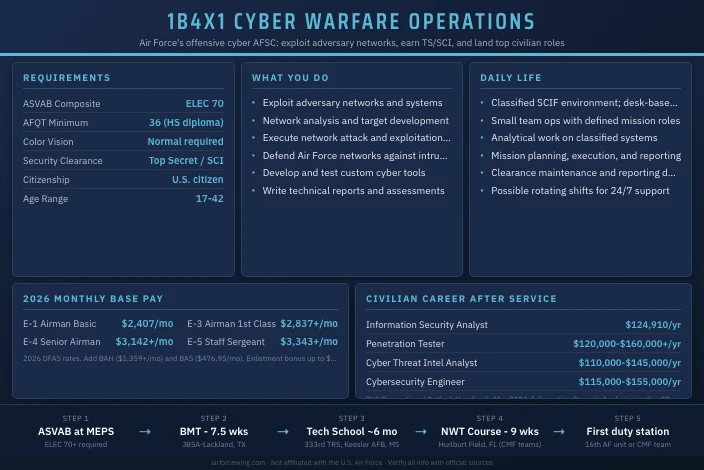
Cyber Warfare Operators plan, execute, and assess offensive and defensive cyberspace operations against adversary networks. They synchronize cyberspace activities with air, land, sea, and space operations to achieve commander objectives. In the 1B4X1 career field, Airmen exploit and attack digital targets, defend Air Force systems against intrusion, and develop tools and techniques that shape how the Air Force fights in the cyber domain.
What the Work Actually Looks Like
A typical day for a 1B4X1 Airman looks nothing like a typical IT job. The work is mission-driven, team-based, and conducted against real adversaries in real time. Operators spend significant time inside classified systems, analyzing network traffic, identifying targets, and executing operations that have been authorized through a formal planning process.
Day-to-day tasks include:
- Identifying and exploiting vulnerabilities in adversary networks and systems
- Conducting digital network analysis and target development
- Executing computer network attack and exploitation missions
- Defending Air Force networks and responding to intrusions
- Developing and testing custom tools and techniques for cyberspace operations
- Writing detailed technical reports and mission assessments
- Coordinating with intelligence analysts and other operators on joint operations
Specializations and Codes
The 1B4X1 career field uses skill levels to mark progression. The shredout suffix indicates a specialization within the career field.
| Code | Skill Level | Status |
|---|---|---|
| 1B431 | Apprentice (3-level) | Initial award upon Tech School completion |
| 1B451 | Journeyman (5-level) | Awarded after OJT and upgrade training |
| 1B471 | Craftsman (7-level) | Senior operator; eligible for NCO roles |
| 1B491 | Superintendent (9-level) | Senior NCO; career field management |
Operators who demonstrate particular expertise may earn Special Experience Identifiers (SEIs) tied to specific mission sets, platforms, or tools, these are classified and not publicly listed. Assignment to specific Cyber Mission Force (CMF) teams under U.S. Cyber Command is a significant specialization path.
Mission Contribution
The 1B4X1 career field supports the Air Force’s role within U.S. Cyber Command and the broader joint cyber mission. Cyber Warfare Operators work on National Mission Teams, Combat Mission Teams, and Cyber Protection Teams, all operating under the Cyber Mission Force structure that has grown significantly since its establishment. Their work directly supports combatant commanders who depend on cyberspace superiority to execute conventional operations.
Salary
Base Pay
All Air Force enlisted pay follows DFAS rates, regardless of AFSC. The table below shows 2026 monthly base pay at the ranks most relevant to early career 1B4X1 Airmen.
| Rank | Grade | Under 2 Years | 4 Years | 6 Years |
|---|---|---|---|---|
| Airman Basic | E-1 | $2,407 | $2,407 | , |
| Airman First Class | E-3 | $2,837 | $3,198 | $3,198 |
| Senior Airman | E-4 | $3,142 | $3,659 | $3,816 |
| Staff Sergeant | E-5 | $3,343 | $3,947 | $4,109 |
| Technical Sergeant | E-6 | $3,401 | $4,069 | $4,236 |
Figures from DFAS 2026 pay tables. These are base pay only.
Special Pay and Bonuses
This is where the 1B4X1 compensation picture gets interesting. The Air Force has designated Cyber Warfare Operations a critical skill, which means significant bonus availability:
- Enlistment bonus: Up to $50,000 for new accessions through select programs
- Reenlistment bonuses: Have reached $80,000 to $100,000 for experienced operators at the Staff Sergeant and Technical Sergeant levels, depending on length of commitment
- Special Duty Assignment Pay: May apply for certain positions; varies by assignment
Bonus amounts change with each fiscal year. Confirm current figures with your recruiter before enlisting.
Allowances and Other Benefits
On top of base pay, Airmen receive tax-free allowances that add substantially to take-home compensation:
- BAH (Basic Allowance for Housing): Varies by duty location, rank, and dependent status. A single E-4 at Joint Base San Antonio earns $1,359/month; with dependents, that rises to $1,728/month. Installations in higher cost-of-living areas pay proportionally more.
- BAS (Basic Allowance for Subsistence): $476.95/month for all enlisted Airmen (2026 rate), flat regardless of location or rank.
- TRICARE: Full medical, dental, vision, mental health, and prescription coverage at no cost on active duty.
- Tuition Assistance: Up to $4,500 per year for college courses while on active duty.
- Post-9/11 GI Bill: After separation, eligible Airmen can use up to 36 months of education benefits. Private school tuition is capped at $29,920.95 per academic year (2025-2026 cap). Public school tuition is fully covered.
Work-Life Balance
Cyber Warfare Operators generally work in a standard office environment during peacetime, though specific assignments vary. The work is mentally demanding, long stretches of focused technical analysis are common, and some mission cycles involve extended hours. The Air Force offers 30 days of paid leave per year, accruing at 2.5 days per month.
Qualifications
Qualification Requirements Table
| Requirement | Minimum Standard |
|---|---|
| ASVAB Composite | ELEC 70 (Electronics composite) |
| AFQT Minimum | 36 (high school diploma) |
| Citizenship | U.S. citizen |
| Age | 17-42 at time of enlistment |
| Education | High school diploma or equivalent |
| Security Clearance | Top Secret with SCI access (SSBI required) |
| Medical | Normal color vision required; meet general enlistment medical standards |
Requirements verified against airforce.com.
ASVAB Details
The Electronics (ELEC) composite is the gating score for 1B4X1. The ELEC composite combines the General Science, Arithmetic Reasoning, Mathematics Knowledge, and Electronics subtests. A score of 70 places you in the upper tier, this is one of the highest ASVAB requirements among enlisted Air Force AFSCs. Strong performance on the Mathematics Knowledge and Electronics subtests matters most. If you’re currently below 70, dedicated study on those two subtests is where to invest your time.
The ELEC 70 requirement is firm. There are no known waivers for the ASVAB composite. If you don’t hit the score, work with a recruiter on test prep and retesting options before committing to another AFSC.
Security Clearance Process
The TS/SCI clearance is the single most significant barrier in this career field, not because people are disqualified often, but because the process takes time and requires a Single Scope Background Investigation (SSBI). That investigation covers:
- Financial history (debts, bankruptcy, delinquent accounts)
- Foreign contacts and travel
- Criminal history beyond what a standard background check covers
- Drug use (history and recency matter)
- Employment and educational history
The investigation can take several months to complete. Factors that complicate or disqualify include significant foreign contacts, large unresolved debts, or recent drug use. Waivers exist for some issues but are not guaranteed. Talk honestly with your recruiter about anything in your background before you apply, surprises later in the process cost everyone time.
Application Process
Service Obligation
Enlisted Airmen in this AFSC typically serve a four-year initial commitment, though specific obligation lengths may vary depending on enlistment bonus agreements and training pipelines. Operators who accept enlistment bonuses take on additional service obligations, confirm the terms before signing.
Entry Rank
Most enlisted recruits enter service as an Airman Basic (E-1) and progress to Airman (E-2) and then Airman First Class (E-3) during the first year. Recruits with qualifying college credits may enter at a higher grade; confirm eligibility with your recruiter.
See our ASVAB study guide for strategies to hit these line scores, or take the PiCAT from home if you are a first-time tester.
Work Environment
Setting and Schedule
Cyber Warfare Operators work primarily in secure, classified facilities. Sensitive Compartmented Information Facilities (SCIFs) and similar controlled environments. The job is entirely office and computer-based. There are no flight line duties, physical field operations in this role, or outdoor work requirements.
Work schedules vary significantly by unit and mission. Some operators work standard day-shift schedules; others work rotating shifts to support 24/7 operations. Certain positions tied to active mission support may involve extended hours during exercises or real-world events. Deployed positions operate under different schedules set by the combatant command.
Chain of Command and Feedback
1B4X1 Airmen work in small, tightly integrated teams. The immediate chain of command runs through NCO team leads to squadron-level officers. Given the classified nature of the work, feedback on mission performance is delivered within the team and through formal Enlisted Performance Report (EPR) channels. The 16th Air Force and its subordinate numbered air forces establish the operational standards Airmen are evaluated against.
Team Dynamics
Cyber Warfare Operators function in small crews with defined mission roles. Individual technical expertise matters, but operations depend on coordination, operators working together through a structured plan. There’s significant individual responsibility: each operator owns their slice of a mission and has to perform it accurately under time pressure. The work rewards people who can think precisely, document clearly, and communicate without ambiguity.
Job Satisfaction
Cyber Warfare Operations is consistently among the more coveted enlisted AFSCs in the Air Force, the mission is genuinely interesting, the pay is competitive, and the civilian translation is strong. Retention tends to be high among operators who enjoy the technical work, though some experienced Airmen leave for private sector roles where the same skills command substantially higher salaries. The Air Force’s reenlistment bonus program for this AFSC is a direct response to that attrition pressure.
Training
Training Pipeline
| Phase | Location | Length | Focus |
|---|---|---|---|
| Basic Military Training (BMT) | JBSA-Lackland, TX | 7.5 weeks | Military fundamentals, discipline, fitness |
| Tech School, CWO Apprentice Course | Keesler AFB, MS | ~6 months | Networking, cybersecurity theory, operational tradecraft, classified systems |
| On-the-Job Training (OJT) | First duty station | 12+ months | 5-level upgrade, mission qualification |
| Cyber Mission Force (CMF) Training | Various | Variable | Team certification, mission-specific tradecraft |
Tech School for 1B4X1 is substantially longer and more technically demanding than most enlisted courses. The 333rd Training Squadron at Keesler AFB runs the Cyber Warfare Operator Apprentice Course, covering networking fundamentals, operating systems, exploitation theory, and operational security. The course was originally designed for prior-service Airmen retraining into the career field but has been expanded to accommodate non-prior-service accessions.
Airmen expected to join U.S. Cyber Command teams complete an additional nine-week Intermediate Network Warfare Training course at Hurlburt Field, FL, before their first operational assignment. This follow-on course covers more advanced offensive techniques and team integration.
Advanced Training
After initial qualification, operators continue developing skills through formal courses, exercises, and self-directed study. The Air Force funds certification training in recognized cybersecurity credentials, including certifications like Security+, CEH, and more advanced qualifications depending on the position. Some operators pursue advanced technical training through the National Security Agency, USCYBERCOM, or partner agencies.
The career field also has a dedicated professional military education path. NCOs in this field attend the standard Air Force PME sequence (Airman Leadership School, NCO Academy, Senior NCO Academy) alongside AFSC-specific advanced courses.
The Cyberspace Operations Badge is awarded at the Journeyman (5-level), Senior (7-level), and Master (9-level/MSgt with 5 years in 1BXXX) tiers. It’s one of the few career-field-specific badges in the enlisted Air Force, and it’s visible recognition of operational experience.
The ASVAB is the first gate. Our ASVAB study guide covers which subtests to prioritize for the ELEC composite.
Career Progression
Rank Progression
| Rank | Grade | Typical Timeline | Milestone |
|---|---|---|---|
| Airman Basic | E-1 | Entry | Enlist |
| Airman | E-2 | ~6 months | Time in service |
| Airman First Class | E-3 | ~16 months | Time in service |
| Senior Airman | E-4 | ~3 years | Time in service; EPR-eligible |
| Staff Sergeant | E-5 | ~5-6 years | Promotion board; 5-level required |
| Technical Sergeant | E-6 | ~8-12 years | Promotion board; 7-level typical |
| Master Sergeant | E-7 | ~14-18 years | Senior NCO; promotion board |
| Senior Master Sergeant | E-8 | ~18-22 years | Senior leadership track |
| Chief Master Sergeant | E-9 | ~20-26 years | Top 1% of enlisted force |
Promotion to E-5 and above is competitive and requires a combination of time in service, time in grade, EPR scores, fitness assessment results, and test scores. Cyber Warfare Operators who perform well tend to promote at rates comparable to or better than the Air Force average, given the high-value nature of the career field.
Specialization Paths
Beyond the standard promotion ladder, experienced 1B4X1 Airmen can pursue:
- Cyber Mission Force team assignment: Working on National Mission Teams (NMT), Combat Mission Teams (CMT), or Cyber Protection Teams (CPT) under USCYBERCOM
- 16th Air Force operations: Assignment to specific numbered air force missions
- NSA / interagency: Selected operators work on joint missions with national-level agencies
- Instructor duty: Teaching at the 333rd TRS at Keesler AFB
Performance Evaluation
The Enlisted Performance Report (EPR) drives promotion decisions at E-5 and above. EPRs are written by the immediate supervisor and reviewed by the senior rater. For cyber operators, EPRs that capture specific mission contributions, even in general terms when classified work limits specifics, carry more weight than generic language. Strong EPRs, combined with professional military education completion and community involvement, build the competitive records needed for promotion to TSgt and above.
Physical Demands
Daily Physical Demands
The 1B4X1 AFSC is one of the least physically demanding in the Air Force. The work is sedentary, seated at workstations in controlled environments for the majority of the duty day. There are no physical performance standards specific to this AFSC beyond the standard Air Force Fitness Assessment.
Air Force Fitness Assessment Standards
All Airmen, regardless of AFSC, take the Air Force Fitness Assessment annually. The test is scored on a 100-point scale with a minimum passing composite of 75. Each component must meet its individual minimum.
| Component | Max Points | Notes |
|---|---|---|
| 1.5-Mile Run | 60 | Primary aerobic component |
| Waist Circumference | 20 | Body composition measure |
| Push-Ups (1 min) | 10 | Muscular endurance |
| Sit-Ups (1 min) | 10 | Core endurance |
Standards are age- and gender-normed. The minimum passing score is 75 out of 100 with component minimums required on each event. Scores below 75 trigger an Unsatisfactory rating, which has career consequences including promotion ineligibility during the period. Consistent performance above 90 (Excellent) supports promotion competitiveness.
Medical Standards
Initial enlistment medical standards apply. Normal color vision is required for this AFSC. Periodic medical evaluations occur throughout the career at standard Air Force intervals. Maintaining security clearance eligibility is its own ongoing requirement, financial problems, foreign contacts, or changes in personal circumstances that arise during service must be reported and can trigger clearance reviews.
Deployment
Duty Stations
1B4X1 Airmen serve at installations with cyber mission units. Primary assignments include:
- Joint Base San Antonio-Lackland, TX (16th Air Force headquarters)
- Fort George G. Meade, MD (proximity to NSA and USCYBERCOM)
- Peterson Space Force Base / Schriever SFB, CO
- Ramstein AB, Germany (USAFE cyber units)
- Yokota AB, Japan (PACAF cyber units)
- Hurlburt Field, FL (Special Operations cyber mission)
Assignment preferences can be submitted but are not guaranteed. The Air Force assignment process weighs unit needs first, individual preference second.
Deployment
Cyber Warfare Operators deploy differently from traditional combat AFSCs. Some missions are conducted remotely from CONUS bases; others require deployed presence at forward locations. Deployment frequency is moderate and varies significantly by unit, some operators deploy multiple times in a career, others spend most of their service stateside. Deployment lengths typically range from 90 to 180 days. The nature of cyber operations means some “deployed” work happens from home stations with secure connectivity to remote systems.
Operators assigned to the 16th Air Force or its subordinate numbered air forces can expect a more structured deployment cycle than those in support roles. Some billets carry higher deployment frequency because of persistent combatant command demand for cyber expertise in theater. Operators at Fort George G. Meade who support NSA or USCYBERCOM missions may find their “deployment” is technically a temporary duty assignment to a classified facility, rather than a traditional forward operating location with force protection posture.
Deployed positions for 1B4X1 Airmen often differ significantly from what conventional maintainers or security forces experience. You’re unlikely to be living in a tent on a forward operating base. More typically, deployed cyber operators work in established facilities with classified network access, standard office infrastructure, and the same basic living conditions available at CONUS installations. The operational pressure differs, timelines are tighter, coordination with joint forces is more frequent, and the consequences of technical errors have immediate mission impact.
Special operations support assignments at Hurlburt Field and similar locations carry a different flavor. Cyber operators embedded with special operations task forces may work in more austere conditions alongside combat personnel, with quicker tasking cycles and more direct operational integration than a conventional cyber unit. These billets are competitive and sought after by experienced operators who want the closest possible connection between their technical work and combat outcomes.
Airmen assigned to Air Expeditionary Force (AEF) rotational schedules follow a more predictable deployment cycle. Volunteer and projected deployment requests can influence the specific assignments, but the Air Force’s needs take priority over individual preferences. Discussing deployment expectations frankly with your recruiter before enlisting, and understanding the specific unit’s tempo when you receive orders, will set realistic expectations for both you and your family.
Risk/Safety
Job Hazards
This AFSC carries minimal physical hazard. The primary risks are classified: operational security (OPSEC) failures and the legal consequences of unauthorized disclosure. Cyber Warfare Operators handle some of the most sensitive information in the U.S. government, and protecting that information is a constant professional and legal obligation.
Safety Protocols
Standard occupational health protocols apply, ergonomics, extended screen time management, and secure facility procedures. The physical environment is a low-risk office setting.
Security Clearance Obligations
Holding a Top Secret/SCI clearance creates ongoing legal obligations. Airmen must:
- Report foreign contacts, travel, and relationships as required by DAFMAN 16-1405
- Report changes in financial circumstances that could affect clearance eligibility
- Follow strict need-to-know and information-handling procedures daily
- Submit to periodic reinvestigation (typically every five years for TS)
Clearance violations, including unauthorized disclosure of classified information, carry federal criminal penalties. The legal obligations of a TS/SCI clearance don’t end when you leave the military. Non-disclosure agreements remain in effect indefinitely.
Deployments to conflict zones for this career field are uncommon but possible, depending on the mission. Cyber operations can occur in support of active combat operations, and operators may be assigned to forward locations where conditions differ from standard CONUS duty.
Impact on Family
Family Considerations
The security clearance investigation process affects families as well. Spouses and dependents may be interviewed as part of an SSBI, and foreign national family members can complicate or in some cases disqualify a clearance. This isn’t unique to 1B4X1, but given the TS/SCI requirement, it’s worth understanding before you apply.
Day-to-day, the work schedule is more predictable than many other AFSCs. The desk-based nature of the job means most operators are home on nights and weekends during standard peacetime duty. Mission surges and exercises change that tempo periodically.
Relocation
PCS moves follow the standard Air Force assignment cycle, typically every two to three years. Cyber Warfare Operators move between installations with cyber mission units, which limits the pool of available assignments compared to more broadly distributed AFSCs. Most assignments will be in the continental United States, with some OCONUS options in Germany, Japan, and other locations with Air Force cyber presence. Moving costs are covered through the Permanent Change of Station allowance system. Families with children in established schools or spouses with established careers should plan for multiple relocations over a 10-20 year career.
The Air Force offers family support through Military OneSource, installation family support centers, and the Airman and Family Readiness Center at each base.
Reserve and Air National Guard
Component Availability
The 1B4X1 AFSC is available in both the Air Force Reserve and the Air National Guard. Cyber Warfare Operations is specifically cited as a high-demand specialty in Reserve and ANG force structure, and both components actively recruit qualified operators. Several ANG units maintain dedicated cyber missions, including missions tasked directly by the National Guard Bureau and state adjutants general.
Drill Schedule
The standard commitment is one Unit Training Assembly (UTA) weekend per month plus two weeks of Annual Training per year. For 1B4X1 specifically, some units require additional training days, readiness exercises, or annual certification requirements tied to their CMF team status. Confirm the specific commitment with the unit you’re considering before signing.
Part-Time Pay
An E-4 Senior Airman drilling with the Reserve or ANG earns approximately $471-$549 per drill weekend (based on 2026 DFAS rates for E-4 with 2-4 years, calculated as 4 drill periods). This is a fraction of active-duty monthly base pay ($3,142-$3,659), but the Reserve/ANG path allows Airmen to maintain civilian careers simultaneously.
Component Comparison
| Feature | Active Duty | Air Force Reserve | Air National Guard |
|---|---|---|---|
| Commitment | Full-time | 1 wknd/mo + 2 wks/yr | 1 wknd/mo + 2 wks/yr |
| Monthly Pay (E-4) | $3,142-$3,816 | ~$471-$549/drill wknd | ~$471-$549/drill wknd |
| Healthcare | TRICARE Prime (no cost) | TRICARE Reserve Select (premiums apply) | TRICARE Reserve Select (premiums apply) |
| Education | Tuition Assistance + GI Bill | Federal TA + GI Bill (partial, based on activation) | State tuition waivers (varies by state) + Federal TA |
| Deployment Tempo | Moderate | Low to moderate (varies by unit) | Low to moderate (varies by unit/mission) |
| Retirement | 20-yr pension (40% high-36) | Points-based; eligible at 60 | Points-based; eligible at 60 |
Civilian Career Integration
The 1B4X1 skill set pairs exceptionally well with civilian cybersecurity careers. Reserve and ANG service in this AFSC is generally compatible with, and often valued by, civilian employers in the defense, finance, technology, and government contracting sectors. Cleared cyber professionals are in high demand. The TS/SCI clearance maintained through Reserve service can itself be a career asset, since civilian employers often pay clearance-holding employees a premium.
USERRA protections apply to all Reservists and Guard members, requiring civilian employers to hold jobs and benefits during periods of military activation.
Post-Service
Civilian Career Translation
Few enlisted AFSCs translate to the civilian job market as directly as 1B4X1. Experienced cyber operators step into roles that typically require years of civilian training to access. The combination of technical skills, clearance, and operational experience is genuinely rare in the civilian market.
| Civilian Job Title | Median Annual Salary | Job Outlook (2024-2034) |
|---|---|---|
| Information Security Analyst | $124,910 | +29% (much faster than average) |
| Penetration Tester / Ethical Hacker | $120,000-$160,000+ | Strong demand; part of broader info sec growth |
| Cyber Threat Intelligence Analyst | $110,000-$145,000 | High demand in government and finance sectors |
| Cybersecurity Engineer | $115,000-$155,000 | Consistently among fastest-growing IT roles |
Salary data from the Bureau of Labor Statistics Occupational Outlook Handbook, May 2024.
Certifications and Licensing
The Air Force funds several industry certifications during service. Common credentials that support post-service employment include CompTIA Security+, Certified Ethical Hacker (CEH), CISSP, and OSCP. Operators who complete advanced training often hold credentials that would cost thousands of dollars to earn independently. These transfer directly to civilian employment.
Transition Assistance
The Air Force Transition Assistance Program (TAP) is mandatory for separating Airmen and includes resume writing, job search workshops, and industry networking. Veterans in cybersecurity also benefit from programs like Hiring Our Heroes, which connects transitioning military with private sector employers. Defense contractors frequently target cleared cyber operators specifically.
Is This a Good Job
Who Does Well in 1B4X1
The Airmen who thrive in this career field tend to share a few characteristics. They’re genuinely curious about how technology works, not just how to use it, but how to break it. They’re methodical, patient with detail work, and comfortable sitting with ambiguity when a problem doesn’t have an obvious answer. They can document their work precisely because in this mission, documentation matters as much as execution.
If you’ve spent time on CTF (Capture the Flag) competitions, taught yourself networking or programming, or find security research interesting for its own sake, you’re already thinking in the right direction.
Who Should Look Elsewhere
This is not the right AFSC if you want variety in your physical environment or a job that changes your scenery regularly. Cyber Warfare Operators spend most of their careers in offices and SCIFs. The work is sedentary and screen-intensive. If that sounds like a problem, it will only get worse over time.
The clearance process is also a genuine filter. People with significant financial problems, recent drug use, or close foreign national relationships face a much harder clearance path. Starting the process with disqualifying issues doesn’t just cost you this AFSC, it can create delays that push you toward a different career field entirely.
Career and Lifestyle Alignment
For technically minded people who want a well-paying, intellectually demanding career with a clear post-service path, 1B4X1 is hard to beat among enlisted options. The signing bonus, clearance, technical training, and civilian demand together make it one of the better financial decisions available to a 17-25 year old. The tradeoff is a demanding clearance standard, a technically rigorous qualification bar, and a career spent mostly behind a screen in classified facilities.
If that tradeoff sounds right to you, it probably is.
More Information
Talk to an Air Force recruiter to get current enlistment bonus figures, confirm available seats, and understand the security clearance process before you commit. Bonus amounts change with each fiscal year and current enlistment incentives may differ from what’s published publicly. Visit airforce.com for the official career overview, and request the CFETP for 1B4X1 if you want the full technical training plan in writing.
Official sources:
- airforce.com: Cyber Warfare Operations, official Air Force career page with current ASVAB requirements and training details
- 16th Air Force, Air Forces Cyber, the primary employing command for 1B4X1 Airmen
- U.S. Cyber Command, the joint command under which many 1B4X1 operators work through Cyber Mission Force teams
- DCSA, Defense Counterintelligence and Security Agency; manages the TS/SCI clearance investigation process
Technical preparation resources: The 1B4X1 career field rewards candidates who already understand how networks work before they arrive at Tech School. If you’re building foundational knowledge before enlisting, the following civilian resources align with what you’ll encounter in training:
- Networking fundamentals through CompTIA Network+ study materials
- Linux command line basics (many offensive cyber operations are Linux-based)
- Capture the Flag (CTF) competitions through platforms like picoCTF, Hack The Box, or TryHackMe, these are the closest civilian analog to the problem-solving style of cyber warfare work
Bonus context: Enlistment bonuses for this AFSC are announced each fiscal year through the Air Force’s Enlisted Accession Bonus program. The figures cited on this page reflect publicly reported amounts, but confirmation requires speaking directly with a recruiter who has access to the current fiscal year incentive schedule.
- Prepare for the ASVAB with our study guide to make sure your line scores qualify
This site is not affiliated with the U.S. Air Force or any government agency. Verify all information with official Air Force sources before making enlistment or career decisions.
Explore more Air Force cyber careers to compare other enlisted cyber AFSCs in this group.