3D1X3 RF Transmission Systems
When a deployed unit is too far from any fiber line, when an aircraft needs to talk to a ground station, when a forward operating location has to reach back to a command post, the link that makes those conversations happen belongs to a 3D1X3 RF Transmission Systems specialist. This is the AFSC that keeps the Air Force connected when the wire ends. The work is hands-on, technical, and genuinely important: you’ll operate satellite terminals, maintain ground radio systems, and troubleshoot antenna arrays that most people never even know exist. The ASVAB electronics requirement sits at ELEC 70, the training runs 96 days at one of the Air Force’s top electronics schools, and the civilian job market for RF and satellite technicians is strong. If you want a technical career that matters from day one, this is worth a close look.
Qualifying requires specific ASVAB line scores. Our ASVAB study guide covers what to target and how to prepare.
Job Role
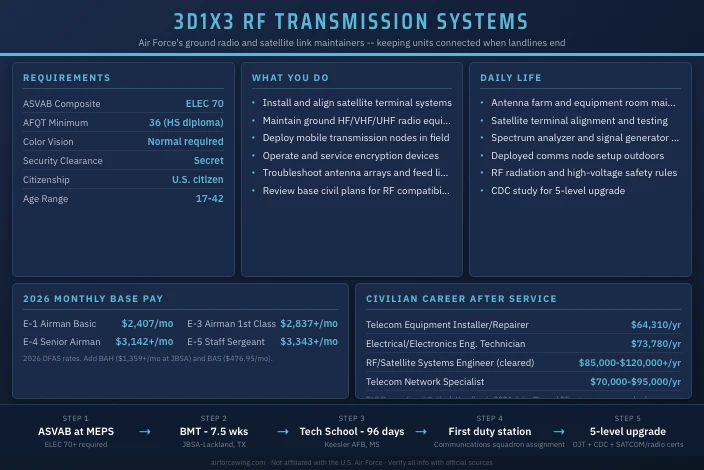
3D1X3 RF Transmission Systems specialists install, operate, maintain, and repair the radio frequency and satellite communications systems that connect Air Force units worldwide. They work with ground-based antenna systems, satellite terminals, line-of-sight radio links, and encryption devices in both fixed-base and deployed environments. When conventional networks are unavailable or unreliable, this AFSC provides the communications backbone.
Day-to-Day Tasks
The work splits between the maintenance bay and the field. At a home station, you might spend a shift aligning a satellite dish, calibrating a high-frequency radio system, or documenting a circuit configuration. On a deployment, the job expands to building a communications node from scratch with portable equipment in an austere location.
Core daily responsibilities include:
- Installing and maintaining ground radio, satellite, and telemetry communication systems
- Deploying and activating mobile and transportable transmission equipment
- Performing preventive and corrective maintenance on RF equipment and antenna arrays
- Evaluating equipment operational status and determining repair versus replace decisions
- Installing and aligning transmission lines, antenna tuners, and waveguide components
- Configuring and operating encryption devices that protect classified voice and data circuits
- Reviewing base civil engineering plans for RF infrastructure compatibility
Specialty Codes and Skill Levels
The RF Transmission Systems career field uses the standard Air Force skill-level progression:
| Code | Skill Level | Description |
|---|---|---|
| 3D1X3 | 3-level (Apprentice) | Entry-level; completes Tech School, works under close supervision |
| 3D1X3 | 5-level (Journeyman) | Independently performs the full range of RF transmission tasks |
| 3D1X3 | 7-level (Craftsman) | Supervisory duties; responsible for training subordinates |
| 3D1X3 | 9-level (Superintendent) | Senior NCO management of communications functions at unit level |
Mission Contribution
Air Force operations depend on communications that survive the loss of ground infrastructure. Satellite uplinks, ground-to-air radio, and tactical line-of-sight links are the systems that function when fiber is cut, when a base is remote, or when a unit is operating far outside normal network coverage. RF Transmission specialists maintain that layer of the communications stack. A failed satellite terminal at a forward location is an operational problem, not just a technical one, and fixing it falls to this career field.
Technology and Equipment
The equipment list is hardware-heavy and genuinely specialized. Specialists work with satellite communications (SATCOM) terminals, high-frequency (HF) and very-high-frequency (VHF) ground radio systems, ultra-high-frequency (UHF) tactical radios, multichannel transmission systems, and encryption devices including Type 1 classified hardware. The job also involves working with antenna arrays, transmission line components, and test equipment such as spectrum analyzers and signal generators. Some systems require precise alignment using specialized tools. People who enjoy working with physical equipment and understand RF theory will find this environment a good match.
Salary
Base Pay
All Air Force pay is determined by paygrade and years of service, per the 2026 DFAS military pay tables. New enlistees enter at E-1 and typically reach E-4 within the first few years. The table below shows representative monthly base pay:
| Rank | Grade | Monthly Base Pay (2026) |
|---|---|---|
| Airman Basic | E-1 | $2,407 |
| Airman | E-2 | $2,698 |
| Airman First Class | E-3 | $2,837 - $3,198 |
| Senior Airman | E-4 | $3,142 - $3,816 |
| Staff Sergeant | E-5 | $3,343 - $4,422 |
| Technical Sergeant | E-6 | $3,401 - $5,044 |
| Master Sergeant | E-7 | $3,932 - $5,537 |
Additional Allowances and Benefits
Base pay is the floor, not the ceiling. Tax-free allowances add significant compensation on top of it.
- Basic Allowance for Housing (BAH): Varies by duty location, paygrade, and dependency status. An E-4 without dependents at a typical CONUS installation receives approximately $1,359/month. An E-5 without dependents at the same installation receives approximately $1,500/month.
- Basic Allowance for Subsistence (BAS): A flat $476.95/month for all enlisted Airmen in 2026, regardless of rank or location.
- TRICARE Prime: Zero-cost health coverage including medical, dental, vision, mental health, and prescriptions for active-duty members, no premiums, no deductibles, no copays.
- Tuition Assistance: Up to $4,500/year for college courses while on active duty, capped at $250 per semester hour.
- Post-9/11 GI Bill: Full in-state tuition at public universities after service, or up to $29,920.95/year at private schools (2025-2026 academic year cap), plus a monthly housing stipend.
Retirement
Airmen entering service today fall under the Blended Retirement System (BRS). The government automatically contributes 1% of basic pay to your Thrift Savings Plan after 60 days and matches up to 4% of your own contributions. Reach 20 years and you receive a pension at 40% of your average high-36 months of basic pay, plus whatever you’ve accumulated in TSP.
Work-Life Balance
Active-duty Airmen earn 30 days of paid leave per year, accruing at 2.5 days per month. Leave carryover is capped at 60 days. Work schedules vary by duty assignment: a communications squadron at a stateside base typically runs standard day shifts with some on-call requirements, while a deployed environment or remote location may require shift work to maintain 24/7 operations.
Qualifications
Basic Requirements
| Requirement | Standard |
|---|---|
| Age | 17-42 at time of enlistment |
| Citizenship | U.S. citizen |
| Education | High school diploma (minimum); GED requires AFQT 65+ |
| AFQT Minimum | 36 (with high school diploma) |
| ASVAB Composite | ELEC 70 (Electronics composite) |
| Color Vision | Normal color vision required |
| Security Clearance | Secret |
| Medical | Normal standards; no significant hearing or vision deficits |
The ELEC 70 requirement is competitive. The Electronics composite draws from the General Science, Arithmetic Reasoning, Mathematics Knowledge, and Electronics Information subtests. Candidates who score below 70 on the ELEC composite are not eligible for this AFSC, regardless of overall AFQT performance.
The Air Force uses five ASVAB composites for AFSC qualification: Mechanical (MECH), Administrative (ADMI), General (GEND), Electronics (ELEC), and the combined Mechanical and Electrical area (MAGE). The 3D1X3 ELEC 70 requirement reflects the depth of electronics and RF theory covered in Tech School.
Application Process
- Take the ASVAB at a Military Entrance Processing Station (MEPS) and score ELEC 70 or higher
- Complete the physical examination at MEPS to verify color vision and general medical eligibility
- Initiate a background investigation for Secret clearance through your recruiter
- Select the 3D1X3 AFSC as part of your enlistment contract, subject to available slots
- Depart for Basic Military Training at Joint Base San Antonio-Lackland, TX
- Proceed to Technical School at Keesler AFB, MS
Background investigations for Secret clearance typically take several weeks to months. In most cases, recruits depart for BMT with their investigation in progress and receive interim clearance before accessing classified systems at their first duty station.
Selection Criteria
Seats in the 3D1X3 training pipeline are filled based on ASVAB scores, recruiter recommendations, and available training quotas. There’s no secondary selection board or additional interview. A strong ELEC score improves your odds of getting the AFSC if multiple specialties interest you. Prior experience with electronics, amateur radio, or satellite systems isn’t required but can help you move faster through Tech School.
Service Obligation
Enlistment in this AFSC carries a standard active-duty obligation tied to the training investment. Expect a minimum of four years active duty, with longer obligations possible depending on enlistment bonuses or follow-on training. Confirm current obligation requirements with your recruiter before signing.
See our ASVAB study guide for strategies to hit these line scores, or take the PiCAT from home if you are a first-time tester.
Work Environment
Setting and Schedule
The work happens in multiple environments depending on your assignment. Most home-station assignments place you in a communications squadron where you split time between a maintenance facility, antenna farms, and equipment rooms. Shift work is common at units that maintain 24/7 communications readiness. Deployed assignments can mean working outdoors in varying weather conditions, setting up antenna systems in sandy or dusty locations, and maintaining equipment with limited supply chain support.
Physical access to equipment often means working at height on antenna structures, in confined spaces behind equipment racks, or in outdoor environments exposed to weather. Personal protective equipment and safety protocols govern high-voltage and RF exposure risks.
Chain of Command and Feedback
Communications squadrons follow a standard Air Force unit structure. You’ll report to a section noncommissioned officer (NCO), who reports up through flight-level and squadron-level leadership. Performance feedback comes through the Enlisted Performance Report (EPR) system, with formal evaluations written annually or at key career milestones. Day-to-day feedback from section NCOs helps junior Airmen understand where they stand before a formal report is written.
Team Dynamics
Early in your career, most work is performed with a partner or under NCO supervision. As you gain skill-level qualifications, you take on more independent tasks. Senior Airmen and Staff Sergeants often work independently on complex maintenance actions while coordinating with other sections. Deployed environments tend to require more cross-functional teamwork, since the team is smaller and each person carries more responsibility.
Job Satisfaction
RF Transmission specialists consistently report satisfaction from the tangible, hardware-focused nature of the work. You can see the results: a satellite terminal that wasn’t working now is. Equipment that was misaligned now has a clean signal. That direct feedback loop appeals to Airmen who prefer concrete problem-solving over abstract analytical work. The field also has lower turnover than some technical specialties because the civilian job market for cleared RF technicians is strong enough that re-enlistment bonuses tend to follow.
Training
Training Pipeline
| Phase | Location | Duration | Focus |
|---|---|---|---|
| Basic Military Training (BMT) | JBSA-Lackland, TX | 7.5 weeks | Military foundation, fitness, Air Force customs |
| Technical School | Keesler AFB, MS | 96 days | RF theory, satellite systems, ground radio, antenna fundamentals |
| First Duty Station | Various | Ongoing | On-the-job qualification, 5-level upgrade training |
Advanced Training and Certifications
After reaching the 5-level, Airmen can pursue additional formal training courses for specialized systems including SATCOM terminals, HAVEQUICK radio systems, and specific antenna platform types. The Air Force also supports pursuit of industry certifications that align with the career field, including CompTIA Network+, CompTIA Security+, and RF-specific credentials. Funding comes through tuition assistance or unit training budgets depending on the certification type. Craftsman (7-level) upgrade training includes additional formal schooling and leadership development courses that prepare you for supervisory positions.
Everything starts with qualifying ASVAB scores. Our study guide covers what to study first.
Career Progression
Rank Progression
| Rank | Paygrade | Typical Time-in-Service | Milestone |
|---|---|---|---|
| Airman Basic | E-1 | Entry | Arrives at BMT |
| Airman | E-2 | 6 months | Automatic promotion |
| Airman First Class | E-3 | 10 months | Automatic promotion |
| Senior Airman | E-4 | 3 years (or below-the-zone earlier) | First competitive milestone |
| Staff Sergeant | E-5 | ~5-6 years | First supervisory paygrade; requires EPR and test score |
| Technical Sergeant | E-6 | ~10-12 years | Section-level leadership |
| Master Sergeant | E-7 | ~16-18 years | Flight-level supervision |
| Senior Master Sergeant | E-8 | ~20+ years | Senior NCO positions |
| Chief Master Sergeant | E-9 | ~22+ years | Top 1% of enlisted force |
Promotions through E-3 are automatic based on time in service. E-4 through E-6 use a weighted promotion system that includes EPR scores, Weighted Airman Promotion System (WAPS) test scores, and time in grade. Standing out in a competitive promotion zone requires strong EPR bullets, additional duties, and community involvement.
Specialization Opportunities
3D1X3 Airmen can develop specializations in SATCOM, tactical radio systems, or engineering installation work. Special Experience Identifiers (SEIs) document specific platform or mission expertise and follow you across assignments. Some Airmen cross-train into related fields like Cyber Transport Systems (3D1X2) or Intelligence systems after reaching the journeyman level.
Role Flexibility
Cross-training into another AFSC after completing an initial enlistment is possible through the Enlisted Retraining Program. Eligibility depends on Air Force needs, your EPR record, and test scores. Airmen who develop strong RF and electronics backgrounds sometimes pursue officer commissioning through the Enlisted Commissioning Program, which can lead to Communications or Acquisition officer career fields.
Performance Evaluation
The Enlisted Performance Report (EPR) is the primary tool for documenting performance. Written annually by your rater (typically a supervisor one or two paygrades above you) and reviewed by a senior rater, the EPR captures duty performance, leadership, and whole-person contributions. Stratification statements, ranking an Airman relative to peers at the same paygrade, carry significant weight in promotion boards. The most effective EPR bullets are specific and quantifiable: they describe what you did, the scope of the impact, and any results that can be measured.
Physical Demands
Daily Physical Demands
This is a physically active job. Installing antenna systems means climbing towers or structures, carrying equipment in field environments, working in awkward positions inside equipment bays, and handling heavy RF hardware. In deployed locations, the physical demands increase: setting up satellite terminals in the field, pulling cable across terrain, and operating in heat or cold without the comfort of a fixed facility.
The 3D1X3 AFSC requires normal color vision because many RF cables, wiring harnesses, and circuit components use color-coded identification schemes. Color vision deficiency may disqualify a candidate from this specialty. Verify your color vision status at MEPS.
Air Force Fitness Assessment Standards
All Airmen, regardless of AFSC, must pass the Air Force Fitness Assessment (FA) annually. The FA is scored on a 100-point scale with a minimum passing composite of 75. Each component has its own minimum:
| Component | Maximum Points |
|---|---|
| 1.5-Mile Run | 60 |
| Push-Ups (1 minute) | 10 |
| Sit-Ups (1 minute) | 10 |
| Waist Circumference / Body Composition | 20 |
Scores are age- and gender-normed. Failing a single component fails the overall assessment regardless of total composite score. Fitness standards apply throughout a career, not just at accession.
Medical Evaluations
Initial medical screening occurs at MEPS before enlistment. After accession, Airmen receive periodic medical evaluations through their assigned Military Treatment Facility. Normal hearing is important for this AFSC given the nature of working with radio systems and conducting communications checks. Any medical condition that affects hearing, vision, or the ability to perform physical labor in field environments may affect continued qualification.
Deployment
Deployment Likelihood and Patterns
3D1X3 specialists deploy regularly. Communications units support Air Expeditionary Force rotations, Joint exercises, and contingency operations worldwide. A typical deployment runs 90 to 180 days, though the specific length varies by mission requirements. Deployed RF transmission specialists set up and maintain the communications infrastructure that supports the entire deployed unit, making the role critical from the first day of any operation.
Unlike career fields where deployment is incidental to the primary mission, communications is the first capability a deployed unit needs to establish and the last one it can afford to lose. 3D1X3 Airmen at an expeditionary operating location are often among the first to arrive and the last to leave, because the base cannot reach back to support networks until transmission systems are operational.
Overseas short tours (unaccompanied assignments to locations like Korea or Guam) are also common for communications Airmen. These run 12 months for most locations and count toward overseas tour credit.
Deployment cycles for most 3D1X3 Airmen at operational units average one rotation every 18 to 24 months. High-demand units, particularly those supporting special operations or theater SATCOM nodes, can deploy at a higher rate. Airmen who want to manage deployment frequency can seek assignment to training units or headquarters organizations, though those billets are limited.
Location Flexibility
The Air Force assigns duty stations based on mission requirements and available slots. Airmen can submit preferences through the base preference program, but assignments are not guaranteed. Major communications squadron locations include:
| Base | Location | Mission Context |
|---|---|---|
| Langley AFB (Langley-Eustis) | VA | ACC headquarters; major communications hub |
| Scott AFB | IL | Air Mobility Command communications; large comms footprint |
| Ramstein AB | Germany | USAFE theater communications |
| Kadena AB | Japan | Pacific theater; SATCOM and radio support |
| Peterson SFB | CO | Space and communications support |
| Grand Forks AFB | ND | ISR communications support |
| Keesler AFB | MS | Home of the 3D1X3 tech school; some permanent billets |
Re-enlistees have more standing to request preferred locations through assignment programs tied to retention bonuses. Airmen who complete overseas short tours earn priority consideration for follow-on stateside assignments, which is one way to strategically manage the assignment cycle over a career.
Risk/Safety
Job Hazards
Working with RF transmission equipment carries real physical risks. High-voltage systems are present throughout the career field, from transmitter equipment to antenna feed systems. RF radiation exposure is a genuine concern when working near active antenna systems, and safety protocols govern minimum distances and power-down procedures before maintenance. Working at height on antenna structures creates fall hazards that require proper training and equipment.
Safety Protocols
The Air Force enforces documented safety programs to manage these risks. Lockout/tagout procedures govern high-voltage equipment maintenance. RF radiation safety briefs and exposure limits are enforced at the unit level. Work on elevated antenna structures requires fall protection and specific training qualifications. Personal protective equipment is standard for applicable maintenance tasks.
Security Clearance Requirements
This AFSC requires a Secret security clearance. The investigation covers criminal history, financial records, foreign contacts, and other background factors. Candidates with significant debt, prior drug use, or foreign national ties may face delays or denial. A clearance denial can prevent entry into this AFSC. Start the background investigation process as early as possible and disclose all relevant information accurately on the SF-86.
Secret clearances are renewed periodically throughout your career. Maintaining your clearance requires consistent financial responsibility and reporting any significant life changes, foreign travel, new foreign contacts, financial difficulties, through your unit security manager.
Service Contract
Enlistment contracts are legal obligations. Extensions for schooling or bonuses increase the service commitment beyond the initial enlistment period. The Air Force does provide separation and discharge processes for Airmen who no longer meet service standards or request administrative separation, though these carry consequences for future benefits and civilian employment depending on the characterization of the discharge.
Impact on Family
Family Considerations
Military life affects families directly. Deployments and overseas assignments create periods of separation that range from weeks to over a year. The Air Force provides support through the Airman and Family Readiness Center (AFRC) at each installation, offering financial counseling, family support programs, and deployment preparation resources. Military OneSource provides 24/7 phone and online support for Airmen and their dependents.
Spouses can access TRICARE Prime coverage at no cost. Children receive dental and vision coverage through the TRICARE Dental Program. The Family Separation Allowance (FSA) provides an additional $250/month during involuntary separations exceeding 30 days, including most deployments.
For 3D1X3 specifically, shift work at stateside communications units is a real scheduling factor. Units that maintain 24/7 operations require Airmen to rotate through day, swing, and night shifts. Families need to adapt to irregular hours that may not align with school schedules, spouse work schedules, or community activities. Building a consistent household routine that accommodates rotating shifts is one of the most practical challenges for communications Airmen with families.
Overseas assignments add complexity. Accompanied tours at locations like Germany or Japan are manageable with preparation. DOD schools, on-base support services, and a large American community at major installations ease the transition. Unaccompanied short tours at Korea or other restricted areas mean a year of separation. The Air Force’s Joint Spouse Program attempts to co-locate military couples, though operational requirements take priority and co-location is not guaranteed.
Relocation
Permanent Change of Station (PCS) moves typically occur every 2-4 years. The Air Force provides a moving allowance and professional movers, but the disruption to schools, spousal employment, and established routines is real. Airmen with families should be prepared to relocate multiple times over a career. Some assignments allow for accompanied tours where families can follow the Airman to an overseas location, while others are unaccompanied.
The Interstate Compact on Educational Opportunity for Military Children applies in nearly all states and addresses some of the most common school transfer friction points, graduation requirements, mid-year enrollment, and extracurricular activity eligibility, that affect military children who move frequently. Researching the specific compact policies for your next duty station before a PCS move can prevent unnecessary administrative delays for school-age children.
Reserve and Air National Guard
Component Availability
The 3D1X3 AFSC is available in both the Air Force Reserve and the Air National Guard (ANG). Communications and RF transmission capabilities are in demand across both components, and most states have units that maintain this specialty. The ANG mission often includes both federal (Title 10) and state (Title 32) obligations, meaning ANG Airmen can be called for state emergencies in addition to federal deployments.
Drill Schedule and Training Commitment
Standard Reserve and ANG commitment is one Unit Training Assembly (UTA) weekend per month and a two-week Annual Tour per year. The 3D1X3 specialty may require additional training days for equipment certification or exercises beyond the standard schedule. Specific requirements vary by unit. Some RF transmission units maintain active communications exercises that demand higher training engagement.
Part-Time Pay
An E-4 Senior Airman in the Reserve or ANG earns approximately $3,142/month at the base rate, paid for four drill periods (UTAs) per drill weekend. That works out to roughly $419 per drill period for an E-4 at less than two years of service. Compare that to active-duty base pay of $3,142/month for the same grade. Part-time service captures military experience and benefits without full-time commitment.
Reserve vs. Active Duty Comparison
| Factor | Active Duty | Air Force Reserve | Air National Guard |
|---|---|---|---|
| Commitment | Full-time | 1 UTA weekend/mo + 2-week annual tour | 1 UTA weekend/mo + 2-week annual tour |
| Monthly Base Pay (E-4) | $3,142+ | ~$419/UTA (4 periods) | ~$419/UTA (4 periods) |
| Healthcare | TRICARE Prime (free) | TRICARE Reserve Select (premiums apply) | TRICARE Reserve Select (premiums apply) |
| Education Benefits | Tuition Assistance ($4,500/yr) + GI Bill | Federal TA eligible; GI Bill eligibility varies | Federal TA + state tuition waivers (varies by state) |
| Deployment Tempo | High; multiple deployments | Moderate; involuntary mobilizations possible | Moderate; state and federal missions |
| Retirement | 20-year pension (BRS) | Points-based Reserve retirement | Points-based Reserve retirement |
TRICARE Reserve Select requires premium payments unlike active-duty TRICARE Prime. ANG Airmen in many states receive state-funded tuition waivers for in-state public universities, which can make the education benefit significantly stronger than the federal TA alone. The Reserve points-based retirement requires 20 qualifying years (not necessarily consecutive) and pays out starting at age 60 rather than immediately upon separation.
Civilian Career Integration
The 3D1X3 training and experience pairs directly with civilian telecommunications and RF systems roles. Defense contractors, wireless carriers, satellite operators, and government agencies actively recruit cleared RF technicians. Reserve and ANG service is generally viewed positively by civilian employers in the defense sector. Federal USERRA protections guarantee job reinstatement rights and continued benefits during military deployments of up to five years, though Airmen should verify specific employer policies before committing to extended mobilizations.
Post-Service
Civilian Career Translation
The skills built in this AFSC are directly transferable. Civilian employers in telecommunications, satellite operations, defense contracting, and wireless infrastructure actively hire veterans with RF transmission backgrounds. The Secret clearance alone opens doors to government and defense contractor positions that pay a significant premium over non-cleared equivalents.
Civilian Career Prospects
| Civilian Job Title | Median Annual Salary | Job Outlook (2024-2034) |
|---|---|---|
| Telecommunications Equipment Installer/Repairer | $64,310 | -3% (but ~23,200 annual openings from replacement demand) |
| Electrical and Electronics Engineering Technician | $73,780 | +2% |
| RF/Satellite Systems Engineer (Defense Contractor) | $85,000 - $120,000+ | Strong; clearance premium applies |
| Telecommunications Network Specialist | $70,000 - $95,000 | Steady; 5G and satellite broadband driving demand |
Salary data from BLS Occupational Outlook Handbook, 2024-2034 projections.
The overall telecommunications installer market shows a projected decline as 5G and broadband build-out phases wind down. But cleared veterans with specialized SATCOM and tactical radio experience occupy a much narrower, higher-demand segment. Defense contractors and government agencies consistently need people who can maintain classified RF systems, and those positions are rarely advertised publicly.
Transition Programs
The Air Force Transition Assistance Program (TAP) provides pre-separation counseling, resume writing, and job placement support. Airmen with RF Transmission backgrounds should also explore programs like Helmets to Hardhats, which connects veterans to skilled trades employment, and the Hiring Our Heroes fellowship program for corporate internship placements. Many civilian RF and telecom employers offer expedited hiring for veterans holding active Secret clearances.
Education Pathways
Tech School credits earned toward an Electronic Systems Technology degree give 3D1X3 veterans a head start on completing a formal associate’s or bachelor’s degree after service. Community College of the Air Force (CCAF) automatically tracks and awards credit throughout active-duty service, so many veterans leave with most of an associate’s degree already completed at no cost.
Is This a Good Job
Who Thrives in This Career
People who succeed in 3D1X3 share a few consistent traits. They like working with physical hardware, not just software. They’re comfortable with technical documentation, test equipment, and diagnostic procedures. They can work independently in the field without constant supervision once trained, and they don’t mind the physical demands of antenna installation work. A background in electronics, amateur radio, or mechanical systems gives you an advantage in Tech School and early-career assignments.
Strong candidates typically:
- Score well on the electronics and math subtests of the ASVAB
- Prefer hands-on problem-solving over purely administrative or analytical roles
- Are comfortable working outdoors and in varying conditions
- Can follow safety protocols without shortcuts
- Have an interest in RF, radio, or telecommunications technology
Potential Challenges
This job isn’t ideal for everyone. If you strongly prefer indoor, climate-controlled office work, deployed field environments and outdoor antenna maintenance will be a friction point. The ELEC 70 threshold means the electronics and math portions of the ASVAB require genuine preparation. People who struggle with technical documentation or who dislike systematic troubleshooting procedures will find the daily work frustrating.
Deployments and overseas assignments are common, and the communications mission doesn’t pause. On-call requirements mean your schedule can shift without much notice. Airmen with significant family obligations should understand that this career field sees more deployment exposure than administrative specialties.
Career and Lifestyle Fit
3D1X3 is a strong fit for someone who wants a technical career with real hardware, a clear upgrade path, and strong post-service options in telecommunications and defense contracting. The Secret clearance adds earning power after service. The physical nature of the work means it’s less desk-bound than most IT AFSCs. If that combination appeals to you, this career field delivers it.
This site is not affiliated with the U.S. Air Force or any government agency. Verify all information with official Air Force sources before making enlistment or career decisions.
More Information
Talk to an Air Force recruiter to confirm current ASVAB requirements, available training slots, and any active enlistment incentives for the 3D1X3 AFSC. Bring your ASVAB scores and ask specifically about the electronics composite. Because every Communications AFSC in this group requires a competitive ELEC score, solid preparation with a focused ASVAB study guide before your test will directly affect which specialties are available to you.
Official Resources
- Air Force Communications careers overview: Official Air Force profile page for 3D1X3, including current eligibility requirements and enlistment incentives
- Keesler AFB, 81st Training Wing: Home of 3D1X3 tech school; training schedules and course descriptions
- DFAS Military Pay Tables: Current-year base pay for all enlisted grades
- Air Force Personnel Center (AFPC): Assignment system, bonus programs, and career field management
- Community College of the Air Force (CCAF): Automatic degree credit tracking, the 3D1X3 tech school earns credits toward an Electronic Systems Technology associate degree; verify your transcript at any point during service
When talking to a recruiter, confirm these specifics: whether the ELEC 70 composite is still the current standard (Air Force composites occasionally change with ASVAB revision cycles), the current minimum enlistment commitment for 3D1X3, and whether any location-based or career field-specific enlistment bonuses are currently active. These details vary by fiscal year and can change between recruiting cycles.
Explore more Air Force communications careers such as 3D1X2 Cyber Transport Systems and 3D1X1 Client Systems.