3D1X2 Cyber Transport Systems
The Air Force’s entire communications backbone, voice calls between command centers, encrypted data links across continents, video teleconferences between commanders and the field, runs through infrastructure that 3D1X2 Cyber Transport Systems specialists build and keep alive. The ASVAB electronics requirement is one of the highest in the entire enlisted force. The security clearance goes all the way to Top Secret/SCI. The training pipeline is 136 days of technical instruction at one of the Air Force’s premier electronics training centers. That’s the price of entry. On the other side is a career in enterprise networking that translates almost directly into some of the best-paying civilian IT jobs in the country.
Qualifying requires specific ASVAB line scores. Our ASVAB study guide covers what to target and how to prepare.
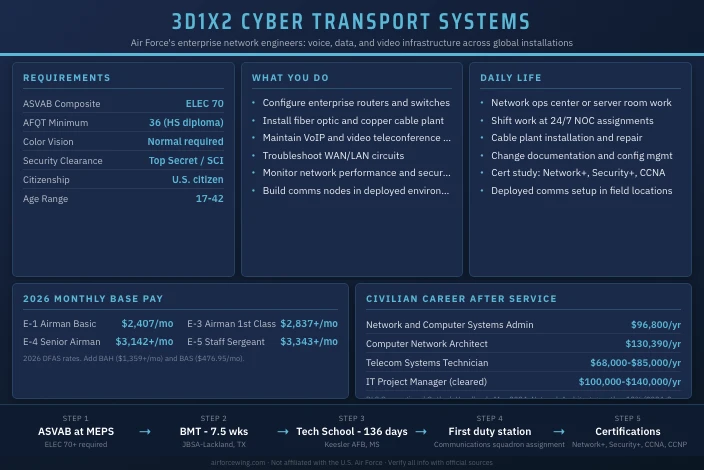
Job Role
3D1X2 Cyber Transport Systems specialists are the engineers of the Air Force’s global communications network. They install, configure, maintain, and troubleshoot the physical and logical infrastructure that carries voice, data, and video traffic across installations worldwide. Without this AFSC, the networks that connect aircraft, command posts, and deployed units go dark.
Day-to-Day Tasks
Transport Systems specialists split their time between hands-on hardware work and analytical network management. On any given shift, the job might involve configuring enterprise routers and switches, pulling and terminating fiber optic cable, troubleshooting a failed voice-over-IP circuit, or monitoring network traffic for performance degradation.
Core daily responsibilities include:
- Installing and maintaining local area networks (LANs), wide area networks (WANs), and voice-over-IP systems
- Configuring and managing network routers, switches, multiplexers, and transmission equipment
- Deploying and troubleshooting fiber optic and copper cable infrastructure
- Analyzing network performance and implementing security protocols
- Maintaining video teleconference systems that support operational briefings and command communications
- Documenting network configurations and infrastructure changes
Specialty Codes and Shredouts
The Cyber Transport Systems career field uses the following skill levels:
| Code | Skill Level | Description |
|---|---|---|
| 3D1X2 / 1D731A | 3-level (Apprentice) | Entry-level; completes Tech School, works under supervision |
| 3D1X2 / 1D732A | 5-level (Journeyman) | Independently performs full range of transport tasks |
| 3D1X2 / 1D733A | 7-level (Craftsman) | Supervisory and training responsibilities |
| 3D1X2 / 1D734A | 9-level (Superintendent) | Senior NCO management of communications functions |
The Air Force redesignated this career field from the 3DXXX series to 1D7XX in 2021 as part of a cyberspace support restructuring. Airforce.com currently lists this specialty under the code 1D731A. Both designations refer to the same Cyber Transport Systems specialty. Verify the current code with a recruiter at the time of enlistment.
Mission Contribution
Every Air Force operation depends on reliable communications. When a base loses connectivity or a circuit fails during an exercise, Transport Systems specialists diagnose and restore it. They maintain the infrastructure that carries classified briefings, operational orders, and real-time intelligence. Deployed units in austere locations often rely on transport specialists to build communications nodes from the ground up using portable equipment.
Technology and Equipment
The equipment list in this career field reads like a data center catalog. Specialists work with enterprise-grade Cisco and Juniper routers and switches, Dense Wavelength Division Multiplexing (DWDM) fiber optic transmission systems, SONET/SDH multiplexers, IP telephony platforms, video teleconferencing systems, and classified network hardware. The work involves both government-furnished and commercial off-the-shelf (COTS) equipment. People who want hands-on time with the same technology that runs large enterprise networks will find it here.
Salary
Base Pay
Pay is the same across all Air Force enlisted jobs and is determined by rank and years of service. The figures below are 2026 DFAS rates.
| Rank | Grade | Entry Pay (under 2 years) | At 4 Years |
|---|---|---|---|
| Airman Basic | E-1 | $2,407/mo | $2,407/mo |
| Airman | E-2 | $2,698/mo | $2,698/mo |
| Airman First Class | A1C / E-3 | $2,837/mo | $3,198/mo |
| Senior Airman | SrA / E-4 | $3,142/mo | $3,659/mo |
| Staff Sergeant | SSgt / E-5 | $3,343/mo | $3,947/mo |
| Technical Sergeant | TSgt / E-6 | $3,401/mo | $4,069/mo |
Most enlisted members reach E-4 (Senior Airman) within two to three years. Pay is base salary only, it does not include housing or food allowances, which add significantly to total compensation.
Allowances and Total Compensation
Beyond base pay, active-duty Airmen receive:
- Basic Allowance for Subsistence (BAS): $476.95/month (flat rate for all enlisted, 2026)
- Basic Allowance for Housing (BAH): Varies by duty location and dependency status. A single E-4 at Joint Base San Antonio draws roughly $1,359/month; with dependents, that rises to $1,728/month. High-cost installations pay considerably more.
- Special Duty and Incentive Pay: Available for certain assignments and qualifications; verify current rates with a recruiter.
Additional Benefits
Active-duty Airmen receive TRICARE Prime at no cost, no enrollment fee, no deductible, no copays for covered medical, dental, vision, and mental health services.
Education benefits include:
- Tuition Assistance (TA): Up to $4,500/year for college courses taken while on active duty, at $250 per semester hour
- Post-9/11 GI Bill: Full in-state tuition at public universities after separation, or up to $29,920.95 per academic year at private schools, plus a monthly housing allowance and $1,000 annual book stipend
- Credit toward degree: Tech School coursework at Keesler counts toward an Electronic Systems Technology degree
Retirement under the Blended Retirement System (BRS) combines a pension (40% of high-36 average pay at 20 years) with a Thrift Savings Plan that the government matches up to 4% of basic pay.
Work-Life Balance
Active-duty Airmen earn 30 days of paid leave per year. Work schedules in communications units typically follow standard duty hours on garrison, though shift work is common at Network Operations Centers and Air Operations Centers that operate around the clock. Deployed and exercise environments can run 12-hour shifts for the duration of the operation.
Qualifications
Qualifications Table
| Requirement | Standard |
|---|---|
| ASVAB Composite | Electronics (ELEC): 70 |
| AFQT Minimum | 36 (high school diploma) |
| Citizenship | U.S. citizen |
| Age | 17-42 at time of enlistment |
| Education | High school diploma or equivalent |
| Color Vision | Normal color vision required |
| Driver’s License | Valid state driver’s license required |
| Security Clearance | Top Secret / SCI (SSBI required) |
| Medical | Meets Air Force enlistment medical standards |
The ELEC 70 score is among the highest ASVAB requirements in the enlisted Air Force. The ELEC composite combines General Science, Arithmetic Reasoning, Mathematics Knowledge, and Electronics subtests. Weak performance on any of these four subtests can push your composite below the cutoff. Plan your study time accordingly.
ASVAB Composite Details
The Air Force Electronics (ELEC) composite draws from four ASVAB subtests: General Science (GS), Arithmetic Reasoning (AR), Mathematics Knowledge (MK), and Electronics Information (EI). A score of 70 or higher is required. This cutoff reflects the genuine technical depth of the work, network protocols, signal transmission, and RF theory all require solid math and electronics foundations.
Security Clearance Process
The Top Secret/SCI clearance requirement is the most time-sensitive part of the 3D1X2 pipeline. After enlisting, candidates undergo a Single Scope Background Investigation (SSBI). That investigation reviews finances, foreign contacts, criminal history, and drug use. The process can take several months to over a year depending on complexity. Tech School cannot begin until the investigation is complete or favorably adjudicated. Candidates with significant financial problems, prior drug use, or foreign national contacts should speak with a recruiter about realistic clearance timelines before signing a contract.
Factors that commonly delay or disqualify clearance investigations:
- Unpaid debt collections or bankruptcy filings
- Prior marijuana use (review current DoD policy with a recruiter)
- Foreign national family members or significant foreign travel
- Prior criminal record (waivers may be available for minor offenses)
Application Process
The enlistment process for 3D1X2 follows the standard Air Force enlisted path:
Service Obligation
Enlistment contracts are typically 4 or 6 years for active duty. The additional obligation for certain bonus-eligible positions may extend the initial commitment. Confirm the current service obligation with your recruiter when selecting this AFSC.
See our ASVAB study guide for strategies to hit these line scores, or take the PiCAT from home if you are a first-time tester.
Work Environment
Setting and Schedule
Most 3D1X2 work happens indoors, inside network operations centers, communication nodes, server rooms, and equipment vaults. The environment is climate-controlled by necessity; the hardware requires it. But transport specialists also work outside when building or repairing cable plant, climbing antenna towers, or installing transmission equipment at remote sites. At deployed locations, the work moves into expeditionary communications shelters and temporary facilities.
Shift work is common at installations that operate a 24/7 Network Operations Center. Day shifts handle most planned maintenance and installations; night shifts focus on monitoring and incident response. In exercise or deployment environments, Transport Systems specialists may work 12-hour shifts for days or weeks at a time.
Chain of Command and Communication
Transport specialists work within a Communications Squadron, which falls under the Wing. Within the unit, work is organized by sections, typically a Network Infrastructure section handles the physical plant, while a Network Operations section handles monitoring and incident management. At the SSgt and TSgt level, NCOs supervise Airmen directly and coordinate with sister units for circuit provisioning and troubleshooting.
Performance feedback in the Air Force runs through the Enlisted Performance Report (EPR) system, with stratification rankings that directly affect promotion chances. Airmen who want to advance need consistent top-tier EPR markings, which come from technical proficiency, attitude, and taking on additional responsibilities.
Team Dynamics and Autonomy
Entry-level specialists work under close supervision while completing their 5-level upgrade training. After earning the journeyman skill level, Airmen take on independent work orders and troubleshooting responsibility. At the Craftsman (7-level) stage, the work shifts substantially toward supervising and training junior Airmen.
The field rewards people who are methodical and patient. A complex network outage can take hours to isolate, involving multiple team members across different systems. You’re rarely solving problems alone, but you do need to bring your own analysis to the table rather than waiting for someone else to diagnose it.
Job Satisfaction
Network transport work is operationally relevant in a concrete way. When the communications infrastructure is down, the unit notices immediately. When you fix it, they notice that too. Airmen in technical career fields tend to report higher job satisfaction than those in support roles, partly because the skill set is deep enough to see real growth over a career. The civilian demand for network engineers also means that the skills you build on active duty have direct market value after separation.
Training
Initial Training Pipeline
| Phase | Location | Duration | Focus |
|---|---|---|---|
| Basic Military Training (BMT) | JBSA-Lackland, TX | 7.5 weeks | Physical fitness, military customs, weapons qualification, core values |
| Technical School | Keesler AFB, MS | 136 days (~27 weeks) | Network fundamentals, LAN/WAN infrastructure, fiber optics, IP telephony, transmission systems, security protocols |
| First Duty Station | Varies | Ongoing | On-the-job upgrade training toward 5-level Journeyman |
BMT is the same for every Air Force enlisted member. The 7.5 weeks cover physical conditioning, drill, weapons handling, and the basics of military life. There’s no technical instruction at BMT, that all happens at Tech School.
Tech School at Keesler AFB
The 336th Training Squadron at Keesler AFB runs the 3D1X2 course. The 136-day program is structured as an 11-block series covering roughly 680 hours of instruction. Students learn network hardware configuration, fiber optic installation and termination, transmission system operation, IP telephony, video teleconferencing systems, and network security principles.
Keesler is the Air Force’s primary electronics and communications training center. The campus hosts multiple 3D career field courses, so Tech School here means studying alongside future Client Systems, RF Transmission, and Cyber Surety specialists. Classroom instruction combines with hands-on lab time using the same enterprise hardware students will maintain at their first duty station.
Completion of Tech School earns academic credits toward an Electronic Systems Technology degree, one of the few tech school pipelines that immediately begins building transferable academic credentials.
Advanced Training and Certifications
The Air Force expects 3D1X2 specialists to pursue and maintain professional certifications aligned with their duty responsibilities. Common certifications associated with this career field include:
- CompTIA Network+: foundational networking certification, often the first target for new Airmen
- CompTIA Security+: required for DoD 8570/8140 compliance; nearly mandatory for any cyber-adjacent role
- Cisco CCNA: the industry standard for network routing and switching proficiency
- Cisco CCNP: senior-level Cisco credential pursued at the Staff Sergeant and above level
The Air Force funds certification testing through the Education Center, and preparation time is worked into professional development planning. Airmen who earn CCNA or CCNP certifications substantially increase their market value for defense contractor and private sector roles post-service.
Everything starts with qualifying ASVAB scores, our study guide covers what to study first.
Career Progression
Rank and Progression Timeline
| Rank | Grade | Typical Milestone |
|---|---|---|
| Airman Basic | E-1 | Entry; first day at BMT |
| Airman | E-2 | After 6 months time-in-service |
| Airman First Class | A1C / E-3 | After 16 months time-in-service |
| Senior Airman | SrA / E-4 | After 3 years time-in-service (or 28 months with early promotion) |
| Staff Sergeant | SSgt / E-5 | Competitive promotion; typically 5+ years TIS |
| Technical Sergeant | TSgt / E-6 | Competitive; typically 8-12 years TIS |
| Master Sergeant | MSgt / E-7 | Senior enlisted; 14+ years typical |
| Senior Master Sergeant | SMSgt / E-8 | Highly competitive; 18+ years typical |
| Chief Master Sergeant | CMSgt / E-9 | Top 1% of enlisted force |
Promotions through E-4 are time-based and essentially automatic barring adverse actions. Staff Sergeant and above require competitive testing and strong EPR rankings. The Communications career field is large enough that promotion competition is steady, but Airmen who earn certifications, take on additional duties, and mentor subordinates build the records that advance them faster.
Specialization Options
Beyond the base AFSC, transport systems specialists can pursue Special Experience Identifiers (SEIs) that mark specific technical capabilities. SEIs are not separate codes but notations on the record that indicate expertise in areas like satellite communications, network operations centers, or specific transmission systems. Airmen seeking an SEI typically apply for assignments that develop that experience.
The career field also feeds into officer accession programs. Highly qualified senior NCOs may apply for the Airman Scholarship and Commissioning Program (ASCP) or Officer Training School (OTS) to commission as a 17D Cyberspace Operations Officer. The technical background from 3D1X2 is a strong foundation for the cyber officer path.
Performance Evaluation
The Enlisted Performance Report (EPR) is the primary tool for evaluating and documenting performance. EPRs are written annually and scored on a 5-point scale, with a stratification comment that compares the Airman against peers rated by the same supervisor. Promotion boards weight EPR rankings heavily, an Airman consistently stratified at the top of their peer group moves ahead of technically equal Airmen rated lower.
To build a strong record: complete 5-level upgrade training on time, pursue certifications proactively, volunteer for additional duties and exercises, and mentor subordinate Airmen. Technical excellence alone is not enough; the EPR system rewards people who contribute beyond their primary job description.
Physical Demands
Daily Physical Requirements
The 3D1X2 career field is primarily technical, not physically intensive. The job involves sitting at workstations, walking between equipment rooms, and occasional lifting of network hardware (switches, servers, cable spools). Cable plant work requires pulling wire through conduit, climbing ladders to access ceiling pathways, and working in confined spaces. Some assignments involve installing equipment in harsh environments during deployments.
The physical demands are moderate. There’s no requirement for combat fitness beyond the standard Air Force Fitness Assessment, and the job does not involve sustained strenuous physical activity in garrison.
Air Force Fitness Assessment Standards
All Airmen take the Air Force Fitness Assessment annually. The assessment is the same for all career fields, there are no AFSC-specific modifications for 3D1X2. The test is scored on a 100-point scale; a composite score of 75 is required to pass. Each component has its own minimum.
| Component | Points |
|---|---|
| 1.5-Mile Run | 60 |
| Waist Circumference or Body Composition | 20 |
| Push-Ups (1 minute) | 10 |
| Sit-Ups (1 minute) | 10 |
Scores are age- and gender-normed. Failing the overall composite or any single component results in a failing assessment, which triggers a mandatory fitness improvement plan. Repeated failures affect promotions and retention. For current age- and gender-specific passing standards, check af.mil.
Medical Evaluations
Beyond the MEPS physical, Airmen receive periodic medical evaluations throughout their career. Normal color vision must be maintained; color vision deficiency acquired after enlistment can affect assignment eligibility. The Top Secret/SCI clearance also requires periodic reinvestigation, typically every 5-6 years, and Airmen must maintain the lifestyle and financial standards that the clearance demands.
Deployment
Deployment Patterns
Communications are not optional in deployed environments. When the Air Force deploys, the network has to go with it. 3D1X2 specialists deploy in support of Air Expeditionary Wing operations, Joint Task Forces, and Combined Air Operations Centers. Deployments run 4-6 months for most standard Air Force rotations.
The tempo depends heavily on the installation and unit type. Airmen assigned to Air Operations Centers or Global Strike Command units may see a different deployment cycle than those at installation communications squadrons. The career field is needed globally, so some assignments carry higher deployment frequency than others.
Duty Station Options
3D1X2 specialists are assigned to communications squadrons at Air Force installations worldwide. A partial list of common duty locations includes:
- Ramstein AB, Germany: largest Air Force installation in Europe; NATO communications hub
- Kadena AB, Japan: Pacific theater; high operational tempo
- Joint Base Elmendorf-Richardson, AK: Alaska-based communications support
- Scott AFB, IL: home of Air Mobility Command
- Peterson SFB, CO: NORAD and USNORTHCOM headquarters
- Peterson SFB / Schriever SFB, CO: space and cyber operations
- Multiple CONUS installations: nearly every major Air Force base has a communications squadron
Duty station assignment starts with the needs of the Air Force, but Airmen can submit a dream sheet of preferred locations. First-term Airmen get fewer choices; those with more service time can influence assignments through reenlistment negotiations and assignment preference programs.
Risk/Safety
Job Hazards
The main physical hazards in this career field are electrical exposure and falls. Network equipment operates at standard 110V/220V power, with the risk of shock during installation or repair if lockout/tagout procedures aren’t followed. Cable work that requires climbing ladders, working in elevated equipment bays, or accessing rooftop antenna mounts carries fall risk. Deployed environments introduce additional hazards depending on the threat environment and operating conditions.
Chemical hazards are minimal. Fiber optic work generates glass shard waste that requires eye protection and careful disposal, but there are no routine exposures to hazardous materials.
Safety Protocols
Air Force communications units follow AFOSH (Air Force Occupational Safety and Health) standards for electrical work, confined space entry, and fall protection. Lockout/tagout procedures are mandatory before working on energized equipment. Personal protective equipment (PPE) requirements are defined by the specific task. Training on job-specific hazards is completed at the unit level before Airmen are authorized to perform certain tasks.
Security and Legal Requirements
The Top Secret/SCI clearance creates ongoing legal obligations. Airmen must report foreign contacts, foreign travel, and significant changes in financial status. Unauthorized disclosure of classified information carries federal criminal penalties under the Espionage Act and the Uniform Code of Military Justice (UCMJ).
Beyond the clearance, Airmen working on classified networks are required to complete annual Information Assurance (IA) training and may be subject to random polygraph examinations depending on the assignment. Some positions also require access to classified SCI facilities (SCIFs), which carry additional access control requirements.
Impact on Family
Family Considerations
Deployments in this career field run 4-6 months on standard rotations. Families on the installation have access to the full suite of Air Force family support programs: Family Advocacy, Airman and Family Readiness Centers, Military Family Life Consultants, and TRICARE healthcare coverage for all eligible dependents.
The clearance investigation also touches family members. During the SSBI process, background investigators may contact family members of the applicant. Foreign national family members or spouses require additional review and can complicate or delay the clearance process. This doesn’t automatically disqualify an applicant, but it is worth discussing with a recruiter before enlisting.
In garrison, the work schedule for Cyber Transport Airmen depends significantly on whether the unit runs a 24/7 Network Operations Center. NOC assignments typically involve rotating shifts, days, evenings, and nights, on a cycle that changes every few weeks. That kind of schedule requires more coordination with spouses and partners than a standard day-shift role. Communications squadrons that don’t have 24/7 NOC responsibilities tend to run closer to standard duty hours, with on-call availability for network outages outside normal operations.
The TS/SCI clearance creates specific spousal considerations that are less common in other AFSCs. Spouses may be interviewed during periodic reinvestigations. Significant foreign national contacts in the immediate family require disclosure and can slow the initial clearance adjudication. None of this is grounds for panic, millions of military families handle clearance obligations successfully, but knowing the requirements before enlisting reduces friction down the road.
Military OneSource offers 24/7 confidential counseling and financial advising to active-duty families at no cost. The Airman and Family Readiness Center at each installation provides deployment preparation programs and reintegration support. Families of Airmen at installations with high communications missions. JBSA, Ramstein, Kadena, typically find robust support programs and active military spouse communities.
Relocation
Permanent Change of Station (PCS) moves occur on average every 2-3 years in the Air Force. Communication squadrons exist at most major installations worldwide, so 3D1X2 specialists have a wider range of possible assignments than more specialized AFSCs. Each PCS move comes with a moving allowance, temporary lodging entitlement, and mileage reimbursement. Families with school-age children often find military base schools or DoDEA schools available at larger installations. Frequent moves are a real factor for families, the Air Force provides resources to manage them, but the disruption is genuine.
Reserve and Air National Guard
Component Availability
The 3D1X2/1D7XX cyber transport specialty exists in all three components: Active Duty, Air Force Reserve, and Air National Guard. Communications squadrons and communications flights are common force structure elements across both the Reserve and Guard. This is one of the most broadly distributed technical AFSCs in the part-time force.
Drill Schedule and Training Commitment
The standard Reserve/ANG commitment is one Unit Training Assembly (UTA) weekend per month (typically 2 days of drill pay) plus two weeks of Annual Tour each year. Cyber transport Airmen in the Guard and Reserve often have additional training requirements tied to certification maintenance and classified network access renewals, but the standard schedule remains the baseline.
Reserve Component Pay and Benefits Comparison
| Category | Active Duty | Air Force Reserve | Air National Guard |
|---|---|---|---|
| Commitment | Full-time | ~39 days/year (UTAs + AT) | ~39 days/year (UTAs + AT) |
| E-4 Monthly Pay | $3,142-$3,659/mo | ~$1,050-$1,220/drill weekend | ~$1,050-$1,220/drill weekend |
| Healthcare | TRICARE Prime (free) | TRICARE Reserve Select (premium) | TRICARE Reserve Select + state benefits |
| Education | TA + full GI Bill | TA + GI Bill (pro-rated by service) | State tuition waivers vary; TA eligible |
| Retirement | 20-year pension (BRS) | Points-based at age 60 | Points-based at age 60 |
| Deployment Tempo | Moderate | Mobilization-dependent | Mobilization-dependent |
The points-based Reserve retirement accrues points for each drill day, active duty day, and qualifying year. Retired pay begins at age 60 (or earlier with activation). A Reservist who completes 20 qualifying years earns retirement pay, but receives it decades later than an active-duty retiree.
TRICARE Reserve Select is available to Selected Reservists for a monthly premium, it’s not free like active-duty TRICARE Prime, but it is substantially cheaper than civilian employer health insurance for equivalent coverage.
Air National Guard members may also qualify for state-specific tuition waivers. These programs vary widely by state, some Guard-heavy states cover full in-state tuition at public universities, while others offer more limited assistance.
Deployment and Mobilization
Reserve and Guard cyber transport Airmen can be mobilized under Title 10 orders for overseas deployments or Title 32 orders for domestic missions. Mobilization frequency has increased since the mid-2000s. A Guard Airman in a communications unit at a major installation may deploy on a 12-18 month cycle depending on unit requirements, or may go years without activation. The uncertainty differs from active duty, where deployment tempo is more predictable.
Civilian Career Integration
3D1X2 is one of the AFSCs where Reserve service and a civilian career align almost perfectly. Network engineers, systems administrators, and telecommunications technicians work in the private sector using skills that are nearly identical to their Guard or Reserve duties. Employers in the defense contracting sector actively seek cleared network professionals, having an active TS/SCI clearance from Reserve service can be worth tens of thousands of dollars in salary premium at a defense contractor.
USERRA (Uniformed Services Employment and Reemployment Rights Act) protects civilian employment during military activations. Most defense contractor employers also actively support Reserve and Guard service, and some provide full pay continuation during deployments.
Post-Service
Civilian Career Transition
The skills from 3D1X2 map cleanly to some of the best-compensated civilian IT roles. Network engineers, systems administrators, and network architects are in demand across every sector of the economy. The combination of hands-on enterprise networking experience, industry certifications, and an active TS/SCI clearance makes post-service job searches faster than most veteran transitions.
Common post-service paths:
The TS/SCI clearance earned in this AFSC is a career accelerant. Defense contractors pay a significant premium for cleared network engineers. Some cleared network positions pay $20,000-$40,000 more annually than identical uncleared roles.
Civilian Career Outlook
| Civilian Job Title | BLS Median Salary | Job Outlook (2024-2034) |
|---|---|---|
| Network and Computer Systems Administrator | $96,800/yr | Stable; ~14,300 openings/year |
| Computer Network Architect | $130,390/yr | +12% (much faster than average) |
| Telecommunications Systems Technician | $68,000-$85,000/yr | Steady demand from carriers and defense |
| IT Project Manager (cleared) | $100,000-$140,000/yr | Strong demand in defense contracting |
BLS data from May 2024. Computer network architect growth of 12% is classified as much faster than average for all occupations.
Transition Programs
The Air Force Transition Assistance Program (TAP) runs separation counseling, resume workshops, and career fair access. Hiring Our Heroes runs fellowship programs that place separating servicemembers in civilian roles during their terminal leave period. Defense contractors including Booz Allen Hamilton, SAIC, Leidos, and Northrop Grumman actively recruit cleared IT professionals at military job fairs. Veterans who earn the GI Bill at the 100% tier can pursue bachelor’s or master’s degrees in computer science or network engineering with housing allowance support.
Is This a Good Job
Ideal Candidate Profile
The Airmen who do best in 3D1X2 share a few characteristics. They like understanding how systems connect, not just whether they work, but why. They’re comfortable reading technical documentation, following complex procedures, and diagnosing problems that aren’t immediately obvious. They can sit with a difficult troubleshooting scenario for hours without losing focus.
This career field suits people who:
- Scored well on math and electronics in school without much effort
- Have already built or configured home networks for fun
- Want IT credentials that transfer directly to high-paying civilian work
- Can pass a thorough financial and personal background investigation
- Are patient with detailed technical work and not frustrated by ambiguity
Potential Challenges
The clearance process is the biggest early hurdle. If your financial history, foreign contacts, or prior drug use creates complications, the investigation could delay your entry into Tech School by months. Candidates who need income quickly can’t afford an open-ended clearance timeline.
The work is also sedentary by comparison to other technical AFSCs. People who want more physical variety, outdoor work, or direct connection to flying operations may find a communications squadron environment confining. Shift work at Network Operations Centers runs nights, weekends, and holidays, that’s the nature of keeping a 24/7 infrastructure alive.
The ELEC 70 bar also means that candidates without strong math and electronics foundations will struggle to qualify. If your practice ASVAB scores are in the 60-65 range on the electronics composite, the work required to reach 70 is substantial but doable with focused study.
Career and Lifestyle Fit
This is the right career field if your goal is to enter active duty, build an enterprise networking skill set, earn industry certifications on the Air Force’s dime, and exit into a six-figure civilian IT career. It also works well for people who want to serve part-time in the Guard or Reserve while working a civilian networking career in parallel, the two reinforce each other directly.
It’s probably not the right fit if you want constant variety, outdoor duty, or work that keeps you physically active throughout the day. Communications squadron life has a steady professional rhythm that many people find satisfying, but others find it too office-like for a military career.
More Information
Your local Air Force recruiter can verify the current AFSC code, training dates, bonus eligibility, and clearance timeline for this career field. Recruiter contact is available through airforce.com. The official careers page for Cyber Transport Systems lists current qualification requirements and training details you can review before your first recruiter appointment.
Official sources:
- airforce.com: Cyber Transport Systems, official Air Force career page with current qualification details
- Keesler AFB 81st Training Wing, home of 3D1X2 Tech School, the 336th Training Squadron
- DCSA Adjudicative Guidelines, Defense Counterintelligence and Security Agency information on TS/SCI clearance requirements and the SSBI process
Certification resources:
- Cisco Certifications, CCNA and CCNP are the primary Cisco credentials aligned with this AFSC. Cisco’s official certification roadmap explains the exam structure and prerequisites.
- CompTIA, Network+ and Security+ are the foundational certifications expected of 3D1X2 Airmen. CompTIA offers study materials and a candidate portal for scheduling exams.
- BLS Network and Computer Systems Administrators outlook, wage data and growth projections for the primary civilian career path out of this AFSC
Civilian market context: The cleared network engineering market is significantly different from the general IT job market. ClearanceJobs.com and LinkedIn both allow searches filtered by clearance level. Comparing TS/SCI network engineer postings to uncleared equivalents at the same experience level will give you a concrete sense of the salary premium the clearance earns in the contractor market.
- Prepare for the ASVAB with our study guide to make sure your line scores qualify
This site is not affiliated with the U.S. Air Force or any government agency. Verify all information with official Air Force sources before making enlistment or career decisions.
Explore more Air Force communications careers to compare this role against other network, cyber, and RF transmission specialties in the 3D career group.