3D1X1 Client Systems
Every computer on every Air Force base, the one a security forces troop uses to pull rosters, the one a flight surgeon uses to pull aircrew records, the one a commander uses to brief a mission, has to work. When it doesn’t, 3D1X1 Client Systems is the call that gets made. These Airmen are the IT backbone of daily Air Force operations, configuring systems, crushing tickets, and maintaining the hardware and software environment that thousands of users depend on. The ASVAB electronics bar is real, and the Secret clearance is non-negotiable. But 67 days of tech school later, you’re in a career field that translates almost line-for-line into civilian IT employment and puts you ahead of most help desk workers before your first year of service is over.
Qualifying requires specific ASVAB line scores. Our ASVAB study guide covers what to target and how to prepare.
Job Role
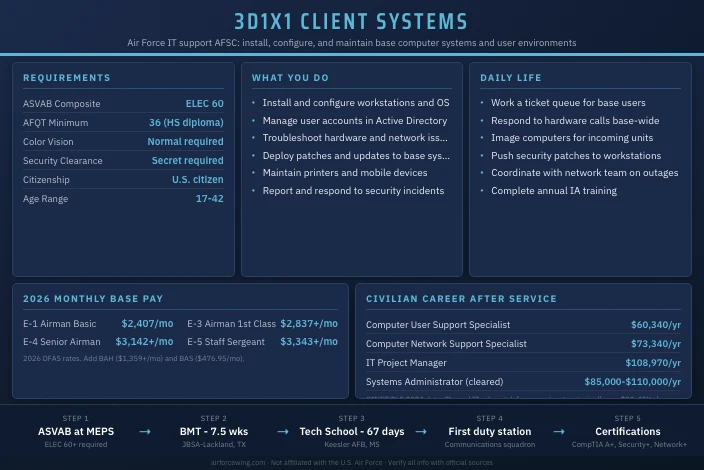
3D1X1 Client Systems specialists install, configure, maintain, and troubleshoot Air Force computer systems, peripherals, and software across the installation. They are the primary IT support tier for base users, managing everything from desktop hardware and operating systems to user accounts, network printers, and mobile devices. Without this AFSC, base IT operations stop.
Day-to-Day Tasks
The daily rhythm of a Client Systems specialist splits between reactive support and scheduled maintenance work. Half the job is working a ticket queue, a user can’t log in, a printer is offline, an application won’t launch. The other half is proactive: imaging and deploying new workstations, pushing software updates across hundreds of machines, or auditing user accounts against security policy.
Core responsibilities include:
- Installing and configuring desktop and laptop computers, operating systems, and enterprise software
- Troubleshooting hardware failures, software conflicts, and network connectivity problems for base users
- Managing user accounts in Active Directory, including access provisioning and removal
- Deploying patches, security updates, and configuration changes across the installation’s workstation fleet
- Maintaining printers, peripherals, and mobile devices connected to the base network
- Documenting support actions, incident tickets, and equipment records in IT service management systems
- Reporting cybersecurity incidents and taking initial corrective action per Air Force policy
Specialty Codes and Skill Levels
| Code | Skill Level | Description |
|---|---|---|
| 3D1X1 / 1D731E | 3-level (Apprentice) | Entry-level; completes Tech School, works under supervision |
| 3D1X1 / 1D732E | 5-level (Journeyman) | Independently performs full range of client systems tasks |
| 3D1X1 / 1D733E | 7-level (Craftsman) | Supervisory duties; trains and evaluates junior Airmen |
| 3D1X1 / 1D734E | 9-level (Superintendent) | Senior NCO leadership of communications functions |
The Air Force redesignated several 3D-series communication AFSCs to 1D7XX codes in 2021 as part of a cyberspace support restructuring. Airforce.com currently lists this specialty as 1D731E. Both designations refer to the same Client Systems specialty. Verify the current code with a recruiter at the time of enlistment.
Mission Contribution
Air Force operations generate enormous amounts of digital work every day. Flight plans, personnel records, intelligence reports, maintenance logs, supply orders, all of it flows through workstations that Client Systems specialists keep online. A crashed laptop the morning of a wing inspection, a network authentication failure across the base, a batch of newly arrived Airmen who need accounts and computers before they can start work, these aren’t abstract problems. Client Systems resolves them directly, and the pace of those resolutions affects real operations.
Deployed and expeditionary environments add another dimension. When a unit stands up communications at an austere location, client systems specialists help establish the user-facing IT environment that connects personnel to the mission network.
Technology and Equipment
The tool set is standard enterprise IT: Windows and macOS workstations, Windows Server environments, Microsoft Active Directory, and IT service management platforms like ServiceNow. Specialists also work with iOS and Android mobile devices enrolled in Mobile Device Management (MDM) systems, network printers, image deployment tools, and Air Force-specific software suites. The environment is largely commercial off-the-shelf, which means the skills transfer cleanly to civilian IT roles using identical platforms.
Salary
Base Pay
Military pay is standardized across all Air Force enlisted jobs. Rank and years of service determine the rate. The figures below are 2026 DFAS rates.
| Rank | Grade | Entry Pay (under 2 years) | At 4 Years |
|---|---|---|---|
| Airman Basic | E-1 | $2,407/mo | $2,407/mo |
| Airman | E-2 | $2,698/mo | $2,698/mo |
| Airman First Class | A1C / E-3 | $2,837/mo | $3,198/mo |
| Senior Airman | SrA / E-4 | $3,142/mo | $3,659/mo |
| Staff Sergeant | SSgt / E-5 | $3,343/mo | $3,947/mo |
| Technical Sergeant | TSgt / E-6 | $3,401/mo | $4,069/mo |
Most Airmen reach E-4 within two to three years. Base pay excludes housing and food allowances, which add significantly to actual take-home compensation.
Allowances and Total Compensation
Beyond base pay, active-duty Airmen receive:
- Basic Allowance for Subsistence (BAS): $476.95/month flat rate for all enlisted Airmen (2026)
- Basic Allowance for Housing (BAH): Varies by duty location and dependency status. A single E-4 at Joint Base San Antonio draws roughly $1,359/month; with dependents that rises to $1,728/month. High-cost installations pay considerably more.
- Special and Incentive Pay: Available for qualifying assignments; verify current rates with a recruiter.
Additional Benefits
Active-duty Airmen receive TRICARE Prime at no cost, no enrollment fee, no deductible, no copays for covered medical, dental, vision, and mental health services.
Education options during service include:
- Tuition Assistance (TA): Up to $4,500/year for college courses while on active duty, at $250 per semester hour
- Post-9/11 GI Bill: Full in-state tuition at public universities after separation, or up to $29,920.95 per academic year at private schools, plus a monthly housing allowance and $1,000 annual book stipend
- Degree credit: Tech School coursework at Keesler counts toward an Information Systems Technology degree
The Blended Retirement System (BRS) combines a pension (40% of high-36 average pay at 20 years) with a Thrift Savings Plan that the government matches up to 4% of basic pay.
Work-Life Balance
Active-duty Airmen earn 30 days of paid leave per year. Client Systems work in garrison typically follows standard duty hours, though Network Control Centers and communications units that support 24/7 operations may include shift work. Exercise and deployment environments run 12-hour shifts for the duration.
Qualifications
Qualifications Table
| Requirement | Standard |
|---|---|
| ASVAB Composite | Electronics (ELEC): 60 |
| AFQT Minimum | 36 (high school diploma) |
| Citizenship | U.S. citizen |
| Age | 17-42 at time of enlistment |
| Education | High school diploma or equivalent |
| Color Vision | Normal color vision required |
| Driver’s License | Valid state driver’s license required |
| Security Clearance | Secret |
| Medical | Meets Air Force enlistment medical standards |
The ELEC 60 score is the lowest ASVAB requirement in the 3D Communications career group, but it’s not an easy bar. The Electronics composite draws from four subtests: General Science, Arithmetic Reasoning, Mathematics Knowledge, and Electronics Information. All four need to be solid. A weak math performance can pull your composite below 60 even with strong electronics scores.
ASVAB Composite Details
The Air Force Electronics (ELEC) composite combines General Science (GS), Arithmetic Reasoning (AR), Mathematics Knowledge (MK), and Electronics Information (EI). The minimum for 3D1X1 is 60. That cutoff reflects the technical baseline required to configure operating systems, troubleshoot hardware, and work within a classified network environment. Candidates who haven’t taken a math course recently should prioritize arithmetic reasoning and algebra review before testing.
Security Clearance Process
Client Systems Airmen require a Secret security clearance. After enlisting, candidates undergo a National Agency Check with Law and Credit (NACLC) investigation. The process reviews criminal history, financial records, foreign contacts, and prior drug use. A Secret clearance investigation is less extensive than a Top Secret or TS/SCI investigation, so timelines are generally shorter, but financial problems and prior drug use still cause delays or denials.
Common factors that complicate clearance investigations:
- Unpaid debt collections or recent bankruptcy
- Prior marijuana use (review current DoD policy with a recruiter)
- Foreign national contacts or significant foreign travel
- Criminal record (waivers may be available for minor offenses)
Application Process
Selection and Service Obligation
Client Systems is a staffed career field with consistent demand across active-duty installations worldwide. It’s not as restrictive a selection as some special operations or aviation support AFSCs, but ASVAB scores drive initial eligibility. Enlistment contracts run 4 or 6 years for active duty. Confirm the current service obligation and any bonus-eligible terms with your recruiter.
See our ASVAB study guide to target the ELEC composite.
Work Environment
Setting and Schedule
Almost all Client Systems work happens indoors, inside offices, communications closets, server rooms, and user workspaces across the installation. The environment is climate-controlled by necessity, the hardware requires it. Airmen move across the base all day, going from one building to the next to resolve support tickets and perform installations. Sitting at a helpdesk for eight hours is one version of the job; physically deploying workstations across a flight line operations building or an aircraft maintenance facility is another.
Standard duty hours are common for most garrison assignments, though some units use shift coverage to support early morning or late-evening operations. During base exercises or real-world activations, the schedule can shift to 12-hour days and 6- or 7-day work weeks until the event concludes.
Chain of Command and Communication
Client Systems Airmen work within Communications Squadrons, which fall under the Wing. Within the squadron, they typically serve in a Client Systems section alongside NCOs and other Airmen handling the same support function. Work is managed through a ticketing system, which tracks open issues, resolution times, and technician assignments. Performance feedback in the Air Force runs through the Enlisted Performance Report (EPR) system, with annual evaluations and stratification rankings that directly affect competitive promotion.
Team Dynamics and Autonomy
Entry-level Airmen in upgrade training work with direct supervision as they work toward their 5-level Journeyman certification. The ticketing environment naturally builds independence fast, you’re often the sole technician responding to a user’s problem, expected to diagnose and resolve it without handing it off. At the NCO level, the job shifts toward managing a support queue, training junior Airmen, and coordinating with the network team on issues that cross system boundaries.
The pace is driven by ticket volume, and that volume can spike without warning. Base-wide software deployments, new hardware rollouts, and cybersecurity incidents all create work surges. Airmen who thrive in this environment are comfortable with structured problem-solving and don’t need every day to look the same.
Job Satisfaction
Client Systems is among the more user-facing technical roles in the enlisted force. The feedback loop is short: a user calls in a problem, you fix it, and they go back to work. That concrete cause and effect can be satisfying in a way that back-end infrastructure work isn’t. The civilian IT market also validates the career, the skills here are the foundation of a systems administrator or IT support career that pays well after service.
Training
Initial Training Pipeline
| Phase | Location | Duration | Focus |
|---|---|---|---|
| Basic Military Training (BMT) | JBSA-Lackland, TX | 7.5 weeks | Physical fitness, military customs, weapons qualification, core values |
| Technical School | Keesler AFB, MS | 67 days | Operating system configuration, hardware installation, Active Directory, network connectivity, IT security fundamentals, Air Force-specific software systems |
| First Duty Station | Varies | Ongoing | On-the-job upgrade training toward 5-level Journeyman |
BMT is identical for every Air Force enlisted member. The 7.5 weeks cover physical conditioning, weapons handling, drill, and military customs. No technical instruction happens at BMT, that starts at Tech School.
Tech School at Keesler AFB
The 81st Training Wing at Keesler AFB, MS hosts the Client Systems course. The 67-day program delivers the foundational IT skills for managing Air Force client environments: Windows and server operating system administration, hardware installation and diagnostics, Active Directory user and group management, network connectivity troubleshooting, mobile device management, and Air Force information security policy.
Keesler is the primary electronics and communications training center for the Air Force, so Client Systems students train alongside future Cyber Transport, RF Transmission, and Cyber Surety specialists. Instruction combines classroom work with hands-on labs using the same equipment and software platforms Airmen will manage at their first duty station. Graduates earn academic credits toward an Information Systems Technology degree.
The 67-day pipeline is one of the shorter tech school courses in the communications group, but the pace is deliberate. Covering Windows administration, Active Directory, and IT security fundamentals in 67 days requires steady daily engagement rather than coast-and-cram studying.
Advanced Training and Certifications
The Air Force expects Client Systems specialists to build and maintain professional certifications that align with DoD information assurance requirements. Common targets include:
- CompTIA A+: the foundational hardware and operating system certification; often the first credential new Airmen pursue
- CompTIA Network+: validates networking knowledge useful for resolving connectivity issues
- CompTIA Security+: required for DoD 8570/8140 Information Assurance compliance; nearly standard across all communications roles
- Microsoft certifications: Microsoft 365 Administrator and Azure Administrator credentials are increasingly relevant as the Air Force moves more workloads to cloud environments
The Air Force Education Center funds certification exam fees, and supervisors build preparation time into professional development plans. Earning CompTIA A+ and Security+ in your first term makes you significantly more competitive for civilian jobs after separation and opens additional assignment options within the Air Force.
Prep for the ELEC 60 requirement starts with our ASVAB study guide.
Career Progression
Rank and Progression Timeline
| Rank | Grade | Typical Milestone |
|---|---|---|
| Airman Basic | E-1 | Entry; first day at BMT |
| Airman | E-2 | After 6 months time-in-service |
| Airman First Class | A1C / E-3 | After 16 months time-in-service |
| Senior Airman | SrA / E-4 | After 3 years TIS (or 28 months with early promotion) |
| Staff Sergeant | SSgt / E-5 | Competitive promotion; typically 5+ years TIS |
| Technical Sergeant | TSgt / E-6 | Competitive; typically 8-12 years TIS |
| Master Sergeant | MSgt / E-7 | Senior enlisted; 14+ years typical |
| Senior Master Sergeant | SMSgt / E-8 | Highly competitive; 18+ years typical |
| Chief Master Sergeant | CMSgt / E-9 | Top 1% of enlisted force |
Promotions through E-4 are essentially time-based and non-competitive. Staff Sergeant and above require passing a promotion test and earning strong EPR rankings. The communications career field is large, and 3D1X1 is one of the most widely staffed AFSCs in it, promotion competition reflects that scale.
Specialization Options
Beyond the base AFSC, Airmen can pursue Special Experience Identifiers (SEIs) that reflect expertise in specific technical areas: enterprise service desk operations, mobile device management, or consolidated communications center work, among others. SEIs don’t change the AFSC code but appear in the record and can influence assignment selection.
The Client Systems career field also feeds directly into officer accession programs. Senior NCOs with strong records can apply for the Airman Scholarship and Commissioning Program (ASCP) or Officer Training School (OTS) to commission as a 17D Cyberspace Operations Officer or 17S Cyberspace Support Officer. The technical depth built in 3D1X1 is a genuine foundation for the cyber officer path.
Performance Evaluation
The Enlisted Performance Report (EPR) drives promotion outcomes. EPRs are written annually on a 5-point scale, with a stratification line that ranks the Airman against peers rated by the same supervisor. Promotion boards read the stratification carefully, “1 of 5” carries more weight than a high numeric score without a strong comparative ranking.
Building a competitive record means finishing upgrade training on time, earning certifications before peers, volunteering for additional duties, and mentoring subordinate Airmen. Technical competence matters, but the EPR system rewards Airmen who contribute beyond their primary job description. Client Systems specialists who take on help desk leadership roles or manage workstation fleet projects build the type of record that advances.
Physical Demands
Daily Physical Requirements
Client Systems work is primarily sedentary to moderately physical. A typical day involves walking across a large installation responding to tickets, carrying laptops or desktop components between buildings, and working at desks and counters configuring equipment. Occasional physical tasks include lifting workstations (typically 20-50 lbs), crawling under desks to run cables, and moving equipment racks during infrastructure upgrades.
There’s no requirement for sustained physical exertion beyond the standard Air Force Fitness Assessment. This is one of the less physically demanding AFSCs in the Air Force.
Air Force Fitness Assessment Standards
All Airmen take the Air Force Fitness Assessment annually, regardless of career field. There are no AFSC-specific modifications for 3D1X1. The test is scored on a 100-point scale; a composite of 75 is required to pass, and each component has its own minimum.
| Component | Maximum Points |
|---|---|
| 1.5-Mile Run | 60 |
| Waist Circumference or Body Composition | 20 |
| Push-Ups (1 minute) | 10 |
| Sit-Ups (1 minute) | 10 |
Scores are age- and gender-normed. Failing the composite or any single component triggers a mandatory fitness improvement plan. Repeated failures affect promotions and reenlistment eligibility. For current passing standards by age and gender group, check af.mil.
Medical Evaluations
Beyond the initial MEPS physical, Airmen receive periodic occupational health evaluations throughout their career. Normal color vision is required for this AFSC; deficiencies identified after enlistment can affect assignment eligibility. The Secret clearance also requires periodic reinvestigation, typically every 10 years, and Airmen must maintain the personal and financial conduct the clearance demands throughout their career.
Deployment
Deployment Patterns
Client Systems Airmen deploy in support of Air Expeditionary Wing and Joint Task Force operations. When a unit stands up in a deployed environment, users need computers, accounts, printers, and IT support, that’s the Client Systems mission in austere conditions. Standard Air Force deployments run 4-6 months for most rotations.
Deployment tempo in this AFSC is generally moderate. Installation-level communications squadrons at large CONUS bases have a different tempo than expeditionary communications units, which operate at higher deployment frequency. Your unit assignment drives the operational pace more than the AFSC code itself.
Duty Station Options
Communications squadrons with Client Systems sections exist at nearly every major Air Force installation worldwide. A partial list of common duty locations includes:
- Joint Base San Antonio, TX: large installation with major communications and IT infrastructure
- Ramstein AB, Germany: Air Force’s largest European base; significant IT support mission
- Kadena AB, Japan: Pacific theater; high operational tempo
- Joint Base Langley-Eustis, VA: Air Combat Command headquarters
- Scott AFB, IL: Air Mobility Command
- Peterson SFB, CO: NORAD/USNORTHCOM headquarters
- Multiple CONUS and OCONUS installations: Client Systems billets exist broadly across the force
Because this AFSC is widely distributed, Airmen have more assignment variety than highly specialized career fields. First-term Airmen get fewer assignment preferences; those with more time in service can influence duty station selection through reenlistment negotiations and assignment preference programs.
Risk/Safety
Job Hazards
The primary physical hazards in Client Systems work are ergonomic strain and minor electrical exposure. Prolonged desk and computer work creates repetitive stress risk. Hardware work on energized equipment carries standard electrical exposure risk, mitigated by lockout/tagout procedures and workplace safety training. Moving heavy equipment, desktop computers, servers, equipment racks, requires proper lifting technique to avoid injury.
Deployed environments introduce location-specific hazards depending on the operational area and threat level, but the IT support role itself carries no specialized physical risk beyond garrison work.
Safety Protocols
Air Force communications units follow AFOSH (Air Force Occupational Safety and Health) standards for electrical work and ergonomic workstation design. Equipment handling procedures and PPE requirements are covered at the unit level. The work environment, climate-controlled server rooms and offices, carries minimal industrial hazard compared to maintenance, explosive ordnance, or civil engineering AFSCs.
Security and Legal Requirements
The Secret clearance creates ongoing legal obligations. Airmen must report foreign contacts, foreign travel outside the normal civilian pattern, and significant changes in financial status. Unauthorized disclosure of classified information carries federal penalties under the Espionage Act and the Uniform Code of Military Justice (UCMJ).
Client Systems Airmen with access to classified IT systems complete annual Information Assurance (IA) training and may have additional access control requirements depending on the specific systems they maintain. Some assignments involve access to sensitive compartmented information facilities (SCIFs) or classified network segments, which carry their own access management rules.
Impact on Family
Family Considerations
Standard Air Force deployment rotations run 4-6 months. Families at home-station have access to the full suite of Air Force support programs: Family Advocacy, Airman and Family Readiness Centers, Military Family Life Consultants, and TRICARE healthcare coverage for eligible dependents. Installation IT support roles generally mean more predictable daily schedules than operational flying or special warfare AFSCs, which can make family life planning somewhat more stable.
The work schedule in garrison for Client Systems Airmen is typically close to standard business hours, 0730 to 1630 or similar, with after-hours callouts for network outages and exercises. That predictability is a real advantage compared to shift-based medical or security forces career fields. Airmen who stay in garrison-based IT roles rather than expeditionary communications units tend to have more consistent schedules throughout the workweek, which eases coordination for childcare, school schedules, and family routines.
Exercise periods change the calculus. Wing exercises and readiness inspections routinely extend duty hours to 12-hour days and six or seven days per week for their duration. These events are scheduled in advance, so families can plan around them, but they are not negotiable once the order is issued.
The Secret clearance creates one unique family dynamic worth understanding: foreign national family members or spouses require additional review during the background investigation, and any significant foreign contacts can complicate or delay the process. This is not unusual in the military, but it is worth discussing with a recruiter early if this applies to your situation.
Military OneSource provides 24/7 counseling, financial planning, and family support resources to active-duty families at no cost. Each installation’s Airman and Family Readiness Center runs deployment preparation programs and reintegration workshops for spouses and dependents.
Relocation
Permanent Change of Station (PCS) moves occur on average every 2-3 years. Because Client Systems billets exist at nearly every Air Force installation, assignment options are broader than for more specialized career fields. Each PCS move includes a moving allowance, temporary lodging entitlement, and mileage reimbursement. Families with school-age children can access DoD schools at larger installations. Frequent moves are a real factor, the support programs exist because they’re needed, but the disruption is genuine.
Reserve and Air National Guard
Component Availability
The 3D1X1/1D7XX Client Systems specialty is available in all three components: Active Duty, Air Force Reserve, and Air National Guard. Communications flights and squadrons are common unit structures in both Reserve and Guard organizations. This is among the most broadly distributed IT AFSCs in the part-time force, which means duty positions are available at many locations.
Drill Schedule and Training Commitment
The standard Reserve and ANG commitment is one Unit Training Assembly (UTA) weekend per month, typically two days of drill pay, plus two weeks of Annual Tour each year. Client Systems Airmen in the Guard and Reserve may have certification maintenance requirements tied to their unit’s information assurance program, but the baseline commitment stays at the standard schedule.
Reserve Component Pay and Benefits Comparison
| Category | Active Duty | Air Force Reserve | Air National Guard |
|---|---|---|---|
| Commitment | Full-time | ~39 days/year (UTAs + AT) | ~39 days/year (UTAs + AT) |
| E-4 Monthly Pay | $3,142-$3,659/mo | ~$1,050-$1,220/drill weekend | ~$1,050-$1,220/drill weekend |
| Healthcare | TRICARE Prime (free) | TRICARE Reserve Select (premium) | TRICARE Reserve Select + state benefits |
| Education | TA + full GI Bill | TA + GI Bill (pro-rated by service) | State tuition waivers vary; TA eligible |
| Retirement | 20-year pension (BRS) | Points-based at age 60 | Points-based at age 60 |
| Deployment Tempo | Moderate | Mobilization-dependent | Mobilization-dependent |
TRICARE Reserve Select is available to Selected Reservists for a monthly premium. It’s not free like active-duty TRICARE Prime, but it’s substantially cheaper than most civilian employer health insurance for comparable coverage.
Air National Guard members may also qualify for state tuition waivers. Programs vary widely, some Guard-heavy states cover full in-state tuition at public universities, while others offer limited assistance. Check your state’s Guard education benefits directly.
The points-based Reserve retirement accrues points for each drill day, active duty day, and qualifying year. Retired pay starts at age 60 (or earlier with qualifying activation periods). A Reservist who completes 20 qualifying years earns retirement pay, but receives it decades after an active-duty retiree would.
Deployment and Mobilization
Reserve and Guard Client Systems Airmen can be mobilized under Title 10 orders for overseas deployments or Title 32 orders for domestic missions. Mobilization frequency varies by unit and national requirements. A Guard Airman in a communications unit at a major installation might deploy on a 12-18 month cycle during high-demand periods, or go years without activation during quieter times. The unpredictability differs from active duty, where deployment schedules are more structured.
Civilian Career Integration
Client Systems is an ideal Reserve or Guard AFSC for people working civilian IT careers. Desktop support technicians, systems administrators, and IT helpdesk professionals work daily with the same platforms. Active Directory, Windows environments, ServiceNow, mobile device management, they’d use on a drill weekend. The overlap is nearly complete, and employers in the defense contracting and federal IT space actively value cleared IT professionals.
USERRA (Uniformed Services Employment and Reemployment Rights Act) protects civilian employment during military activations. Most technology and defense employers are familiar with Reserve and Guard service and many actively support it.
Post-Service
Civilian Career Transition
The skills from 3D1X1 map directly to entry-level and mid-level civilian IT roles. Desktop support, systems administration, and IT operations are hiring categories in virtually every industry sector, healthcare, finance, education, government, and defense. The combination of hands-on Windows and Active Directory experience, IT certifications, and a Secret clearance accelerates the job search compared to civilian candidates without security credentials.
Defense contractors pay a premium for cleared IT personnel. Federal agencies, including the Department of Defense and intelligence community, run large IT support operations that actively recruit veterans with relevant clearances.
Civilian Career Outlook
| Civilian Job Title | Median Salary | Job Outlook (2024-2034) |
|---|---|---|
| Computer User Support Specialist | $60,340/yr | 40,800 openings/year |
| Computer Network Support Specialist | $73,340/yr | ~9,600 openings/year |
| IT Project Manager | $108,970/yr | Much faster than average (+7%) |
O*NET data from 2024. Entry-level separation typically targets desktop support or junior sysadmin roles. Mid-career Airmen with certifications and 6-10 years of experience more commonly compete for network support and junior project management positions.
Transition Programs
The Air Force Transition Assistance Program (TAP) provides separation counseling, resume writing workshops, and career fair access. Hiring Our Heroes runs fellowship programs that place transitioning servicemembers in civilian roles during their terminal leave period. The GI Bill at the 100% tier covers full in-state tuition at public universities, many veterans use it to earn a bachelor’s degree in information technology or computer science, which pushes earning potential well above the median.
Airmen who earn CompTIA certifications during active duty can present those credentials immediately in civilian job interviews, without waiting for school enrollment or additional preparation. That advantage is real at the entry level, where credentials often matter more than degree pedigree.
Is This a Good Job
Ideal Candidate Profile
Client Systems attracts Airmen who like fixing things and working with people, but in a structured, technical context rather than an open-ended creative one. The job has clear success criteria: the ticket is closed, the system is online, the user is working. That kind of concrete feedback suits people who want to know whether they did their job well.
This career field suits people who:
- Enjoy troubleshooting and find it satisfying to isolate a problem through logical steps
- Are comfortable interacting with non-technical users and explaining problems without jargon
- Want marketable IT credentials that apply directly to civilian employment
- Can handle a daily work pace driven by fluctuating ticket volume
- Want a technical Air Force career without a grueling physical requirement
Potential Challenges
The work can feel repetitive over time, especially in high-volume support environments where tickets tend to cluster around the same set of recurring problems. Password resets, printer offline tickets, and software crashes generate a lot of workload that isn’t technically complex. Airmen who want constant novel challenges may find the Client Systems workload less stimulating than a career field with more irregular or complex technical problems.
The ELEC 60 requirement means candidates with weak math or electronics backgrounds will need deliberate preparation before testing. It’s achievable, the bar is the lowest in the 3D communications group, but a candidate who hasn’t studied arithmetic reasoning or basic electronics recently shouldn’t assume the score will come easily.
Shift work and exercise-driven schedule disruptions are real factors, particularly at installations with 24/7 communications support missions. The work is generally predictable in garrison, but the Air Force operates around the clock.
Career and Lifestyle Fit
This is a strong choice for people who want active-duty service, a genuine IT skill set, and a clear post-service career path. The 67-day tech school is one of the quicker entries into a technical career field. The Secret clearance, while less intensive to obtain than Top Secret credentials, still adds market value in the defense and federal IT sectors.
It’s also a solid choice for people who plan to serve part-time in the Guard or Reserve while working civilian IT careers. The overlap between the military and civilian versions of this job is nearly complete. Guard service in 3D1X1 reinforces a civilian IT career rather than competing with it.
More Information
Your local Air Force recruiter can confirm current AFSC codes, training dates, bonus availability, and clearance processing timelines. Recruiter contact and job details are available through airforce.com. Reviewing the current qualifications page before your first recruiter meeting will make that conversation faster and more productive.
Official sources to check:
- airforce.com: Client Systems career page, official job description, current qualification requirements, and training details
- Keesler AFB 81st Training Wing, home of the 3D1X1 Tech School; some general training information is public
- DoD 8140 Cyberspace Workforce Framework, the policy framework governing certification requirements for DoD IT roles, including 3D1X1
For civilian career research:
- CompTIA certifications, A+, Network+, and Security+ are the primary certification targets for Client Systems Airmen. CompTIA’s website lists current exam objectives and study resources.
- BLS Computer Support Specialists outlook, median wages, job growth projections, and employer types for the careers this AFSC leads to
- ClearanceJobs.com, a job board specifically for cleared professionals, useful to understand what the Secret clearance is worth in the civilian contractor market
Clearance process resources:
- Your recruiter initiates the clearance application after enlistment. The SF-86 form is submitted through the Defense Counterintelligence and Security Agency (DCSA) system. Review current adjudicative guidelines at DCSA to understand how financial history and foreign contacts are evaluated.
See our ASVAB study guide for targeted prep on the Electronics composite, or take the PiCAT at home before your MEPS appointment.
This site is not affiliated with the U.S. Air Force or any government agency. Verify all information with official Air Force sources before making enlistment or career decisions.
Explore more Air Force communications careers alongside this role, including 3D1X2 Cyber Transport Systems, which handles enterprise network infrastructure, and 3D0X3 Cyber Surety, which covers information security compliance.