3D0X3 Cyber Surety
Every Air Force network has a lock. Cyber Surety Airmen are the ones who build it, check it, and make sure nobody left the door open. While other cyber specialties manage cables and routers, the 3D0X3 is auditing those systems, reviewing access controls, scanning configurations, and enforcing the security standards that keep sensitive Air Force data out of the wrong hands. It’s one of the few enlisted jobs where the work product is trust: proving that a system is safe enough to handle classified information. That kind of responsibility comes with a Top Secret clearance, a Security+ certification before you leave Tech School, and a direct path to one of the fastest-growing fields in the entire civilian job market.
Qualifying requires specific ASVAB line scores. Our ASVAB study guide covers what to target and how to prepare.
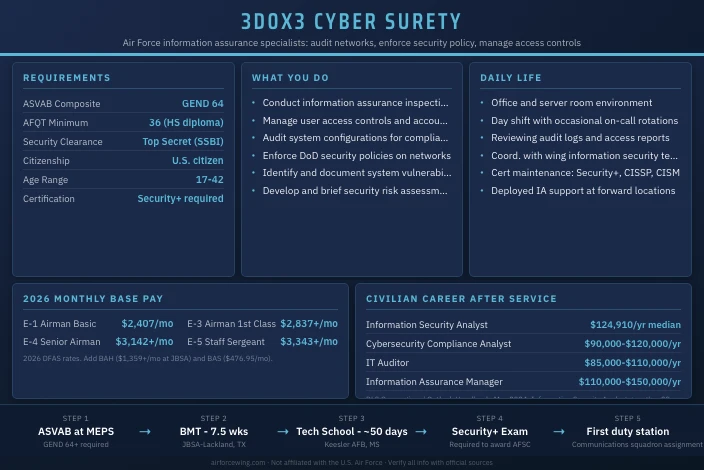
Job Role
3D0X3 Cyber Surety Airmen protect Air Force information systems by evaluating networks for security compliance, managing user access, identifying vulnerabilities, and enforcing Department of Defense information assurance policies. They serve as the Air Force’s front-line inspectors for cybersecurity, the people who verify that systems are configured correctly, that access is granted only to those who need it, and that risks are documented and reported up the chain before they become incidents.
Daily Tasks
Day-to-day work for a Cyber Surety Airman centers on compliance and risk management. A typical shift might include:
- Reviewing system audit logs for unauthorized access attempts
- Conducting information assurance inspections on unit networks and workstations
- Managing and auditing user accounts and access control lists
- Evaluating system configurations against DoD Security Technical Implementation Guides (STIGs)
- Documenting vulnerabilities and preparing risk assessment reports for commanders
- Coordinating with network administrators on remediation timelines
- Briefing leadership on cybersecurity posture and outstanding findings
The work is analytical rather than hands-on with hardware. You’re reading reports, running scans, documenting findings, and communicating security risk in plain language to people who aren’t always technical. Writing and communication matter as much as technical knowledge in this role.
Specialized Roles and AFSC Shredouts
The 3D0X3 AFSC does not have formal shredouts at the 5- or 7-skill level under the current career field education and training plan. Specialization happens through additional duty assignments and Special Experience Identifiers (SEIs) earned over time. Common SEI tracks include:
| Identifier | Focus Area |
|---|---|
| Computer Network Defense | Active threat monitoring and incident response |
| Information Assurance Officer duties | Supporting commissioned IA Officers on policy |
| PKI / Key Management | Public Key Infrastructure and certificate management |
At the Senior NCO level, Cyber Surety Airmen often move into information assurance management roles, overseeing entire wing or major command cybersecurity programs.
Mission Contribution
Every classified Air Force network, from a base operations center to a deployed tactical node, has to be certified before it handles sensitive data. Cyber Surety Airmen run that certification process. Without this function, no system gets accredited, and no mission data moves. The role sits at the intersection of policy and operations: translating DoD cybersecurity requirements into actions that network administrators and unit commanders can execute. When a Cyber Surety Airman finds a misconfigured firewall rule or an unauthorized account before an adversary does, the mission continues without incident.
Technology and Equipment
The tools of this job are software-heavy. Cyber Surety Airmen work with:
- STIG Viewer and SCAP compliance checker tools for automated configuration auditing
- eMASS (Enterprise Mission Assurance Support Service) for tracking system authorizations
- Splunk and other SIEM platforms for log review and anomaly detection
- Active Directory for user account and permissions management
- DoD-approved vulnerability scanning tools such as Nessus/ACAS
You will not be pulling cable or racking servers. The work environment is closer to an IT auditor or compliance analyst than a field technician.
Salary
Base Pay
Cyber Surety Airmen enter service at the E-1 pay grade (Airman Basic) unless they receive an advanced enlistment rank for college credits or JROTC participation. All pay figures below are 2026 DFAS rates.
| Grade | Rank | Entry Pay (Under 2 Yrs) | Pay at 4 Yrs |
|---|---|---|---|
| E-1 | Airman Basic (AB) | $2,407/mo | $2,407/mo |
| E-2 | Airman (Amn) | $2,698/mo | $2,698/mo |
| E-3 | Airman First Class (A1C) | $2,837/mo | $3,198/mo |
| E-4 | Senior Airman (SrA) | $3,142/mo | $3,659/mo |
| E-5 | Staff Sergeant (SSgt) | $3,343/mo | $3,947/mo |
| E-6 | Technical Sergeant (TSgt) | $3,401/mo | $4,069/mo |
Base pay is the foundation, but it’s not the full picture. At a major installation, a single E-4 also receives Basic Allowance for Housing (BAH rates vary by location, roughly $1,359/month without dependents at Joint Base San Antonio as a reference) and Basic Allowance for Subsistence ($476.95/month for enlisted in 2026). Neither allowance is taxed, which meaningfully increases effective compensation.
Additional Benefits
Active-duty Airmen receive TRICARE Prime at no cost, zero enrollment fees, zero deductibles, zero copays for medical, dental, vision, mental health, and prescriptions. Housing and food are covered through BAH and BAS when living off base. On-base housing is available at many installations.
Education benefits run two tracks. Tuition Assistance covers up to $4,500 per year in tuition while you’re on active duty. After separation, the Post-9/11 GI Bill covers full in-state tuition at public universities, up to $29,920.95/year at private schools (2025-2026 academic year cap), a monthly housing allowance tied to the E-5 BAH rate at the school’s ZIP code, and up to $1,000/year in book stipend.
Retirement under the Blended Retirement System (BRS) begins with the government automatically contributing 1% of your basic pay to the Thrift Savings Plan after 60 days of service. The government matches up to 4% of your contributions. At 20 years of service, you’re eligible for a pension worth 40% of your average highest-36 months of basic pay.
Work-Life Balance
The Air Force provides 30 days of paid leave per year, accruing at 2.5 days per month, with a maximum carryover of 60 days. Cyber Surety roles are almost exclusively day-shift on garrison, with some units running an on-call rotation for urgent security incidents. Deployed tempo is lower than for operational or maintenance AFSCs, most Surety Airmen deploy less than once every three years.
Qualifications
Requirements Table
| Requirement | Detail |
|---|---|
| ASVAB Score | General (GEND) 64 minimum |
| AFQT Minimum | 36 (high school diploma); 65 (GED) |
| Citizenship | U.S. citizen required |
| Age | 17-42 at time of enlistment |
| Education | High school diploma or equivalent |
| Security Clearance | Top Secret (Single Scope Background Investigation) |
| Medical | Normal color vision not required; standard MEPS physical |
| Certification | CompTIA Security+ required before AFSC award |
| No-Use Period | Drug use disqualifiers per standard Air Force policy |
The GEND 64 score reflects the analytical and written communication demands of the job. The General composite draws from Word Knowledge, Paragraph Comprehension, Arithmetic Reasoning, and Mathematics Knowledge, all cognitive and verbal skills rather than electronics or mechanical aptitude. If you are still below that threshold, the Air Force ASVAB test prep guide focuses on the verbal and math sections that drive the General score.
The Top Secret clearance requirement means a Single Scope Background Investigation (SSBI) is required. SSBI investigations cover a 10-year personal history and typically take several months to complete. Award of the 3-skill level is authorized on an interim basis pending clearance adjudication, but you should be prepared for a thorough background review before receiving your final clearance.
Application Process
The process to enter 3D0X3 follows the standard Air Force enlisted path:
Selection Criteria and Competitiveness
The GEND 64 threshold filters for candidates with solid reading comprehension and quantitative reasoning. There is no prior experience requirement, but any background in IT, networking, or computer science will help you absorb the Tech School curriculum faster. Strong academic performance in high school, particularly in English and math, is the best preparation you can do before enlisting.
Some recruiters report that 3D0X3 slots fill quickly because the civilian demand for cleared cybersecurity professionals creates retention pressure, which limits how many open accession billets exist at any given time. If the job is not immediately available, ask your recruiter about the wait-list process.
Service Obligation
Standard first-term enlistment is four years active duty. The Top Secret clearance and specialized training may result in a service commitment addendum, confirm the exact obligation with your recruiter before signing.
Enlistees enter service at E-1 (Airman Basic). Those with 15 or more college credits may enter at E-2; 30 or more credits at E-3. JROTC completers may also qualify for an advanced entry rank.
Work Environment
Setting and Schedule
Cyber Surety Airmen work primarily indoors, server rooms, classified work areas, and standard office spaces. The environment is climate-controlled, office-oriented, and technology-heavy. There is no flight-line work and no exposure to chemicals or heavy equipment in this role. Most assignments run standard Monday-through-Friday day shifts, though units with 24/7 security operations center (SOC) responsibilities may rotate Surety personnel into on-call coverage.
At deployed locations, the environment changes. Forward-deployed Cyber Surety Airmen support theater network security operations from hardened communications facilities, often in austere conditions. Deployed shifts may run 12 hours, and the pace of security findings and remediations accelerates significantly compared to garrison duty.
Leadership and Communication
The Air Force uses the Enlisted Performance Report (EPR) system to evaluate performance annually. For E-4 and above, EPRs are rated on a five-tier scale, and the narrative section matters enormously for promotion boards. Cyber Surety NCOs who write clear, concise security findings and who brief commanders effectively tend to earn stronger EPR narratives because their contributions are highly visible to leadership.
Communication flows through the standard Air Force chain of command: team leader, flight chief, superintendent, and commander. In practice, Cyber Surety Airmen interact frequently with unit information assurance officers, typically commissioned officers or GS civilians, who rely on Surety NCOs to manage the day-to-day compliance workload.
Team Dynamics and Autonomy
At the 5-skill level (Staff Sergeant), Cyber Surety Airmen operate with significant autonomy. You own your inspection schedule, manage your findings tracker, and brief your own unit commanders without a supervisor in the room. Junior Airmen (3-skill level) work under closer supervision while learning the tool suite and documentation standards. The transition from 3-level to 5-level is where most of the real learning happens, and experienced TSgts and MSgts invest considerable time developing junior personnel.
Job Satisfaction and Retention
Cyber Surety is one of the Air Force’s higher-retention career fields because the skills translate so directly to high-paying civilian jobs. The Top Secret clearance alone has tangible market value. Many Airmen use their first term to earn Security+, then build toward CISSP or CISM before separating. Units that support professional certification study, including paid exam vouchers and protected study time, tend to have better morale and retention than those that do not.
Training
Initial Training Pipeline
| Phase | Location | Duration | Focus |
|---|---|---|---|
| Basic Military Training (BMT) | JBSA-Lackland, TX | 7.5 weeks | Military foundations, discipline, fitness |
| Tech School, Course 1 | Keesler AFB, MS | ~2 weeks | Information assurance fundamentals |
| Tech School, Course 2 | Keesler AFB, MS | ~3 weeks | Network security concepts, STIGs, access control |
| Tech School, Course 3 | Keesler AFB, MS | ~2 weeks | Applied compliance, audit tools, Security+ prep |
| Security+ Examination | Keesler AFB, MS | 1 day | Required for AFSC award |
Total Tech School time is approximately 50 days at Keesler AFB, MS, home of the 81st Training Wing, which trains the majority of Air Force communications and cyberspace Airmen. The three-course structure is sequential, you cannot advance to Course 2 without completing Course 1, and passing the Security+ is the final gate before graduation.
The CompTIA Security+ certification is a DoD 8570 baseline requirement for Information Assurance Technical (IAT) Level II positions. Earning it in Tech School means you arrive at your first duty station already meeting the minimum certification standard for most IA billets, a real advantage over civilians entering the same field.
Advanced Training and Professional Development
After arriving at a first duty station, Cyber Surety Airmen pursue certification upgrades on a defined timeline:
- 5-skill level upgrade training: Completed at the first duty station over 12-18 months through a Career Development Course (CDC) and on-the-job training with a certified trainer
- 7-skill level (NCO level): Requires SSgt rank and completion of the 7-level CDC; typically achieved around the 6-8 year mark
- 9-skill level: Reserved for SMSgt and above; represents senior IA program management
The Air Force also supports voluntary certification advancement. Common goals for Cyber Surety NCOs include:
- CISSP (Certified Information Systems Security Professional), the standard for senior IA roles
- CISM (Certified Information Security Manager), valuable for management-track Airmen
- CEH (Certified Ethical Hacker), useful for those moving into vulnerability assessment
- CAP (Certified Authorization Professional), directly aligned with the AFSC’s authorization and accreditation work
Units vary in how aggressively they support certification study. Ask specifically about exam voucher programs and protected study time when interviewing duty stations during assignment cycles.
Everything starts with qualifying ASVAB scores. Our study guide covers what to study first.
Career Progression
Rank Progression Table
| Rank | Grade | Typical Time Frame | Notes |
|---|---|---|---|
| Airman Basic (AB) | E-1 | Entry | BMT graduation |
| Airman (Amn) | E-2 | ~6 months | Automatic with time-in-service |
| Airman First Class (A1C) | E-3 | ~16 months | Automatic with time-in-service |
| Senior Airman (SrA) | E-4 | ~3 years | Automatic with TIS/TIG; may accelerate for BTZ |
| Staff Sergeant (SSgt) | E-5 | ~5-6 years | Competitive promotion board |
| Technical Sergeant (TSgt) | E-6 | ~10-11 years | Competitive; EPR and development records weighed |
| Master Sergeant (MSgt) | E-7 | ~14-16 years | Highly competitive |
| Senior Master Sergeant (SMSgt) | E-8 | ~19-20 years | Very limited promotion allocations |
| Chief Master Sergeant (CMSgt) | E-9 | ~22+ years | Fewer than 1% of enlisted force |
The below-the-zone (BTZ) program allows exceptional Airmen to be promoted to SrA six months ahead of the standard schedule. Strong performance in the 3-level period, clean audit logs, good EPR narratives, and active CDC completion, positions Airmen well for BTZ consideration.
Role Flexibility and Transfers
Cyber Surety Airmen who want to cross-train into a different career field can apply through the Air Force retraining program, typically after completing their initial service commitment. Common cross-training destinations include 1D7X1 (Cyber Defense Operations), 3D1X2 (Cyber Transport Systems), and intelligence AFSCs that build on the existing Top Secret clearance. The clearance itself is a major asset when applying for retraining, billets requiring TS typically have shorter wait times for cleared Airmen.
Performance Evaluation
Air Force performance is documented through the Enlisted Performance Report (EPR) system. EPRs are written annually and rated on a five-tier scale (1 = Does Not Meet, 5 = Truly Among the Best). The narrative matters more than the number, raters must write specific, achievement-based narratives tied to mission impact. Cyber Surety Airmen who quantify their work (number of systems audited, vulnerabilities found and remediated, units brought into compliance) consistently produce stronger EPR inputs than those who describe duties in generic terms.
To succeed in this career, three behaviors matter most: complete certifications early, document everything, and brief your findings clearly to commanders. NCOs who can translate technical security findings into command-level risk decisions get noticed faster than those who cannot.
Physical Demands
Physical Requirements
The 3D0X3 AFSC has no physical demands beyond the Air Force-wide fitness standard. There is no heavy lifting requirement, no flight-line physical exposure, and no occupational physical profile requirement specific to Cyber Surety. The job is performed almost entirely at a desk or workstation.
All Airmen must pass the Air Force Fitness Assessment annually. The FA is scored on a 100-point scale and requires a minimum composite score of 75, with passing minimums required on each individual component.
Fitness Assessment Standards (Under 25, Reference)
| Component | Max Points | Minimum (Male, Under 25) | Minimum (Female, Under 25) |
|---|---|---|---|
| 1.5-Mile Run | 60 | Must meet minimum | Must meet minimum |
| Push-Ups (1 min) | 10 | Must meet minimum | Must meet minimum |
| Sit-Ups (1 min) | 10 | Must meet minimum | Must meet minimum |
| Waist Circumference | 20 | Must meet maximum | Must meet maximum |
| Composite | 100 | 75 | 75 |
Standards are age- and gender-normed. Current passing thresholds for all age groups are published at af.mil. The Fitness Assessment is administered annually for most Airmen.
Medical Evaluations
Initial medical screening occurs at MEPS and must meet standard Air Force enlistment requirements. No color vision standard is required for 3D0X3. A periodic physical is required for clearance renewal, the SSBI reinvestigation cycle for Top Secret clearances runs approximately every five years. Airmen must report any changes to their personal circumstances (financial, legal, foreign contacts) that could affect clearance eligibility throughout their career.
Deployment
Deployment Details
Cyber Surety is not a high-deployment AFSC by Air Force standards. Most Airmen deploy once or twice over a four-year first term, with typical rotation lengths of 60-120 days. Deployments are almost entirely to overseas locations, supporting theater network security operations at established forward bases rather than in high-threat combat environments.
During deployments, Surety Airmen integrate into theater communications squadrons and may be tasked with rapid system accreditation for mission networks that come online quickly. The pace is faster than garrison, but the core work, auditing configurations, managing access, documenting risks, is the same.
Duty Stations
Cyber Surety billets exist at virtually every major Air Force installation worldwide. High-density assignments include:
- Keesler AFB, MS: training and operational assignments
- Joint Base San Antonio-Lackland, TX: major communications and cyberspace units
- Joint Base Langley-Eustis, VA: Air Combat Command installations
- Peterson Space Force Base, CO: cyberspace operations concentration
- Ramstein Air Base, Germany: USAFE theater
- Kadena Air Base, Japan: PACAF theater
Assignment preferences are submitted through the Air Force assignment system. First-term Airmen generally receive an assignment from the needs-of-the-Air-Force list, though stated preferences are considered when operational requirements allow.
Risk/Safety
Job Hazards
The 3D0X3 AFSC carries minimal physical hazard. Cyber Surety Airmen work in controlled indoor environments and are not routinely exposed to toxic materials, extreme weather, or mechanical hazards. The primary risks are stress-related, the responsibility of managing a wing’s security compliance program, identifying gaps before they become incidents, and briefing commanders on unfavorable findings creates sustained professional pressure.
Security and Legal Requirements
The Top Secret security clearance is the central legal obligation of this AFSC. Holding a TS clearance comes with ongoing reporting requirements:
- Report foreign travel before and after trips
- Report foreign national contacts who could constitute a security concern
- Report financial changes that could indicate vulnerability to coercion
- Report any criminal activity, including minor offenses
Violations of security obligations can result in clearance suspension or revocation, which effectively ends a career in this AFSC. The Air Force takes security responsibility seriously, and Cyber Surety Airmen are held to a higher standard than most career fields because their work directly involves classified system oversight.
Losing a Top Secret clearance while serving in 3D0X3 will result in mandatory retraining into a different AFSC. Protect your clearance with the same diligence you apply to auditing other people’s systems.
Enlistment contracts include a standard service commitment. The classified training pipeline creates a de facto obligation to serve long enough for the Air Force to recoup its training investment, verify the specific terms with your recruiter.
Impact on Family
Family Considerations
Cyber Surety is a family-friendly AFSC by military standards. Deployments are infrequent compared to maintenance, security forces, or special operations career fields. The standard duty schedule is Monday-through-Friday with predictable hours, which makes school enrollment, childcare planning, and routine family life more manageable than many other AFSCs.
The Air Force provides Military OneSource counseling, on-base family support centers, school liaison programs, and financial counseling at no cost to Airmen and their dependents. TRICARE Prime covers the entire family at zero enrollment cost on active duty.
The predictable garrison schedule creates real advantages for families. Spouses who work or attend school can plan around a consistent weekly routine. School-age children experience fewer disruptions at home-station compared to families in maintenance or operations career fields that run rotating shifts. Childcare at Child Development Centers is available at most Air Force installations, though demand at major bases often exceeds capacity, getting on the waitlist early after a PCS is important.
One factor families should plan for is the security clearance lifestyle. Top Secret holders have ongoing reporting requirements that affect foreign travel and certain personal decisions. Before taking an international vacation or hiring a foreign national service provider, Airmen must consult their unit security officer. This isn’t burdensome for most families, but it requires awareness that doesn’t apply to non-cleared career fields.
Spouses who are licensed professionals, nurses, teachers, engineers, may face re-licensing requirements after moves across state lines. The Interstate Compact programs have improved this for several professions, but gaps remain. The installation’s Airman and Family Readiness Center employment counselors can help with licensing reciprocity and local job markets at the gaining base.
Relocation and Flexibility
Permanent Change of Station (PCS) moves occur every two to four years on average. Each move is fully funded by the government through the Defense Personal Property Program. The Air Force also provides a Dislocation Allowance to offset costs not covered by the standard move package. Families with school-age children should contact the installation’s school liaison office early to manage enrollment transitions smoothly.
Assignment lengths vary by location. CONUS assignments are typically three years; overseas tours run two to three years depending on the command and whether dependents accompany the Airman. Cyber Surety billets are available at most major installations, including overseas locations with strong school systems and support infrastructure. Ramstein and Kadena both have well-established American school systems and Family Support Centers.
Reserve and Air National Guard
Component Availability
The 3D0X3 Cyber Surety AFSC is available in both the Air Force Reserve and the Air National Guard. ANG units in particular maintain active 3D0X3 billets because state cybersecurity missions create demand for information assurance expertise beyond the active-duty force. Reserve component Surety Airmen may support federal cyber missions under Title 10 orders or state cybersecurity programs under Title 32.
Drill Schedule and Training Commitment
The standard Reserve commitment is one Unit Training Assembly (UTA) weekend per month plus a two-week Annual Tour. Cyber Surety units may require additional training days for system authorization renewals, annual IA inspections, or cyber readiness exercises beyond the standard schedule. Confirm the unit’s specific training calendar before committing, cyber units tend to run more exercises than support career fields.
Part-Time Pay
An E-4 SrA in the Reserve earns drill pay for four drill periods per UTA weekend (two per day). At the 2026 rate of $3,142/month active-duty base pay, a drill period equals approximately $104. Four drill periods per weekend yields roughly $416/month for a standard two-day UTA. This compares to the $3,142/month active-duty base pay at the same grade and time-in-service.
Component Comparison
| Category | Active Duty | Air Force Reserve | Air National Guard |
|---|---|---|---|
| Commitment | Full-time | 1 wknd/mo + 2 wks/yr | 1 wknd/mo + 2 wks/yr |
| Monthly Pay (E-4) | $3,142+ | ~$416 (drill wknds) | ~$416 (drill wknds) |
| Healthcare | TRICARE Prime (free) | TRICARE Reserve Select (premium) | TRICARE Reserve Select (premium) |
| Education Benefits | Tuition Assistance ($4,500/yr) + GI Bill | Federal TA; GI Bill eligibility varies by activation | State tuition waivers + Federal TA |
| Deployment Tempo | ~1 deployment per 3-4 yrs | Less frequent; voluntary or federal mobilization | Less frequent; state and federal missions |
| Retirement | 20-yr pension (BRS) | Points-based reserve retirement | Points-based reserve retirement |
Benefits Differences
Reserve and ANG Airmen accessing TRICARE Reserve Select pay a monthly premium unlike active-duty TRICARE Prime. State tuition benefits for ANG Airmen vary considerably by state, some states offer full tuition waivers at public universities for active Guard members. Check your state’s specific program before enlisting.
The Reserve retirement system awards points for drill weekends, annual tours, and active-duty mobilizations. Retirement pay begins at age 60 (or earlier with qualifying active-duty time under certain provisions). This differs from the active-duty 20-year immediate-annuity pension.
Deployment and Mobilization
Reserve and ANG Cyber Surety Airmen are mobilized less frequently than their active-duty counterparts. When mobilized under Title 10 orders, they serve under the same conditions as active-duty Airmen, including the same pay and benefits for the mobilization period. Employer protections under the Uniformed Services Employment and Reemployment Rights Act (USERRA) require civilian employers to hold your position during mobilization and prohibit discrimination based on military service.
Civilian Career Integration
The 3D0X3 field pairs naturally with civilian careers in information security, IT compliance, and risk management. ANG and Reserve service actively supports this integration: the same skills used on drill weekends are directly applicable to civilian IA roles, and cleared status may qualify you for contractor billets that require active federal clearances. Many defense contractors specifically seek Reserve Airmen who maintain current Top Secret access.
Post-Service
Transition to Civilian Life
The 3D0X3 skill set translates almost perfectly to the civilian information security labor market. The combination of a Top Secret clearance, Security+ certification, and documented STIG compliance experience positions separating Airmen strongly for roles that many civilian candidates cannot access at all.
The Air Force Transition Assistance Program (TAP) provides pre-separation counseling, resume workshops, and job fair access. The Hiring Our Heroes program runs corporate fellowship programs specifically designed for transitioning service members, including placements with defense and technology employers.
Civilian Career Prospects
| Civilian Job Title | Median Annual Salary | Job Outlook (2024-2034) |
|---|---|---|
| Information Security Analyst | $124,910 | +29% (much faster than average) |
| Computer Systems Analyst | $103,800 | +11% (faster than average) |
| IT Auditor / Compliance Analyst | ~$95,000-$115,000 | Strong; driven by regulatory demand |
| Information Assurance Manager | ~$110,000-$150,000 | Strong; cleared roles command premium |
The 29% projected growth rate for Information Security Analysts is among the highest of any occupation tracked by the Bureau of Labor Statistics. With federal agencies and defense contractors aggressively hiring cleared personnel, former Cyber Surety Airmen hold an advantage that most civilian job seekers simply do not.
Common certification upgrades that maximize post-service salary include CISSP (often a baseline requirement for IA management roles), CISM, and CAP for government contractor work. Many employers pay for these certifications as part of a hiring package.
Is This a Good Job
Ideal Candidate Profile
The people who do best in 3D0X3 tend to share a few characteristics. They’re detail-oriented, the kind of person who notices when something is slightly off and wants to investigate it. They write well and can explain technical findings to non-technical audiences without dumbing things down. They’re comfortable with repetitive audit work and don’t need constant physical action or variety to stay engaged.
Strong candidates typically have:
- High scores in reading comprehension and written English
- An interest in how systems work at the policy and governance level (not just the hardware level)
- Patience for documentation and process
- Comfort with classified environments and the responsibility that comes with them
- Long-term interest in a civilian cybersecurity career
Potential Challenges
This job is not for everyone. If you want to be outside, work with your hands, or deal with constant variety, Cyber Surety will feel repetitive. Much of the work is reviewing documents, running automated scans, and writing up findings, day after day. Some units have limited resources for professional development, which can slow certification progress and create frustration for Airmen who want to advance their skills quickly.
Deployed environments are more dynamic, but the garrison experience dominates the first term. If you’re looking for high-operational-tempo work, security forces, special warfare, or maintenance AFSCs will suit you better.
Career and Lifestyle Alignment
Cyber Surety is an excellent fit if your five-year plan involves working in civilian cybersecurity after the Air Force. The job builds exactly the credentials, clearance, and experience that civilian hiring managers in that field are looking for. The deployment rate is low, the schedule is predictable, and the compensation trajectory, both military and post-service, is strong.
It’s a poor fit if you’re motivated primarily by action, physical challenge, or operational flying support. The job’s value is intellectual and analytical, not kinetic.
More Information
Ask a recruiter to confirm current 3D0X3 accession policy, retraining options, and security clearance processing timelines before you sign a contract. You can also review the broader communications field at airforce.com and compare it against the other communications AFSCs linked below.
- Prepare for the ASVAB with our study guide to make sure your line scores qualify
This site is not affiliated with the U.S. Air Force or any government agency. Verify all information with official Air Force sources before making enlistment or career decisions.
Explore more Air Force Communications and Information careers including 3D1X2 Cyber Transport Systems and 3D1X1 Client Systems for a full picture of the 3D career group.