1D7X3 Cable and Antenna Operations
Every radio transmission, every data packet, every voice call on a military installation runs through some combination of copper wire, coaxial cable, fiber optic strand, or antenna. The Airmen in the 1D7X3 AFSC are the ones who put that infrastructure in the ground, keep it running, and fix it when something breaks. Without them, the network stops. Without the network, nothing works.
Cable and Antenna Operations is one of the most physically demanding jobs in Air Force communications. You’ll climb antenna towers, run trenches in all weather, splice fiber under a base flightline, and trace faults through hundreds of feet of buried cable. The work is hands-on, outdoors, and measurably important. If you’d rather be in a server room than on a tower, this is not the right AFSC. If you want to build the systems that everything else depends on, this is worth a serious look.
The 1D7X3 specialty code replaced the legacy 3D1X7 designation in 2022 as part of the Air Force’s broader cyber workforce restructuring. The work is the same; the code is current.
Qualifying requires specific ASVAB line scores. Our ASVAB study guide covers what to target and how to prepare.
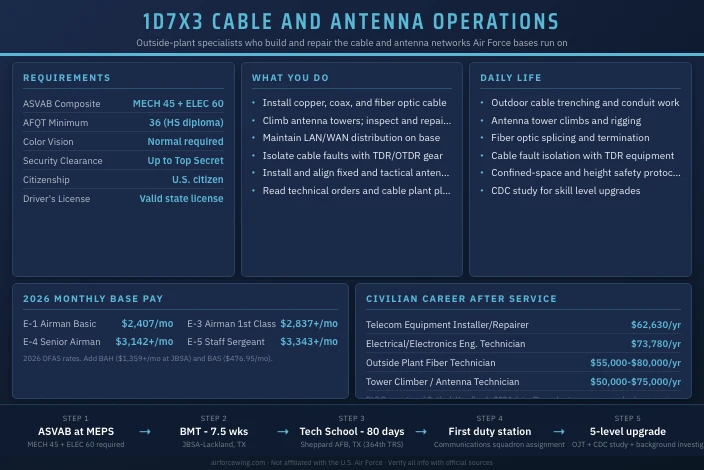
Job Role and Responsibilities
Cable and Antenna Operations specialists install, maintain, troubleshoot, and repair the fixed and tactical communications infrastructure that Air Force bases use to connect aircraft, commanders, and missions. They work with copper, coaxial, waveguide, and fiber optic cable systems as well as the antenna networks that carry voice and data when physical lines aren’t available. This role directly supports command and control (C2) operations by keeping the physical layer of Air Force networks operational.
Day-to-Day Work
On any given duty day, a 1D7X3 Airman might be digging a conduit trench, splicing a fiber break, climbing a tower to inspect an antenna feed, or running cable through a building for a new communications circuit. The job splits between outdoor plant work, anything underground, aerial, or on towers, and indoor termination work where cables connect to racks, patch panels, and distribution frames.
Common daily tasks include:
- Installing and routing copper core, coaxial, and fiber optic cable
- Performing cable fault isolation using time-domain reflectometers (TDRs) and other test equipment
- Climbing antenna structures to inspect, repair, and align antenna systems
- Maintaining local area networks (LAN) and wide area network (WAN) distribution infrastructure
- Reading and applying technical orders, cable plant drawings, and installation work orders
- Operating vehicles and equipment such as trenchers, cable plows, and aerial lift equipment
Specialized Roles and Codes
The 1D7X3 AFSC includes a notable shredout variant:
| Code | Title | Focus |
|---|---|---|
| 1D7X3 | Cable and Antenna Operations | Base-level cable plant and antenna systems |
| 1D7X3C | Cable and Antennae Defense Operations | Added emphasis on hardened and protected infrastructure |
The “C” suffix indicates an additional qualification track tied to defending critical communications infrastructure. Most initial assignments are to the base 1D7X3 code; the shredout is typically applied based on position requirements at a specific unit.
Mission Contribution
The Air Force’s digital backbone connects everything from combat aircraft datalinks to the unclassified administrative networks base personnel use every day. None of that works if the physical layer fails. A severed fiber cable on an installation can knock out base communications entirely. A misaligned antenna feed can drop a critical satellite link. The 1D7X3 Airman is the person who finds the fault, fixes it, and gets the mission back online. That responsibility doesn’t come with a lot of fanfare, but it comes with a direct line to mission impact that most jobs can’t match.
Equipment and Technology
Work in this specialty spans tools from a basic cable stripper to sophisticated fiber optic splice machines and spectrum analyzers. You’ll routinely work with:
- Optical time-domain reflectometers (OTDRs) for fiber fault location
- Time-domain reflectometers (TDRs) for copper cable testing
- Fiber optic fusion splicers and mechanical splice kits
- Antenna alignment tools and signal level meters
- Conduit boring equipment and cable pulling machinery
- Climbing gear, safety harnesses, and fall protection systems for antenna work
Salary and Benefits
Base Pay
Air Force enlisted Airmen earn the same base pay regardless of AFSC. Pay is set by the 2026 DFAS military pay tables and increases with rank and years of service. Cable and Antenna Operations Airmen are not currently designated for a Service Commitment Incentive, but enlistment bonuses for specific AFSCs change regularly based on Air Force manning needs, your recruiter will have current bonus availability at the time you enlist.
| Rank | Pay Grade | Years of Service: 2 | Years of Service: 4 | Years of Service: 6 | Years of Service: 8 |
|---|---|---|---|---|---|
| Airman (Amn) | E-2 | $2,698 | $2,698 | $2,698 | - |
| Senior Airman (SrA) | E-4 | $3,303 | $3,659 | $3,816 | $3,816 |
| Staff Sergeant (SSgt) | E-5 | $3,599 | $3,947 | $4,109 | $4,299 |
| Technical Sergeant (TSgt) | E-6 | $3,743 | $4,069 | $4,236 | $4,613 |
Source: DFAS 2026 pay tables. Figures reflect the 2026 pay raise.
Allowances and Additional Compensation
Beyond base pay, active-duty Airmen receive two major monthly allowances. Basic Allowance for Subsistence (BAS) is a flat $476.95 per month for all enlisted Airmen in 2026. Basic Allowance for Housing (BAH) varies by duty location, pay grade, and whether you have dependents. At Joint Base San Antonio, TX, an E-4 without dependents receives $1,359 per month in BAH; with dependents, that rises to $1,728. BAH at higher-cost duty stations runs significantly higher.
Healthcare, Education, and Retirement
Active-duty Airmen and their families receive healthcare through TRICARE Prime at no cost, no enrollment fees, no deductibles, no copays for most care. Dental and vision coverage are available through separate programs.
The Air Force covers up to $4,500 per year in Tuition Assistance for college courses taken while on active duty, capped at $250 per semester credit hour. After separation, the Post-9/11 GI Bill covers full in-state tuition at public colleges, or up to $29,920.95 per academic year at private schools, plus a monthly housing allowance.
Retirement under the Blended Retirement System (BRS) pays 40% of your high-36 average basic pay after 20 years. The Thrift Savings Plan (TSP) adds government matching contributions starting at 60 days of service, up to 5% of basic pay total.
Leave
Active-duty Airmen earn 30 days of paid leave per year, accruing at 2.5 days per month.
Qualifications and Eligibility
Qualification Table
| Requirement | Standard |
|---|---|
| ASVAB Composite | MECH 45 AND ELEC 60, OR MECH 45 AND ELEC 55 with Cyber Test score of 60 |
| AFQT Minimum | 36 (high school diploma); 65 (no diploma) |
| Citizenship | U.S. citizen |
| Age | 17-42 at enlistment |
| Security Clearance | Eligible for Top Secret (Tier 5); minimum Secret required |
| Color Vision | Normal color vision required |
| Depth Perception | Normal depth perception required |
| Physical | Normal gait and balance; freedom from fear of heights and claustrophobia |
| Driver’s License | Valid state driver’s license |
| Education | High school diploma or GED equivalent |
ASVAB Line Scores
The Air Force uses its own composite scoring system for AFSC qualification. The 1D7X3 uses two composites: the Mechanical (MECH) composite, which draws from General Science, Auto and Shop, Mathematics Knowledge, and Mechanical Comprehension subtests; and the Electronics (ELEC) composite, which draws from General Science, Arithmetic Reasoning, Mathematics Knowledge, and Electronics Information.
To hit MECH 45, you need solid performance on mechanical comprehension and basic math. To hit ELEC 60, you need to study electronics theory and arithmetic hard. Students who invest time in ASVAB prep before their MEPS appointment consistently score higher on both composites. Studying for the ASVAB before your recruiter meeting improves your lineup of available AFSCs across the board.
Physical and Medical Standards
The height and weight requirements are the same as for all Air Force enlistees. The critical physical standards specific to 1D7X3 are related to the tower climbing component of the job. You must have normal color vision, normal depth perception, and no disqualifying fear of heights. The entrance physical at MEPS screens for these conditions as part of the standard medical examination. If you have any prior back, knee, or shoulder injuries, discuss them with your recruiter before MEPS, the physical demands of this job are real.
Application Process
- Contact an Air Force recruiter and take the ASVAB if you haven’t already.
- Pass the MEPS physical examination, including vision and color blindness screening.
- Request 1D7X3 during job counseling at MEPS if your scores qualify. The job requires a background investigation; your recruiter will initiate the security clearance process.
- Sign an enlistment contract specifying your AFSC.
- Ship to BMT at JBSA-Lackland, TX.
Service Obligation and Entry Rank
Most enlisted Airmen enter at E-1 (Airman Basic) and sign a four-year active-duty service commitment. Prior college credit or JROTC participation may qualify you to enter at E-2 or E-3. After completing Tech School, your four-year obligation clock begins.
Work Environment
Setting and Schedule
The work environment for 1D7X3 Airmen is one of the most variable in Air Force communications. Your shift might start in an underground cable vault, move to the roof of a base facility for aerial cable work, and end on a tower for antenna inspection. Roughly 60% of the job is outdoors. Weather doesn’t pause operations, if a cable fails in January in North Dakota, you go fix it.
| Environment | Typical Schedule | On-Call |
|---|---|---|
| Stateside garrison | Monday-Friday, standard hours | Rotating after-hours on-call |
| 24/7 comm unit | Shift schedule (days/swings/nights) | Built into shift rotation |
| Deployed location | 12-hour shifts, continuous ops | Always available |
Some units operate shift schedules to cover 24/7 communications requirements. Deployed environments operate continuously around the clock.
Chain of Command and Feedback
You’ll work under a supervisor from day one and operate within your unit’s communications squadron structure. Performance feedback follows the Air Force Enlisted Performance Report (EPR) cycle, with formal mid-term feedback sessions and an annual EPR. In communications squadrons, you work alongside other 3D and 1D career field Airmen, so cross-training and informal mentorship from senior NCOs are common.
Teamwork and Autonomy
Entry-level Airmen work closely supervised during skill level 3 (apprentice) training. As you progress to skill level 5, you’ll work more independently, plan cable routes, manage work orders, and supervise junior Airmen on projects. Senior NCOs frequently manage teams of 3-6 technicians on larger installation jobs.
Job Satisfaction
Outside-plant communications work has a concrete quality that office-based jobs don’t. You can see what you built at the end of the day. Surveys of Airmen in physical infrastructure roles consistently cite the tangible, measurable work as a source of satisfaction. The trade-off is the physical wear and variable weather conditions. Airmen who prefer predictable indoor work environments tend to have lower satisfaction in this specialty than those who don’t mind outdoor physical work.
Training and Skill Development
Initial Training Pipeline
| Phase | Location | Duration | Focus |
|---|---|---|---|
| Basic Military Training (BMT) | JBSA-Lackland, TX | 7.5 weeks | Air Force customs, drill, fitness, core values |
| Technical School | Sheppard AFB, TX | 80 days | Cable systems, antenna theory, fiber optics, safety |
BMT at Lackland is the same 7.5-week program all enlisted Airmen complete. It covers Air Force customs, physical fitness, drill, core values, and basic warrior skills. The academic and physical demands are manageable with preparation; most Airmen report that the mental adjustment is harder than the physical one.
After BMT, you report to Sheppard AFB, TX, where the 364th Training Squadron runs the Cable and Antenna Systems Apprentice course. The 80-day curriculum covers:
- Cable theory: copper, coaxial, waveguide, and fiber optic fundamentals
- Antenna systems: design principles, installation techniques, and alignment
- Cable fault isolation methods using TDR and OTDR equipment
- Fiber optic splicing, termination, and testing
- Safety protocols for tower climbing, confined spaces, and high-voltage proximity work
- Technical order (TO) interpretation and documentation requirements
Students who complete this course earn college credit toward a Community College of the Air Force (CCAF) Associate of Applied Science degree in Electronic Systems Technology: a formal credential that transfers to civilian employment.
Advanced Training and Professional Development
After Tech School, you’ll receive a 3-skill level (Apprentice) designation and begin on-the-job training (OJT) at your first duty station. Upgrading to the 5-skill level (Journeyman) requires completing your Career Development Course (CDC) self-study curriculum and demonstrating proficiency across your AFSC tasks. That process typically takes 12-18 months.
At the 7-skill level (Craftsman) you’re eligible for supervisory roles and advanced courses at Air Force technical schools. The 9-skill level (Superintendent) is for senior NCOs managing units and programs.
The Air Force also supports voluntary certifications relevant to cable and antenna work, including fiber optic installer certifications and tower safety credentials. These add civilian marketability and can support promotion packages.
Everything starts with qualifying ASVAB scores. Our study guide covers what to study first.
Career Progression and Advancement
Rank Progression Timeline
| Skill Level | Grade | Typical Time in Grade | Role |
|---|---|---|---|
| 3-level (Apprentice) | E-1 to E-3 | First 12-18 months | Learning core tasks under supervision |
| 5-level (Journeyman) | E-4 to E-5 | After CDC completion | Independent work; team member |
| 7-level (Craftsman) | E-6 to E-7 | 8-12 years of service | Supervisory; manages projects and junior Airmen |
| 9-level (Superintendent) | E-8 to E-9 | 16+ years of service | Unit-level management; program oversight |
Promotion from E-4 to E-5 requires completing the 5-skill level upgrade, meeting time-in-grade requirements, and competing in the Air Force promotion system based on EPR scores, decorations, education, and fitness. The biggest career inflection points are the 5-to-7 level transition and the Staff Sergeant-to-Technical Sergeant promotion board.
Specialization and Shredouts
As you advance, you may pursue assignment to units with specific mission sets that deepen your expertise. These include:
- Contingency communications flights, which deploy mobile cable and antenna infrastructure in support of expeditionary operations
- Special communications units that support sensitive programs requiring cleared infrastructure work
- Units supporting SATCOM ground terminals and hardened command-and-control facilities
The 1D7X3C shredout designator is applied to positions focused on defended communications infrastructure. Assignment to a 1D7X3C position typically comes with additional background investigation requirements and technical training.
Role Flexibility and Retraining
The Air Force allows enlisted Airmen to request retraining into different AFSCs, subject to Air Force Force Development guidance and available allocations. Airmen in good standing who want to cross-train can submit retraining applications after completing their initial service commitment. Communications background transfers well to cyber, intelligence systems, and IT career fields.
Performance Evaluation
The Enlisted Performance Report (EPR) system rates Airmen on five performance factors: job knowledge, leadership, teamwork, personal qualities, and mission impact. EPRs are written by your rater and reviewed by your additional rater. In this specialty, a strong EPR might document fiber outages prevented through proactive maintenance, tower inspection cycles completed ahead of schedule, or the number of Airmen trained on OTDR fault isolation techniques. Concrete numbers and mission-impact statements carry more weight than vague descriptors.
Physical Demands and Medical Evaluations
Daily Physical Requirements
This AFSC is among the more physically demanding in Air Force communications. Expect to:
- Carry cable reels, tool bags, and equipment across installation grounds
- Climb towers and antenna structures using safety harnesses and fall protection
- Work in trenches and confined spaces (underground cable vaults, conduit access points)
- Operate digging and cable-pulling equipment
- Stand, kneel, and crouch for extended periods during installation work
The outdoor physical work is consistent year-round. Cold, heat, and wet conditions don’t pause cable maintenance requirements. Physical conditioning during your enlistment directly affects both performance and injury prevention in this specialty.
Air Force Fitness Assessment Standards
All Airmen must pass the Air Force Fitness Assessment annually. The assessment is scored on a 100-point scale; 75 is the minimum passing composite. Each component has its own minimum, and failing any single component fails the overall assessment regardless of the composite score. Standards are age- and gender-normed.
| Component | Max Points | Notes |
|---|---|---|
| 1.5-Mile Run | 60 | Timed run; aerobic component worth the most points |
| Waist Circumference / Body Composition | 20 | Abdominal circumference measurement |
| Push-Ups (1 minute) | 10 | Muscular endurance |
| Sit-Ups (1 minute) | 10 | Core endurance |
| Total | 100 | Minimum passing: 75 composite |
Standards are age- and gender-normed per Air Force Fitness Assessment policy. Verify current component minimums with official Air Force sources.
The physical demands of 1D7X3 work, tower climbing, outdoor labor, carrying equipment, mean that staying above minimum fitness standards isn’t just a career requirement. It’s a practical daily necessity.
Medical Evaluations
Beyond the MEPS entrance physical, active-duty Airmen undergo periodic health assessments. The primary ongoing medical requirement specific to 1D7X3 is maintaining the physical ability to climb, which means any injury that affects balance, gait, or upper-body strength needs to be disclosed and evaluated. Airmen who develop conditions limiting their ability to climb may be considered for reclassification into a different AFSC.
Deployment and Duty Stations
Deployment
Cable and Antenna Operations Airmen deploy in support of contingency and combat operations. Deployed 1D7X3 Airmen set up communications infrastructure at forward operating locations, install and maintain base cable plants at expeditionary bases, and support tactical antenna systems for deployed units.
| Deployment Type | Typical Length | Theater Examples |
|---|---|---|
| Standard AEF rotation | 4-6 months | CENTCOM, AFRICOM |
| Short-notice contingency | 90-180 days | INDOPACOM, EUCOM |
| Exercise support (TDY) | 2-6 weeks | CONUS or allied nation |
Deployment frequency depends heavily on your unit’s mission and Air Force global posture requirements at a given time. Communications units that support combatant command headquarters and major expeditionary wings see higher deployment tempo than units at stateside training bases.
Common permanent duty stations for 1D7X3 Airmen include Ramstein AB, Germany; Kadena AB, Japan; Peterson SFB, Colorado; Joint Base Langley-Eustis, Virginia; and Hurlburt Field, Florida. AFPC manages the assignment process. Airmen submit location preferences through the Assignment Preference and Association Program, but assignments are driven primarily by Air Force needs.
Duty Stations
1D7X3 Airmen serve across the Air Force’s global installation network. Assignments are managed through the Air Force Personnel Center (AFPC) and are driven by Air Force needs, Airman preferences listed on assignment preference worksheets, and career development requirements. Common assignment locations for communications AFSCs include major operational wings in CONUS (Continental United States), OCONUS bases in Europe and the Pacific, and expeditionary locations.
New accessions typically receive their first duty station assignment while in Tech School at Sheppard AFB. You can submit location preferences, but assignment is not guaranteed.
Risk, Safety, and Legal Considerations
Job Hazards
The most significant hazards in this specialty are:
- Working at heights: Tower climbing carries fall risk. Proper use of fall protection equipment and adherence to tower safety protocols is mandatory on every climb.
- Confined space entry: Underground cable vaults and conduit systems qualify as confined spaces. Atmospheric testing and buddy systems are required before entry.
- Electrical exposure: High-voltage cables and RF energy near antenna systems present shock and radiation hazards. Personal protective equipment and safety clearances are required before working near energized systems.
- Heavy equipment operation: Trenching machines, cable plows, and aerial lifts require specific operator qualifications and present crush and rollover risks.
Safety Protocols
The Air Force manages these risks through mandatory technical order compliance, formal tower climbing certification, confined space entry programs, and lockout/tagout procedures for electrical work. No Airman climbs a tower without current tower safety training and proper equipment. Violations of safety protocols result in disciplinary action regardless of rank.
Security Clearance and Legal Obligations
Personnel in the 1D7X3 specialty must be eligible for a Top Secret (Tier 5) clearance based on current position requirements. Entry-level requirements begin at Secret, with higher clearance levels required as you move into specific positions involving sensitive infrastructure. The background investigation process begins after you enlist and can take several months to complete.
All Airmen are subject to the Uniform Code of Military Justice (UCMJ), which governs conduct both on and off duty. Communications infrastructure Airmen with security clearances are also subject to ongoing security monitoring and periodic reinvestigation requirements throughout their careers.
Impact on Family and Personal Life
Family Life
Frequent outdoor work, rotating on-call duty, and deployment cycles affect family scheduling in ways that more predictable jobs don’t. Maintenance emergencies don’t respect evenings or weekends. Deployments of four to six months are a real period of separation for families.
Family support resources available at every major installation:
- Airman and Family Readiness Center: deployment briefings, counseling, financial planning, emergency assistance
- Family Advocacy Program: crisis intervention and family counseling
- Military Family Life Consultant: confidential, no-record counseling sessions
- School Liaison Officer: assists with student enrollment transitions during PCS
- Military OneSource: 24/7 hotline, relocation support, spouse employment assistance
BAH makes off-base housing financially accessible at most duty stations. Families who want stability between deployments generally find Air Force basing more settled than Army infantry or Marine Corps assignments.
Relocation
Permanent Change of Station (PCS) moves happen roughly every two to four years. The Air Force covers moving costs through the Household Goods (HHG) program, and BAH adjusts to reflect housing costs at the new location. Frequent relocation affects school continuity for children and civilian career continuity for spouses. The School Liaison Officer at each installation helps families manage enrollment timelines and credit transfers between school districts.
Reserve and Air National Guard
Component Availability
The 1D7X3 AFSC is available in both the Air Force Reserve and the Air National Guard (ANG). Cable and antenna infrastructure exists on every major Air Force installation, including Reserve and Guard bases, which means both components maintain positions for this specialty. The ANG in particular has strong demand for communications infrastructure Airmen at the state level, since base communications systems require ongoing maintenance regardless of federal activation status.
Drill Schedule and Training Commitment
Standard Reserve and Guard commitment is one weekend per month (Unit Training Assembly, or UTA) plus 15 days per year for Annual Tour. For 1D7X3 Airmen, the UTA weekends involve maintaining unit equipment, completing required training, and staying current on technical orders. Infrastructure work that keeps the base systems running often happens during these drill periods.
Some positions in this AFSC require additional training days beyond the standard schedule to maintain certifications, particularly tower safety training, which has specific currency requirements.
Part-Time Pay
A Reserve or Guard Airman drilling at E-4 earns approximately 4 days of E-4 base pay per UTA weekend (two drill periods per day). Based on 2026 DFAS rates, that works out to approximately $419 for a standard weekend drill ($3,142 monthly active-duty base pay / 30 days x 4 drill periods). Full active-duty base pay for an E-4 starts at $3,142 per month.
Component Comparison
| Feature | Active Duty | Air Force Reserve | Air National Guard |
|---|---|---|---|
| Commitment model | Full-time, 4-year minimum | One weekend/month + 15 days/year | One weekend/month + 15 days/year |
| Monthly pay (E-4 entry) | $3,142 | ~$419/weekend drill | ~$419/weekend drill |
| Healthcare | TRICARE Prime (no cost) | TRICARE Reserve Select (premiums apply) | TRICARE Reserve Select (premiums apply); state options vary |
| Education benefits | Active-duty TA ($4,500/yr); full GI Bill at separation | Federal TA; GI Bill prorated by service | State tuition waivers (varies by state); Federal TA; GI Bill prorated |
| Deployment tempo | Moderate (4-6 month AEF rotations) | Lower; can be mobilized for federal missions | Lower; state and federal activation possible |
| Retirement | BRS pension at 20 years (40% high-36) | Points-based Reserve retirement at age 60 | Points-based retirement at age 60 |
ANG service in this AFSC pairs well with civilian outside-plant telecommunications work or construction management careers. The technical skills are directly transferable, and state employers are increasingly familiar with Guard members who bring infrastructure installation expertise to civilian roles.
USERRA protections require civilian employers to hold positions, restore seniority, and maintain benefits for employees serving in the Guard or Reserve. Most employers accommodate the standard drill weekend schedule without difficulty.
Post-Service Opportunities
Civilian Career Path
The skills developed in 1D7X3 translate directly into civilian telecommunications, fiber infrastructure, and construction management careers. The fiber build-out driving internet expansion across rural and suburban America is actively hiring people who can splice fiber, read cable plant drawings, and manage outside-plant installation projects.
Airmen who complete four or more years in this specialty leave with hands-on experience that most civilian applicants don’t have without several years on the job. Add the CCAF Electronic Systems Technology associate degree earned through Tech School and OJT credit, and you have credentials that translate into starting positions above entry level at many employers.
Civilian Career Prospects
| Job Title | Median Annual Salary | Job Outlook |
|---|---|---|
| Telecom Equipment Installer/Repairer | $62,630 | Stable; ~13,200 openings/year |
| Electrical/Electronics Engineering Technician | $73,780 | 1% growth (2024-2034) |
| Outside Plant Fiber Technician | $55,000-$80,000 | Strong demand due to broadband expansion |
| Tower Climber / Antenna Technician | $50,000-$75,000 | Steady demand from wireless carriers |
| Cleared Telecom Infrastructure Technician | $75,000-$100,000+ | Premium for cleared candidates with defense contractors |
Base salary data from O*NET OnLine and BLS Occupational Outlook Handbook (2024). Cleared candidates command significant salary premiums with defense contractors and government integrators.
Transition Assistance
The Air Force’s Transition Assistance Program (TAP) begins preparing Airmen for separation 180 days out and includes resume writing, interview skills, and VA benefits enrollment. The Hiring Our Heroes program connects veterans with corporate internships and employment networks. Defense contractors such as SAIC, Leidos, CACI, and Raytheon actively recruit cleared communications veterans, your security clearance alone has significant value to employers who can’t easily obtain one for civilian hires.
Is This a Good Job for You? The Right (and Wrong) Fit
Who Thrives Here
People who do well in 1D7X3 tend to share a few traits:
- Comfortable working at heights on antenna towers and rooftops
- Hands-on problem solver who prefers physical work over desk work
- Able to read technical drawings and follow detailed work orders
- Physically fit for outdoor labor in variable weather conditions
- Reliable under on-call demands and willing to respond after hours
They find satisfaction in maintaining systems that other people depend on without noticing.
The technical complexity is real but learnable. You don’t need an electronics background walking in. The tech school covers what you need, and OJT at your unit builds on that. What you do need is the patience to read and follow technical orders precisely, the mechanical sense to troubleshoot problems systematically, and the physical baseline to handle outdoor infrastructure work day after day.
The security clearance requirement is a filter worth understanding. A clean financial and legal history makes the investigation go smoothly. Problems in those areas, even old ones, can delay or derail your entry into the career field.
Potential Challenges
This is not the right specialty if you want indoor, climate-controlled, desk-based work. The outdoor physical demands are constant. Deployments happen. On-call rotations mean your schedule is not always your own.
Tower climbing is also not a task that everyone adapts to comfortably. The safety training is rigorous, but the psychological component, working at significant heights on a structure that moves in the wind, is a real factor. It’s worth honestly assessing your comfort with heights before targeting this AFSC.
Career and Lifestyle Alignment
For someone interested in telecommunications, fiber infrastructure, or the physical layer of communications systems, this AFSC offers training and experience that civilian employers value and pay for. The combination of a security clearance, hands-on infrastructure skills, and a CCAF credential gives you a strong starting position after service. Defense contractors, telecom carriers, and broadband infrastructure firms all hire people with exactly this background.
If your goal is a career in networking, cybersecurity, or IT systems management, a different AFSC, 3D1X2 Cyber Transport Systems or 3D0X3 Cyber Surety, may be a better fit. The 1D7X3 path leads most naturally toward outside-plant infrastructure, construction project management, and cleared telecom contractor roles.
More Information
Talk to an Air Force recruiter about current 1D7X3 availability, enlistment bonuses, and assignment options. ASVAB scores lock in before you talk to a job counselor at MEPS, so taking time to prepare for the Mechanical and Electronics subtests before your appointment will expand your available AFSC options. Use solid ASVAB prep resources to maximize your composite scores before your test date.
This site is not affiliated with the U.S. Air Force or any government agency. Verify all information with official Air Force sources before making enlistment or career decisions.
Explore more Air Force Communications and Information careers such as 3D1X2 Cyber Transport Systems and 3D1X3 RF Transmission Systems.