1D731K Knowledge Operations Management
Most people picture Air Force communications jobs as cables and hardware. Knowledge Operations Management is different. These Airmen manage the information itself: how it flows, how it’s stored, who can access it, and how long it’s kept. A wing commander can’t make good decisions with bad data. A unit deploying overseas can’t function without organized records. Every document, database, and information management system on an Air Force installation has a 1D731K behind it somewhere, making sure the information is where it needs to be when someone needs it. The GEND 64 ASVAB bar is accessible, the 41-day tech school is one of the shortest pipelines in the group, and the job leads directly to administrative, records management, and knowledge management careers that exist in every sector.
Qualifying requires specific ASVAB line scores. Our ASVAB study guide covers what to target and how to prepare.
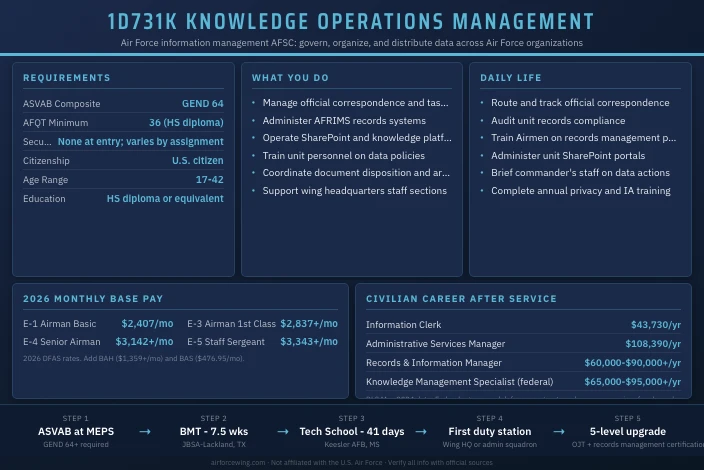
Job Role
1D731K Knowledge Operations Management specialists perform, supervise, and manage data, information, and knowledge-sharing services across Air Force organizations in both garrison and expeditionary environments. They develop and govern the processes, technologies, and practices that allow commanders and their staffs to efficiently capture, organize, retrieve, and use information. This AFSC is the backbone of administrative data integrity across the Air Force.
Day-to-Day Tasks
The daily tempo in this specialty runs through a mix of administrative coordination, records governance, and user education. On any given day, a Knowledge Operations specialist might be processing correspondence for a wing commander, auditing a unit’s records disposition schedule, or training other Airmen on how to properly document official actions.
Core responsibilities include:
- Managing official correspondence flow, including formatting, tracking, and routing documents through command channels
- Maintaining organizational records systems and ensuring documents are properly created, protected, stored, and disposed of per Air Force instructions
- Operating and administering information management systems, including SharePoint portals and Air Force-specific knowledge management platforms
- Educating unit personnel on data policies, document management procedures, and information-sharing tools
- Evaluating contracts and operational plans for their information management requirements and impact
- Retrieving and analyzing data to support unit planning and reporting requirements
- Coordinating with wing and higher-headquarters staff on information governance issues
Specialty Codes and Skill Levels
| Code | Skill Level | Description |
|---|---|---|
| 1D731K | 3-level (Apprentice) | Entry-level; completes Tech School and works under direct supervision |
| 1D751K | 5-level (Journeyman) | Independently manages information systems and unit records programs |
| 1D771K | 7-level (Craftsman) | Supervises junior Airmen and manages section-level knowledge operations |
| 1D791K | 9-level (Superintendent) | Senior NCO; leads knowledge operations programs at squadron or wing level |
The 1D7XX designation is the current code series following a 2021 Air Force cyberspace support restructuring. Verify the active code with your recruiter at the time of enlistment, as designations can change.
Mission Contribution
Air Force planning, reporting, and operations all depend on reliable information management. A deployment order with missing attachments, a personnel record filed incorrectly, a wing inspection package with gaps in its document trail, any of these can slow operations or create legal liability. Knowledge Operations specialists prevent these problems by governing the systems and practices that every unit uses to handle information.
At the wing level, a Knowledge Operations NCO sitting at the executive suite level often becomes the person the commander’s action officer calls first when a document needs to be found, updated, or cleared through the right channels quickly. That proximity to leadership creates visibility and influence unusual for an E-5 or E-6 in most career fields.
Technology and Equipment
Day-to-day tools include SharePoint and Microsoft 365 environments, Air Force Records Information Management System (AFRIMS), Air Force-specific document control and correspondence tracking software, and enterprise content management platforms. Much of the software is commercial-off-the-shelf with Air Force configuration on top. Airmen in this specialty also manage physical records systems and coordinate electronic records disposition in compliance with DoD and Air Force records management policy.
Salary
Base Pay
Military pay is the same across all Air Force enlisted jobs. Rank and years of service determine the rate. The figures below reflect 2026 DFAS rates.
| Rank | Grade | Entry Pay (under 2 years) | At 4 Years |
|---|---|---|---|
| Airman Basic | E-1 | $2,407/mo | $2,407/mo |
| Airman | E-2 | $2,698/mo | $2,698/mo |
| Airman First Class | A1C / E-3 | $2,837/mo | $3,198/mo |
| Senior Airman | SrA / E-4 | $3,142/mo | $3,659/mo |
| Staff Sergeant | SSgt / E-5 | $3,343/mo | $3,947/mo |
| Technical Sergeant | TSgt / E-6 | $3,401/mo | $4,069/mo |
Most Airmen reach E-4 within two to three years. Base pay does not include housing or food allowances.
Allowances and Total Compensation
Active-duty Airmen receive allowances on top of base pay:
- Basic Allowance for Subsistence (BAS): $476.95/month flat rate for all enlisted Airmen (2026)
- Basic Allowance for Housing (BAH): Varies by duty location and dependency status. A single E-4 at Joint Base San Antonio draws roughly $1,359/month; with dependents, $1,728/month. High-cost installations pay considerably more.
- Special and Incentive Pay: Available for qualifying assignments; verify current rates with a recruiter.
Additional Benefits
Active-duty Airmen receive TRICARE Prime at no cost, no enrollment fee, no deductible, no copays for covered medical, dental, vision, and mental health services.
Education options during active service include:
- Tuition Assistance (TA): Up to $4,500/year at $250 per semester hour
- Post-9/11 GI Bill: Full in-state tuition at public universities after separation, or up to $29,920.95 per academic year at private schools, plus a monthly housing allowance and $1,000 annual book stipend
- Degree credit: Knowledge Operations course work at Keesler counts toward an Information Management degree
The Blended Retirement System (BRS) provides a pension worth 40% of your high-36 average pay at 20 years, combined with a Thrift Savings Plan that the government matches up to 4% of basic pay.
Work-Life Balance
Active-duty Airmen earn 30 days of paid leave per year. Knowledge Operations work in garrison typically follows standard duty hours, since the role is administrative by nature. Wing executive support positions may require early or extended hours when senior leaders are working compressed timelines. Exercises and deployments shift the schedule to 12-hour days for their duration.
Qualifications
Qualifications Table
| Requirement | Standard |
|---|---|
| ASVAB Composite | General (GEND): 64 |
| AFQT Minimum | 36 (high school diploma) |
| Citizenship | U.S. citizen |
| Age | 17-42 at time of enlistment |
| Education | High school diploma or equivalent |
| Security Clearance | None required at entry; some assignments require Secret or higher |
| Medical | Meets Air Force enlistment medical standards |
Desirable preparation: High school courses in English composition, business communications, mathematics, computer applications, and information systems all build directly relevant background for this AFSC.
ASVAB Composite Details
The Air Force General (GEND) composite draws from Word Knowledge (WK), Paragraph Comprehension (PC), Arithmetic Reasoning (AR), and Mathematics Knowledge (MK). The minimum for 1D731K is 64. That bar reflects the reading, writing, and reasoning skills needed to manage official correspondence, interpret Air Force instructions, and advise unit personnel on records policy.
Candidates with strong verbal and reading comprehension scores tend to exceed this threshold comfortably. Anyone who hasn’t taken standardized tests recently should review arithmetic reasoning and vocabulary before the ASVAB, both pull down composite scores disproportionately when neglected.
Security Clearance Process
Entry into this AFSC does not require a security clearance as a universal baseline, which sets it apart from most other 1D7XX roles. However, many duty positions, particularly those in wing executive support, headquarters staff, or expeditionary environments, do require Secret access. In practice, expect to initiate a clearance investigation at some point in your first duty assignment.
Clearance eligibility is based on a National Agency Check with Law and Credit (NACLC). Financial responsibility and honest disclosure of background information are the primary factors. If you know your financial or personal history includes potential complications, discuss this with your recruiter before enlisting.
Application Process
Selection and Service Obligation
Knowledge Operations Management is a consistently staffed career field with demand at installations worldwide. It isn’t a restrictive selection like special operations support AFSCs, and the GEND 64 bar is achievable with focused preparation. Standard active-duty enlistment contracts run 4 or 6 years. Confirm the current obligation and any bonus terms with your recruiter.
See our ASVAB study guide to target the GEND composite and prepare for the MEPS appointment.
Work Environment
Setting and Schedule
Knowledge Operations work happens almost entirely indoors, in office and administrative environments. The physical environment is comfortable: desks, computers, printers, and filing systems. This isn’t a wrench-on-metal or cable-pulling role.
Typical work settings include:
- Unit orderly room: administrative hub for a squadron or group
- Wing headquarters staff section: executive support for senior leadership
- Command post: operational coordination center
- Records management office: installation-level document governance
Standard garrison duty hours are the norm. The schedule becomes less predictable in wing executive support billets, where the pace mirrors the commander’s operational calendar, pre-inspection surges, major exercises, and deployment preparations create real workload spikes. Expeditionary assignments run 12-hour shifts for the duration of the rotation.
Chain of Command and Communication
Knowledge Operations Airmen work across the Air Force organizational structure. At the unit level, they sit in orderly rooms or administrative support sections reporting to an NCO. At the wing level, specialists supporting executive staff work directly alongside senior officers and civilian equivalents. That exposure to decision-making processes is unusual for junior enlisted Airmen.
Performance feedback runs through the Enlisted Performance Report (EPR) system, annual evaluations with stratification rankings that directly affect competitive promotion.
Team Dynamics and Autonomy
The job is collaborative by design. Knowledge Operations Airmen coordinate with every section of the unit they support, personnel, maintenance, operations, medical, legal, because information governance touches all of them. The role builds a broad view of how a wing or unit functions that most AFSCs don’t develop at the junior enlisted level.
With experience, the role requires substantial independent judgment. A SSgt managing a wing’s AFRIMS program or advising a deployment team on document management may be the only person in the room who understands the policy details. That professional responsibility comes early in this career field.
Job Satisfaction
Satisfaction in this career field tends to come from organizational impact rather than hands-on technical work. Airmen who like knowing how a unit actually operates, who prefer solving information and process problems over hardware problems, and who want close proximity to leadership tend to find this AFSC rewarding. Those who prefer isolated technical work or want to avoid heavy communication with other people will likely find it less engaging.
Training
Initial Training Pipeline
| Phase | Location | Duration | Focus |
|---|---|---|---|
| Basic Military Training (BMT) | JBSA-Lackland, TX | 7.5 weeks | Physical fitness, military customs, weapons qualification, core values |
| Technical School | Keesler AFB, MS | 41 days | Knowledge management theory, AFRIMS records management, correspondence management, SharePoint administration, Air Force information policy |
| First Duty Station | Varies | Ongoing | On-the-job upgrade training toward 5-level Journeyman |
BMT covers physical conditioning, weapons handling, and military customs. No specialty training occurs there. Tech School follows immediately.
Tech School at Keesler AFB
The 81st Training Wing at Keesler AFB, MS runs the Knowledge Operations Management initial skills course alongside several other 1D7XX communications courses. At 41 days, it’s one of the shorter pipelines in the group, but the content is dense. The curriculum covers Air Force records management policy and AFRIMS operation, official correspondence and tasker management, knowledge management platforms including SharePoint, information governance frameworks, and document disposition and destruction standards.
Students work through a mix of classroom instruction and practical labs applying Air Force instructions to real records management scenarios. The goal is producing Airmen who can walk into a unit orderly room or wing headquarters staff section and immediately contribute to information management work.
Advanced Training and Certifications
Unlike the more technical 1D7XX roles, Knowledge Operations does not have a defined civilian certification ladder (such as CompTIA for IT roles). Professional development runs through Air Force-specific training:
- Records Management Refresher Training: required annually for all Airmen with AFRIMS responsibilities; Airmen in this AFSC are often the unit’s primary trainer
- Information Assurance Training: DoD-required annual training; more relevant as positions involve classified or sensitive data
- Supervisory Development Course (SDC): required preparation for NCOs approaching the 7-level upgrade
- Air Force SharePoint Administrator Training: available for Airmen managing unit portals and knowledge management systems
The Air Force also offers tuition assistance and voluntary education programs that support degree completion. Many 1D731K Airmen pursue associate’s or bachelor’s degrees in business administration, information management, or organizational communication, fields that directly align with civilian career paths in this specialty.
Prepare for the GEND 64 requirement with our ASVAB study guide before your MEPS test date.
Career Progression
Rank and Progression Timeline
| Rank | Grade | Typical Milestone |
|---|---|---|
| Airman Basic | E-1 | Entry; first day at BMT |
| Airman | E-2 | After 6 months time-in-service |
| Airman First Class | A1C / E-3 | After 16 months time-in-service |
| Senior Airman | SrA / E-4 | After 3 years TIS (or 28 months with early promotion) |
| Staff Sergeant | SSgt / E-5 | Competitive; typically 5+ years TIS |
| Technical Sergeant | TSgt / E-6 | Competitive; typically 8-12 years TIS |
| Master Sergeant | MSgt / E-7 | Senior enlisted; 14+ years typical |
| Senior Master Sergeant | SMSgt / E-8 | Highly competitive; 18+ years typical |
| Chief Master Sergeant | CMSgt / E-9 | Top 1% of enlisted force |
Promotions through E-4 are essentially time-based. Staff Sergeant and above require passing a promotion test and earning strong EPR rankings that stratify the Airman favorably against peers. Knowledge Operations NCOs serving in wing executive support or headquarters billets tend to have higher visibility to raters and can build competitive records more quickly than those in more isolated assignments.
Specialization Options
The career field doesn’t have extensive shredout codes, but Special Experience Identifiers (SEIs) exist for Airmen with demonstrated expertise in specific areas such as wing-level executive support, major command staff operations, or joint headquarters information management. These appear in the personnel record and can influence assignment preferences.
The administrative and information management background of 1D731K also opens pathways to officer commissioning. Airmen with strong records can apply through the Airman Scholarship and Commissioning Program (ASCP) or Officer Training School (OTS). The analytical and organizational communication skills this AFSC develops apply across officer career fields in force support, public affairs, and acquisition.
Performance Evaluation
The Enlisted Performance Report (EPR) determines competitive promotion outcomes. Raters score performance on a 5-point scale and stratify the Airman against peers under the same supervisor. That stratification line, “1 of 5 Airmen,” for example: carries more weight in promotion board deliberations than the numeric score alone.
Building a competitive record in Knowledge Operations means mastering the AFRIMS program early, volunteering to lead unit information management training, taking on additional duties such as unit deployment manager or wing inspection preparation coordinator, and pursuing professional development through the voluntary education program. Airmen in this AFSC who become the person commanders turn to for urgent document or records problems build exactly the kind of visible, results-based record promotion boards value.
Physical Demands
Daily Physical Requirements
Knowledge Operations work is sedentary. A typical day involves sitting at a computer, reviewing and routing documents, training unit personnel, and managing records systems. Physical demands beyond walking between office spaces are minimal. No field operations, hardware lifting, or sustained physical activity is inherent to the daily work.
This is one of the least physically demanding AFSCs in the Air Force, though deployed and exercise environments require Airmen to operate in less comfortable conditions for extended periods.
Air Force Fitness Assessment Standards
All Airmen take the Air Force Fitness Assessment annually, regardless of career field. There are no AFSC-specific modifications for 1D731K. The test scores on a 100-point scale with a minimum passing composite of 75.
| Component | Maximum Points |
|---|---|
| 1.5-Mile Run | 60 |
| Waist Circumference or Body Composition | 20 |
| Push-Ups (1 minute) | 10 |
| Sit-Ups (1 minute) | 10 |
Scores are age- and gender-normed. Failing the composite or any individual component triggers a mandatory fitness improvement plan. Repeated failures affect promotions and reenlistment eligibility. For current passing thresholds by age and gender group, check af.mil.
Medical Evaluations
Beyond the initial MEPS physical, Airmen receive periodic occupational health evaluations during their career. No unique medical requirements apply to 1D731K compared to standard Air Force enlistment standards. Airmen whose duties expand to include classified or sensitive data handling will encounter periodic clearance reinvestigation requirements as part of maintaining access.
Deployment
Deployment Patterns
Knowledge Operations specialists deploy in support of Air Expeditionary Wing operations, expeditionary squadrons, and joint headquarters. When a unit establishes itself in a deployed location, information management, correspondence, records, document control, must function from day one.
| Rotation Type | Typical Length | Environment |
|---|---|---|
| Standard AEF rotation | 4-6 months | Inside-the-wire admin/command post facility |
| MAJCOM staff support | Variable (60-180 days) | Headquarters element |
| CONUS exercise support | Days to weeks | Home installation or TDY location |
Deployment frequency depends heavily on the unit. Airmen assigned to expeditionary communications units or major command headquarters staffs may deploy more frequently than those in installation support roles. The administrative and headquarters nature of the work means deployment environments are typically inside the wire, operating from command post or administrative facilities rather than austere forward positions.
Duty Station Options
Wing headquarters, major command staff sections, and installation support squadrons at almost every Air Force installation require Knowledge Operations specialists. Common duty locations include large installations with major command headquarters. Scott AFB, IL (Air Mobility Command), Joint Base Langley-Eustis, VA (Air Combat Command), Ramstein AB, Germany (USAFE-AFAFRICA), and Joint Base Pearl Harbor-Hickam, HI (PACAF), but billets exist across the force at smaller installations as well.
Because the AFSC supports administrative and headquarters functions found at every installation, assignment variety is broad. Airmen approaching reenlistment have more influence over location preferences than those still in their first term.
Risk/Safety
Job Hazards
Occupational hazards in Knowledge Operations are minimal. The primary risks are ergonomic: prolonged computer and desk work creates repetitive stress exposure. Deployed environments introduce location-specific risk depending on the operational area, but the administrative role itself has no inherent physical hazard comparable to maintenance, civil engineering, or security forces work.
Safety Protocols
Air Force occupational safety standards apply to office environments, covering ergonomic workstation setup and standard workplace safety practices. The work environment carries negligible industrial risk.
Security and Legal Requirements
Clearance requirements vary by assignment rather than applying uniformly to the AFSC at entry. When positions do require Secret access, Airmen must maintain the financial and personal conduct the clearance demands throughout its validity and report significant changes per DoD policy. Unauthorized disclosure of protected information carries federal penalties under the Uniform Code of Military Justice (UCMJ) and applicable federal statute.
Airmen in this specialty handle official documents and correspondence, many of which are For Official Use Only (FOUO) or subject to Privacy Act protections. Mishandling those materials, even non-classified records, can result in administrative or legal action. Annual privacy and information assurance training reinforces these obligations.
Impact on Family
Family Considerations
Knowledge Operations work in garrison generally follows standard duty hours, an advantage for family scheduling compared to shift-based career fields. Wing executive support billets can require extended hours during inspection preparation, major exercises, and command transitions, but these surges are typically known in advance and time-limited.
During deployments (typically 4-6 months), families at home station have access to a full support network:
- Airman and Family Readiness Center: deployment briefings, support groups, emergency assistance
- Family Advocacy Program: counseling and crisis intervention
- Military Family Life Consultant: confidential, no-record counseling sessions
- TRICARE: healthcare coverage for all eligible dependents
- Military OneSource: 24/7 support hotline and online resources at no cost
- School Liaison Officer: assists with student transitions during PCS or deployment
The predictable garrison schedule in most 1D731K billets is an advantage for dual-income households and families with young children. Childcare coordination around standard office hours is simpler than in shift-based AFSCs.
Relocation
Permanent Change of Station (PCS) moves occur roughly every 2-3 years. Because Knowledge Operations billets exist at virtually every Air Force installation worldwide, the AFSC offers broad assignment options. Spouses building civilian careers benefit from the broad basing, common installation types (large CONUS bases near metro areas) offer stronger local job markets than remote or single-mission installations. Each PCS includes a moving allowance, temporary lodging entitlement, and mileage reimbursement. Families with school-age children can access DoD schools at larger installations.
Reserve and Air National Guard
Component Availability
The Knowledge Operations Management specialty is available in all three components: Active Duty, Air Force Reserve, and Air National Guard. Administrative and records management functions exist at Reserve and Guard units across the country, making this AFSC broadly available in part-time service. Wing headquarters and operations group staff sections in Guard and Reserve wings regularly carry 1D731K billets.
Drill Schedule and Training Commitment
The standard Reserve and ANG commitment is one Unit Training Assembly (UTA) weekend per month plus two weeks of Annual Tour per year. Knowledge Operations Airmen in the Guard and Reserve may carry unit records management responsibilities between drill weekends, particularly in small units where they’re the only member with the AFSC. The AFRIMS records management and annual privacy training requirements don’t pause between drill periods.
Reserve Component Pay and Benefits Comparison
| Category | Active Duty | Air Force Reserve | Air National Guard |
|---|---|---|---|
| Commitment | Full-time | ~39 days/year (UTAs + AT) | ~39 days/year (UTAs + AT) |
| E-4 Monthly Pay | $3,142-$3,659/mo | ~$1,050-$1,220/drill weekend | ~$1,050-$1,220/drill weekend |
| Healthcare | TRICARE Prime (free) | TRICARE Reserve Select (premium) | TRICARE Reserve Select + state benefits |
| Education | TA + full GI Bill | TA + GI Bill (pro-rated by service) | State tuition waivers vary; TA eligible |
| Retirement | 20-year pension (BRS) | Points-based at age 60 | Points-based at age 60 |
| Deployment Tempo | Moderate | Mobilization-dependent | Mobilization-dependent |
TRICARE Reserve Select requires a monthly premium but is significantly less expensive than comparable civilian employer health insurance.
Air National Guard members may qualify for state tuition assistance programs. Coverage varies widely by state, some states cover full in-state tuition at public universities, others offer limited support. Check your state Guard’s education office directly.
The points-based Reserve retirement system accrues retirement points for each drill day and active duty day served. A member who earns 20 qualifying years receives retirement pay, but at age 60 rather than after 20 years as with active-duty retirement.
Deployment and Mobilization
Reserve and Guard Knowledge Operations Airmen can be mobilized under Title 10 for overseas operations or Title 32 for domestic missions. A Guard member at a wing with headquarters staff requirements might deploy on a 6-12 month rotation during high-demand periods, or see little mobilization activity during quieter years. Mobilization predictability differs from active duty, where deployment cycles are more structured.
Civilian Career Integration
Knowledge Operations Management pairs well with civilian administrative, records management, and knowledge management careers. An Airman working as an administrative coordinator, records manager, or SharePoint administrator in a civilian role will find the drill weekend reinforces the same platforms and policies. Defense contractors and federal agencies value cleared personnel with information management backgrounds.
USERRA protects civilian employment during military activations. Most civilian employers in the administrative and federal contracting sectors are familiar with Reserve and Guard obligations.
Post-Service
Civilian Career Transition
The skills from 1D731K map directly to civilian administrative management, records management, and knowledge management roles. Every large organization, healthcare systems, government agencies, universities, law firms, and financial institutions, manages official records and correspondence under regulatory requirements. The Air Force trains these Airmen to do exactly that work at a high standard from the start.
Federal agencies run the largest concentrations of records management positions, and veterans with relevant experience and cleared backgrounds often receive hiring preference. Defense contractors supporting DoD administrative functions actively recruit Airmen from administrative specialty codes.
The Air Force Transition Assistance Program (TAP) provides separation counseling, resume workshops, and job fair access. Hiring Our Heroes fellowship programs place transitioning service members in civilian roles during terminal leave. The Post-9/11 GI Bill supports degree completion in business administration or information management for Airmen pursuing higher-earning management roles.
Civilian Career Outlook
| Civilian Job Title | Median Salary | Job Outlook |
|---|---|---|
| Information Clerk | $43,730/yr | ~149,200 openings/year |
| Administrative Services Manager | $108,390/yr | +4% (as fast as average); 36,400 openings/year |
| Records and Information Manager | Varies; typically $60,000-$90,000+ | Consistent demand in regulated industries |
BLS data from May 2024. Entry-level separation typically targets information clerk and administrative coordinator roles. Airmen with 6-10 years of experience and 7-level credentials are competitive for administrative services manager and records management leadership positions, which carry substantially higher compensation.
Is This a Good Job
Ideal Candidate Profile
An Airman who reads Air Force instructions carefully and actually enjoys figuring out what the regulation requires will stand out quickly in this specialty. The job requires writing accurately, understanding policy in detail, and explaining it to people who’d rather not deal with it, then following up when they don’t comply. That combination of analytical precision and interpersonal persistence isn’t universal.
What separates someone who thrives in 1D731K from someone who tolerates it is proximity to leadership. By E-5, you’re advising a squadron commander on records compliance and briefing wing staff on documentation procedures. If that access to decision-making sounds engaging rather than stressful, this AFSC fits.
This career field suits people who:
- Are strong readers and writers who think carefully before responding
- Like process and organization, knowing where things are and why they’re there
- Enjoy working at the headquarters level, close to decision-makers
- Want a reliable administrative skill set that transfers directly to civilian employment
- Are comfortable learning and enforcing policy in detail
Potential Challenges
The work can feel bureaucratic. A significant portion of the job involves ensuring compliance with records policies and correspondence formatting standards, rules that matter for legal and operational reasons, but that don’t always feel urgent in the moment. Airmen who need constant novelty or visible technical challenges may find the pace less engaging than hardware-intensive communications AFSCs.
Salary growth in post-service administrative careers is slower at the entry level than in IT or cybersecurity. The ceiling is high for managers and directors, but reaching it requires either advanced education or significant civilian work experience. Airmen who want to maximize their civilian earning potential should use TA or the GI Bill to complete a bachelor’s degree before or shortly after separation.
The absence of a universal clearance requirement at entry means this AFSC doesn’t automatically generate the cleared-professional hiring premium that most other 1D7XX roles receive. Airmen who acquire a clearance through their duty assignments should document that access carefully for the civilian job search.
Career and Lifestyle Fit
This is a solid choice for Airmen who want an accessible entry point into Air Force communications, predictable garrison hours, and a clear path to civilian administrative or records management careers. The 41-day tech school and GEND 64 bar make it the most accessible AFSC in the 1D7XX group from an entry perspective.
It’s also a strong fit for people who plan to serve part-time in the Guard or Reserve while building civilian careers in administration, records management, or federal contracting. The overlap between the military and civilian versions of this work is direct and practical.
More Information
Your local Air Force recruiter can confirm current AFSC codes, training dates, and any bonus availability. Contact information and job details are available through airforce.com. Reviewing the qualifications before your first recruiter meeting makes the conversation more productive.
Official sources to check:
- airforce.com: Knowledge Operations Management career page, current job description, qualifications, and training details
- DFAS Pay Tables, 2026 enlisted base pay rates
- AFRIMS overview at af.mil, Air Force Records Information Management System policy and training requirements
For civilian career research:
- BLS Information Clerks outlook, median wages, job growth, and employer types
- BLS Administrative Services Managers outlook, salary and demand for the higher-level career path
See our ASVAB study guide for targeted preparation on the General composite, or take the PiCAT at home before your MEPS appointment.
This site is not affiliated with the U.S. Air Force or any government agency. Verify all information with official Air Force sources before making enlistment or career decisions.
Explore more Air Force communications careers such as 3D1X1 Client Systems and 3D1X3 RF Transmission Systems.