3E8X1 Explosive Ordnance Disposal
Every military installation sits on land that has a history. Old ordnance buried under training ranges. IEDs on routes leading to the flight line. A suspicious package at the gate. When those calls come in, the Air Force sends one career field: 3E8X1 Explosive Ordnance Disposal.
EOD technicians locate, identify, render safe, and dispose of conventional explosives, improvised devices, chemical agents, and nuclear or radiological weapons. They deploy to combat zones, support the Secret Service during presidential travel, and clear unexploded ordnance from ranges used by generations of Airmen before you. The job demands the highest ASVAB scores in the civil engineering career group, a ten-month training pipeline, and a personality that stays calm when everyone else is running away from the problem. For the right person, it’s one of the most respected and well-compensated enlisted careers in the Air Force. Your ASVAB study guide is the place to start preparing.
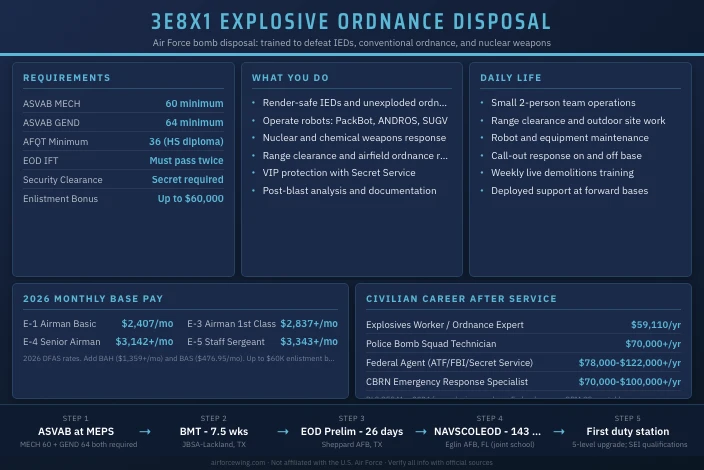
Job Role
3E8X1 Explosive Ordnance Disposal Airmen locate, identify, and neutralize explosive hazards including improvised explosive devices, unexploded conventional ordnance, nuclear weapons components, and chemical or biological munitions. They operate across combat, contingency, and peacetime environments, often working as two-person teams using remote tools, robots, and personal protective equipment to defeat threats that no other career field is trained to handle.
Daily Tasks
A typical EOD shift doesn’t look like a combat documentary. Most working days involve range clearance operations, equipment inspections, training exercises, and responding to call-outs on base or from civilian law enforcement partners. When a deployment cycle hits, the tempo changes completely.
Day-to-day responsibilities include:
- Conducting area searches for unexploded ordnance on training ranges and airfields
- Responding to suspicious package and IED call-outs on and off base
- Maintaining and operating EOD robots such as the man-portable PackBot and the Buffalo MRAP
- Performing render-safe procedures on malfunctioning aircraft weapons
- Supporting VIP protection operations for the Secret Service and other agencies
- Conducting nuclear weapons accident response and render-safe procedures
- Maintaining technical proficiency through weekly live-fire and demolitions training
- Documenting incidents and completing post-blast analysis reports
Specific Roles and Shredouts
The 3E8X1 AFSC does not use formal shredouts the way some career fields do. Specialization happens through Special Experience Identifiers (SEIs) and assignment-specific qualifications earned over a career.
| Identifier | Qualification |
|---|---|
| 3E8X1 (5-level) | Journeyman, independently responds to and defeats explosive hazards |
| 3E8X1 (7-level) | Craftsman, leads EOD teams, manages equipment and training |
| 3E8X1 (9-level / 3E800) | Superintendent, flight chief and wing-level EOD program management |
| SEI 491 | Nuclear EOD qualified (render-safe procedures on nuclear weapons) |
| SEI 492 | Chemical/Biological EOD qualified |
Mission Contribution
EOD is one of the few career fields that operates at every level of the threat spectrum, from a dud 20mm round on a gunnery range to a radiological dispersal device in a major city. The Air Force cannot project airpower from a compromised airfield, and EOD is the team that keeps runways and ramps clear of the hazards that history leaves behind. During overseas contingency operations, Air Force EOD teams have worked alongside Army and Marine Corps units as the primary counter-IED force on routes and in villages far from any flight line.
Technology and Equipment
EOD technicians work with some of the most specialized gear in the enlisted force.
- EOD suits (the 30-pound protective ensemble for manual approach operations)
- Robotics systems: FLIR PackBot, iRobot SUGV, Northrop Grumman ANDROS
- Disruptors and render-safe tools: Explosive ordnance disposal tools used to interrupt IED circuits without detonation
- X-ray systems for package and IED imaging
- Demolitions charges for deliberate destruction of ordnance that cannot be moved
- Nuclear and chemical detection equipment for radiological and CBRN response
Salary
Base Pay
EOD technicians earn the same base pay as all enlisted Airmen at equivalent rank and years of service. What sets this career field apart is the enlistment bonus and the retention bonuses available once you’re in.
Enlistment Bonus: Up to $60,000 for a six-year active-duty contract, paid upon completion of the EOD training pipeline. Bonus amounts and eligibility change year to year, verify current figures with your recruiter.
| Rank | Entry Pay (Less than 2 years) | Pay at 4 Years |
|---|---|---|
| E-1 Airman Basic (AB) | $2,407/mo | $2,407/mo |
| E-3 Airman First Class (A1C) | $2,837/mo | $3,198/mo |
| E-4 Senior Airman (SrA) | $3,142/mo | $3,659/mo |
| E-5 Staff Sergeant (SSgt) | $3,343/mo | $3,947/mo |
| E-6 Technical Sergeant (TSgt) | $3,401/mo | $4,069/mo |
Figures from DFAS 2026 Military Pay Tables. Base pay only.
Allowances and Additional Pay
Base pay is only part of the picture. Airmen living off-base receive Basic Allowance for Housing (BAH), which varies by duty location, rank, and dependent status. At Joint Base San Antonio, an E-4 without dependents receives $1,359/mo BAH; with dependents, $1,728/mo. Basic Allowance for Subsistence (BAS) adds $476.95/mo for all enlisted members.
EOD technicians who earn nuclear or chemical SEI qualifications may also qualify for hazardous duty pay depending on assignment. Airmen deployed to designated combat zones earn tax-free basic pay for those months.
Healthcare, Education, and Retirement
All active-duty Airmen receive TRICARE Prime with no enrollment fee, no deductibles, and no copays for covered services. Coverage includes medical, dental, vision, and mental health care for the member and dependents.
The Post-9/11 GI Bill covers full in-state tuition at public schools, or up to $29,920.95 per academic year at private schools, plus a monthly housing allowance and an annual book stipend. Airmen who complete at least six years of service can transfer the benefit to a spouse or dependent children, with a four-year additional service obligation.
Retirement uses the Blended Retirement System (BRS). After 20 years, the pension pays 40% of your highest 36-month average basic pay. The BRS also includes automatic Thrift Savings Plan contributions, the government puts in 1% of basic pay automatically and matches up to 4% more.
Work-Life Balance
EOD works a standard schedule at home station, typically Monday through Friday with on-call rotations. When workload spikes during exercises, evaluations, or range clearance seasons, extended hours are normal. Airmen earn 30 days of paid leave per year, accruing at 2.5 days per month.
Qualifications
Requirements Table
| Requirement | Standard |
|---|---|
| Citizenship | U.S. citizen |
| Age | 17-42 at enlistment |
| Education | High school diploma or GED |
| AFQT Minimum | 36 |
| ASVAB Composites | MECH 60 and GEND 64 (both required) |
| Physical Fitness | Pass the EOD Initial Fitness Test (IFT) |
| Height | 60-78 inches |
| Security Clearance | Secret (Top Secret eligibility screened at accession) |
| Medical | Normal color vision; meet all MEPS physical standards |
| Drug screen | Pass urinalysis; no recent drug use |
Requirements per airforce.com and AFI 36-2101.
Dual composite requirement. 3E8X1 is the only civil engineering AFSC that requires qualifying scores in two separate composites. You must meet both the MECH 60 and GEND 64 thresholds, meeting only one does not qualify you. Study both the mechanical and general portions of the ASVAB equally.
EOD Initial Fitness Test (IFT)
Before you can be selected for 3E8X1 training, you must pass the EOD Initial Fitness Test: and pass it twice. The IFT is separate from the Air Force Fitness Assessment and is scored as pass/fail.
| Event | Minimum Standard |
|---|---|
| Pull-ups | 6 in 2 minutes |
| Sit-ups | 40 in 2 minutes |
| Push-ups | 40 in 2 minutes |
| 1.5-mile run | Under 11:00 |
If you’re preparing to enlist, train specifically for the IFT before you arrive at MEPS. A 10:59 mile-and-a-half is faster than the Air Force Fitness Assessment minimum for most age groups.
Application Process
- Contact an Air Force recruiter and indicate interest in 3E8X1
- Take the ASVAB at a Military Entrance Processing Station (MEPS)
- Complete a physical exam verifying height, weight, color vision, and medical eligibility
- Pass the EOD IFT (administered at MEPS or a testing center)
- Complete a background investigation for Secret clearance eligibility
- Receive an AFSC 3E8X1 enlistment contract with a six-year active-duty commitment
The full accession process typically takes two to six months depending on the clearance investigation and recruiter coordination.
Selection and Service Obligation
EOD is a competitive career field with limited accession seats each year. Recruiters look for applicants who score well on both required composites and who demonstrate the mental composure and physical readiness the IFT measures. A waiver process exists for some disqualifying conditions, but medical and clearance waivers for EOD are reviewed more strictly than in most career fields.
The standard enlistment contract for 3E8X1 is six years, which is the term required to receive the enlistment bonus. Selectees enter service at E-1 Airman Basic (AB).
See our ASVAB study guide for strategies to hit these line scores.
Work Environment
Setting and Schedule
EOD Airmen work in every environment imaginable. At a home station in the continental U.S., a typical week mixes indoor equipment maintenance and training with outdoor range clearance operations and call-out response. The job is physically active regardless of the day’s tasking, suits weigh 30 pounds, robots need to be loaded and unloaded from vehicles, and range clearance means walking terrain for hours.
Overseas deployments move the work to forward operating bases, patrol bases, and urban environments where team protection and situational awareness define the schedule. Some assignments embed Air Force EOD with Army and Marine Corps maneuver units.
Work schedules at home station are generally Monday through Friday with rotating on-call duty. Flight lines, airfields, and range training areas are the most common operating environments when not deployed.
Leadership and Teamwork
EOD teams are small, typically two people. That dynamic builds an unusually tight working relationship between team members, with clear roles divided between the number one and number two technician on any given call-out. The number one approaches the device; the number two provides observation, communications, and safety oversight from a standoff position.
Performance feedback follows the standard Air Force Enlisted Performance Report (EPR) system. EPRs are written by the flight commander and reviewed up the chain. Given the small team size in most EOD flights, performance is visible quickly and recognition tends to come faster than in larger units.
Job Satisfaction and Retention
EOD has historically had retention challenges because the pipeline is long and demanding, and civilian federal law enforcement EOD positions pay competitively. The Air Force addressed this with retention bonuses on top of the enlistment bonus. Airmen who stay through their initial contract can negotiate continuation pay and selective retention bonuses, which have historically reached into five figures. Those who stay for a full career report strong job satisfaction tied to the uniqueness of the mission and the quality of the people they work with.
Training
Training Pipeline Overview
3E8X1 has the longest enlisted training pipeline in the civil engineering career group by a significant margin. Budget approximately ten months from BMT graduation to your first duty station.
| Phase | Location | Duration | Focus |
|---|---|---|---|
| Basic Military Training (BMT) | JBSA-Lackland, TX | 7.5 weeks | Air Force fundamentals, discipline, fitness |
| EOD Preliminary Course | Sheppard AFB, TX | 26 days | EOD foundations, written knowledge, physical screening |
| Naval School, Explosive Ordnance Disposal (NAVSCOLEOD) | Eglin AFB, FL | 143 days | Hands-on device work across all threat types: conventional, IED, nuclear, chemical |
| First Duty Station | Varies | Ongoing | 5-level upgrade training under a certified 7-level |
EOD Preliminary Course
The preliminary course at Sheppard AFB serves as the final gate before the main school. Attrition is deliberate. Instructors assess academic performance on explosive theory and physics, and they conduct physical evaluations similar to the IFT. Candidates who don’t meet the standard get recycled or removed from the pipeline. The Air Force designed the preliminary course specifically to reduce attrition at NAVSCOLEOD, where training costs are higher.
NAVSCOLEOD at Eglin AFB
The joint EOD school at Eglin AFB, FL is a shared schoolhouse for all services. Army, Navy, Marine Corps, Air Force, and Coast Guard train side by side. The 143-day course covers:
- Conventional military ordnance (bombs, rockets, artillery rounds, aircraft gun systems)
- Improvised explosive devices and circuit analysis
- Nuclear weapons render-safe procedures
- Chemical, biological, radiological, and nuclear (CBRN) response
- Underwater ordnance (dive qualifications for some assignments)
- Robotics and tool operation
Failure at NAVSCOLEOD results in removal from the EOD pipeline and retraining into a different AFSC.
Advanced Training
After earning the 5-level, Airmen can pursue a range of additional qualifications:
- Nuclear SEI (SEI 491): Focused training on nuclear weapons accidents and render-safe procedures
- Chemical/Biological SEI (SEI 492): Expanded CBRN response qualifications
- Dive qualification: Available at some duty stations with underwater ordnance requirements
- Robotics operator certification: Advanced training on the suite of remote systems
- Instructor duty at Sheppard or Eglin: Available to 7-level and above
The Air Force funds all advanced training and certifications. No out-of-pocket cost.
Start by reviewing our ASVAB study guide to understand which line scores to target before you talk to a recruiter.
Career Progression
Rank Progression
| Rank | Grade | Typical Time | Key Milestone |
|---|---|---|---|
| Airman Basic (AB) | E-1 | Entry | BMT start |
| Airman (Amn) | E-2 | 6 months TIS | Automatic promotion |
| Airman First Class (A1C) | E-3 | 16 months TIS | Automatic promotion |
| Senior Airman (SrA) | E-4 | 3 years TIS | First competitive zone |
| Staff Sergeant (SSgt) | E-5 | ~5 years TIS | Completion of 5-level; first NCO rank |
| Technical Sergeant (TSgt) | E-6 | ~10-12 years TIS | Craftsman level; team leadership |
| Master Sergeant (MSgt) | E-7 | ~14-16 years TIS | Flight superintendent eligible |
| Senior Master Sergeant (SMSgt) | E-8 | ~18-20 years TIS | Wing-level program management |
| Chief Master Sergeant (CMSgt) | E-9 | ~22+ years TIS | Senior enlisted advisor |
TIS = Time in Service (approximate; promotion is competitive above E-4).
Specialization and Career Broadening
The Air Force provides structured career broadening assignments for senior EOD Airmen. Common paths include:
- Instructor duty at the EOD Preliminary Course (Sheppard AFB) or NAVSCOLEOD (Eglin AFB)
- Silver Flag Exercise Site EOD instructor
- Special Duty Assignments: Recruiting duty, ROTC cadre, protocol
- Joint assignments: Embedded with Army, Navy, or Special Operations units
- Interagency assignments: Supporting the Secret Service, FBI, and Department of Homeland Security on protective detail and render-safe operations
Performance Evaluation
EPRs are written annually by your rater (typically a flight commander or NCO supervisor) and reviewed by a senior rater. Scores drive promotion board eligibility and special duty assignment selection. In a small career field like EOD, your reputation travels faster than your paperwork. Consistent performance, certification completion, and visible leadership in the flight are the factors that separate competitive records.
Physical Demands
Daily Physical Demands
The work is demanding from the first day of training and stays that way for the length of your career. A typical day can include:
- Carrying 30-pound EOD suits over uneven terrain
- Loading and unloading 100-plus-pound robot platforms
- Walking range clearance routes for hours in hot or cold weather
- Performing manual approach procedures that require fine motor control while wearing a protective ensemble
- Physical training requirements that exceed the standard Air Force Fitness Assessment minimums
Air Force Fitness Assessment Standards
All Airmen, including EOD technicians, take the Air Force Fitness Assessment annually. The FA scores on a 100-point scale and requires a minimum composite of 75 to pass. Each component also has its own minimum score that must be met independently.
| Component | Max Points | Notes |
|---|---|---|
| 1.5-Mile Run | 60 | Highest-weighted component |
| Waist Circumference / Body Composition | 20 | Age- and gender-normed |
| Push-Ups (1 minute) | 10 | Minimum score required |
| Sit-Ups (1 minute) | 10 | Minimum score required |
Minimum passing composite: 75 out of 100. Failing the FA has career consequences, including promotion ineligibility. EOD Airmen are expected to stay well above the minimum given the physical demands of the job.
Medical Evaluations
Beyond the initial MEPS physical, EOD Airmen undergo periodic medical evaluations tied to their clearance renewal and occupational health requirements. Working around explosives and CBRN agents triggers specific hearing and respiratory monitoring programs. Airmen who develop conditions that prevent them from wearing the protective ensemble or operating in hazardous environments may face medical review for continued service in the AFSC.
Deployment
Deployment Patterns
EOD is one of the most deployed enlisted career fields in the Air Force. During peak combat operations, Air Force EOD flights deployed to Afghanistan and Iraq on six-month rotations, with some Airmen cycling through three or four tours in consecutive years. The current tempo is lower, but EOD continues to support overseas contingency operations, theater security packages, and SOCOM-supported missions at a higher rate than most civil engineering career fields.
Deployments are typically six months, though some assignments stretch to nine months. Volunteer opportunities for extended or consecutive deployments exist for Airmen who want them.
The nature of EOD’s mission means deployments are rarely to administrative support locations. You deploy to wherever ordnance threats exist, forward operating bases, airfields in active theaters, and expeditionary locations supporting special operations. Some EOD Airmen embed directly with Army combat units or SOCOM teams rather than deploying with Air Force squadrons. That joint integration is a defining feature of the career field and accelerates professional development faster than most Air Force career paths.
Deployment readiness requirements include maintaining current certifications on all device categories, completing pre-deployment medical and dental screenings, and passing a fitness validation. EOD Airmen who let their technical currency lapse can be held back from deploying until recertified.
Duty Stations
Air Force EOD flights are attached to civil engineer squadrons at major active-duty installations worldwide. Common duty stations include:
| Base | State/Country | Notes |
|---|---|---|
| Eglin AFB | FL | Home of NAVSCOLEOD; many EOD billets |
| Nellis AFB | NV | Test and training ranges |
| Kadena AB | Japan | Pacific theater |
| Ramstein AB | Germany | European theater |
| Joint Base Elmendorf-Richardson | AK | Northern tier, extreme cold weather operations |
| Joint Base Pearl Harbor-Hickam | HI | Pacific gateway |
| Langley-Eustis AFB | VA | ACC headquarters |
| Barksdale AFB | LA | Nuclear weapons mission; SEI 491 heavily represented |
| Whiteman AFB | MO | Nuclear strike wing |
| Minot AFB | ND | Dual nuclear mission |
Nuclear-capable bases (Barksdale, Whiteman, Minot, Malmstrom, F.E. Warren) maintain EOD teams qualified for nuclear weapons accident response, making those assignments particularly valuable for Airmen pursuing SEI 491 qualification.
Assignments are managed through the Air Force Personnel Center (AFPC). Preferences are submitted through the vMPF system, but operational needs determine final placement. EOD is a small career field, which means assignment choices are narrower than larger AFSCs, but the field’s reputation and tight-knit community mean word travels fast about open assignments at desirable duty stations.
Risk/Safety
Job Hazards
This is the plainest statement in this article: EOD is dangerous work. Manual approach procedures place the technician within feet of a device that could kill them. Protective equipment reduces risk but does not eliminate it. Air Force EOD Airmen have been killed and injured in combat by IEDs, and the profession carries a casualty rate that has no equivalent in most other career fields.
The hazards extend beyond blast risk. CBRN operations expose technicians to toxic agents. Demolitions operations involve working with explosive materials that have small but real margins for error. Range clearance surfaces old, unstable ordnance that has degraded over decades.
Safety Protocols
The Air Force invests heavily in EOD safety through:
- Standing operating procedures for every device category and render-safe technique
- Two-person team requirements: no solo approach operations
- Robotics-first doctrine: remote systems are deployed before manual approach whenever tactically feasible
- Hazmat and CBRN PPE rated for the specific agent types encountered
- Certification requirements that must be current before any live device operation
- After-action reviews following every real-world incident
Security Clearance
3E8X1 requires a Secret clearance, with Top Secret eligibility screened at accession for Airmen assigned to nuclear-related duties. The background investigation covers the standard National Agency Check, Local Agency Check, and Credit Check (NACLC) process. Financial issues, foreign contacts, and prior drug use are the most common disqualifiers. Nuclear-qualified EOD Airmen (SEI 491) undergo periodic reinvestigation at a higher frequency than standard clearance holders.
Applicants with prior law enforcement involvement, significant debt, or foreign national family members should address those factors directly with a recruiter before enlisting.
Impact on Family
Family Considerations
EOD deployments are frequent and sometimes sudden. Families stationed at bases with active EOD flights should expect that the call-out pager or phone can interrupt weekends, evenings, and holidays. That reality is manageable for families who plan around it and use the support resources available, but it catches some families off guard.
The Air Force provides Airman and Family Readiness Centers at every major installation, staffed with counselors, financial advisors, and deployment preparation programs. The Military OneSource program offers 12 free counseling sessions per family member per issue per year, available by phone or video. Many EOD flights have informal family support networks that form naturally from the close working relationships in small teams.
The nature of EOD work, including the genuine danger and the classified aspects of some missions, can create emotional distance that families need to manage. Spouses of EOD Airmen who have gone through deployments consistently point to pre-deployment planning as the most effective tool: establishing routines, building connections with other EOD families on base, and using AFRC resources early rather than waiting for a crisis.
Family Separation Allowance (FSA) provides an additional $250/month during involuntary separations exceeding 30 days, including deployments. During combat zone deployments, basic pay is fully tax-exempt. These financial additions help offset the income disruption families sometimes feel during the transition into and out of deployment cycles.
Mental health resources matter in this field. EOD Airmen have higher-than-average exposure to traumatic scenarios over the course of a career. The Air Force Mental Health Clinic at most installations provides counseling, and the Embedded Mental Health program places providers directly inside operational units at some bases.
Relocation
Assignments are typically three years (stateside) or two to three years (overseas). EOD Airmen have access to the standard Permanent Change of Station (PCS) move entitlements, which cover household goods shipping and some travel costs. Families moving overseas should plan for additional preparation, particularly for school-aged children at installations in Japan, Germany, or South Korea.
The Interstate Compact on Educational Opportunity for Military Children eases mid-year school transitions in most states, addressing one of the most consistent sources of friction for military families who move frequently. Most DOD-operated schools at overseas installations offer a stable curriculum regardless of which base you are assigned to.
Reserve and Air National Guard
Component Availability
3E8X1 is available in both the Air Force Reserve and the Air National Guard. EOD is one of the Reserve components’ most valued specialties because the training pipeline is too expensive and long for many units to develop internally. Most Reserve and Guard EOD units maintain experienced technicians who have completed active-duty careers.
Drill Schedule and Training Commitment
Standard Reserve and Guard commitment is one weekend per month (Unit Training Assembly, or UTA) plus two weeks per year (Annual Training). EOD Airmen in the Reserve components have additional requirements:
- Annual weapons qualification training
- Periodic currency training on new device types and render-safe techniques
- CBRN refresher training cycles
- Some units require additional weekend assemblies tied to equipment certification schedules
Component Comparison
| Category | Active Duty | Air Force Reserve | Air National Guard |
|---|---|---|---|
| Commitment model | Full-time | 1 weekend/mo + 2 weeks/yr + voluntary deployments | Same as Reserve |
| Monthly pay (E-4 drill) | $3,142+/mo (base pay) | ~$785 per weekend (4 drill periods) | Same as Reserve |
| Healthcare | TRICARE Prime (free) | TRICARE Reserve Select (premiums apply) | Same as Reserve |
| Education | Post-9/11 GI Bill | Montgomery GI Bill, Reserve | State tuition waivers (varies by state) |
| Deployment tempo | Highest | Moderate (often mobilized to support active units) | Moderate |
| Retirement | 20-year pension (BRS) | Points-based system; pension at age 60 | Points-based system; pension at age 60 |
Civilian Career Integration
Reserve and Guard EOD technicians work well alongside federal law enforcement and public safety careers because the EOD skill set directly supports bomb squad operations. The primary USERRA conflict to be aware of: some civilian EOD or law enforcement positions have their own deployment obligations that may stack with military activations during high-demand periods. Most civilian employers in law enforcement and federal service understand military obligations and comply with USERRA protections, which require reinstatement and prohibit discrimination based on military service.
Post-Service
Transition to Civilian Careers
The 3E8X1 skill set translates to a narrow but well-compensated set of civilian careers. The federal government is the largest employer of civilian EOD technicians, through the FBI’s bomb squad programs, the Secret Service, the Bureau of Alcohol, Tobacco, Firearms and Explosives (ATF), and Department of Defense civilian explosive ordnance disposal positions.
State and local bomb squads, typically staffed by sworn law enforcement officers with additional EOD training, also recruit heavily from the military EOD community. Many departments send candidates to the FBI’s Hazardous Devices School in Huntsville, Alabama, which accepts military-trained EOD veterans with reduced prerequisites.
The Air Force Transition Assistance Program (TAP) provides career counseling, resume writing workshops, and employer connection events starting 365 days before separation. Veterans with EOD experience who want to stay in the federal sector can search open positions at USAJobs through the Office of Personnel Management.
Civilian Career Outlook
| Civilian Career | Median Annual Pay | Job Outlook |
|---|---|---|
| Explosives Worker / Ordnance Handling Expert | $59,110/yr | Stable (about 500 openings/yr) |
| Police Officer / Bomb Squad Technician | $70,000+/yr (varies by department) | Varies by jurisdiction |
| Federal Agent (ATF, FBI, Secret Service) | GS-10 to GS-13 range ($78,000-$122,000+) | Competitive |
| Nuclear/CBRN Emergency Response Specialist | $70,000-$100,000+/yr | Growing in DHS and DoE sectors |
Explosives worker data from the Bureau of Labor Statistics May 2024 figures. Federal pay varies by grade, location, and agency.
Certifications and Licensing
Military EOD training does not map directly to a civilian license in most states, but it provides the documented experience base that federal law enforcement agencies accept for accelerated qualification. Veterans interested in state/local bomb squad positions should contact individual departments about their lateral entry or certification reciprocity policies.
Is This a Good Job
Who This Is For
EOD attracts a specific personality. You should honestly assess whether you match it before committing to a six-year contract.
Strong candidates typically:
- Perform well under pressure without freezing or rushing
- Have genuine mechanical aptitude and interest in how things work
- Are comfortable with ambiguity, field conditions rarely match the textbook
- Prefer small teams over large organizations
- Score strongly on both MECH and GEND ASVAB composites without significant study effort on either
- Meet or exceed the IFT standards before arrival at MEPS
The six-year commitment is longer than most enlisted AFSCs. That’s partly because the training pipeline takes almost a year. Leaving during the first contract means the Air Force absorbed a very expensive training cost with limited return. Recruiters know this, and it makes them selective.
Potential Challenges
The job isn’t for everyone. Consider these honestly:
- Deployment frequency is higher than almost any other Air Force enlisted career field
- The pipeline is long and has high attrition: you can complete BMT and the preliminary course and still wash out of the main school at Eglin
- The work is genuinely dangerous: no amount of training eliminates that
- The career field is small, which means fewer duty station options than larger AFSCs
Career and Lifestyle Fit
If you’re drawn to law enforcement, federal service, or bomb squad work after the military, EOD sets you up better than almost any other enlistment path. The training is federally recognized, the security clearance stays active and transferable, and the reputation of military-trained EOD technicians in federal hiring pools is strong.
If you want predictable hours, a large career field with many duty station options, and low deployment likelihood, a different civil engineering AFSC will serve you better.
This site is not affiliated with the U.S. Air Force or any government agency. Verify all information with official Air Force sources before making enlistment or career decisions.
More Information
Talk to an Air Force recruiter about the 3E8X1 program, bonus eligibility, and current accession seat availability. Recruiters can schedule your IFT, walk you through the clearance process, and tell you which duty stations have open EOD billets. Find your local recruiter at airforce.com. Before that meeting, use our ASVAB study guide to make sure both your MECH and GEND composites are ready.
Official Resources
Several official sources provide current, verified information about the 3E8X1 career field:
- airforce.com/careers: EOD: The Air Force’s official career profile page for 3E8X1, including current bonus eligibility and accession requirements
- DFAS Military Pay Tables: Current-year base pay scales for all enlisted grades
- Air Force Personnel Center (AFPC): Assignment management, bonus information, and career field manning data
- NAVSCOLEOD at Eglin AFB: The joint EOD school that trains all service EOD technicians; training schedules and course details
- CFETP 3E8X1: The Career Field Education and Training Plan, the authoritative document for all training requirements, qualification standards, and career progression milestones
- USAJobs.gov: Federal civilian EOD positions at FBI, ATF, and DoD agencies, the post-service hiring pool for career changers
When speaking with a recruiter, confirm: current IFT pass rates and administration schedule, the active enlistment bonus amount (it changes annually), and which duty stations are currently filling accession seats. The bonus and seat availability change each fiscal year and can shift significantly within a single recruiting cycle.
Explore more Air Force civil engineering careers such as 3E0X1 Electrical Systems and 3E1X1 HVAC and Refrigeration.