3E7X1 Fire Protection
Every Air Force installation, flight line, and aircraft hangar depends on a small crew to keep a fire from turning into a disaster. That crew is the 3E7X1 Fire Protection specialists. Air Force firefighters trained to fight structural blazes, aircraft fires, hazardous material incidents, and medical emergencies. If you want a physically demanding job that builds lifelong skills and leads directly to a civilian firefighting career, this AFSC is worth your serious attention.
Qualifying requires specific ASVAB line scores. Our ASVAB study guide covers what to target and how to prepare.
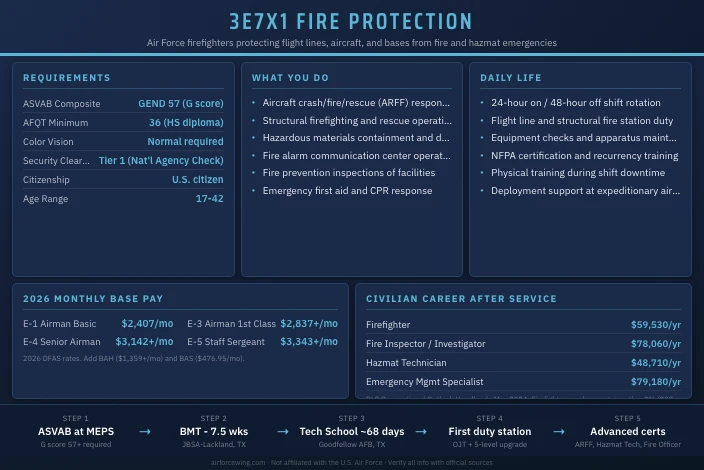
Job Role
3E7X1 Fire Protection specialists protect Air Force personnel, aircraft, and facilities from fire, hazmat incidents, and other emergencies. They respond to aircraft crashes and fuel fires, conduct building inspections, maintain fire suppression systems, and operate fire alarm communication centers. They are the primary emergency responders on every Air Force installation worldwide.
Daily Tasks
A typical shift blends emergency response readiness with prevention work. Fire Protection Airmen:
- Respond to structural fires, aircraft crash/fire/rescue (CFR) emergencies, and hazardous material releases
- Conduct fire prevention inspections of facilities, hangars, and fuel storage areas
- Test and maintain fire alarm systems, suppression equipment, and firefighting apparatus
- Operate the fire alarm communication center, managing dispatch and base-wide notifications
- Administer emergency first aid and support medical response until EMS arrives
- Train base personnel on fire extinguisher use, evacuation procedures, and prevention practices
Specialized Roles and Shredouts
The 3E7X1 AFSC does not carry formal coded shredouts, but Airmen develop specializations through assignment and additional training. Common specialty tracks include aircraft rescue and firefighting (ARFF), hazardous materials technician, and fire alarm/communications operator. Senior NCOs can branch into fire prevention inspector roles at the supervisory level.
Mission Contribution
Air Force flight operations are impossible without reliable fire coverage. Aircraft at the flight line carry thousands of pounds of jet fuel, and a single incident without fast, professional response can destroy aircraft worth hundreds of millions of dollars and kill aircrew. Fire Protection specialists make flight operations, fuel handling, and weapons storage all possible by standing ready every hour of every day.
Equipment
Airmen in this AFSC work with a wide range of specialized equipment:
- Aircraft Rescue and Firefighting (ARFF) vehicles: high-flow foam trucks designed for flight line response
- Structural engine companies with standard firefighting equipment
- Personal Protective Equipment (PPE): structural turnout gear, proximity suits for aircraft fires, SCBA breathing apparatus
- Hazmat detection and containment equipment
- Fire alarm control panels and communication dispatch consoles
Salary
Base Pay
Base pay is the same for all Airmen at the same grade and years of service. Entry-level Airmen join at E-1 through E-3.
| Rank | Grade | Monthly Base Pay (Entry) |
|---|---|---|
| Airman Basic | E-1 | $2,407 |
| Airman | E-2 | $2,698 |
| Airman First Class | A1C (E-3) | $2,837 |
| Senior Airman | SrA (E-4) | $3,142 |
| Staff Sergeant | SSgt (E-5) | $3,343 |
| Technical Sergeant | TSgt (E-6) | $3,401 |
| Master Sergeant | MSgt (E-7) | $3,932 |
2026 DFAS rates. Pay increases with years of service. See dfas.mil for the full pay table.
Allowances and Additional Compensation
Base pay is only part of the picture. Most Airmen also receive:
- Basic Allowance for Housing (BAH): Varies by installation and dependency status. A single E-4 at Joint Base San Antonio receives roughly $1,359/month. Rates at high-cost bases like Joint Base Pearl Harbor-Hickam or Joint Base Lewis-McChord are substantially higher.
- Basic Allowance for Subsistence (BAS): $476.95/month for all enlisted Airmen in 2026.
- Hazardous Duty Incentive Pay (HDIP): Airmen assigned to specific hazardous duty positions may qualify for HDIP; consult your recruiter or finance office for current eligibility and amounts.
Additional Benefits
Active-duty Airmen receive TRICARE Prime at no cost, no premiums, no deductibles, full coverage for medical, dental, vision, mental health, and prescriptions. The Air Force also pays up to $4,500 per year in tuition assistance for college courses taken off-duty.
The Blended Retirement System (BRS) automatically enrolls new Airmen and provides a 20-year pension equal to 40% of your high-36 average pay, plus a government-matched Thrift Savings Plan (TSP) contribution of up to 5% of basic pay.
Work-Life Balance
Fire Protection Airmen typically work 24-hour shifts followed by 48 hours off, mirroring civilian fire department schedules. This schedule gives significant blocks of off-time but requires full mental and physical readiness during each shift. Annual leave accrues at 2.5 days per month (30 days per year).
Qualifications
Entry Requirements
| Requirement | Standard |
|---|---|
| ASVAB General (G) Score | 57 minimum |
| AFQT Score | 36 minimum (high school diploma); 65 (GED) |
| Citizenship | U.S. citizen |
| Age | 17-42 at enlistment |
| Color Vision | Normal (no colorblindness) |
| Driver’s License | Valid state license required |
| Security Clearance | National Agency Check (Tier 1) |
| Phobias | No pyrophobia, acrophobia, or claustrophobia |
| Physical Standards | Must meet NFPA firefighter physical standards |
The G composite score of 57 is a moderate threshold, achievable with focused preparation on the Word Knowledge, Paragraph Comprehension, Arithmetic Reasoning, and Mathematics Knowledge subtests that make up the G score. Studying with a solid ASVAB prep course before MEPS will put that score in reach.
The phobia and physical standards for this AFSC are strictly enforced. The nature of the job, confined spaces, elevated platforms, and proximity to open flame, means recruits with documented claustrophobia, acrophobia, or pyrophobia are disqualified. No waivers are typically available for these conditions.
Application Process
- Contact an Air Force recruiter and take the ASVAB at a Military Entrance Processing Station (MEPS).
- Achieve a G score of 57 or higher. If your score falls short, you can retest after 30 days.
- Complete a full MEPS medical screening including vision testing and physical evaluation.
- Request 3E7X1 as your AFSC during job selection. Slots are allocated based on need, so the AFSC may not always be immediately available.
- Sign an enlistment contract with your Guaranteed Training Enlistment Program (GTEP) for 3E7X1.
- Complete a National Agency Check for the Tier 1 security clearance.
The full process from initial contact to ship date typically runs two to six months, depending on MEPS availability and open training seats.
Selection and Service Obligation
Competition for this AFSC is moderate. Firefighting is a popular field, and it regularly fills its training class seats. A competitive application includes a clean background, good physical fitness scores, and no history of fire-related offenses. Active-duty enlistment obligations are typically four years for an initial contract.
Work Environment
Setting and Schedule
Fire Protection Airmen work on a 24-on/48-off rotation at most installations. This means long duty days but generous off-time between shifts. The work environment spans the fire station, the flight line, and any facility on the installation. During exercises or contingency operations, the pace intensifies significantly.
Fire stations on Air Force bases are well-resourced compared to many municipal departments. Airmen have access to exercise equipment, rest areas, and structured training time during shifts. Still, every shift carries the potential for a real emergency with little warning.
Chain of Command and Feedback
Fire Protection specialists report to a fire station shift supervisor (typically a TSgt or MSgt), who in turn reports to the Station Fire Chief and eventually the Base Civil Engineer. Performance feedback comes through the Air Force Enlisted Performance Report (EPR) system, with formal EPRs written annually. Supervisors also conduct informal counseling and job performance reviews on a regular basis.
Team Dynamics
Teamwork is foundational in this AFSC. Fire crews operate as tight units, and trust between crew members is built through constant training and shared experience. At the same time, each Airman must be capable of independent action in a fast-moving emergency. Senior Airmen and NCOs mentor junior members directly, and skill advancement is tracked through formal qualification checkrides.
Job Satisfaction
Fire Protection consistently ranks among the more satisfying enlisted jobs because the mission is visible and the skills are tangible. You know exactly what you do and why it matters. Retention in this career field is relatively strong, experienced Airmen recognize that the training, equipment, and steady shift schedule are hard to match in many civilian departments.
Training
Training Pipeline
| Phase | Location | Length | Focus |
|---|---|---|---|
| Basic Military Training (BMT) | JBSA-Lackland, TX | 7.5 weeks | Military fundamentals, physical conditioning, Air Force culture |
| Technical Training (Tech School) | Goodfellow AFB, TX | ~68 days (~10 weeks) | Firefighting, ARFF, hazmat response, first aid, fire alarm systems |
| On-the-Job Training (OJT) | First Duty Station | ~12-18 months | Qualification on local equipment and aircraft, 5-level upgrade |
BMT covers the basics every Airman needs: physical fitness, uniform standards, drill, and Air Force values. Tech School at Goodfellow AFB is where the real firefighting training begins.
Goodfellow AFB in San Angelo, TX hosts the Department of Defense’s primary firefighting school and trains firefighters from all military branches and several allied nations. The facility includes a live burn building, an aircraft burn pit, and a full-scale hazmat training area.
Tech School Content
Tech School at Goodfellow covers:
- Structural firefighting techniques and ladder operations
- Aircraft Rescue and Firefighting (ARFF) operations
- Hazardous materials recognition, containment, and decontamination
- Emergency medical response and CPR/first aid (Red Cross certification awarded)
- Fire alarm systems and communications center operations
- Fire prevention inspection methods
Graduates earn college credits toward a Fire Science degree from the Community College of the Air Force (CCAF) through the program.
Advanced Training
After reaching the 5-skill level at the duty station, Airmen can pursue:
- Hazardous Materials Technician certification through additional formal courses
- ARFF certification to higher NFPA standards
- Fire Officer Development courses for NCOs pursuing supervisory roles
- CCAF Associate of Applied Science in Fire Science Technology: completed largely through Tech School credit plus on-duty courses
The Air Force’s tuition assistance program covers off-duty college courses, and many Airmen in this career field pursue a full fire science degree while serving.
Everything starts with qualifying ASVAB scores. Our study guide covers what to study first.
Career Progression
Rank Progression
| Rank | Grade | Typical Timeline | Key Milestone |
|---|---|---|---|
| Airman Basic | E-1 | Entry | Start of BMT |
| Airman | E-2 | ~6 months | BMT graduation |
| Airman First Class | A1C (E-3) | ~16 months | Tech School graduation |
| Senior Airman | SrA (E-4) | ~3 years | 5-level upgrade complete |
| Staff Sergeant | SSgt (E-5) | ~5-6 years | First NCO rank; shift supervisor eligible |
| Technical Sergeant | TSgt (E-6) | ~11-12 years | Senior NCO; station-level leadership |
| Master Sergeant | MSgt (E-7) | ~15-17 years | Flight or section superintendent track |
| Senior Master Sergeant | SMSgt (E-8) | ~17-20 years | Installation fire chief track |
| Chief Master Sergeant | CMSgt (E-9) | ~20+ years | Senior enlisted advisor or wing-level position |
Promotion to E-5 and above is competitive and based on EPR scores, Fitness Assessment results, education, and performance during the Weighted Airman Promotion System (WAPS) testing cycle.
Role Flexibility
Retraining to a different AFSC is possible but requires Air Force approval and typically happens between three and six years of service. Fire Protection Airmen who retrain often move into related fields like security forces or emergency management. Moving the other direction, into Fire Protection from another AFSC, is less common but not impossible with a qualifying G score and meeting the physical standards.
Performance Evaluation
The EPR system uses a five-point scale. Supervisors document specific accomplishments, leadership actions, and mission impact. A “5” EPR (Exceeds Standards) is required for promotion competitiveness at the higher enlisted grades. Airmen who succeed in this career field combine strong physical performance, initiative in self-development, and measurable contributions to their station’s mission readiness.
Physical Demands
Daily Physical Demands
Fire Protection is one of the more physically demanding enlisted career fields. Daily tasks include:
- Donning and operating in 30-50 lb turnout gear and SCBA equipment
- Carrying and deploying heavy hose lines
- Climbing ladders and working in elevated and confined spaces
- Performing rescue drags and carries of incapacitated personnel
- Sustained physical exertion in high-heat environments
The NFPA 1582 standard governs medical fitness for firefighters. Airmen in this AFSC are evaluated against NFPA physical and medical standards at accession and periodically throughout their career.
Air Force Fitness Assessment
All Airmen regardless of AFSC take the Air Force Fitness Assessment annually. The test is scored on a 100-point scale with a minimum passing composite of 75. Each component has its own minimum threshold.
| Component | Max Points | Notes |
|---|---|---|
| 1.5-Mile Run | 60 | Primary cardiovascular measure |
| Waist Circumference / Body Composition | 20 | Measured before aerobic test |
| Push-Ups (1 minute) | 10 | Muscular endurance |
| Sit-Ups (1 minute) | 10 | Core strength |
Standards are age- and gender-normed. Minimum passing scores vary by age group and sex. Check af.mil for current scoring tables.
Fire Protection Airmen typically exceed the minimum FA standards. Shift culture in most fire stations includes daily physical training, and the job itself demands a higher fitness baseline than many desk-based AFSCs.
Medical Evaluations
Beyond the standard MEPS screening at accession, Fire Protection Airmen receive periodic occupational health evaluations tied to NFPA 1582. These screenings assess cardiovascular fitness, respiratory health (given SCBA use), hearing, and vision. Airmen who develop a disqualifying medical condition may require a medical review and possible retraining.
Deployment
Deployment Details
Fire Protection specialists deploy regularly. Air Force expeditionary bases overseas and contingency airfields require organic fire coverage, and 3E7X1 Airmen fill those requirements on rotational cycles. Deployments typically run 6 months, though 4-month rotations occur depending on the AOR and operational requirements. Domestic deployments in support of natural disasters or national emergencies are also possible. Air Force fire protection units have supported wildfire response and hurricane recovery operations alongside civilian agencies.
Fire Protection units typically deploy on a 1:2 dwell ratio, roughly one deployment year for every two years home, though this varies by installation and operational tempo. At high-tempo periods, dwell ratios can compress. Airmen at some installations have experienced back-to-back rotations with limited home-station time in between when operations demand it.
In deployed locations, fire coverage must be continuous. Aircraft Rescue and Firefighting (ARFF) response is required before any aircraft can take off or land, which means the fire crew is on call every time the flight line is active. At some contingency airfields, 3E7X1 Airmen operate with minimal equipment and limited mutual aid from surrounding communities, the crew there is the only crew.
Duty Station Options
3E7X1 Airmen are stationed wherever the Air Force operates airfields and flight lines. Common installations include:
- Joint Base San Antonio-Lackland, TX (Tech School and permanent party fire station)
- Langley-Eustis, VA; Seymour Johnson AFB, NC
- Travis AFB, CA; Beale AFB, CA
- Ramstein AB, Germany; Kadena AB, Japan; Spangdahlem AB, Germany
- Al Udeid AB, Qatar (deployed location)
- Tyndall AFB, FL; Eglin AFB, FL
- Dyess AFB, TX; McConnell AFB, KS
Assignment preferences are submitted through the Air Force assignment system, but actual orders depend on Air Force manning requirements. Most Airmen complete at least one overseas assignment during a career in this AFSC, and overseas tours typically add an Overseas COLA payment to base compensation.
Risk/Safety
Job Hazards
This is a hazardous career field. Firefighting exposes Airmen to:
- Structural collapse, toxic smoke, and extreme heat
- Jet fuel and other aviation-grade flammable liquids
- Hazardous materials including compressed gases, industrial chemicals, and munitions propellants
- Oxygen-deficient atmospheres requiring SCBA use
- Physical trauma risk during rescues and vehicle operations
The Air Force takes occupational health in this AFSC seriously. Airmen receive regular training on new hazard types and participate in exercises that stress their protective equipment and procedures.
Safety Protocols
Every fire station operates under a structured safety management program. Key protocols include:
- SCBA accountability and air monitoring during any interior attack
- Incident Command System (ICS) for all multi-unit responses
- NFPA 1500-compliant station operations and equipment maintenance programs
- Buddy system requirements for all hazardous environments
No Airman operates alone in a hazardous environment. Every evolution has a safety officer or officer in charge designated.
Security and Legal Requirements
The National Agency Check (Tier 1) required for this AFSC involves a background investigation of criminal history, financial responsibility, and character. A serious criminal record or significant financial problems can disqualify an applicant. The standard four-year enlistment contract legally obligates service, and breaking that contract without authorization has significant legal and career consequences.
Impact on Family
Family Considerations
The 24/48 shift schedule can be one of the better work arrangements for families in the enlisted force compared to 8-to-5 jobs with on-call requirements. Two full days off after each duty day allows for predictable family time, school events, and appointments. The tradeoff is clear: those 24-hour duty days are genuinely unavailable, no leaving early, no stepping away during an active incident. A fire call at hour 22 of a 24-hour shift is handled the same way as a call at hour two.
Deployments of 4-6 months require family members to manage the household independently for extended periods. The Air Force provides support through Airman and Family Readiness Centers at each installation. Pre-deployment programs help families set up power of attorney, review finances, and establish communication plans. Support groups for spouses are common in fire protection units because the career field has a consistent community of families going through the same experience.
Military OneSource offers 24/7 counseling, financial planning, and referral services at no cost to active-duty families. On-base childcare facilities and school liaison programs exist at most major installations to help families manage the practical challenges of military life.
Relocation
Air Force Airmen receive Permanent Change of Station (PCS) orders approximately every two to four years. Each move includes military household goods transportation through the Defense Personal Property Program, and BAH adjusts automatically to the cost of housing at the new installation. Families with school-age children feel PCS moves most acutely, changing schools mid-year or having a child finish an academic year apart from the family are real scenarios. Many Fire Protection Airmen request stabilized assignments or coordinate PCS timing to align with school year endings. The Air Force school liaison office at each installation assists with enrollment, credit transfers, and connecting families to local school district resources during transitions.
Reserve and Air National Guard
Component Availability
The 3E7X1 AFSC is available in both the Air Force Reserve and the Air National Guard. Air National Guard fire protection units also support state emergency missions, including wildfire response and disaster relief, making the ANG particularly attractive for Airmen who want to serve closer to home.
Drill Schedule
The standard commitment is one weekend per month (Unit Training Assembly, or UTA) and two weeks per year (Annual Tour). Fire Protection Airmen typically complete annual NFPA recertification and proficiency training during UTAs or the Annual Tour. Live fire exercises may require additional training days beyond the standard drill schedule.
Part-Time Pay and Benefits
A drilling E-4 with this AFSC earns approximately four days of base pay per drill weekend (two UTAs = four days). At the 2026 E-4 entry rate of $3,142/month, that works out to roughly $419 per drill weekend. Annual Tour pays the same daily rate for two weeks.
| Feature | Active Duty | Air Force Reserve | Air National Guard |
|---|---|---|---|
| Commitment | Full-time | 1 wknd/mo + 2 wks/yr | 1 wknd/mo + 2 wks/yr |
| Monthly Base Pay (E-4 entry) | $3,142 | ~$419/drill weekend | ~$419/drill weekend |
| Healthcare | TRICARE Prime (free) | TRICARE Reserve Select (premium-based) | TRICARE Reserve Select |
| Education | $4,500/yr TA + GI Bill | Federal TA + Post-9/11 GI Bill (qualifying service) | State tuition waivers (varies) + Federal TA |
| Retirement | 20-yr active pension (40% high-36) | Points-based Reserve retirement (age 60) | Points-based Reserve retirement (age 60) |
| Deployment Tempo | Moderate (1:2 dwell) | Lower (but mobilizations occur) | Lower (plus state missions) |
ANG Airmen in most states receive state-funded tuition benefits at public colleges, which can substantially exceed the federal tuition assistance cap.
Civilian Career Integration
Fire Protection is one of the cleanest active-to-civilian transitions in the enlisted force. Reserve and ANG Airmen in this AFSC often work as paid municipal or county firefighters on their off-days, using the same skills and certifications. USERRA protections require civilian employers to hold jobs for deployed service members and prohibit discrimination based on military service obligations.
Post-Service
Civilian Transition
The skills, certifications, and physical fitness habits built in 3E7X1 transfer directly into civilian firefighting. Veterans leaving this AFSC are among the most prepared entry-level candidates for municipal fire department jobs. The Red Cross first aid and CPR certification earned in Tech School, combined with NFPA-compliant training throughout the career, meets or exceeds civilian fire academy standards in many states. Some states grant direct reciprocity for military firefighting certifications, others require a supplemental testing process, but military training records are typically sufficient to waive the full academy requirement.
The Air Force’s Transition Assistance Program (TAP) assists departing Airmen with resume writing, interview preparation, and job placement. Many municipalities actively recruit veterans for fire department positions because of their discipline, documented training history, and familiarity with structured command systems.
Federal firefighting positions, including those with federal installations, the Forest Service, and the Bureau of Land Management, give preference to veterans under the Veterans’ Preference rules, which can substantially improve hiring outcomes for separated Airmen.
Civilian Career Prospects
| Civilian Career | Median Annual Salary | Job Outlook (2024-2034) |
|---|---|---|
| Firefighter | $59,530/yr | +3% (as fast as average) |
| Fire Inspector / Investigator | $78,060/yr | +6% (faster than average) |
| Hazardous Materials Technician | $48,710/yr | Varies by sector |
| Emergency Management Specialist | $79,180/yr | Varies |
Salary data: BLS Occupational Outlook Handbook, May 2024.
Veterans with six or more years of service are eligible to transfer Post-9/11 GI Bill benefits to dependents, covering up to $29,920.95 per academic year at private institutions for the 2025-2026 school year. Airmen who complete a full 20-year career retire with a pension equal to 40% of their high-36 average basic pay under the legacy system, or similar benefits under the Blended Retirement System, and are eligible for TRICARE retiree healthcare coverage.
Is This a Good Job
Ideal Candidate Profile
3E7X1 is a strong match if you:
- Want physically demanding, hands-on work with a clear daily purpose
- Are comfortable in high-stress, rapidly changing situations
- Can work well in a tight-knit team where everyone depends on each other
- Want a direct path to a civilian firefighting career without paying for fire academy
- Are physically fit or committed to getting there before shipping
The AFSC draws people who would have pursued firefighting regardless of military service. If that describes you, the Air Force version offers better pay during service, free advanced training, and a stronger post-service resume than most civilian entry routes.
Potential Challenges
The job is not a fit for everyone. Think carefully if:
- You have phobias related to heights, confined spaces, or fire. These are disqualifying.
- You dislike shift work. The 24/48 schedule is fixed and non-negotiable on most installations.
- You prefer desk or technical work. This AFSC has almost no office component.
- Deployment is a hard no. Fire Protection units deploy regularly, and readiness to deploy is a job requirement.
- You have significant physical limitations. NFPA medical standards are not waiverable for most conditions.
Career and Lifestyle Alignment
For someone who thrives in team environments, enjoys physical challenge, and wants a career that means something beyond a paycheck, 3E7X1 delivers. The 24/48 shift model also gives enough off-time for college coursework, side projects, or family life in a way that straight day-shift jobs don’t always allow. If you complete a full career, you leave with a federal firefighter pension option, a CCAF degree, and enough NFPA certifications to land a municipal fire department job within weeks of separation.
More Information
Talk to an Air Force recruiter to confirm current ASVAB minimums, open training seats, and enlistment contract options for 3E7X1. Availability of specific AFSCs shifts with Air Force manning needs, so the sooner you start the conversation, the better your chances of securing the slot you want. Your recruiter can also provide current information on any enlistment incentives tied to this career field. Find a recruiter at airforce.com.
For official occupational information, the Air Force Personnel Center at afpc.af.mil publishes the 3E7X1 Career Field Education and Training Plan (CFETP), which lists every task requirement at each skill level and the formal training required to advance. The CFETP is a useful reference for understanding exactly what the job involves before you commit.
Goodfellow AFB in San Angelo, TX hosts the Louis F: Garland DoD Fire Academy, which trains military firefighters from all branches and several allied nations. The academy’s training standards are benchmarked against NFPA requirements, and the facility includes live burn structures and an aircraft fire training pit. Visiting or researching the academy can give you a clear picture of what Tech School involves.
The Bureau of Labor Statistics profiles civilian firefighting careers in the Firefighters entry of the Occupational Outlook Handbook, which provides current salary data, hiring requirements, and job market projections that give context to what 3E7X1 experience is worth after service.
- Prepare for the ASVAB with our study guide to make sure your line scores qualify
This site is not affiliated with the U.S. Air Force or any government agency. Verify all information with official Air Force sources before making enlistment or career decisions.
Explore more Air Force civil engineering careers such as 3E0X1 Electrical Systems and 3E8X1 Explosive Ordnance Disposal.