3E5X1 Engineering
Every Air Force base starts as a blueprint. Before a single runway gets poured or a hangar gets built, someone has to survey the site, map the terrain, draw the plans, and manage the contracts. That’s the 3E5X1 Engineering specialist. These Airmen are the technical backbone of Air Force civil engineer squadrons, the people who translate operational requirements into construction reality and make sure that bases overseas can be stood up fast when the mission demands it.
The job mixes field work, CAD drafting, GIS analysis, and contract oversight in a way that few other enlisted specialties can match. If you’re good at math, comfortable with technical drawing, and want a role that builds directly toward a high-paying civilian career in engineering or construction management, 3E5X1 is worth a close look.
ASVAB scores are the entry gate. Prep for the General composite before test day to give yourself the best shot at qualifying.
Qualifying requires specific ASVAB line scores. Our ASVAB study guide covers what to target and how to prepare.
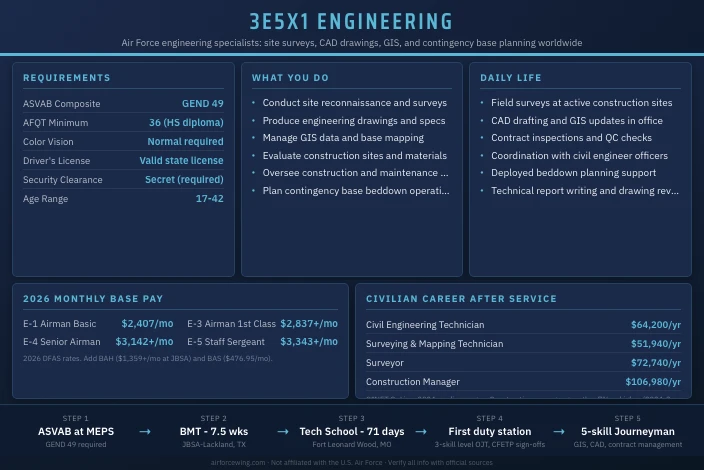
Job Role
Air Force Engineering specialists (AFSC 3E5X1) plan, survey, design, and oversee construction and infrastructure projects at Air Force installations worldwide. They conduct site surveys and reconnaissance, produce engineering drawings and specifications, manage Geographic Information System (GIS) databases, evaluate construction sites, and oversee contractor performance on maintenance and construction contracts. In contingency environments, they develop beddown plans that define how personnel and aircraft will occupy a new or austere base.
Day-to-Day Responsibilities
The work shifts between field and office depending on what’s on the project board. On a typical week, a 3E5X1 Airman might spend part of the day at a construction site inspecting contract work, part of it updating GIS maps in the squadron, and part of it drafting specifications for an upcoming repair project.
Common daily tasks include:
- Running topographic, boundary, and construction surveys using total stations and GPS equipment
- Producing and revising technical drawings using CAD software
- Managing GIS data layers for base infrastructure and real property records
- Reviewing contractor submittals, schedules, and quality control plans
- Evaluating construction materials and site conditions
- Writing technical reports, inspection logs, and project documentation
- Supporting contingency planning by developing personnel and aircraft beddown layouts
Deployed assignments add a different dimension. At forward operating locations, 3E5X1 Airmen may be among the first civil engineer personnel on the ground, conducting rapid surveys and producing the basic plans that allow the rest of the engineering team to work.
Specialized Roles and Codes
The 3E5X1 AFSC does not carry formal shredout suffixes at the base code level, but Airmen naturally develop depth in one of several technical lanes based on assignment and additional training:
| Specialty Area | Focus | Where It’s Common |
|---|---|---|
| GIS / Geospatial | Digital mapping, base infrastructure databases | Installation Civil Engineer squadrons |
| Design and Drafting | CAD drawings, specifications, as-built documentation | Base Civil Engineer design sections |
| Contract Management | Contractor oversight, quality assurance | Installations with large construction programs |
| Contingency Engineering | Beddown planning, expeditionary surveys | Mobility and rapid engineer units |
Special Experience Identifiers (SEIs) can document specific expertise and influence assignment preferences in later career stages.
Mission Contribution
The Air Force can’t sustain operations from a base it hasn’t built or mapped. 3E5X1 Airmen provide the survey data, design documents, and construction oversight that keep Air Force infrastructure functional and compliant with federal and military standards. At contingency locations, their beddown planning work is what allows flying operations to begin, nothing flies from a base that hasn’t been laid out and assessed.
Technology and Equipment
The technical toolkit spans field and office work. Survey instruments include total stations, GPS receivers, and levels. Office work runs through AutoCAD and GIS platforms such as ArcGIS. Contract management requires familiarity with the Air Force Contract Augmentation Program (AFCAP) systems and project tracking software. Deployed operations may involve handheld GPS units, drone-based survey tools, and lightweight drafting setups in austere conditions.
Salary
Base Pay
Pay follows standard military pay tables based on rank and time in service. The table below shows 2026 monthly base pay for common enlisted grades in this AFSC, sourced from DFAS pay tables.
| Rank | Grade | Base Pay (Under 2 Years) | Base Pay (4 Years) |
|---|---|---|---|
| Airman Basic | E-1 | $2,407/mo | $2,407/mo |
| Airman First Class | E-3 | $2,837/mo | $3,198/mo |
| Senior Airman | E-4 | $3,142/mo | $3,659/mo |
| Staff Sergeant | E-5 | $3,343/mo | $3,947/mo |
| Technical Sergeant | E-6 | $3,401/mo | $4,069/mo |
| Master Sergeant | E-7 | $3,932/mo | $4,663/mo |
Base pay alone understates total compensation. Airmen who live off-base receive Basic Allowance for Housing (BAH), which varies by duty location and dependency status. At Joint Base San Antonio, an E-4 without dependents draws $1,359/month in BAH, that’s $16,308 per year on top of base pay. Basic Allowance for Subsistence (BAS) adds $476.95/month for all enlisted Airmen, regardless of where they’re stationed.
Additional Benefits
Active-duty Airmen and their families receive healthcare through TRICARE Prime at no cost: no premiums, no deductibles, and no copays for medical, dental, vision, and prescriptions. The Blended Retirement System includes Thrift Savings Plan (TSP) matching of up to 5% of basic pay, beginning after 60 days of service.
Education is well-supported. Tuition Assistance covers up to $4,500 per year for college courses taken on active duty. The Post-9/11 GI Bill, available after separation, covers full in-state tuition at public universities and up to $29,920.95 per academic year at private schools, along with a monthly housing allowance and up to $1,000 annually in book stipends. Airmen with six or more years of service can transfer GI Bill benefits to dependents.
Leave and Work-Life Balance
Active-duty Airmen earn 30 days of paid leave per year, accruing at 2.5 days per month. Most 3E5X1 assignments in stateside civil engineer squadrons follow a standard Monday-through-Friday schedule, though construction projects and contract deadlines can extend hours. Deployed or expeditionary assignments operate on a different tempo, often running 12-hour days for the duration.
Qualifications
Entry Requirements
| Requirement | Standard |
|---|---|
| Citizenship | U.S. citizen |
| Age | 17-42 |
| Education | High school diploma or equivalent |
| AFQT Minimum | 36 (HS diploma), 65 (GED/alternate credential) |
| ASVAB Composite | GEND 49 |
| Color Vision | Normal color vision required |
| Driver’s License | Valid state driver’s license required |
| Security Clearance | Secret clearance required |
| Math / Computer Skills | Working knowledge of math and computer applications |
The General (GEND) composite tests verbal and quantitative reasoning, word knowledge, paragraph comprehension, arithmetic reasoning, and mathematics knowledge. Candidates should prioritize these four subtests in ASVAB preparation. Unlike some civil engineering AFSCs, 3E5X1 requires only a single composite score, but it also requires a Secret clearance, which adds a background investigation step to the accession process.
The Secret clearance requirement means your background will be reviewed before you can ship to training. Any significant foreign contacts, financial problems, or past drug use can complicate or disqualify the investigation. Be upfront with your recruiter about your history early in the process.
ASVAB line score requirements come from the official Air Force careers page. Scores can change with policy updates, confirm the current threshold with your recruiter before test day.
Application and Selection Process
From initial ASVAB to shipping, the process typically takes 3-6 months. The clearance investigation runs concurrently with other steps in most cases. Waivers are available for some minor medical conditions and certain non-graduate AFQT shortfalls, but the GEND 49 composite cannot be waived.
Service Obligation and Entry Rank
Standard enlisted contracts are 4 years of active duty. Some training pipelines or enlistment bonus agreements carry 6-year obligations. New Airmen enter service as Airman Basic (E-1) regardless of civilian education level.
Strengthen your ASVAB prep with our study guide, or take the PiCAT from home if you haven’t yet tested.
Work Environment
Setting and Schedule
3E5X1 Airmen split their time between field sites and the office. Survey work takes them to active construction sites, perimeter areas, and sometimes off-installation locations. Office work involves CAD stations, GIS workstations, and project tracking software. The ratio changes based on the current project load, a squadron running a major construction contract may have Airmen at the site daily for weeks, while slower periods bring more design and administrative work.
Stateside assignments generally run standard weekday hours with some flexibility around construction inspections that may require early starts. Deployed or expeditionary assignments operate differently: when a forward base is being set up, hours stretch and the pace is unrelenting until the mission is complete.
Chain of Command and Communication
3E5X1 Airmen work within the operations or engineering flight of a civil engineer squadron. They report to NCO supervisors and work closely with civil engineer officers (32E) who rely on them for technical drawing production, survey data, and contract documentation. Communication with contractors is part of the job. Airmen review submittals, attend construction progress meetings, and document contractor performance for the contracting officer’s record.
Work tracking moves through project management and CMMS software. Every inspection, drawing revision, and survey result gets documented. That paper trail has real consequences, inaccurate as-built drawings or missed inspection notes can delay projects and create legal exposure for the government.
Team Dynamics and Autonomy
Junior Airmen at the 3-skill level work under direct NCO supervision on survey parties and drafting tasks. As they build the 5-skill level, they take on independent inspection assignments and begin managing their own sections of larger projects. Senior Airmen and Staff Sergeants with strong technical skills often run contract quality assurance programs with limited daily oversight. The job rewards people who are self-directed and detail-oriented, errors in drawings or survey data ripple through an entire construction project.
Job Satisfaction
3E5X1 Airmen report a high degree of variety in their day-to-day work, which keeps the job from becoming repetitive. The combination of field time, design work, and contract oversight gives Airmen a well-rounded technical background that few other enlisted career fields can replicate. Satisfaction tends to be highest among Airmen who have genuine interest in engineering and construction, and lowest among those who expected a purely outdoor or physical role.
Training
Initial Training Pipeline
| Phase | Location | Duration | Focus |
|---|---|---|---|
| Basic Military Training (BMT) | JBSA-Lackland, TX | 7.5 weeks | Military foundation, fitness, discipline |
| Technical School (3E531 Apprentice) | Fort Leonard Wood, MO | 71 academic days | Surveying, CAD drafting, GIS, contract management, specifications writing |
Tech School at Fort Leonard Wood runs approximately 14 weeks in calendar time, accounting for weekends, holidays, and class start dates. The curriculum covers:
- Land surveying techniques using total stations and GPS
- Topographic and construction survey calculations
- AutoCAD fundamentals and engineering drawing standards
- GIS data management and base infrastructure mapping
- Construction materials testing and inspection procedures
- Contract management basics: specifications, quality control, submittal review
- Contingency engineering: beddown planning, site reconnaissance, expeditionary operations
- Technical report writing and project documentation
Graduates receive the 3-skill level (apprentice) designation and the AFSC code 3E531. Course completion counts toward a Community College of the Air Force (CCAF) degree in Construction Technology, which can be completed during the first enlistment.
Fort Leonard Wood is also home to Army Corps of Engineer training. The installation has a large technical training infrastructure, and 3E5X1 students attend alongside personnel from other military specialties, a useful networking opportunity for Airmen interested in joint construction or engineering roles.
Advanced Training and Development
After reaching the 5-skill level, Airmen can pursue training that deepens their technical and leadership capabilities:
- GIS Advanced Training through Air Force Civil Engineer Center resources
- Project Management Professional (PMP) preparation, many installations support PMP exam prep through Tuition Assistance
- AutoCAD and Civil 3D certification courses available through off-duty education programs
- Quality Assurance Representative (QAR) Training for Airmen assigned to high-value construction contracts
- Troop Construction Project Management Course (AFIT WMGT 437), required for promotion to Master Sergeant
- RED HORSE Pre-Deployment Training for Airmen assigned to expeditionary engineering units
The Air Force’s Tuition Assistance program supports bachelor’s degrees in civil engineering technology, construction management, or geographic information systems, all directly applicable to the 3E5X1 career field and to civilian employment afterward.
Start with a strong ASVAB score. Our study guide covers the General composite subtests in detail.
Career Progression
Rank and Skill Level Timeline
| Rank | Grade | Typical Timeframe | Skill Level |
|---|---|---|---|
| Airman Basic | E-1 | Accession | , |
| Airman | E-2 | 6 months | 3 (Apprentice) |
| Airman First Class | E-3 | 16 months | 3 |
| Senior Airman | E-4 | 36 months | 5 (Journeyman) |
| Staff Sergeant | E-5 | ~6 years total | 5 |
| Technical Sergeant | E-6 | ~10-12 years total | 7 (Craftsman) |
| Master Sergeant | E-7 | ~15-17 years total | 7 |
| Senior Master Sergeant | E-8 | ~19-21 years total | 9 (Superintendent) |
| Chief Master Sergeant | E-9 | ~22+ years total | 9 |
Promotion to Staff Sergeant and above is merit-based and competitive across the Air Force. The Enlisted Performance Report (EPR) drives promotion board scores. For 3E5X1, performance indicators that matter most include drawing quality and technical accuracy, survey and inspection results, contract oversight documentation, and mentorship of junior Airmen.
Specialization and Retraining
Senior Airmen and Staff Sergeants interested in engineering leadership can apply for crossflow into related civil engineering specialties or pursue Officer Training School (OTS) for a commission into the civil engineer officer (32E) career field. Prior 3E5X1 Airmen who commission carry a practical construction and design background that makes them immediately useful in engineering officer roles.
Performance Evaluation
The Air Force EPR system evaluates Airmen across five performance dimensions: Job Performance, Professional Qualities, Organizational Contributions, Fitness, and Leadership. For 3E5X1, supervisors pay particular attention to technical accuracy, a drawing error or missed inspection finding reflects directly on the EPR. Completing the CCAF degree and pursuing additional certifications (PMP, AutoCAD, QAR) consistently strengthens EPR records and promotion competitiveness.
Physical Demands
Daily Physical Requirements
3E5X1 is moderately physical. Survey work in the field involves:
- Walking survey traverses over uneven terrain, sometimes for hours
- Carrying survey equipment, total stations, tripods, rods, typically 20-40 pounds
- Working outdoors in heat, cold, and varying weather
- Climbing ladders or accessing rooftops for as-built documentation
- Extended standing and walking during construction site inspections
The desk-based portion of the job (CAD, GIS, report writing) is sedentary, so the overall physical demand varies considerably day to day. This AFSC doesn’t require exceptional physical conditioning beyond passing the Air Force Fitness Assessment, but Airmen on survey parties in hot climates or austere locations will find the field work genuinely demanding.
Air Force Fitness Assessment Standards
All Airmen must pass the Air Force Fitness Assessment annually. The assessment is age- and gender-normed with a minimum composite passing score of 75 out of 100. The table below shows minimum passing standards for the under-25 age bracket.
| Component | Max Points | Male (Under 25) Min | Female (Under 25) Min |
|---|---|---|---|
| 1.5-Mile Run | 60 | 13:30 | 16:22 |
| Push-Ups (1 min) | 10 | 42 reps | 27 reps |
| Sit-Ups (1 min) | 10 | 38 reps | 38 reps |
| Waist Measurement | 20 | 32.5 inches | 31.5 inches |
There is no modified fitness standard for civil engineering AFSCs. Standards are the same across the Air Force.
Medical Evaluations
The MEPS physical establishes baseline medical qualification. Normal color vision is required at entry and is tested during the MEPS exam. Deployed Airmen receive pre-deployment medical screenings. Airmen doing regular survey fieldwork in high-heat environments should be aware of heat injury risk, unit safety programs address this through hydration requirements and work-rest cycles.
Deployment
Deployment Patterns
Civil engineering Airmen deploy regularly. The standard Air Force deployment cycle runs at roughly a 1:2 ratio for most operational positions, deployed once for every two to three years at home station. Typical deployments last 4-6 months, though contingency operations can run longer.
3E5X1 Airmen deploy as part of base civil engineer expeditionary teams. Their survey and design skills are in high demand at forward locations where base infrastructure needs to be assessed, documented, or expanded rapidly. At a new or damaged installation, 3E5X1 Airmen conduct the site surveys that allow the rest of the engineering team to plan repairs or new construction. Without accurate ground survey data, construction teams cannot properly position new structures, assess drainage patterns, or calculate earthwork volumes. The survey work that seems routine at a stateside garrison assignment becomes operationally critical when the base civil engineer needs a beddown plan within 48 hours of arriving at a contingency location.
Airmen assigned to RED HORSE squadrons face a higher deployment tempo, these units exist specifically for expeditionary construction and often operate in austere, combat-adjacent environments. RED HORSE Airmen deploy with a self-sustained team that carries its own equipment and logistics support. For 3E5X1 Airmen seeking high operational tempo and a more intense version of the expeditionary civil engineer mission, a RED HORSE assignment is the most direct path.
Duty Station Options
3E5X1 Airmen are assigned across the full range of Air Force installations. Common assignment locations include:
- Tyndall AFB, FL (major reconstruction program and expeditionary training)
- Ramstein Air Base, Germany (USAFE installations)
- Kadena AB, Japan (PACAF infrastructure)
- Nellis AFB, NV (Air Warfare Center construction programs)
- Travis AFB, CA (AMC mobility hub)
- Hurlburt Field, FL (special operations support)
OCONUS assignments are common and bring additional overseas pay and allowances alongside the overseas experience. Airmen on accompanied OCONUS tours bring family to the installation; unaccompanied tours run 12 months without family authorization at most locations.
Risk/Safety
Job Hazards
The primary hazards for 3E5X1 Airmen come from the construction environment:
- Struck-by and caught-in hazards on active construction sites, the leading causes of construction fatalities
- Fall hazards when accessing rooftops, scaffolding, or elevated areas for as-built inspections
- Heat and cold stress during extended outdoor survey work in extreme climates
- Vehicle traffic hazards on flight lines and construction zones
Survey work near active flight lines carries specific hazards from aircraft operations, jet blast, and ground vehicle traffic. Airmen working at contingency locations may face additional security and environmental hazards depending on the location.
Safety Protocols
Air Force construction sites operate under OSHA and Air Force safety standards. Key requirements include:
- Personal protective equipment (PPE): hard hats, safety vests, steel-toed boots on all construction sites
- Confined space entry permits for any enclosed inspection work
- Site safety briefings before any survey or inspection activity at active construction projects
- Fall protection systems when working above six feet
- Site-specific hazard analyses for contingency and expeditionary survey operations
3E5X1 Airmen receive construction safety training in Tech School, with refresher training at unit level.
Security and Legal Obligations
The 3E5X1 AFSC requires a Secret security clearance. The investigation is initiated during accession processing and covers employment history, foreign contacts, financial records, and character references. Airmen with an active clearance must report significant foreign travel, new foreign contacts, and financial changes to their security manager.
The standard enlistment contract carries the legal obligations of military service, including the duty to deploy, follow lawful orders, and maintain conduct standards under the Uniform Code of Military Justice (UCMJ).
Impact on Family
Military service reshapes family life regardless of AFSC. Permanent Change of Station (PCS) moves happen roughly every 2-4 years, bringing school transitions for children and job changes for spouses. The Air Force Personnel Center (AFPC) considers documented hardship requests during the assignment process, though mission requirements take priority.
Most Air Force installations offer a full range of family support programs. Military OneSource provides counseling and financial advising. Family readiness centers offer deployment preparation programs and reintegration support. The Air Force Aid Society handles emergency financial needs. Installations near growing metro areas, like those near Tyndall, Travis, or Ramstein, often have active spousal employment markets with federal civilian hiring programs that give military spouses priority placement preference.
Deployments are the biggest strain on families in engineering roles. A 4-6 month deployment every 2-3 years is realistic for active-duty 3E5X1 Airmen. Families who build strong support networks, base programs, other military families, community ties, tend to handle the separation better than those who don’t prepare for it.
The stateside schedule for 3E5X1 is generally more predictable than for specialties tied to flight operations or shift work. Most civil engineer engineering sections operate on a standard weekday schedule during normal operations, with occasional overtime during construction inspection peaks or contract deadlines. That predictability is a real quality-of-life advantage for families compared to shift-work AFSCs. The tradeoff is the deployment cycle, which happens on a recurring basis rather than being rare.
Spouses who work in fields that require state licensing, healthcare, real estate, education, law, face consistent challenges across PCS moves because licenses often don’t transfer between states. The Airman and Family Readiness Center provides spousal employment resources at every installation, and the Military Spouse JD Network, state bar reciprocity programs, and DOD state licensing initiatives have improved portability for some professions. Researching the licensing situation in your likely next duty state before each PCS move avoids last-minute complications.
Reserve and Air National Guard
Component Availability
The 3E5X1 AFSC is available in both the Air Force Reserve and the Air National Guard. Guard units in most states maintain engineering positions, and demand for survey and design skills in part-time components is consistently strong. Air National Guard engineering Airmen also support state emergency response and civil infrastructure missions, which keeps the skill set active between federal deployments.
Drill Schedule and Training Commitment
The standard commitment is one Unit Training Assembly (UTA) weekend per month and two weeks of Annual Tour per year. For 3E5X1 positions, the standard schedule generally holds, though Airmen may need to complete clearance refresher requirements or technical certification renewals on additional days. Units supporting large facility programs or state infrastructure missions may schedule additional drill days around project milestones.
Part-Time Pay
A Reserve or Guard E-4 earns two days of base pay per drill day, four drill days per UTA weekend. At 2026 rates, an E-4 with under two years earns $3,142/month on active duty. That same Airman draws approximately $419 for a drill weekend, just over 13% of a full active-duty month’s base pay, for roughly four days of work.
Component Comparison
| Factor | Active Duty | Air Force Reserve | Air National Guard |
|---|---|---|---|
| Commitment | Full-time | 1 UTA/month + 2-wk Annual Tour | 1 UTA/month + 2-wk Annual Tour |
| Monthly Pay (E-4, <2 yrs) | $3,142/mo | ~$419/drill weekend | ~$419/drill weekend |
| Healthcare | TRICARE Prime (free) | TRICARE Reserve Select (premiums apply) | TRICARE Reserve Select (premiums apply) |
| Education | TA ($4,500/yr) + GI Bill | Federal TA + state tuition waivers (varies) | State tuition waivers (many states cover 100% in-state) |
| Deployment Tempo | 1:2 ratio, 4-6 months | Lower; mobilizations possible | Lower; state missions + federal mobilizations |
| Retirement | 20-year pension (high-36) | Points-based at age 60 | Points-based at age 60 |
Air National Guard members in some states benefit from full in-state tuition waivers, a significant financial advantage for Airmen pursuing engineering or construction management degrees part-time.
Civilian Career Integration
3E5X1 pairs directly with civilian careers in civil engineering, construction management, and geospatial technology. Guard and Reserve service in this AFSC is generally an asset to civilian employers in those industries. Construction firms, survey companies, and GIS consulting firms actively recruit veterans with military engineering backgrounds. USERRA protects civilian employment rights when Airmen are activated and prohibits employer discrimination based on military service status.
Post-Service
Military engineering training translates directly to civilian employment. The skills 3E5X1 Airmen develop, site surveying, CAD and GIS work, construction contract management, and technical report writing, align with multiple well-paying civilian career categories.
The most common post-service paths are civil engineering technician, survey and mapping technician, licensed surveyor (with additional state examination requirements), and construction manager. Airmen who complete a CCAF degree or a bachelor’s degree in construction technology during service can enter civilian positions at higher starting levels, bypassing entry-level roles.
Civilian Career Outlook
| Civilian Job Title | Median Annual Wage | Job Outlook (2024-2034) |
|---|---|---|
| Civil Engineering Technician | $64,200 | Slower than average (+1-2%) |
| Surveying and Mapping Technician | $51,940 | Faster than average (+5-6%) |
| Surveyor | $72,740 | Average (+3-4%) |
| Construction Manager | $106,980 | Much faster than average (+7% or higher) |
Wage data from O*NET OnLine, 2024 median wages.
State licensing for surveyors requires passing a professional examination, but most states offer credit toward licensure for documented military survey experience. Construction manager roles, the highest-paid path in this table, typically require a combination of education and experience, both of which 3E5X1 service directly provides.
Post-service transition support is available through the Transition Assistance Program (TAP), which includes career counseling, resume workshops, and federal hiring assistance. The DOD SkillBridge program allows Airmen to intern with civilian employers for up to 180 days before separation while still receiving full military pay and benefits. The Hiring Our Heroes program connects separating veterans with civilian engineering and construction employers specifically seeking military-trained personnel.
Is This a Good Job
The Right Fit
3E5X1 works best for people who:
- Have genuine interest in engineering, construction, or geospatial technology
- Like work that mixes field time with technical desk work, not just one or the other
- Are comfortable with math and don’t mind technical drawings, specifications, and data management
- Want a skill set with strong, direct civilian value after service
- Can work independently and manage details carefully, drawing errors have real consequences
- Are willing to obtain and maintain a security clearance
The GEND 49 requirement filters for verbal and quantitative aptitude. Candidates who did well in math, English, and any technical coursework tend to pick up the drafting and GIS training quickly. Interest in geography, mapping, or construction is a strong indicator of fit.
Potential Challenges
This AFSC is a poor match if you:
- Want exclusively outdoor or physical work, a significant portion of the job is desk-based
- Are not comfortable with detailed documentation, report writing, or contract paperwork
- Have a background that may complicate a Secret clearance investigation
- Want a role with minimal deployment exposure
- Are not interested in math or technical drawing at any level
The clearance requirement is a real constraint. Candidates with significant foreign contacts, financial problems, or past drug use should discuss this honestly with a recruiter before committing to this AFSC.
Long-Term Perspective
Airmen who stay for a full career move from survey party member to project manager to senior NCO overseeing entire construction programs. The path to Chief Master Sergeant in 3E5X1 runs through increasingly complex contracts, larger GIS programs, and installation-level infrastructure decisions. Those who leave after one or two enlistments typically enter civilian employment with marketable technical skills, a CCAF credential, and documented project experience. Construction management at the senior level offers six-figure civilian salaries and is one of the faster-growing engineering occupations in the country, and the 3E5X1 background is a direct pipeline into it.
More Information
Talk to an Air Force recruiter to find out if 3E5X1 seats are available in your contract cycle, what the current GEND score threshold looks like, and whether any enlistment incentives apply. Recruiters can also walk you through the clearance investigation timeline and what to expect at MEPS. Visit airforce.com for the official job description and current qualification details.
When you talk to a recruiter, ask specifically about the Secret clearance investigation process and how long it typically takes from enlistment to clearance adjudication. The investigation runs concurrently with accession steps in most cases, but candidates with complex backgrounds, significant foreign travel, previous drug use, or financial issues, may experience delays. Being transparent with your recruiter about your history upfront gives them the information needed to set accurate expectations.
For research beyond the recruiter conversation, these sources are worth reviewing:
- airforce.com: Engineering, official AFSC description and current qualification requirements
- Air Force Civil Engineer Center (AFCEC), context on the civil engineer mission, RED HORSE operations, and installation support programs
- Community College of the Air Force (CCAF), details on the Construction Technology associate degree that 3E5X1 Tech School credits apply toward
- O*NET: Civil Engineering Technicians, civilian occupational requirements and salary benchmarks for post-service planning
- Project Management Institute (PMI), information on the PMP certification that senior 3E5X1 Airmen commonly pursue on active duty
The CCAF degree enrollment is automatic when you start technical training. Many Airmen complete the Construction Technology associate degree within their first enlistment by completing a few general education courses on base through Tuition Assistance. Check your CCAF transcript through your education office early in your first assignment to see how many credits you already have.
- Prepare for the ASVAB with our study guide to hit the GEND 49 threshold
This site is not affiliated with the U.S. Air Force or any government agency. Verify all information with official Air Force sources before making enlistment or career decisions.
Explore more Air Force civil engineering careers such as 3E0X1 Electrical Systems and 3E1X1 HVAC and Refrigeration.