3E2X1 Pavements and Construction Equipment
Every runway an F-22 launches from, every aircraft parking apron at a forward operating location, every road connecting a base’s hangars to its fuel depot. Airmen in 3E2X1 built or repaired them. The Pavements and Construction Equipment specialty puts you behind the controls of bulldozers, excavators, and asphalt pavers, then hands you demolitions training on top of it. It’s one of the few enlisted AFSCs where you spend your career operating heavy iron and blowing things up, all in the same job.
Qualifying requires specific ASVAB line scores. Our ASVAB study guide covers what to target and how to prepare.
Job Role
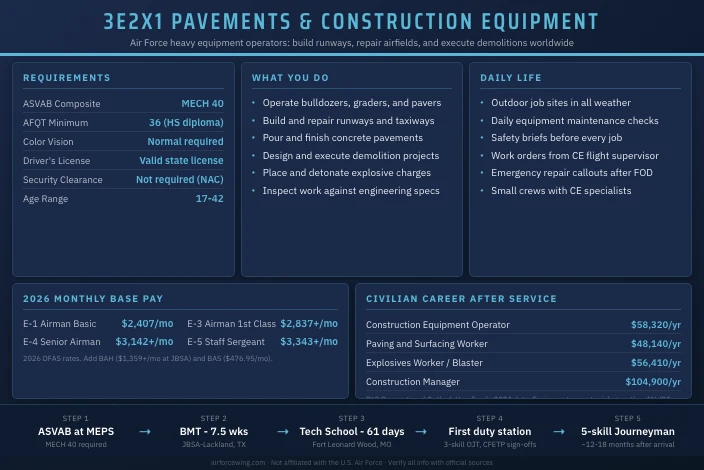
3E2X1 Airmen operate heavy construction equipment and build, repair, and maintain airfield pavements, roads, and base infrastructure. They construct and inspect concrete and asphalt runways, aircraft parking aprons, taxiways, and roads. They also design demolition projects, place charges, and detonate explosives to clear or prepare construction sites.
Daily Tasks
Depending on the installation and mission requirements, a typical duty day can include:
- Operating bulldozers, motor graders, front-end loaders, excavators, and asphalt pavers
- Pouring and finishing concrete slabs for aircraft parking areas and base roads
- Laying and compacting asphalt on runways and taxiways
- Inspecting completed work against engineering specs and quality standards
- Planning and executing controlled demolitions of structures or pavement
- Performing operator-level maintenance checks on construction equipment
- Coordinating with civil engineering flight supervisors on project timelines and priorities
Most of your workday happens outdoors on job sites. You’ll frequently share the job site with other civil engineer specialists, electricians, water and fuels personnel, and structural Airmen.
Specific Roles
The 3E2X1 career field uses skill-level suffixes to indicate experience, not specialty shredouts. There are no formal prefix codes that redirect into separate career tracks.
| Code | Title |
|---|---|
| 3E231 | Pavements and Construction Equipment (Apprentice) |
| 3E251 | Pavements and Construction Equipment (Journeyman) |
| 3E271 | Pavements and Construction Equipment (Craftsman) |
| 3E291 | Pavements and Construction Equipment (Superintendent) |
Mission Contribution
Air Force flight operations depend entirely on maintained airfields. A cracked taxiway or a failed runway surface can ground aircraft and shut down a mission. When a base takes damage during combat operations, or when the Air Force needs to establish a bare base in an austere location, 3E2X1 Airmen are the ones who show up first to grade the site and put down the pavement that makes operations possible.
Technology and Equipment
This AFSC is as hands-on as it gets. You operate equipment including bulldozers, scrapers, motor graders, compactors, and asphalt paving machines. On demolitions tasks you work with standard military explosive charges and detonating systems. At some installations you’ll use computer-aided design (CAD) software and engineering specifications to plan project layouts before breaking ground.
A strong ASVAB score opens more doors during the accessions process, the ASVAB prep guide covers every subtest that feeds the MECH composite.
Salary
Base pay depends on rank and years of service. A new Airman in this AFSC starts at the E-1 through E-4 range while in initial training and at the first duty station.
Base Pay
| Rank | Grade | Entry Pay (Under 2 Yrs) |
|---|---|---|
| Airman Basic | E-1 | $2,407/mo |
| Airman | E-2 | $2,698/mo |
| Airman First Class | E-3 | $2,837/mo |
| Senior Airman | E-4 | $3,142/mo |
| Staff Sergeant | E-5 | $3,343/mo |
| Technical Sergeant | E-6 | $3,401/mo |
All figures come from the DFAS 2026 pay tables.
Pay climbs steadily with promotions and time in service. A Technical Sergeant (E-6) with 12 years of service earns $5,044 per month in base pay alone.
Allowances and Total Compensation
Base pay is only part of the picture. Tax-free allowances add meaningful money to each paycheck:
- BAH (Basic Allowance for Housing): Varies by duty station, pay grade, and dependent status. At Joint Base San Antonio, a single E-4 receives $1,359/mo; with dependents, $1,728/mo.
- BAS (Basic Allowance for Subsistence): $476.95/mo for all enlisted Airmen.
- Special pays: No AFSC-specific special pay exists for 3E2X1, but hazardous duty incentive pay may apply during demolitions-qualified deployments. Check with your recruiter for current rates.
Benefits
Healthcare: Active-duty Airmen and their dependents are covered under TRICARE Prime at no cost. Coverage includes medical, dental, vision, mental health, and prescriptions with no enrollment fees or copays.
Education: Air Force Tuition Assistance covers up to $4,500 per year for college courses taken while on active duty. The Post-9/11 GI Bill pays full in-state tuition at public universities and up to $29,920.95 per academic year at private schools, plus a monthly housing allowance and an annual book stipend.
Retirement: The Blended Retirement System (BRS) combines a 20-year pension at 40% of your high-36 average pay with Thrift Savings Plan (TSP) matching. The government contributes up to 5% of your base pay to your TSP.
Leave: 30 days of paid leave per year, accruing at 2.5 days per month.
Work-Life Balance
Work schedules vary by installation and deployment cycle. On a typical garrison week, Airmen work a standard duty day from Monday through Friday. Large construction projects or emergency repair tasking can push the schedule into nights and weekends. Some civil engineering flights use shift work to maintain 24-hour operational capability, particularly at high-tempo bases.
Qualifications
Requirements Table
| Requirement | Standard |
|---|---|
| ASVAB Composite | Mechanical (MECH) 40 |
| AFQT Minimum | 36 (HS diploma), 65 (GED) |
| Citizenship | U.S. citizen |
| Age at Enlistment | 17-42 |
| Color Vision | Normal required |
| Driver’s License | Valid state license required |
| Security Clearance | Not required (National Agency Check) |
| Physical Profile | Must meet PULHES standards |
Requirements are published on the airforce.com 3E2X1 career page.
The MECH composite score draws from General Science, Auto and Shop Information, Mathematics Knowledge, and Mechanical Comprehension subtests of the ASVAB. Study time on mechanical reasoning and basic math pays off here. The PICAT practice test lets you preview ASVAB questions before your official MEPS appointment.
The MECH 40 requirement is on the lower end of civil engineering AFSC minimums. Scoring higher gives you more AFSC options during the accessions process and can make you more competitive for assignment preferences.
Application Process
Selection Criteria
3E2X1 is not a highly competitive AFSC at the point of accession, the MECH 40 threshold is achievable for most candidates who study for the test. A valid driver’s license is required before you ship. If you’ve operated any heavy equipment in civilian life, farm equipment, forklifts, road construction machinery, mention it to your recruiter. Prior experience doesn’t change the minimum score requirement, but it signals aptitude to your training cadre once you reach Tech School.
Service Obligation
Active-duty enlistees commit to a four-year initial enlistment. You enter at E-1 (Airman Basic) on day one of Basic Military Training.
Color vision waivers are not available for 3E2X1. If you have a color vision deficiency identified at MEPS, you will not be eligible for this AFSC.
Work Environment
Setting and Schedule
This job is almost entirely outdoors. Job sites range from airfield aprons baking in direct sun to forward operating locations in desert or arctic conditions. You’ll work in heat, cold, rain, and dust depending on where you’re stationed and what mission you’re supporting.
The physical environment is also noisy. Heavy equipment produces significant sound levels, and personal protective equipment (PPE) including hearing protection and safety vests is standard on every job site.
Most garrison duty follows a standard Monday through Friday schedule, but project deadlines and emergency repair requirements can change that quickly. An FOD (Foreign Object Debris) incident on an active runway or storm damage to taxiways can trigger an immediate, around-the-clock repair response.
Leadership and Communication
3E2X1 Airmen work in civil engineering flights or squadrons under the base civil engineer. Day-to-day direction comes from NCO supervisors who manage project work orders and resource allocation. Communication is direct and task-focused. On job sites, safety briefs before work begins are standard.
Performance feedback happens through the Enlisted Performance Report (EPR) system, typically on an annual cycle. Your NCO rates your job performance, adherence to standards, and potential for advancement.
Team Dynamics and Autonomy
At lower skill levels you work under close supervision, executing tasks as directed. As you progress to the 5-skill journeyman level you’ll take on more independent work and may lead small teams. Craftsmen (7-level) regularly supervise projects and smaller Airmen. The job demands situational awareness and personal discipline on job sites, heavy equipment accidents are serious, and the safety culture reflects that.
Job Satisfaction
Airmen in 3E2X1 consistently point to the tangible nature of the work as a source of satisfaction. You see what you built. A runway or road you constructed supports missions for years. The demolitions training element draws a lot of interest from recruits, and for those who enjoy it, it remains a distinctive part of the career for the full term. Retention rates in civil engineering specialties are generally steady, though they fluctuate with civilian construction labor market conditions.
Training
Training Pipeline
| Phase | Location | Duration | Focus |
|---|---|---|---|
| Basic Military Training (BMT) | JBSA-Lackland, TX | 7.5 weeks | Military foundations, fitness, discipline |
| Technical School | Fort Leonard Wood, MO | 61 days (~8.5 weeks) | Equipment operation, pavements construction, demolitions |
After arriving at your first duty station, you continue skills development under the Career Field Education and Training Plan (CFETP). Your supervisor signs off on tasks in your training record as you demonstrate proficiency. Reaching the 5-skill journeyman level requires completing all core task requirements and satisfying time-in-service criteria.
Tech School Details
The 3E2X1 Tech School at Fort Leonard Wood, MO covers:
- Identifying and operating major construction equipment types (dozers, graders, scrapers, pavers, compactors)
- Concrete and asphalt pavement construction techniques
- Airfield pavement repair methods
- Demolitions fundamentals: charge placement, detonating systems, and safety procedures
- Equipment maintenance checks and operator-level servicing
- Airfield inspection and quality assurance procedures
You leave Tech School eligible to earn college credit toward a Construction Technology degree, making this one of the AFSCs where your training has a direct civilian credential pathway from day one. Before you ship, a solid MECH score is your ticket, the ASVAB study guide targets exactly the subtests this composite draws from.
Advanced Training
Once you reach the 5-skill level, career development opportunities include:
- Noncommissioned Officer (NCO) leadership courses through the Enlisted Professional Military Education (EPME) system
- Advanced explosive demolitions training through the civil engineer readiness program
- Opportunities to attend the Air Force School of Engineering (for senior NCOs)
- Off-duty education through Tuition Assistance toward associate or bachelor’s degrees in construction management or a related field
Career Progression
Rank and Skill-Level Progression
| Rank | Grade | Typical TIG | Skill Level |
|---|---|---|---|
| Airman Basic | E-1 | 0-6 months | 1-level (trainee) |
| Airman | E-2 | 6 months | 3-level (in Tech School) |
| Airman First Class | E-3 | 1 year | 3-level |
| Senior Airman | E-4 | 3 years | 5-level (journeyman) |
| Staff Sergeant | E-5 | 5-6 years | 5-level |
| Technical Sergeant | E-6 | 9-11 years | 7-level (craftsman) |
| Master Sergeant | E-7 | 14-17 years | 7-level |
| Senior Master Sergeant | E-8 | 18-20 years | 9-level (superintendent) |
| Chief Master Sergeant | E-9 | 22+ years | 9-level |
TIG = typical time-in-grade; promotion timing varies by Air Force-wide promotion rates and individual performance.
Role Flexibility and Transfers
If your interests shift, the Air Force allows retraining requests after your initial enlistment obligation is complete, subject to Air Force needs and manning levels. Civil engineer career fields share common technical foundations, which makes lateral moves into specialties like 3E1X1 (Heating, Ventilation and Air Conditioning) or 3E0X1 (Electrical Systems) a reasonable transition for motivated Airmen.
Performance Evaluation
The Enlisted Performance Report rates you in several performance areas including job knowledge, duty performance, leadership, and personal conduct. Stratified EPR rankings ("#1 of 15 SSgts") carry significant weight for promotion board consideration. Feedback from supervisors happens at least twice per rating period through the formal feedback system.
Succeeding in This Career
Three things drive success in 3E2X1: showing up to every job site with situational awareness, taking equipment maintenance seriously, and building your technical reputation early. Airmen who get noticed are those who volunteer for additional duties, pursue off-duty education, and earn strong stratified EPR rankings. The demolitions qualification is a differentiator. Airmen who maintain currency in that skill are more competitive for deployment taskings and special duty assignments.
Physical Demands
Daily Physical Requirements
This is a physically demanding job. A typical day involves:
- Standing, walking, and bending for extended periods on job sites
- Climbing into and out of heavy equipment cabs repeatedly
- Lifting and carrying materials up to 50 pounds
- Working in extreme heat and cold without significant indoor relief
- Operating vibrating machinery (hand-arm and whole-body vibration exposure is ongoing)
Hearing protection is mandatory around operating equipment. Sun and heat exposure is constant at many duty locations. Demolitions work requires fine motor control and calm focus under potentially hazardous conditions.
Air Force Fitness Assessment Standards
All Airmen take the Air Force Fitness Assessment (FA) annually. The FA is scored on a 100-point scale with a minimum passing composite of 75. Standards are age- and gender-normed.
| Component | Max Points |
|---|---|
| 1.5-Mile Run | 60 |
| Push-Ups (1 minute) | 10 |
| Sit-Ups (1 minute) | 10 |
| Waist Circumference | 20 |
Each component has a minimum passing threshold in addition to the composite score requirement. Standards are published annually by Air Force Personnel Center.
Medical Evaluations
Initial medical qualification happens at MEPS. Color vision is tested at MEPS, a deficiency disqualifies you from this AFSC without waiver eligibility. Periodic occupational health reviews are standard for Airmen working around construction equipment, noise, and demolitions materials. Hearing tests (audiograms) are conducted at regular intervals given ongoing noise exposure in the field.
Deployment
Deployment Details
3E2X1 Airmen deploy at a moderate-to-high tempo. Civil engineer units are in demand for contingency operations because bases cannot function without maintained pavements and infrastructure. Deployments typically run 4 to 6 months, though Air Expeditionary Force (AEF) rotation schedules and unit mission requirements affect actual lengths.
Overseas and contingency deployments can take 3E2X1 Airmen to bare bases and forward locations where infrastructure is minimal. Building or repairing runways in austere environments with limited resources is a real part of the job. At a bare base deployment, the team may arrive to nothing but a cleared site and must establish basic operations capability, grading and compacting aircraft parking surfaces, cutting roads between facilities, and laying or repairing asphalt before flying operations can begin. This is one of the most operationally relevant phases of the job, and it’s where equipment skills built during stateside assignments matter the most.
Demolitions-qualified Airmen may also support site clearance operations during contingency deployments, using explosive demolitions to remove obstacles, clear structures, or prepare terrain for construction. The rules governing use of demolitions in operational environments are governed by operational orders and theater-level approval authorities, not by individual discretion.
Duty Stations
3E2X1 Airmen serve at installations worldwide wherever the Air Force maintains civil engineer squadrons. Installations with active civil engineer operations include:
- Travis AFB, CA: large civil engineer squadron with heavy equipment operations
- Seymour Johnson AFB, NC: ACC installation with active pavement maintenance programs
- Kadena AB, Japan: OCONUS Pacific installation
- Ramstein AB, Germany: major USAFE hub
- Joint Base Pearl Harbor-Hickam, HI: Pacific assignment with joint base infrastructure
- Tyndall AFB, FL: major reconstruction program following 2018 hurricane damage
First-duty station assignments depend on Air Force needs. You can submit a Dream Sheet listing preferred locations, but assignment is not guaranteed. OCONUS tours provide additional pay and allowances including overseas cost-of-living adjustments.
Risk/Safety
Job Hazards
3E2X1 carries genuine occupational hazards:
- Heavy equipment accidents: Operating bulldozers and pavers in close proximity to personnel creates serious injury risk if safety procedures are ignored.
- Explosive materials: Demolitions training and real-world use introduces hazards that require strict adherence to safety protocols.
- Noise-induced hearing loss: Long-term exposure to heavy equipment engines and demolitions blasts is an occupational health concern.
- Heat and cold injuries: Extended outdoor work in extreme climates increases risk of heat exhaustion, heat stroke, frostbite, and hypothermia.
Safety Protocols
Air Force civil engineer units follow established safety standards that include mandatory PPE (hearing protection, hard hats, safety vests, gloves), pre-operation equipment checks, safety briefings before each work evolution, and strict chain-of-command sign-off procedures for demolitions operations. Violations carry serious disciplinary consequences.
Security and Legal Requirements
3E2X1 does not require a formal security clearance beyond a standard National Agency Check (NAC) conducted during accessions processing. The enlistment contract establishes your service obligation. Deployment orders are non-negotiable, you go where the Air Force sends you. Demolitions work falls under strict legal and safety frameworks governing ordnance handling, and unauthorized procedures carry criminal and administrative consequences under the Uniform Code of Military Justice (UCMJ).
Impact on Family
Family Considerations
Deployment cycles and irregular work hours during high-tempo periods affect family life. Civil engineer units tend to deploy at a moderate rate, meaning some years may include two or more shorter deployments or one long one. The Air Force provides:
- Family support programs through the Airman and Family Readiness Center
- On-base family housing or BAH to cover off-base housing costs
- TRICARE coverage for eligible dependents at no enrollment cost
- School liaison programs for families with children
Emergency repair tasking can pull 3E2X1 Airmen away from home with little or no notice. A runway damaged by severe weather, an apron failure during flight operations, or a declared civil engineering emergency at a remote installation can mean an unplanned absence of days to weeks, even for Airmen at their home station. Families benefit from treating the schedule as variable rather than assuming it will follow the standard garrison pattern.
For spouses pursuing professional careers, the regular PCS move cycle is the most significant lifestyle challenge. State licensing for skilled trades and many professional fields requires state-specific credentials that don’t automatically transfer when you move. While military spouse portability laws have improved in some professions, families should research licensing requirements in likely duty station states before making long-term career plans. The Airman and Family Readiness Center at any installation can connect spouses with employment resources and licensing guidance specific to the new duty station area.
Relocation
Permanent Change of Station (PCS) moves typically happen every 3 to 4 years. The Air Force pays for your household goods move, and BAH covers housing at the new installation. Frequent moves are a reality of military life, and families who build flexibility into their plans adjust more easily than those who don’t.
Reserve and Air National Guard
Component Availability
3E2X1 is available in both the Air Force Reserve and the Air National Guard. Civil engineering is one of the most actively recruited specialties in the Reserve Component because infrastructure capability is in demand both stateside and during deployments. The Air National Guard operates 3E2X1 positions at most state Wings.
Drill Schedule and Training Commitment
Standard Reserve Component commitment is one Unit Training Assembly (UTA) weekend per month, typically two 4-hour periods per day (16 total training periods annually), plus a 15-day Annual Tour each year. Civil engineer units may require additional training days for equipment currency or specialized exercises. Demolitions currency requires periodic recertification.
Part-Time Pay
An E-4 (Senior Airman) earns 4 days of base pay per drill weekend (one UTA = 4 drill periods). At the 2026 under-two-years rate, that’s approximately $419/weekend (4 x $3,142/mo ÷ 30 days). Active-duty E-4 monthly base pay is $3,142/mo. Reserve drill pay covers only training days, not a full-time income substitute.
Benefits Comparison
| Feature | Active Duty | Air Force Reserve | Air National Guard |
|---|---|---|---|
| Commitment | Full-time | 1 wknd/mo + 15 days/yr | 1 wknd/mo + 15 days/yr |
| Monthly Base Pay (E-4) | $3,142 | ~$419/drill weekend | ~$419/drill weekend |
| Healthcare | TRICARE Prime (free) | TRICARE Reserve Select (premium-based) | TRICARE Reserve Select or state options |
| Tuition Assistance | Up to $4,500/yr (federal) | Up to $4,500/yr (federal) | Federal TA + state tuition waivers (varies by state) |
| GI Bill | Post-9/11 GI Bill (full) | Montgomery GI Bill-SR or kicker if called to AD | Similar to Reserve, plus state benefits |
| Retirement | 20-yr pension (BRS) | Points-based Reserve pension | Points-based Reserve pension |
| Deployment Tempo | Moderate-high | Mobilization-based | Mobilization-based |
Deployment and Mobilization
Reserve and Air National Guard Airmen in 3E2X1 can be mobilized for contingency deployments, natural disaster response (airfield restoration after hurricanes or floods is a frequent mission), and overseas rotations. Mobilization length varies from 30-day activations to full 6-month deployments depending on mission requirements.
Civilian Career Integration
The Air National Guard is especially well-suited for 3E2X1 Airmen with civilian construction industry careers. Heavy equipment operators, paving contractors, and construction project managers can maintain Guard membership without the frequent PCS moves of active duty. USERRA protects your civilian employment rights while on military orders, your employer must reemploy you after deployment and cannot penalize you for military service.
Post-Service
Transition to Civilian Life
Military construction skills transfer directly to the civilian market. Airmen who leave with 3E2X1 experience carry:
- Heavy equipment operator certifications recognized by civilian contractors
- Demolitions training that may qualify for specialized civilian demolition work (with appropriate licensing)
- Project management experience from running construction tasking
- Safety training equivalent to OSHA standards in many respects
The Transition Assistance Program (TAP) at every installation provides workshops on resume writing, interview preparation, VA benefits, and employer connections.
Civilian Career Prospects
| Civilian Job Title | Median Annual Wage | Job Outlook (2024-2034) |
|---|---|---|
| Construction Equipment Operator | $58,320 | +4% (as fast as average) |
| Paving and Surfacing Worker | $48,140 | +5% |
| Construction Manager | $104,900 | +8% |
| Explosives Worker / Blaster | $56,410 | +4% |
Wage data from the BLS Occupational Outlook Handbook (2024). About 46,200 construction equipment operator openings are projected annually through 2034.
Union-affiliated construction trades often give military veterans credit toward apprenticeship hours, accelerating the path to journeyman pay rates in the civilian trades.
Education Benefits
The Post-9/11 GI Bill covers full in-state tuition at public universities plus a monthly housing allowance. Tech School credits apply toward Construction Technology associate degree programs at many community colleges. Construction management bachelor’s degrees are a natural fit for 3E2X1 Airmen who want to move into project management roles.
Is This a Good Job
Ideal Candidate Profile
3E2X1 attracts people who are comfortable working outdoors in all conditions, like operating machinery, and want tangible results from their work. If you grew up around construction, farming, or mechanical trades you’ll recognize the rhythm of this job quickly.
Strong candidates typically:
- Prefer physical, hands-on work over desk assignments
- Have patience for the pace of construction projects (build quality takes time)
- Take safety culture seriously
- Want a civilian-marketable skill set at the end of their service
The demolitions component draws interest from a specific type of person, one who wants a structured environment that still involves controlled, high-consequence technical work. That’s the job.
Potential Challenges
This AFSC is not a good fit if you have trouble with outdoor physical work, don’t adapt well to irregular hours and deployment disruptions, or expect a stable 9-to-5 schedule at a single location. PCS moves every few years are a given. The noise and vibration environment is persistent, long-term hearing protection discipline matters for your quality of life after service.
Demolitions work requires psychological steadiness. The training pipeline identifies those who don’t handle the stress of ordnance work well, and there’s no shame in finding that out early. Most Airmen who struggle with the physical demands do so in the first year before fitness becomes routine.
Career and Lifestyle Alignment
If your goal is to build a civilian construction career, 3E2X1 is one of the most direct AFSC-to-civilian pipelines in the Air Force. Four years of active duty produces a credentialed, experienced equipment operator who walks into the civilian market ahead of peers who trained the traditional route. If you intend to stay in for 20 years, the 3E2X1 career field has a clear senior NCO path with increasing supervisory responsibility at large civil engineer units.
This site is not affiliated with the U.S. Air Force or any government agency. Verify all information with official Air Force sources before making enlistment or career decisions.
More Information
Talk to an Air Force recruiter to get current ASVAB score cutoffs, available bonuses, and first-duty station options for 3E2X1. Recruiting offices can also connect you with Airmen currently serving in the career field. If you haven’t taken the ASVAB yet, the ASVAB prep guide is the best place to start.
When you meet with a recruiter, ask whether demolitions qualification is guaranteed as part of the tech school pipeline or whether it depends on assignment. Also ask about current deployment rates for civil engineer units, the tempo changes with Air Force operational requirements, and a recruiter with recent placements in the career field can give you a current picture. Ask specifically whether any enlistment bonuses are tied to 3E2X1 in the current fiscal year, as bonus availability changes quarterly.
For official information on this career field, the following sources are reliable:
- airforce.com: Pavements and Construction Equipment, official AFSC overview and current qualification details
- Air Force Civil Engineer Center (AFCEC), context on civil engineer mission and capabilities
- BLS Occupational Outlook Handbook: Construction Equipment Operators, civilian wage and employment data for post-service planning
The Community College of the Air Force (CCAF) automatically enrolls you when you begin tech school. By the time you finish your first enlistment, you may have enough credits toward a Construction Technology associate degree to complete it with minimal additional coursework. Ask your education office about your CCAF credit status early in your first assignment, many Airmen finish the degree mid-career without realizing how close they already are.
This site is not affiliated with the U.S. Air Force or any government agency. Verify all information with official Air Force sources before making enlistment or career decisions.
Explore more Air Force civil engineering careers such as 3E0X1 Electrical Systems and 3E1X1 Heating and HVAC.