3E1X1 Heating, Ventilation, Air Conditioning and Refrigeration
Every base in the Air Force depends on systems that most Airmen never think about, until they break. The 3E1X1 HVAC and Refrigeration technician is the person who keeps those systems running. Climate control in aircraft hangars, medical refrigeration units, boiler plants, industrial chillers: if it moves air or manages temperature, this AFSC owns it. The job combines hands-on mechanical work with real technical depth, and it translates almost directly into one of the most in-demand civilian trades in the country. Civilian HVAC technicians earned a median salary of $59,810 in 2024, with job growth projected at 8 percent through 2034. The Air Force will train you to do this work at no cost, then pay you while you do it.
Qualifying requires specific ASVAB line scores, our ASVAB study guide covers what to target and how to prepare.
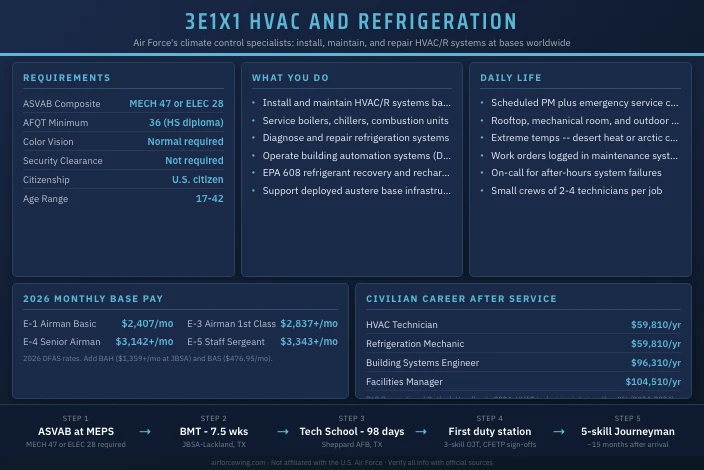
Job Role
The 3E1X1 AFSC covers the installation, operation, maintenance, and repair of heating, ventilation, air conditioning, and refrigeration (HVAC/R) systems across Air Force installations. Technicians work on equipment ranging from small window units and walk-in freezers to large central plant chillers and boiler systems that heat entire base complexes. The role also includes combustion heating equipment and industrial air compressors used in maintenance and flight operations.
What You Do Day to Day
A typical shift involves a mix of scheduled preventive maintenance and emergency service calls. On any given day you might be:
- Inspecting and replacing filters, belts, and refrigerant levels on base housing units
- Troubleshooting a failed chiller at a medical clinic or command facility
- Servicing boiler controls and fuel systems in a heating plant
- Running refrigerant recovery equipment and recharging systems to EPA standards
- Responding to a compressor failure in a food storage facility
- Documenting work in maintenance management systems
Weather extremes drive the tempo. Extreme cold or heat generates a surge of emergency calls, and HVAC technicians often work overtime when base infrastructure is stressed.
Specialty Codes and Shredouts
The 3E1X1 AFSC follows the standard Air Force skill-level suffix system:
| Code | Description |
|---|---|
| 3E131 | HVAC/R, Apprentice (3-skill level, Tech School graduate) |
| 3E151 | HVAC/R, Journeyman (5-skill level) |
| 3E171 | HVAC/R, Craftsman (7-skill level) |
| 3E191 | HVAC/R, Superintendent (9-skill level) |
No published lateral shredouts exist for 3E1X1. Specialization typically develops through assignment to specific equipment types, industrial refrigeration, central plant, or flight line support, rather than a formal AFSC suffix.
Mission Contribution
Uncontrolled temperature is an operational problem, not just a comfort issue. Weapons storage, avionics maintenance facilities, medical clinics, server rooms, and aircraft hangars all have strict environmental requirements. A chiller failure in an avionics repair shop can ground aircraft. A refrigeration failure in a medical facility puts patient care at risk. The 3E1X1 technician is the safeguard between those risks and mission failure.
Equipment and Technology
The work spans a wide range of equipment types. You will operate refrigerant recovery and recharging equipment, combustion analyzers, electronic diagnostic tools, and building automation system (BAS) terminals. Large installations use central chiller plants and campus-wide direct digital control (DDC) networks to manage temperature across hundreds of buildings. At smaller bases, the same Airman handles everything from window units to heating plants personally.
Salary
Base Pay and Allowances
Air Force pay is the same regardless of AFSC. All figures below are 2026 DFAS rates.
| Pay Grade | Rank | Monthly Base Pay (Entry) |
|---|---|---|
| E-1 | Airman Basic (AB) | $2,407 |
| E-2 | Airman (Amn) | $2,698 |
| E-3 | Airman First Class (A1C) | $2,837 |
| E-4 | Senior Airman (SrA) | $3,142 |
| E-5 | Staff Sergeant (SSgt) | $3,343 |
| E-6 | Technical Sergeant (TSgt) | $3,401 |
Base pay does not tell the full compensation picture. Add Basic Allowance for Housing (BAH), which varies by duty station and dependency status. At Joint Base San Antonio, a single E-4 receives $1,359 per month in BAH. A single E-5 gets $1,500 per month. Basic Allowance for Subsistence (BAS) adds $476.95 per month for all enlisted members in 2026. Neither allowance is taxable income.
Additional Benefits
Healthcare under TRICARE Prime costs nothing on active duty, no enrollment fee, no deductible, and no copay for most services. Coverage includes medical, dental, vision, mental health, and prescriptions. The Thrift Savings Plan (TSP) under the Blended Retirement System starts with a 1% automatic government contribution after 60 days, then matches up to 4% of basic pay once you begin contributing.
The Post-9/11 GI Bill covers full in-state tuition at public schools and up to $29,920.95 per year at private schools for the 2025-2026 academic year. You also receive a monthly housing allowance and up to $1,000 per year in book stipends. After six years of service and a four-year re-enlistment commitment, you can transfer GI Bill benefits to a dependent.
Work-Life Balance
Most HVAC/R technicians work standard day shifts during normal operations. When equipment fails at 0200 in a medical facility or a critical storage area, on-call rotations bring technicians in regardless of hour. Deployments add tempo to the schedule, but stateside assignments are generally predictable. Annual leave accrues at 2.5 days per month, 30 days per year, with a maximum 60-day carryover.
Qualifications
Entry Requirements Table
| Requirement | Standard |
|---|---|
| ASVAB Composite | MECH 47 or ELEC 28 |
| AFQT Minimum | 36 (high school diploma) |
| Color Vision | Normal required (per AFI 48-123) |
| Driver’s License | Valid state license required |
| Citizenship | U.S. citizen |
| Age | 17-42 |
| Security Clearance | Not required |
| Medical | Normal per MEPS standards |
The OR condition on the ASVAB composite is meaningful. If your mechanical score misses 47, you can still qualify with an electrical score of 28, a much lower bar. This makes 3E1X1 accessible to a wide range of applicants. Verify current scores with your recruiter, as thresholds can be updated by AFPC.
The MECH composite draws from General Science, Auto/Shop, Mathematics Knowledge, and Mechanical Comprehension subtests. An ASVAB prep course focused on mechanical reasoning and auto/shop knowledge is the fastest way to hit the 47 threshold.
Waivers
Color vision waivers are not available for this AFSC, normal color vision is a hard requirement because technicians must distinguish wire colors, refrigerant gauges, and warning indicators. Age waivers above 42 require AFPC approval and are uncommon. Other medical waivers follow standard Air Force waiver procedures through MEPS and AFPC.
Application Process
The path from interest to assignment follows a standard enlisted accession timeline:
Service Obligation and Entry Grade
All non-prior service enlisted recruits enter as E-1 Airman Basic. A standard four-year active-duty service commitment applies for most accession contracts. Some six-year contracts are available and may be tied to specific bonus eligibility. Recruits with college credits or specific credentials may qualify for an advanced entry grade waiver to E-2 or E-3 at accession.
See our ASVAB study guide for strategies to hit these line scores.
Work Environment
Setting and Schedule
3E1X1 technicians work in nearly every physical environment an Air Force base contains. One assignment might be an office-temperature climate-control room inside a centralized plant. The next service call is a rooftop unit in Texas in July or a boiler room in Alaska in January. Outdoor work in extreme temperatures is routine, not exceptional.
Most stateside assignments operate on a standard Monday-through-Friday schedule with rotating on-call duty for after-hours emergencies. Deployed locations often run 12-hour shifts, six or seven days per week, depending on mission tempo. Flight line support environments can add noise, hazardous materials, and confined-space work to the daily mix.
Chain of Command and Performance Feedback
HVAC/R technicians typically work in a Civil Engineer Squadron (CES) under the Operations Flight. The immediate chain runs from the crew chief or work center NCO up through the Operations Flight Commander. Work orders are generated through maintenance management systems (currently TRIRIGA or similar), which tracks task completion and creates a documented performance record.
The Air Force uses the Enlisted Performance Report (EPR) system for annual evaluations. Supervisors rate Airmen on job performance, professional qualities, and leadership potential. EPR scores and bullet statements directly influence promotion boards. Strong performance in high-visibility work, such as restoring a critical system quickly, generates specific bullets that stand out at promotion.
Team Dynamics
Most work happens in small crews of two to four technicians. Junior Airmen work alongside journeymen (5-skill level) and craftsmen (7-skill level) during on-the-job training (OJT) while completing their Career Field Education and Training Plan (CFETP) task sign-offs. Bigger jobs, replacing a chiller, repairing a campus-wide cooling loop, bring in larger crews and sometimes contractors.
Individual accountability is high. Each technician is responsible for the work they sign off in the maintenance management system. Equipment failures traced to poor maintenance or improper repair become part of the documented record.
Job Satisfaction
HVAC/R is consistently one of the more retention-friendly AFSCs in the civil engineering group. The civilian demand for the skill set is obvious, which gives Airmen real negotiating power at re-enlistment. Technicians who invest in EPA 608 certification and state licensure while on active duty frequently continue in the trade after separation. Feedback from the career field tends to emphasize the predictability of stateside assignments and the direct applicability of skills learned, both factors that reduce early separation.
Training
Initial Training Pipeline
| Phase | Location | Length | Focus |
|---|---|---|---|
| Basic Military Training (BMT) | JBSA-Lackland, TX | 7.5 weeks | Military customs, fitness, core Airman skills |
| Technical School | Sheppard AFB, TX | 98 days (~14 weeks) | HVAC systems, refrigeration, combustion equipment, electrical controls |
Tech School at Sheppard is run by the 364th Training Squadron under Air Education and Training Command (AETC). The curriculum covers refrigeration theory, system diagnostics, combustion equipment, electrical controls, and EPA 608 refrigerant certification preparation. Trainees work on actual equipment, not just simulators, before they graduate.
The 3-skill level awarded at Tech School graduation is the apprentice level. It means you’re cleared to work on equipment under supervision while completing OJT task sign-offs at your first duty station. Most Airmen reach the 5-skill level (Journeyman) within approximately 15 months of arriving at their first assignment, depending on task completion pace and supervisor evaluations.
Advanced Training and Professional Development
Several pathways exist for additional training after initial qualification:
- EPA 608 Certification: Required for technicians who handle refrigerants. Most complete this during or shortly after Tech School. The Air Force provides study materials and testing opportunities.
- NATE Certification: The North American Technician Excellence credential is recognized across the civilian HVAC industry. Some installations offer preparation support.
- Building Automation Systems: Technicians assigned to large installations may receive additional training on direct digital control (DDC) platforms used to manage base-wide climate systems.
- RED HORSE: After earning the 5-skill level, technicians can apply for assignment to a Rapid Engineer Deployable Heavy Operational Repair Squadron Engineering (RED HORSE) unit, which specializes in austere construction and field repairs in deployed environments.
- Tuition Assistance: The Air Force covers up to $4,500 per year in tuition for courses taken while on active duty, applicable toward associate or bachelor’s degree programs in engineering technology, facilities management, or related fields.
Everything starts with qualifying ASVAB scores, our study guide covers what to study first.
Career Progression
Rank and Time-in-Grade Progression
| Rank | Grade | Typical Timeframe |
|---|---|---|
| Airman Basic (AB) | E-1 | Entry (BMT) |
| Airman (Amn) | E-2 | ~6 months TIS |
| Airman First Class (A1C) | E-3 | ~16 months TIS |
| Senior Airman (SrA) | E-4 | ~3 years TIS |
| Staff Sergeant (SSgt) | E-5 | Competitive board, ~4-6 years |
| Technical Sergeant (TSgt) | E-6 | Competitive board, ~8-10 years |
| Master Sergeant (MSgt) | E-7 | Competitive board, ~14-16 years |
| Senior Master Sergeant (SMSgt) | E-8 | Competitive board, ~20 years |
| Chief Master Sergeant (CMSgt) | E-9 | Competitive board, ~22+ years |
Promotion to E-5 and above is competitive and based on EPR scores, testing, and a whole-person evaluation. Technicians who pursue additional certifications, take on additional duties (dorm NCO, unit fitness program manager), and write strong EPR bullets gain an edge at promotion boards.
Specialization Opportunities
Within 3E1X1, career specialization develops through assignment type rather than a separate AFSC code. Airmen assigned to central plant operations develop depth in large chiller and boiler systems. Flight line support assignments build experience with fuel-cooled avionics and specialized environmental control units. RED HORSE assignments build expeditionary construction skills.
Retraining into related AFSCs such as 3E0X1 Electrical Systems or 3E4X1 Water and Fuels Systems Maintenance is possible after earning the 5-skill level, subject to Air Force manning requirements and board approval.
Performance Evaluation
The EPR system rates Airmen on a scale that ultimately produces a promotion recommendation. For NCOs (E-5 and above), EPR bullets carry heavy weight at promotion boards. A technician who restored a critical facility chiller under time pressure, saving a mission, should document the specific impact in measurable terms: equipment back online in X hours, avoided cost of Y, directly supported Z mission. Vague bullets about “maintaining equipment” don’t compete.
Physical Demands
Daily Physical Requirements
This job is physically demanding in ways that vary by task. Lifting compressors, coils, and air handlers requires regular overhead lifting and carrying loads up to 50 pounds or more. Work in mechanical rooms, rooftop installations, and crawl spaces requires bending, kneeling, and working in confined spaces. You will be on your feet for most of each shift.
Outdoor work in temperature extremes is routine, summer heat in the desert Southwest, winter cold at northern bases. Personal protective equipment (PPE) for refrigerant handling and combustion equipment is required and worn regularly, not just in theory.
Air Force Fitness Assessment Standards
All Airmen take the Air Force Fitness Assessment (FA) annually. The FA is the same regardless of AFSC. Scores are age- and gender-normed with a minimum composite passing score of 75 out of 100.
| Component | Maximum Points |
|---|---|
| 1.5-Mile Run | 60 |
| Waist Circumference | 20 |
| Push-Ups (1 minute) | 10 |
| Sit-Ups (1 minute) | 10 |
Each component has its own minimum score that must be met regardless of total composite. Verify current passing standards by age and gender at af.mil.
Medical Evaluations
The normal color vision requirement is evaluated at MEPS and does not change after accession. Periodic medical evaluations follow standard Air Force enlisted requirements, no AFSC-specific medical tests beyond the initial MEPS examination. Technicians who regularly work with refrigerants and combustion equipment receive safety and health monitoring through base Bioenvironmental Engineering.
Deployment
Deployment Likelihood and Locations
3E1X1 technicians deploy regularly, though at a lower frequency than high-demand AFSCs like EOD or special warfare. Deployments typically run four to six months in length. Locations have historically included Southwest Asia, Europe, and Pacific Command installations, depending on current operational requirements.
On deployment, HVAC/R technicians support base infrastructure at forward-operating locations, contingency bases, and expeditionary sites. This can mean maintaining life-support climate control in extreme environments, desert heat above 115 degrees or arctic cold well below zero. At these locations, climate control is not a comfort issue, it is a survival and equipment protection issue. Medical facilities, command centers, server rooms, and aircraft maintenance bays all require controlled environments that 3E1X1 technicians keep operational under field conditions and with limited parts support.
RED HORSE units, which deploy more frequently and to more austere locations than standard civil engineering squadrons, also employ 3E1X1 technicians in expeditionary construction roles. Assignment to a RED HORSE unit changes the deployment tempo significantly.
Duty Station Options
The Air Force assigns duty stations based on manning requirements, not individual preference. That said, 3E1X1 is coded at most major installations because every Air Force base has climate systems that need maintaining. Common duty stations include:
- Joint Base San Antonio-Lackland, TX
- Tinker AFB, OK
- Travis AFB, CA
- Ramstein AB, Germany
- Kadena AB, Japan
- Elmendorf-Richardson, AK
- Nellis AFB, NV
- Eglin AFB, FL
- Hill AFB, UT
Airmen submit assignment preference worksheets, and AFPC considers preferences when vacancies exist. Popular locations and overseas tours are competitive. Overseas assignments add an Overseas Cost of Living Allowance (OCOLA) to standard pay, which can substantially increase take-home compensation at high-cost locations like Japan or Germany.
Risk/Safety
Job Hazards
The 3E1X1 work environment carries real hazards. Refrigerant exposure at high concentrations displaces oxygen and can cause asphyxiation in poorly ventilated mechanical rooms, this is a documented occupational fatality risk in the commercial HVAC trade. Electrical hazards exist in motor control panels and compressor wiring, including exposure to 480V three-phase power in large commercial equipment. Combustion equipment maintenance involves high-temperature surfaces, fuel systems under pressure, and the risk of flue gas exposure. Confined-space work in mechanical rooms, equipment pits, and crawl spaces creates permit-required confined space entry situations requiring atmospheric testing and standby rescue procedures.
Working on rooftop units and elevated mechanical platforms introduces fall hazard exposure. Technicians working in extremely cold outdoor environments at northern installations face cold stress and frostbite risks. In desert environments, heat illness is a real concern during summer maintenance operations.
Safety Protocols
The Air Force enforces OSHA-equivalent standards on all bases through the installation Safety office and Bioenvironmental Engineering. Technicians receive lock-out/tag-out (LOTO) training, confined space entry certification, and refrigerant handling certification before working independently on those systems. Each of these certifications requires demonstrated competency, not just classroom attendance.
PPE requirements are specific to the task, gloves and eye protection for general maintenance, face shields and chemical-resistant gloves for refrigerant handling, hearing protection in mechanical rooms above 85 dB, and fall protection harnesses for elevated work. Supervisors enforce PPE use, and violations are documented as safety discrepancies.
Security and Legal Requirements
3E1X1 does not require a security clearance for entry. Some assignments to sensitive facilities may require a limited access authorization through base security, which involves a background check. All personnel are subject to the Uniform Code of Military Justice (UCMJ) and standard Air Force conduct standards. The four-year service obligation is a legal contract, early separation requires a formal separation action and approval through AFPC, and is not granted simply on personal request.
Impact on Family
Family Considerations
Stateside assignments offer predictable schedules most of the time, which benefits families with children in school or spouses with civilian careers. The standard Monday-through-Friday schedule with rotating on-call duty means most evenings and weekends are available, a meaningfully better work-life balance than shift-based AFSCs. Deployments are the main disruptor, a four to six month absence, often with limited communication windows in the first weeks of a new theater.
The Air Force provides family support through the Airman and Family Readiness Center (AFRC) on every installation. AFRC programs include deployment preparation briefings, financial counseling, childcare referrals, and support group connections for spouses managing households alone during deployments.
Military OneSource provides 24/7 counseling and referral services at no cost to active-duty families, this includes mental health support, legal consultations, and financial planning assistance. Spouse employment programs at most installations include resume help, job placement assistance, and connections to base hiring programs.
On-call duty is part of this job and does not respect weekends or evenings when critical equipment fails. Families adjust to the reality that a 0200 call to fix a chiller at the medical clinic is an occasional part of the job, not an exception.
Relocation
Permanent Change of Station (PCS) moves occur every two to four years on average. The Air Force covers moving expenses through the Defense Personal Property Program, which includes packing, transport, and unpacking of household goods. BAH rates adjust automatically to reflect the housing market at the new duty station, so housing costs stay manageable after a move. Repeated relocations create real challenges for spouses in careers with state licensing requirements, nursing, teaching, and trades licensing are common friction points. Military spouse licensing portability laws have improved in most states over the past decade, but the situation varies. Families with school-age children feel PCS moves most acutely, and many Airmen request stabilized assignments or coordinate PCS timing to avoid mid-year school transfers.
Reserve and Air National Guard
The 3E1X1 AFSC is available in both the Air Force Reserve and the Air National Guard, making it one of the more accessible civil engineering specialties for part-time service.
Commitment and Drill Schedule
The standard Reserve and ANG commitment is one weekend per month (Unit Training Assembly, or UTA) plus two weeks of Annual Tour per year. HVAC/R does not typically require additional mandatory training days beyond the standard schedule, though some units may add exercises tied to contingency readiness assessments.
Pay Comparison
An E-4 Senior Airman with this AFSC earns approximately $829 per drill weekend (two UTA days at 2026 rates). Active-duty monthly base pay for the same grade is $3,142 at entry. The part-time commitment produces roughly one-quarter of the active-duty base pay equivalent, without housing or subsistence allowances.
Component Comparison
| Feature | Active Duty | Air Force Reserve | Air National Guard |
|---|---|---|---|
| Commitment | Full-time | 1 weekend/mo + 2 wks/yr | 1 weekend/mo + 2 wks/yr |
| Monthly Pay (E-4) | $3,142+ | ~$829 (drill only) | ~$829 (drill only) |
| Healthcare | TRICARE Prime (free) | TRICARE Reserve Select (premium) | State-dependent; TRICARE Reserve Select available |
| Education Benefits | Full GI Bill + TA | Partial GI Bill eligibility; TA available | State tuition waivers available (varies by state) |
| Deployment Tempo | Regular | Lower; subject to mobilization | Lower; subject to mobilization |
| Retirement | 20-year active pension | Points-based Reserve retirement | Points-based Reserve retirement |
Civilian Career Integration
The 3E1X1 skill set transfers directly to civilian HVAC work, making Reserve and ANG service a strong complement to a civilian trade career. Employers in the construction and facilities management industries generally view military HVAC experience favorably. USERRA protections require civilian employers to hold positions for Reserve and Guard members during deployments and to restore them without penalty upon return.
Air National Guard units in states with active construction markets. Texas, Florida, Georgia, California, often report that members use Guard service to maintain technical currency while building civilian careers simultaneously. State-specific tuition waivers vary, but many ANG-heavy states offer significant tuition benefits through their state education programs.
Post-Service
Transition to Civilian Life
The 3E1X1 AFSC is one of the cleanest enlisted-to-civilian skill transfers in the Air Force. Civilian HVAC contractors and facilities management firms actively recruit veterans with military HVAC experience because the training is rigorous and the documentation is verifiable. The Air Force’s Transition Assistance Program (TAP) helps departing Airmen write resumes, prepare for civilian interviews, and connect with employers through programs like Hiring Our Heroes.
EPA 608 certification, earned during or after Tech School, is required for any civilian HVAC role involving refrigerants. State HVAC contractor licenses add earning power, most states have licensing reciprocity or streamlined pathways for veterans with documented military training hours.
Civilian Career Prospects
| Civilian Job Title | Median Annual Salary | Job Outlook (2024-2034) |
|---|---|---|
| HVAC Technician | $59,810 | +8% (much faster than average) |
| Refrigeration Mechanic | $59,810 | +8% |
| Building Systems Engineer | $96,310 | +5% |
| Facilities Manager | $104,510 | +4% |
Figures from the Bureau of Labor Statistics Occupational Outlook Handbook, 2024 data.
The 8% projected growth for HVAC technicians outpaces the overall workforce average of 3%. An aging building stock, expanding commercial construction, and growing regulatory requirements around energy efficiency and refrigerant management are all driving demand that isn’t slowing down.
Separation and Discharge Policies
Airmen who complete their service obligation and choose not to re-enlist receive an honorable discharge and full transition benefits. Voluntary early separation before the contract end date requires an approved request through the unit commander and AFPC. Grounds for early separation include involuntary reduction in force, hardship, or medical separation, not personal preference alone.
Is This a Good Job
The Right Fit
This AFSC rewards people who like working with mechanical systems and don’t mind physical labor. If you’ve done home repair, run tools since you were a teenager, or worked in construction, this job will feel natural. Strong candidates tend to be:
- Detail-oriented about maintenance records and documentation
- Comfortable with both electrical and mechanical systems
- Able to diagnose problems methodically rather than guessing
- Physically capable of extended hands-on work in demanding environments
- Interested in building a post-military trade career
The dual-composite ASVAB pathway (MECH 47 or ELEC 28) means the bar is reachable for most high school graduates with basic math and mechanical reasoning skills.
The Wrong Fit
This job is not a desk role, and it never becomes one, even at senior NCO grades. Supervisors in this AFSC still work alongside their Airmen. If you strongly prefer office or knowledge-work environments, 3E1X1 will be a daily mismatch.
Deployment frequency is real. Four to six months away from home, sometimes more than once in a four-year contract, is a factor that affects relationships and family stability. On-call duty for equipment failures doesn’t respect evenings or weekends. The work is essential, which means when systems fail at inconvenient times, you respond.
Career and Lifestyle Alignment
The strongest reason to choose 3E1X1 over other civil engineering AFSCs is the civilian career outcome. An HVAC/R technician separating after four years has a skill set that the civilian labor market pays $59,810 per year to hire, and that number climbs substantially with experience, EPA certification, state licensure, and specialization in commercial refrigeration or industrial systems. The Air Force is, in this case, a paid apprenticeship for a trade with strong long-term earnings potential and no requirement for a college degree.
If you want to serve, earn competitive pay, develop a physically demanding but highly marketable trade skill, and leave with a career already built, 3E1X1 is one of the better combinations in the entire enlisted force.
More Information
Talk to an Air Force recruiter to confirm current ASVAB thresholds, bonus availability, and open accession seats for 3E1X1 before committing. Seats in specific AFSCs fluctuate with Air Force manning needs, and a recruiter has access to the current job board that no public source can fully replicate. Find a recruiter at airforce.com.
- Prepare for the ASVAB with our study guide to make sure your line scores qualify
For official information on this AFSC, the Air Force Personnel Center at afpc.af.mil publishes the 3E1X1 Career Field Education and Training Plan (CFETP). The CFETP lists every task a technician must complete at each skill level, useful both for understanding what the job entails and for knowing what to expect during OJT at your first duty station.
The Bureau of Labor Statistics publishes salary and job outlook data for HVAC and Refrigeration Mechanics and Installers that gives context to the civilian market you’ll enter after service. Civilian EPA 608 certification requirements, which align with what the Air Force teaches in Tech School, are governed by the Environmental Protection Agency, confirm current exam requirements at epa.gov.
Air Education and Training Command’s 364th Training Squadron at Sheppard AFB runs the 3E1X1 Tech School. Sheppard also trains HVAC/R technicians for other military branches and several allied nations, which means the training standards are benchmarked against a broad population of technical professionals.
This site is not affiliated with the U.S. Air Force or any government agency. Verify all information with official Air Force sources before making enlistment or career decisions.
Explore more Air Force civil engineering careers such as 3E0X1 Electrical Systems and 3E8X1 Explosive Ordnance Disposal.