3E0X1 Electrical Systems
Every Air Force base runs on electricity. The power feeding flight simulators, hospital equipment, radar systems, airfield lighting, and the barracks where Airmen sleep, all of it passes through systems maintained by 3E0X1 Electrical Systems specialists. When a generator fails during a Red Flag exercise or a circuit trips at a remote forward operating base, these are the Airmen who fix it. The role is part licensed electrician, part infrastructure engineer, and part first responder for anything that draws a current.
If you have any interest in electrical trades, construction, or hands-on technical work, this AFSC leads to one of the most direct civilian-to-military skill translations in the entire enlisted force. Four years here can set you up for a journeyman electrician card before most civilian apprentices finish their first year.
Qualifying for this AFSC requires specific ASVAB line scores. Reviewing the mechanical and electronics subtests before test day is strongly recommended.
Qualifying requires specific ASVAB line scores. Our ASVAB study guide covers what to target and how to prepare.
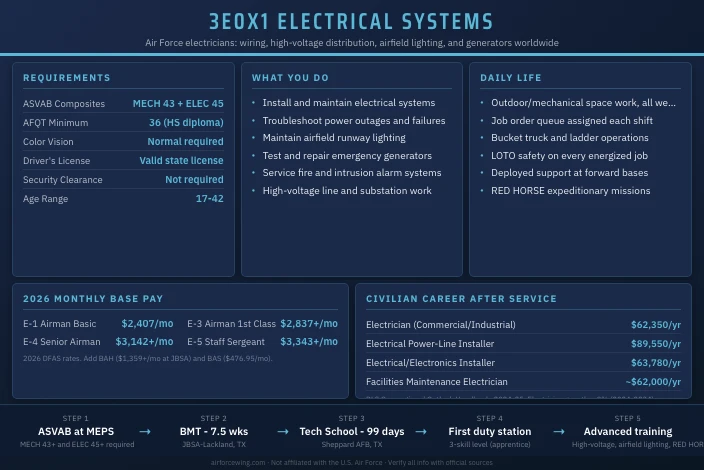
Job Role
Air Force Electrical Systems specialists (AFSC 3E0X1) install, inspect, maintain, troubleshoot, and repair electrical distribution systems and components across Air Force installations worldwide. They work on everything from 480-volt industrial power systems and high-voltage distribution lines to airfield lighting networks, emergency generators, fire alarm systems, and cathodic protection equipment. The role combines building infrastructure maintenance with field-expedient repair under operational conditions.
Day-to-Day Responsibilities
On most days, 3E0X1s work from a job order queue, a list of service calls generated by units, facility managers, or preventive maintenance schedules. A typical shift might include:
- Inspecting and testing electrical panels, circuit breakers, and transformers
- Troubleshooting power outages or equipment malfunctions in shops and dormitories
- Maintaining airfield lighting systems (approach lights, runway edge lights, precision approach path indicators)
- Installing or replacing wiring in new construction or facility renovation projects
- Performing scheduled maintenance on emergency generators
- Repairing or testing fire alarm and intrusion detection systems
- Working on grounding and lightning protection systems for hangars and fuel storage areas
Deployments and contingency assignments add another dimension. Electrical Systems Airmen with RED HORSE units may set up base camp power grids from scratch in austere environments, which requires both technical precision and physical endurance.
Specialized Roles and Shredouts
The 3E0X1 AFSC does not currently carry formal shredout suffixes, but Airmen often develop deep specialization in one of three areas through follow-on duty assignments and additional training:
| Specialty Area | Focus | Where It’s Common |
|---|---|---|
| High-Voltage Distribution | Transmission lines, substations, primary power | Large installations, OCONUS bases |
| Airfield Lighting | Runway/approach/taxiway systems | Flying wings, training bases |
| RED HORSE / Contingency | Expeditionary power, combat construction | Mobility bases, deployed locations |
Special Experience Identifiers (SEIs) can be awarded to document expertise in areas like airfield lighting (SEI 471) and high-voltage systems. These appear on official records and affect assignment preferences.
Mission Contribution
The Air Force cannot launch a single sortie without reliable electrical infrastructure. Every aircraft maintenance hangar, every command post, every fuel pump, and every runway light depends on 3E0X1 work. At forward operating bases and contingency locations, Electrical Systems Airmen are often among the first civil engineering personnel on the ground, standing up power before other units can function.
Technology and Equipment
Daily tools range from multimeters and insulation testers to bucket trucks, cable pullers, and conduit benders. Larger projects involve thermographic cameras for identifying overheating connections, power quality analyzers, and Computerized Maintenance Management Systems (CMMS) for tracking work orders. High-voltage work requires specialized personal protective equipment including arc-flash rated clothing and insulated tools rated for the specific voltage class.
Salary
Base Pay
Pay follows standard military pay tables based on rank and years of service. The table below shows 2026 base pay for common enlisted grades in this AFSC, pulled from current DFAS pay tables.
| Rank | Grade | Base Pay (Under 2 Years) | Base Pay (4 Years) |
|---|---|---|---|
| Airman Basic | E-1 | $2,407/mo | $2,407/mo |
| Airman First Class | E-3 | $2,837/mo | $3,198/mo |
| Senior Airman | E-4 | $3,142/mo | $3,659/mo |
| Staff Sergeant | E-5 | $3,343/mo | $3,947/mo |
| Technical Sergeant | E-6 | $3,401/mo | $4,069/mo |
| Master Sergeant | E-7 | $3,932/mo | $4,663/mo |
Base pay does not capture the full picture. Airmen who live off-base receive Basic Allowance for Housing (BAH), which varies by duty location and dependency status. At Joint Base San Antonio-Lackland, for example, an E-4 without dependents draws $1,359/month in BAH, that alone adds $16,308 per year to total compensation. Basic Allowance for Subsistence (BAS) adds another $476.95/month for all enlisted Airmen, regardless of location.
Additional Benefits
Healthcare through TRICARE Prime covers active-duty Airmen and their families at no cost, no premiums, no deductibles, and no copays. Dental and vision are included. The Air Force also contributes up to 5% of basic pay into a Thrift Savings Plan (TSP) under the Blended Retirement System, with matching that begins after 60 days of service.
Education benefits include up to $4,500 per year in Tuition Assistance for courses taken during service. After separation or retirement, the Post-9/11 GI Bill covers full in-state tuition at public universities, plus a monthly housing allowance and up to $1,000 per year in book stipends. At private schools, the GI Bill pays up to $29,920.95 per academic year. Airmen with six or more years of service can transfer unused GI Bill benefits to dependents.
Leave and Work-Life Balance
Active-duty Airmen earn 30 days of paid leave per year, accrued at 2.5 days per month. Most 3E0X1 assignments follow a standard 8-hour workday with a rotating on-call schedule for emergency calls after hours. Installations with larger civil engineering flights may have formal shift structures. Deployed or contingency assignments can run 12-hour days for extended periods.
Qualifications
Entry Requirements
| Requirement | Standard |
|---|---|
| Citizenship | U.S. citizen |
| Age | 17-42 |
| Education | High school diploma or alternate credential |
| AFQT Minimum | 36 (HS diploma), 65 (GED/alternate credential) |
| ASVAB Composites | MECH 43 and ELEC 45 |
| Color Vision | Normal color vision required (per AFI 48-123) |
| Driver’s License | Valid state driver’s license required |
| Medical | No disqualifying conditions; must be physically capable of working at heights |
| Security Clearance | Not required for entry; may vary by assignment |
The dual-composite requirement, both MECH 43 and ELEC 45, is the most selective part of this qualification. Candidates who score well in mechanical comprehension and electronics fundamentals but fall short on one composite cannot qualify regardless of their AFQT. Studying both the mechanical and electronics subtests before taking the ASVAB is strongly recommended.
The ASVAB line score requirements shown here come from the official Air Force careers page. These scores can change. Confirm current thresholds with your recruiter before the test.
Application and Selection Process
The process from initial ASVAB to shipping date typically runs 3-6 months, depending on your readiness, processing speed, and the availability of 3E0X1 training seats. Waivers are available for minor medical issues and some AFQT shortfalls for non-graduates, but the MECH/ELEC composite minimums cannot be waived.
Service Obligation
Most enlisted contracts are 4 years of active duty service. Airmen with special training pipelines or bonuses may carry 6-year obligations. The initial training (BMT + Tech School) does not add to the standard contract length.
New Airmen enter as Airman Basic (E-1) at accession.
See our ASVAB study guide for strategies to hit these line scores, or take the PiCAT from home if you are a first-time tester.
Work Environment
Setting and Schedule
The work is primarily outdoors and in mechanical spaces, utility tunnels, equipment rooms, substations, building exteriors, and flight line areas. Electrical Systems Airmen work on ladders, in bucket trucks, in confined spaces, and on rooftops. Heat, cold, and adverse weather are normal parts of the job because electrical infrastructure doesn’t go down on pleasant days.
At large installations, the civil engineering flight runs a standard day-shift schedule with an on-call element for after-hours emergencies. Smaller flights or deployed locations may run rotating 12-hour shifts. RED HORSE units and Rapid Deployment teams operate on expedition schedules that can include continuous operations for days at a time during exercises or deployments.
Chain of Command and Communication
3E0X1 Airmen work within a civil engineering squadron’s electrical systems section, which sits under the operations flight or facilities flight depending on the wing’s organization. Non-commissioned officers at the E-5 and E-6 level directly supervise apprentice and journeyman Airmen. Larger projects are overseen by a senior NCO or a civil engineer officer.
Work orders flow through a Computerized Maintenance Management System. Supervisors review and assign tasks each morning, and Airmen are expected to document their work, time, materials, and completion notes, before closing an order. That documentation trail becomes part of the facility’s maintenance history.
Team Dynamics and Autonomy
Junior Airmen at the 3-skill level work under direct supervision on all projects involving energized equipment. Once Airmen reach the 5-skill level (typically after 16-20 months), they run service calls independently and mentor apprentices. The 7-skill level opens crew chief and NCO leadership responsibilities. Experienced Airmen in the 7- and 9-skill bracket often have significant autonomy over project planning, material procurement, and quality inspections.
Job Satisfaction
Electrical Systems Airmen frequently report high job satisfaction tied to tangible outcomes. When a generator comes back online, when a runway light system passes its pre-inspection, the result is immediate and visible. The work is physical and varied enough to avoid the monotony of desk-based jobs, and the civilian marketability of the skills keeps retention interest high.
Training
Initial Training Pipeline
| Phase | Location | Duration | Focus |
|---|---|---|---|
| Basic Military Training (BMT) | JBSA-Lackland, TX | 7.5 weeks | Military foundation, fitness, discipline |
| Technical School (3E031 Apprentice) | Sheppard AFB, TX | 99 academic days | Electrical theory, wiring, power distribution, airfield lighting, alarm systems |
Tech School at Sheppard runs roughly five months in calendar terms, depending on class start dates, holiday schedules, and academic hold time. The curriculum covers:
- AC/DC circuit theory and Ohm’s Law applications
- Residential, commercial, and industrial wiring methods
- Transformer installation and maintenance
- High-voltage distribution system fundamentals
- Airfield lighting system installation and troubleshooting
- Fire alarm and intrusion detection system maintenance
- Grounding, bonding, and lightning protection systems
- Electrical safety (NFPA 70E, lockout/tagout procedures)
- Generators, operation, preventive maintenance, and load testing
Graduates receive the 3-skill level (apprentice) designation and an Air Force Specialty Code of 3E031. Course completion also counts toward a Community College of the Air Force (CCAF) degree in Electronic Systems Technology.
Sheppard AFB is home to the largest technical training center in the Air Force. The 3E0X1 course runs alongside training for several other civil engineering AFSCs, so students often cross paths with future HVAC, pavements, and water and fuels peers.
Advanced Training and Development
After reaching the 5-skill level, Airmen can pursue specialty training in areas that expand their professional profile:
- High-Voltage Electrical Line Worker training for Airmen assigned to primary power systems
- Airfield Lighting Maintenance courses through the Air Force Civil Engineer Center
- Troop Construction Project Management Course (AFIT WMGT 437), mandatory for promotion to Master Sergeant on active duty
- RED HORSE Pre-Deployment Training for Airmen assigned to rapid engineer units
- OSHA 30-Hour Construction certification, often completed at unit level
- NFPA 70E Electrical Safety training, required for energized work permits
The Air Force also supports civilian professional development through Tuition Assistance, which Airmen can use to pursue an associate’s or bachelor’s degree in electrical engineering technology, construction management, or a related field during off-duty hours.
Everything starts with qualifying ASVAB scores. Our study guide covers what to study first.
Career Progression
Rank and Skill Level Timeline
| Rank | Grade | Typical Timeframe | Skill Level |
|---|---|---|---|
| Airman Basic | E-1 | Accession | , |
| Airman | E-2 | 6 months | 3 (Apprentice) |
| Airman First Class | E-3 | 16 months | 3 |
| Senior Airman | E-4 | 36 months | 5 (Journeyman) |
| Staff Sergeant | E-5 | ~6 years total | 5 |
| Technical Sergeant | E-6 | ~10-12 years total | 7 (Craftsman) |
| Master Sergeant | E-7 | ~15-17 years total | 7 |
| Senior Master Sergeant | E-8 | ~19-21 years total | 9 (Superintendent) |
| Chief Master Sergeant | E-9 | ~22+ years total | 9 |
Promotion to Staff Sergeant and above is merit-based and competitive. The Enlisted Performance Report (EPR) is the primary evaluation tool. Supervisors rate Airmen on job performance, leadership, education, and whole-person contribution. An EPR score of 5 (the highest) is often required for promotion board consideration at the senior enlisted levels.
Specialization and Retraining
3E0X1 Airmen who want to expand their technical depth can pursue crossflow assignments to related civil engineering specialties through the formal retraining process. Officer Candidate School (OCS) is an option for Senior Airmen and Staff Sergeants who want to commission, particularly into the civil engineer officer (32E) career field. Many prior-3E0X1 officers use their enlisted electrical background as a direct asset in facilities management and construction oversight roles.
Performance Evaluation
The Air Force uses the Enlisted Performance Report (EPR) system to evaluate Airmen. At the E-4 level and below, EPRs are generated by supervisors and reviewed by a rater and additional rater. Reports become more detailed and consequential at E-5 and above. Key performance indicators for 3E0X1s include:
- Quality and safety of electrical work completed
- Formal training completions and skill-level upgrades
- Leadership and mentoring of junior Airmen
- Community involvement and off-duty professional development
Completing your CCAF degree while on active duty significantly strengthens your EPR record and promotion competitiveness. Most 3E0X1 Airmen can finish the Electronic Systems Technology associate’s degree within their first enlistment.
Physical Demands
Daily Physical Requirements
3E0X1 is a physically demanding AFSC. On any given day, Airmen may be:
- Carrying tool bags, wire spools, and conduit sections weighing 30-50 pounds
- Climbing ladders and working in bucket trucks at heights of 20-40 feet
- Working in confined spaces (utility tunnels, electrical vaults) with limited mobility
- Kneeling and crouching to access panels or underground junction boxes
- Operating hand and power tools for extended periods
The job does not require elite athleticism, but it does require sustained physical capability. Airmen with shoulder, knee, or back issues may find the work aggravating over a full career. Height restrictions on some bucket truck operations may also apply depending on installation safety policies.
Air Force Fitness Assessment Standards
All Airmen must pass the Air Force Fitness Assessment annually. The assessment is age- and gender-normed, with a minimum composite passing score of 75 out of 100. The table below shows minimum passing standards for the under-25 age bracket.
| Component | Max Points | Male (Under 25) Min | Female (Under 25) Min |
|---|---|---|---|
| 1.5-Mile Run | 60 | 13:30 | 16:22 |
| Push-Ups (1 min) | 10 | 42 reps | 27 reps |
| Sit-Ups (1 min) | 10 | 38 reps | 38 reps |
| Waist Measurement | 20 | 32.5 inches | 31.5 inches |
Standards are the same across all AFSCs, there is no modified standard for civil engineering roles.
Medical Evaluations
Beyond the initial MEPS physical, Airmen receive periodic medical screenings as part of their annual fitness cycle and prior to deployments. The color vision requirement (normal, per AFI 48-123) is checked at MEPS and can be tested again if there is any question. Airmen working on high-voltage systems may be subject to hearing conservation program monitoring given the ambient noise in electrical equipment rooms.
Deployment
Deployment Patterns
Civil engineering Airmen deploy regularly. The standard Air Force deployment cycle runs on an approximately 1:2 ratio (deployed once every two to three years) for most operational positions, though this varies by assignment and Air Force readiness requirements. Deployments typically last 4-6 months, though contingency operations can run longer.
3E0X1 Airmen deploy as part of base civil engineer (BCE) expeditionary teams or with RED HORSE squadrons. RED HORSE deployments are the most demanding, these teams operate in austere, often combat-adjacent environments building and restoring infrastructure with minimal support. Volunteer assignments to RED HORSE carry higher deployment frequency.
Duty Station Options
3E0X1 Airmen are assigned across the full range of Air Force installations. Common duty stations include major flying wings, training bases, global strike command bases, and overseas locations in Europe and the Pacific. A sample of typical assignment locations:
- Nellis AFB, NV (Air Warfare Center)
- Ramstein Air Base, Germany
- Kadena AB, Japan (PACAF)
- Tinker AFB, OK (logistics and sustainment)
- Eglin AFB, FL (test and evaluation, RED HORSE)
- F.E. Warren AFB, WY (ICBM fields)
OCONUS assignments are common and generally considered desirable for the combined cultural experience and additional allowances that come with overseas service.
Risk/Safety
Job Hazards
Electrical work carries inherent and serious risks. The primary hazards for 3E0X1 Airmen are:
- Electrical shock and arc flash from energized circuits, potentially fatal at industrial voltages
- Falls from ladders, rooftops, and bucket trucks
- Confined space hazards including oxygen-deficient atmospheres in underground vaults
- Heat stress during summer operations in outdoor electrical equipment areas
High-voltage work carries the highest risk. Primary distribution systems on Air Force installations typically run at 13.8 kV or higher, contact with an energized line at that level is almost always fatal.
Safety Protocols
The Air Force applies NFPA 70E (Standard for Electrical Safety in the Workplace) as the governing standard for all energized electrical work. Key safety requirements include:
- Lockout/tagout (LOTO) procedures before any maintenance on de-energized systems
- Arc-flash hazard analysis and appropriate PPE before working near energized equipment
- Confined space entry permits, including atmospheric testing before entry
- Fall protection systems (harnesses, lanyards) at heights over six feet
- Buddy system requirements for high-voltage work
Airmen receive formal LOTO and electrical safety training in Tech School, with annual refresher training at unit level. Safety violations are taken seriously and can affect EPR ratings and promotion.
Security and Legal Obligations
The base 3E0X1 AFSC does not require a security clearance. However, Airmen working on certain installations or assigned to specific programs (such as ICBM fields or SCIF facilities) may require a Secret clearance, processed through standard personnel security channels. The standard enlistment contract includes the legal obligations of military service, including obligations to deploy, follow lawful orders, and maintain conduct standards under the Uniform Code of Military Justice (UCMJ).
Impact on Family
Military life affects families regardless of AFSC. Permanent Change of Station (PCS) moves happen approximately every 2-4 years for most Airmen, which means school changes for children and employment disruptions for spouses. The Air Force’s Personnel Center (AFPC) considers family hardship requests in the assignment process, though operational needs take priority.
The support infrastructure available at most installations is substantial. Military OneSource provides counseling, financial advising, and family readiness resources. The Air Force Aid Society assists with emergency financial needs. Family support centers offer deployment preparation programs, reintegration resources, and spousal employment assistance.
Deployments are the biggest family stressor for 3E0X1 Airmen. A 6-month deployment every 2-3 years is a realistic expectation in an active career. Families who have built strong local support networks, other military families, base programs, extended family, tend to handle deployment cycles better than those who are isolated.
Many installations near Air Force bases have active hiring programs for military spouses in federal civil service. The Priority Placement Program (PPP) gives military spouses preference for federal jobs when following a service member to a new duty station.
The daily work schedule for 3E0X1 Airmen in garrison typically follows a standard day shift, which is one of the more family-friendly schedules available in the maintenance and civil engineering fields. Unlike shift-based career fields such as security forces or healthcare, most electrical systems Airmen work predictable hours except during exercises, inspections, or emergency callouts. That predictability makes things like childcare coordination, school pickup schedules, and evening routines more manageable.
On-call duty is the exception to that norm. Most electrical sections rotate personnel on an on-call schedule for after-hours electrical emergencies, a power outage at the hospital or flight operations building doesn’t wait for business hours. That rotating on-call schedule typically assigns one Airman per week on standby after duty hours, which is worth discussing with your family before the assignment begins.
RED HORSE assignments, if you pursue them, carry a different tempo. These units deploy more frequently and to more austere locations than standard civil engineering flights, and the pace on exercises and contingencies can be intense. Families affiliated with RED HORSE units often build strong bonds with other unit families because everyone faces the same cycle.
Base housing or BAH makes near-base living affordable at most 3E0X1 assignment locations. Families with school-age children benefit from the Interstate Compact on Educational Opportunity for Military Children, which standardizes enrollment and credit transfer between schools in member states, reducing the friction of mid-year moves when a PCS happens during the school year.
Reserve and Air National Guard
Component Availability
3E0X1 Electrical Systems is available in both the Air Force Reserve and the Air National Guard. Guard units in most states carry electrical systems positions, and the demand for skilled trade Airmen in part-time components is consistently high. Electrical work on Air National Guard facilities also supports state emergency response missions.
Drill Schedule and Training Commitment
The standard commitment is one Unit Training Assembly (UTA) weekend per month and two weeks of Annual Tour per year. For 3E0X1 positions in both the Reserve and Guard, that standard schedule generally holds. Some units add additional training days for specialized certifications (airfield lighting, high-voltage line work) beyond what the UTA schedule covers. Annual exercises at state or regional level may also add a few days each year.
Part-Time Pay
A Reserve or Guard E-4 earns two days of base pay per drill day, four days per UTA weekend. At 2026 rates, an E-4 with under two years draws $3,142/month on active duty. A drill weekend (four drill days) pays approximately $419, slightly more than 13% of a full month’s active-duty pay, for roughly four days of work.
Component Comparison
| Factor | Active Duty | Air Force Reserve | Air National Guard |
|---|---|---|---|
| Commitment | Full-time | 1 UTA/month + 2-wk Annual Tour | 1 UTA/month + 2-wk Annual Tour |
| Monthly Pay (E-4, <2 yrs) | $3,142/mo | ~$419/drill weekend | ~$419/drill weekend |
| Healthcare | TRICARE Prime (free) | TRICARE Reserve Select (premiums apply) | TRICARE Reserve Select (premiums apply) |
| Education | TA ($4,500/yr) + GI Bill | Federal TA + state tuition waivers (varies) | State tuition waivers (many states offer 100% in-state) |
| Deployment Tempo | 1:2 ratio, 4-6 months | Lower; mobilizations possible | Lower; state missions + federal mobilizations |
| Retirement | 20-year pension (high-36) | Points-based at age 60 | Points-based at age 60 |
State tuition benefits for Air National Guard members vary significantly. Several states cover full in-state tuition for Guard members, a major advantage for Airmen pursuing degrees while serving part-time.
Civilian Career Integration
3E0X1 pairs directly with civilian electrical trade careers. Guard and Reserve service in this AFSC is generally an asset to civilian employers in construction, utilities, and facilities management, these industries respect military training and often preferentially hire veterans. USERRA protections require civilian employers to hold jobs and provide reemployment rights when Airmen are called to active duty. The Uniformed Services Employment and Reemployment Rights Act (USERRA) also prohibits discrimination against employees based on military service.
Post-Service
Military electrical training translates directly into civilian employment. The skills 3E0X1 Airmen develop, high-voltage distribution, generator maintenance, airfield systems, alarm systems, align with multiple high-demand civilian occupational categories.
The most common post-service paths include journeyman electrician (commercial and industrial), facilities maintenance technician, electrical inspector, and utility company field technician. Airmen who complete additional coursework during service may enter civilian apprenticeships at an advanced standing, reducing the time to journeyman licensure.
Civilian Career Outlook
| Civilian Job Title | Median Annual Wage | Job Outlook (2024-2034) |
|---|---|---|
| Electrician (Commercial/Industrial) | $62,350 | +9% (much faster than average) |
| Electrical and Electronics Installer and Repairer | $63,780 | +5% |
| Electrical Power-Line Installer and Repairer | $89,550 | +6% |
| Facilities Maintenance Electrician | ~$56,000-$68,000 | Steady demand |
Wage data from the Bureau of Labor Statistics Occupational Outlook Handbook, 2024-25 edition.
State electrical licensing requirements vary, but most states offer military experience credit toward journeyman or master electrician licensing. Airmen who served in high-voltage roles may qualify for power line installer licenses, which carry some of the highest median wages in the electrician trades. Programs like Helmets to Hardhats connect veterans directly to union apprenticeship openings in the construction industry.
Post-service transition support is available through the Air Force’s Transition Assistance Program (TAP), which provides career counseling, resume writing, and federal hiring resources before separation. The DOD SkillBridge program lets Airmen intern with civilian employers for up to 180 days before separation, receiving full military pay and benefits during the internship.
Is This a Good Job
The Right Fit
3E0X1 works best for people who:
- Like working with their hands and solving technical problems, not sitting at a desk
- Have genuine interest in electrical systems, construction, or the building trades
- Want a skill they can use for the rest of their life regardless of how long they serve
- Can work independently and make decisions on-site without constant supervision
- Are physically capable and comfortable working at heights or in confined spaces
- Want a role with high civilian marketability from day one after service
The dual ASVAB requirement signals that this isn’t a job the Air Force hands to everyone. Airmen who score well in both mechanical and electronics composites tend to have the math background and spatial reasoning that makes the technical training click. If you did well in physics, shop class, or any hands-on STEM coursework, this role will suit your aptitude.
Potential Challenges
This AFSC is a poor fit if you:
- Want work that’s mostly indoors or in a controlled environment
- Have a fear of heights, enclosed spaces, or electricity (these are daily realities)
- Are not willing to deploy, electrical systems Airmen are in high demand at contingency locations
- Have color vision deficiency (a disqualifying condition for this AFSC)
- Are looking for a primarily desk or administrative role
The workload is uneven. When the base is running normally, the pace is structured. When something major fails, a substation goes down, a storm takes out half the base’s power. Airmen work until the problem is solved, regardless of the hour. That reality suits some people and exhausts others.
Long-Term Perspective
Most 3E0X1 Airmen who stay for a full career land in senior NCO positions managing teams, overseeing large projects, and advising civil engineer officers on technical matters. The trajectory from apprentice electrician to Chief Master Sergeant is a 22-plus year path that spans continents and mission sets. Airmen who leave after one or two enlistments typically enter the civilian workforce with marketable skills, documented training, and the discipline that contractors and utilities companies hire for. There are few AFSCs where the investment in the Airman pays off as visibly, for both the Air Force and the Airman, as 3E0X1.
More Information
Talk to an Air Force recruiter to find out whether 3E0X1 seats are available in your contract cycle, what current ASVAB score thresholds look like, and whether any enlistment incentives apply. Recruiters can also walk you through the MEPS color vision testing process and what to expect at your physical. Visit airforce.com for the official job description and current qualification details.
A few additional resources worth knowing about before you commit:
Official Air Force sources to bookmark:
- Air Force Civil Engineer Center (AFCEC), the organization responsible for Air Force civil engineering programs, including electrical infrastructure standards
- DFAS Pay Tables, current base pay by grade and years of service, updated each January
- AFPC Assignment System, the official personnel system where Airmen submit assignment preferences and review available positions
For civilian career research:
- Helmets to Hardhats connects veterans to union construction apprenticeship programs nationwide. Many 3E0X1 veterans use this program to enter the electrical trades at journeyman level or above after separation.
- The Bureau of Labor Statistics Occupational Outlook for Electricians provides current wage data and employment projections by region.
- State licensing boards for electrical contractors can be found through the National Electrical Contractors Association (NECA), most states have a licensing reciprocity path for veterans with documented military electrical training.
Before you test: The dual MECH/ELEC composite requirement (MECH 43 and ELEC 45) means you need two specific line scores simultaneously. Studying for one without the other can leave you one composite short of qualifying even if you hit the AFQT. A targeted ASVAB study guide that covers both mechanical and electronics subtests is the most efficient preparation approach for this AFSC.
This site is not affiliated with the U.S. Air Force or any government agency. Verify all information with official Air Force sources before making enlistment or career decisions.
Explore more Air Force civil engineering careers such as 3E1X1 HVAC and Refrigeration and 3E8X1 Explosive Ordnance Disposal.