5R0X1 Religious Affairs
Regarding “5R0X1A”: Research across the official CFETP, AFI 52-101, and Air Force recruiting materials confirms this career field carries a single designation: 5R0X1. No “A” shred-out has been established. If a recruiter or third-party source references “5R0X1A,” verify with an official Air Force source before acting on it.
Most Air Force jobs involve machines, networks, or logistics. This one involves people at their lowest points. Religious Affairs Airmen work directly alongside chaplains to support the spiritual and emotional health of the entire base population, from the brand-new Airman Basic wrestling with homesickness to the TSgt facing a deployment right after a family crisis.
There’s only one enlisted AFSC in the Chaplain Corps: 5R0X1 Religious Affairs. Previously called Chaplain Assistant, the specialty was redesignated to better reflect the full scope of what these Airmen actually do. The work covers multi-faith program management, crisis intervention, volunteer coordination, budget administration, and direct counseling support, all under the confidentiality umbrella of the chaplain’s privileged communication.
The technical school is one of the shortest in the Air Force at 26 days. What takes longer to develop is the judgment, discretion, and interpersonal skill the job demands every single day.
Qualifying requires specific ASVAB line scores. Our ASVAB study guide covers what to target and how to prepare.
Job Role
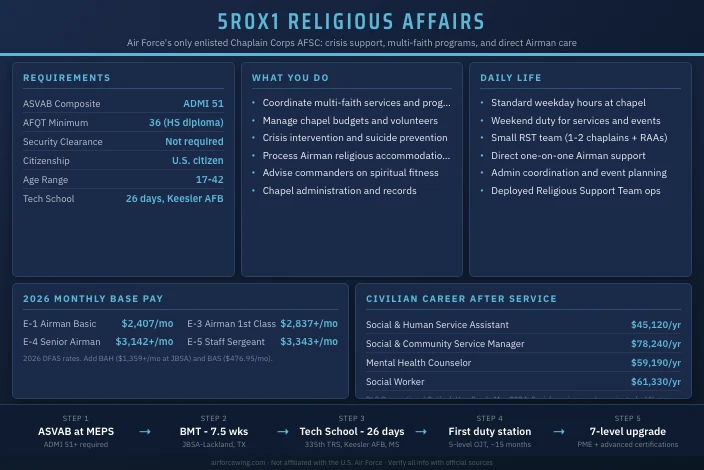
Religious Affairs Airmen (RAAs) are the enlisted backbone of the Air Force Chaplain Corps. They manage chapel programs, provide crisis intervention support, coordinate religious accommodation for Airmen of all faiths, and advise commanders on spiritual fitness and religious matters across their unit. RAAs work as part of a Religious Support Team (RST) alongside a chaplain officer, enabling the chaplain to exercise ministry and privileged communication.
Daily Tasks
The day-to-day work blends administrative coordination with direct human support:
- Recruit, train, and supervise volunteers who assist with chapel programs
- Coordinate multi-faith worship services, religious education events, and holiday observances
- Manage chapel budgets, schedules, and facility operations
- Provide crisis intervention counseling in moments of personal emergency or suicidal ideation
- Process religious accommodation requests from Airmen seeking dietary, uniform, or observance exceptions
- Advise unit commanders and first sergeants on the spiritual fitness of their Airmen
- Maintain accurate records of religious program activities and support provided
Specialization and Shredouts
The 5R0X1 AFSC does not carry formal numeric shredouts the way maintenance or intelligence specialties do. Career specialization happens through Special Experience Identifiers (SEIs) earned at duty stations and through advanced training, including specialized crisis intervention and religious diversity certifications.
| Skill Level | Grade Range | Description |
|---|---|---|
| 1-Level (Helper) | Entry (BMT) | No AFSC awarded until Tech School |
| 3-Level (Apprentice) | E-1 to E-3 | Awarded after Tech School completion |
| 5-Level (Journeyman) | E-4 to E-5 | Awarded after ~15 months OJT at first duty station |
| 7-Level (Craftsman) | E-6 to E-7 | Awarded after professional military education and duty qualifications |
| 9-Level (Superintendent) | E-8 to E-9 | Senior enlisted leadership |
Mission Contribution
The Chaplain Corps protects First Amendment rights inside the military. Airmen in this AFSC are legally required to support religious programs for all faiths represented in the force, not just one tradition. Their work directly affects retention, mental health outcomes, and unit cohesion.
RAAs are also the primary trained suicide intervention responders within the Chaplain Corps framework. That responsibility is not incidental to the job. It is one of its core functions.
Salary
Pay is based on rank and years of service, not on the AFSC itself. The table below shows 2026 base pay for the grades most common in this specialty.
| Rank | Grade | Monthly Base Pay (under 2 yrs) |
|---|---|---|
| Airman Basic | E-1 | $2,407 |
| Airman | E-2 | $2,698 |
| Airman First Class | E-3 | $2,837 |
| Senior Airman | E-4 | $3,142 |
| Staff Sergeant | E-5 | $3,343 |
| Technical Sergeant | E-6 | $3,401 |
Source: DFAS 2026 military pay tables.
Base pay is only part of total compensation. Active duty Airmen also receive:
- Basic Allowance for Housing (BAH): Varies by duty location, pay grade, and dependent status. At JBSA, a single E-4 receives $1,359/month; with dependents, $1,728/month.
- Basic Allowance for Subsistence (BAS): $476.95/month for enlisted members (2026 rate).
- TRICARE: Full medical, dental, vision, and mental health coverage at no cost on active duty.
- Tuition Assistance: Up to $4,500/year toward college courses while serving.
- Post-9/11 GI Bill: After separation, covers full in-state tuition at public schools, up to $29,920.95/year at private schools, plus a monthly housing allowance and $1,000/year book stipend.
Retirement
Airmen who entered service after January 1, 2018 fall under the Blended Retirement System (BRS). The BRS pairs a 20-year pension at 40% of high-36 average basic pay with a Thrift Savings Plan (TSP) where the government automatically contributes 1% and matches up to 4% of your contributions. The government match begins after 60 days of service and vests at two years.
Work-Life Balance
Religious Affairs Airmen typically work standard weekday hours at chapel facilities. Weekend duty occurs around scheduled religious services and special events. The job does not follow shift schedules the way medical or security forces AFSCs do. Deployments happen but tend to be shorter and less frequent than high-demand technical specialties.
Qualifications
The ASVAB score requirement for 5R0X1 is an Administrative (ADMI) composite of 51. The minimum AFQT for Air Force enlistment is 36 with a high school diploma, or 65 with a GED.
| Requirement | Details |
|---|---|
| ASVAB Composite | Administrative (ADMI) 51 minimum |
| AFQT Minimum | 36 (HS diploma); 65 (GED) |
| Age | 17-42 at time of enlistment |
| Citizenship | U.S. citizen |
| Security Clearance | Not required |
| Education | High school diploma or GED |
| Medical | Must meet standard Air Force enlistment medical standards |
| Other | Must be able to work sensitively with people of all religious backgrounds |
Sources: airforce.com Religious Affairs, AFI 36-2101.
Application Process
- Contact an Air Force recruiter and take the ASVAB at a Military Entrance Processing Station (MEPS).
- Score at least 51 on the Administrative composite.
- Complete the medical examination at MEPS.
- Meet with your recruiter to list 5R0X1 as a job preference on your enlistment contract.
- Ship to Basic Military Training (BMT) at JBSA-Lackland, TX.
There is no special application beyond the standard enlistment process. No interview or pre-accession screening board is required. Your recruiter will confirm the AFSC’s current availability in the recruiting pool, since fill rates can temporarily close a specialty to new applicants.
Selection and Competitiveness
The ADMI 51 composite is a moderate score requirement. The administrative area tests word knowledge, paragraph comprehension, arithmetic reasoning, and general science. Many applicants qualify without targeted study. That said, this AFSC draws candidates who are genuinely motivated by the people-support mission, and those with strong interpersonal backgrounds in ministry, counseling, social services, or community volunteerism tend to stand out during the assignment process.
If you have a documented history of serious mental health treatment, you may need a medical waiver. The Air Force reviews each case individually. Disclose everything accurately at MEPS; omissions discovered later can result in discharge.
Service Obligation
The standard enlistment contract for the Air Force is four years of active duty, with an option for six. The Chaplain Corps has historically not offered selective reenlistment bonuses for 5R0X1, though bonus availability changes with annual manning reviews. Verify current bonus status with your recruiter.
Enlistees enter at E-1 (Airman Basic) unless they have qualifying college credit or JROTC service, which can accelerate entry rank to E-2 or E-3.
Preparing for the ASVAB Administrative composite? An ASVAB study guide with practice tests can help you build the vocabulary and reading comprehension skills this composite emphasizes.
Work Environment
Setting and Schedule
Most of the work happens in chapel facilities on Air Force installations. Chapels operate more like small nonprofit organizations than military units. The team is typically small, one to three chaplains and a proportional number of RAAs, which means you have a high degree of direct ownership over programs and relationships.
Work hours align with the chapel’s programming calendar. Expect standard Monday-through-Friday days during off-peak periods, with occasional weekend duty for services, holiday programs, and special events. There’s no traditional shift rotation. Compared to operational or medical AFSCs, the schedule is predictable.
Chain of Command and Feedback
RAAs report to the Wing Chaplain through the senior chaplain at their installation. Performance feedback comes through the Enlisted Performance Report (EPR) system, with feedback sessions tied to rating cycles. Because the chaplain community is small, you tend to know the people evaluating your performance directly.
The unique aspect of the chain of command here is the confidentiality relationship. RAAs are legally bound by the same privileged communication protections as the chaplain when acting within the scope of those duties. That means what Airmen share in the chapel context stays there, which requires both trustworthiness and clear judgment about the limits of that protection.
Team Dynamics
You will spend most of your career working closely with one or two chaplains. The RST model is intentionally small and tight-knit. You won’t have a large peer group of fellow 5R0X1 Airmen at your installation, which is different from most other career fields.
That said, the Chaplain Corps spans every major installation worldwide, and RAAs maintain a strong professional community through field training, conferences, and the Career Field Manager’s programs.
Job Satisfaction
Retention rates for 5R0X1 tend to be solid. Airmen who choose this AFSC typically do so because they’re drawn to the mission, not for technical challenge or bonus pay. The work is emotionally demanding but rarely physically dangerous. Those who stay describe high day-to-day meaning in their work. Those who leave often move into civilian ministry, social services, or nonprofit careers where the skills transfer directly.
Training
Initial Training Pipeline
| Phase | Location | Duration | Focus |
|---|---|---|---|
| Basic Military Training (BMT) | JBSA-Lackland, TX | 7.5 weeks | Military foundation, fitness, core values |
| Technical School (Tech School) | Keesler AFB, MS (335th Training Sqdn) | 26 days | Religious program management, crisis intervention, multi-faith support, administrative duties |
| On-the-Job Training (OJT) | First duty station | ~15 months | 5-level upgrade, supervised religious support operations |
BMT is the same 7.5-week program all enlisted Airmen complete at JBSA-Lackland. It covers Air Force culture, physical fitness, drill, and the fundamentals of military service. After BMT, you PCS (permanently change station) to Keesler AFB in Biloxi, MS for the 5R0X1 Technical School.
The Tech School for Religious Affairs runs through the 335th Training Squadron. At 26 days, it’s among the shorter pipelines in the enlisted Air Force. Curriculum covers religious diversity education, chapel program administration, crisis intervention techniques, suicide intervention protocols, financial management of chapel funds, and facility operations. The compressed timeline means on-the-job training at your first duty station carries significant weight in your development.
Advanced Training and Professional Development
After reaching the 5-level, RAAs become eligible for several development paths:
- Chaplain Resource Board training: Deepens expertise in multi-faith program management
- Applied Suicide Intervention Skills Training (ASIST): A two-day certification widely used in crisis intervention roles
- Non-Commissioned Officer Academy (NCOA): Required for SSgt and TSgt professional military education
- Senior NCO Academy: Required for advancement to MSgt and above
- Defense Language Institute: A small number of 5R0X1 Airmen receive language training for assignments with international units or overseas commands
The Air Force Tuition Assistance program allows you to pursue a degree while serving. Many RAAs pursue degrees in theology, psychology, social work, or counseling, which strengthens both their current performance and their post-service options.
Everything starts with qualifying ASVAB scores. Our study guide covers what to study first.
Career Progression
Promotion Timeline
| Rank | Grade | Typical Time in Service |
|---|---|---|
| Airman Basic | E-1 | Entry |
| Airman | E-2 | 6 months |
| Airman First Class | E-3 | 16 months |
| Senior Airman | E-4 | 3 years (or earlier with below-the-zone promotion) |
| Staff Sergeant | E-5 | ~5-6 years |
| Technical Sergeant | E-6 | ~11-12 years |
| Master Sergeant | E-7 | ~17 years |
| Senior Master Sergeant | E-8 | ~19-20 years |
| Chief Master Sergeant | E-9 | ~22+ years |
E-1 through E-3 promotions are time-based. Starting at E-4, promotion becomes competitive and requires a strong EPR record, completed professional military education (PME), and community involvement.
Performance Evaluation
The Enlisted Performance Report (EPR) is the primary tool for evaluating Air Force Airmen. EPRs are written by the rater (typically the senior chaplain or senior RAA at your installation) and reviewed by the additional rater. Scores range from 1 to 5, with 5 being the top mark.
In a small career field like 5R0X1, your EPR narrative carries heavy weight. Raters know you personally, which is an advantage when you’re performing well. Identifying concrete, quantifiable accomplishments (number of volunteers trained, programs coordinated, Airmen counseled, budget managed) is essential for competitive EPRs.
How to Succeed in This Career
The path to advancement in 5R0X1 follows the same mechanics as other enlisted careers but with a few specific emphases.
First, take initiative on program development. Chaplains have ministry expertise; RAAs have operational and administrative skill. The most effective RAAs don’t wait to be told what programs to run. They identify gaps, propose solutions, and deliver results.
Second, build your PME record early. Completing Airman Leadership School (ALS) as a SrA and NCO Academy on time, combined with a strong EPR at each level, makes promotion competitive rather than just possible.
Third, the interpersonal dimension of this work is evaluated even when it isn’t written as a formal task. How you handle a grieving Airman at 2100 on a Friday matters to the chaplain who will write your next EPR.
Role Transfers
Retraining to another AFSC is possible through the Enlisted Retraining Program. RAAs who want to move toward administrative, force support, or counseling-adjacent roles often find the crossover straightforward because the ADMI composite that qualifies them for 5R0X1 overlaps with many other administrative fields.
Officers cannot directly convert from 5R0X1. But several RAAs have pursued chaplain officer positions after completing a qualifying graduate degree in theology or ministry, commissioning through OTS, and applying for the 52RX chaplain AFSC.
Physical Demands
Daily Physical Demands
Religious Affairs is not a physically demanding specialty. The daily work involves chapel administration, program coordination, and interpersonal counseling support. There are no physical fitness requirements tied specifically to this AFSC beyond standard Air Force standards.
That said, all Airmen maintain fitness year-round. Deployments can require field conditions, and the Air Force Fitness Assessment is administered annually to every active duty Airman regardless of career field.
Air Force Fitness Assessment
The Air Force Fitness Assessment consists of four components and is scored on a 100-point scale. A minimum composite score of 75 is required to pass. All components are age- and gender-normed.
| Component | Maximum Points |
|---|---|
| 1.5-Mile Run | 60 |
| Waist Circumference / Body Composition | 20 |
| Push-Ups (1 minute) | 10 |
| Sit-Ups (1 minute) | 10 |
You must meet the minimum standard on each component, not just the composite total. Standards by age and gender are published by the Air Force and updated periodically. Verify current scoring tables at af.mil.
The assessment is conducted annually for most Airmen. A failed assessment triggers a series of mandatory follow-up evaluations and can affect promotion eligibility.
Medical Standards
5R0X1 does not have specialty-specific medical requirements beyond standard Air Force enlistment medical standards. The main factors are normal hearing (since the work involves extensive one-on-one communication) and psychological suitability. The MEPS medical exam will screen for both.
Deployment
Deployment Patterns
Religious Affairs Airmen deploy in support of Air Force expeditionary operations worldwide. Every deployed Air Force unit has access to chaplain support, and RAAs deploy as part of Religious Support Teams attached to those units.
Deployment lengths for 5R0X1 typically run 90 to 180 days for AEF (Air and Space Expeditionary Force) rotations. The deployment tempo for this AFSC is moderate compared to high-demand specialties like security forces or special warfare support. Many RAAs complete an entire 4-year first term with one or two deployments.
Deployed environments range from established bases in Europe or the Pacific to austere expeditionary locations in the Middle East or Africa. The role in all environments is the same: support the spiritual and emotional health of the Airmen assigned to that unit.
Duty Stations
5R0X1 positions exist at nearly every major Air Force installation worldwide. Common stateside duty locations include:
- JBSA-Lackland / Randolph, TX
- Langley-Eustis AFB, VA (Joint Base)
- Travis AFB, CA
- Eglin AFB, FL
- Ramstein AB, Germany (overseas)
- Kadena AB, Japan (overseas)
Assignment preferences are submitted through the Air Force Personnel Center (AFPC), but fill requirements drive actual assignments. High-demand overseas locations and large installations with active chapel programs tend to have more openings.
Risk/Safety
Job Hazards
5R0X1 carries a low physical risk profile. Standard workplace safety protocols apply at chapel facilities. Deployed assignments introduce the same general risks as any expeditionary environment, but RAAs are not assigned to combat roles.
The most significant risk in this career field is emotional. Regular exposure to Airmen in crisis, including those experiencing suicidal ideation, grief, trauma, and severe family stress, creates cumulative emotional demands. The Air Force provides mental health resources for Airmen in support roles, and chaplains themselves play a role in monitoring the wellness of their RAAs.
Privileged Communication
Religious Affairs Airmen are bound by the same privileged communication protections as their chaplain. This is a legal protection, not simply a professional courtesy. Unauthorized disclosure of protected communications is a serious violation with legal consequences. Understanding the boundaries of privileged communication is part of Tech School training and remains relevant throughout your career.
Security Clearance
No security clearance is required for 5R0X1. This is one of few Air Force AFSCs where a clean background is still required (for standard suitability reasons) but no adjudicated clearance investigation is initiated.
Legal and Contractual Obligations
Standard enlistment obligations apply. The initial contract is four years of active duty. Stop-Loss policies can extend a service member’s obligation during periods of high operational demand, though this is uncommon in the current environment.
Impact on Family
Family Considerations
The chaplain community tends to be a close-knit and stable environment. Chapel programs serve families as much as they serve individual Airmen. Spouses and dependents at most installations have access to the same chapel programs, Family Life programs, and support services that RAAs help run. That’s genuinely useful during the moments that military life is hard: deployments, PCS moves, and the recurring stress of building a life around the Air Force’s schedule.
Duty hours are more predictable than shift-based career fields. That consistency helps families plan around work schedules, school calendars, and community activities.
Relocation
PCS moves happen every two to three years for most Air Force Airmen. Religious Affairs Airmen follow the same assignment process as other AFSCs. Availability of open slots determines where you go. Consecutive overseas tours are possible but not common.
The Military Family Life Counseling program and installation family support centers are accessible at every major base, and RAAs often work alongside those services in their professional capacity.
Reserve and Air National Guard
Component Availability
5R0X1 is available in both the Air Force Reserve and the Air National Guard. Part-time positions exist at installations with active chapel programs. Not every Reserve or ANG base has dedicated Religious Affairs billets, so availability depends on your geographic area.
Drill Schedule
The standard commitment is one weekend per month (Unit Training Assembly, or UTA) plus two weeks per year for Annual Tour. 5R0X1 does not require significantly more training days than this standard schedule, though specialty training updates and annual certifications may occasionally extend the commitment.
Part-Time Pay
An E-4 (Senior Airman) in the Reserve or ANG earns pay for four drill periods per UTA weekend, calculated at daily rates derived from active-duty base pay. At 2026 rates, an E-4 with less than two years earns approximately $188/day for drill days, or roughly $752 for a full drill weekend.
Component Comparison
| Factor | Active Duty | Air Force Reserve | Air National Guard |
|---|---|---|---|
| Commitment | Full-time | 1 weekend/mo + 2 wks/yr | 1 weekend/mo + 2 wks/yr |
| Monthly Base Pay (E-4) | $3,142+ | ~$752/drill weekend | ~$752/drill weekend |
| Healthcare | TRICARE Prime (free) | TRICARE Reserve Select (premiums apply) | TRICARE Reserve Select (premiums apply) |
| Education | Federal TA + GI Bill | Federal TA; Montgomery GI Bill-Selected Reserve | State tuition waivers (vary by state) + MGIB-SR |
| Retirement | 20-year pension (BRS) | Points-based at age 60 | Points-based at age 60 |
| Deployment Tempo | Moderate (1-2 deployments per 4-yr term) | Lower; mobilization-driven | Lower; federalization-driven |
TRICARE Reserve Select requires monthly premium payments but provides full coverage comparable to TRICARE Prime. State-level tuition benefits through the Air National Guard vary significantly by state and can be among the strongest education benefits in the military for part-time service.
Civilian Career Integration
The 5R0X1 skill set pairs naturally with civilian ministry, nonprofit management, social services, and community health work. Reserve and ANG service in this AFSC strengthens a civilian resume for these roles, rather than conflicting with it. Employers in healthcare, social services, and faith-based organizations generally view military chaplain-support experience as directly relevant.
USERRA (Uniformed Services Employment and Reemployment Rights Act) protections apply to all reservists and ANG members, requiring civilian employers to accommodate drill and deployment schedules and restore employment rights upon return.
Post-Service
The skills built in 5R0X1 translate broadly into civilian careers involving counseling support, program coordination, community services, and faith-based leadership. The crisis intervention training alone is a sought-after qualification in healthcare, social services, and nonprofit sectors.
Civilian Career Prospects
| Civilian Job Title | Median Annual Salary | Job Outlook (2024-2034) |
|---|---|---|
| Social and Human Service Assistant | $45,120 | +6% (faster than average) |
| Social and Community Service Manager | $78,240 | +6% (faster than average) |
| Mental Health / Substance Abuse Counselor | $59,190 | Above average growth |
| Social Worker | $61,330 | Steady demand |
Source: Bureau of Labor Statistics Occupational Outlook Handbook, May 2024.
Certifications and Licensing
Several civilian credentials align with 5R0X1 training and experience:
- Crisis Prevention Institute (CPI) certification: Directly recognized in hospital, school, and community settings
- Applied Suicide Intervention Skills Training (ASIST): Widely recognized credential for crisis roles
- Certified Community Services Executive (CCSE): Targets program management in nonprofit settings
- Chaplaincy ordination or endorsement: For those moving into civilian or hospital chaplaincy roles
A degree in theology, social work, psychology, or counseling strengthens post-service career options significantly. The Air Force Tuition Assistance program during service, followed by the GI Bill after separation, can cover most or all of that education cost.
Transition Support
The Air Force Transition Assistance Program (TAP) provides mandatory pre-separation counseling, resume workshops, and job-placement support. Given the breadth of the RAA’s experience in program management, crisis response, and community service, most servicemembers in this AFSC have a strong civilian employment story to tell.
Is This a Good Job
Who This Job Fits
If you want a people-first Air Force career that doesn’t involve wrenches, code, or cockpits, 5R0X1 is worth serious consideration. The ideal candidate:
- Genuinely cares about people’s emotional and spiritual wellbeing
- Can maintain confidentiality under pressure without exceptions
- Works comfortably with people from religious traditions different from their own
- Handles emotionally difficult conversations without burning out quickly
- Prefers steady, relationship-based work over high-adrenaline operations
You don’t need to be religious yourself. You do need to take religion seriously as something that genuinely matters to people. Chaplains describe the best RAAs as people who are equally comfortable helping an Atheist Airman process grief and helping a Muslim Airman arrange halal meals for Ramadan.
Who Should Look Elsewhere
This AFSC may not be the right fit if you:
- Want technical hands-on work with equipment or systems
- Prefer a large peer group rather than a small tight-knit team
- Struggle with emotional exposure to crisis, grief, or trauma
- Want guaranteed rapid advancement through competitive technical pathways
- Need clear daily metrics of success rather than relationship-based outcomes
The 5R0X1 career field has only one enlisted AFSC. There are no lateral moves within the Chaplain Corps enlisted structure. If your interests shift significantly, retraining to another AFSC is the path forward.
Long-Term Fit
A full career in Religious Affairs leads naturally into senior chaplain support roles, Wing Chaplain office management, and Air Force-level religious program coordination. CMSgts in this career field influence Air Force-wide policy on spiritual fitness and religious accommodation.
After service, the civilian paths in counseling, social services, and faith-based program management are strong and growing. The BLS projects faster-than-average growth across most of the relevant civilian occupations.
More Information
To learn more about the 5R0X1 Religious Affairs AFSC, contact an Air Force recruiter at airforce.com or visit your nearest Military Entrance Processing Station. Recruiters can confirm current bonus availability, open assignment slots, and the most up-to-date qualification requirements. Talking to a recruiter costs you nothing and gives you the current picture before you commit.
- Prepare for the ASVAB with our study guide to make sure your line scores qualify
This site is not affiliated with the U.S. Air Force or any government agency. Verify all information with official Air Force sources before making enlistment or career decisions.
Explore more Air Force Chaplain Corps careers to understand the full scope of the 5R career group and how Religious Affairs Airmen support the Chaplain mission across every installation.