2T3X1 Mission Generation Vehicular Equipment Maintenance
Every Air Force vehicle that moves aircraft, hauls munitions, or carries troops to the flight line depends on someone keeping it running. The 2T3X1 Mission Generation Vehicular Equipment Maintenance specialist is that person. Without serviceable vehicles, the flying mission stops, and this AFSC is the reason it doesn’t.
If you can diagnose a problem with your hands as fast as you can with a multimeter, and you want a job where your work has a direct connection to combat readiness, this role is worth a hard look. The ASVAB composite is achievable, the training pipeline is one of the shorter ones in the Air Force, and the civilian job market for vehicle technicians is consistently strong. If the Mechanical composite is the thing standing between you and this job, the ASVAB prep guide covers exactly what to study.
Job Role
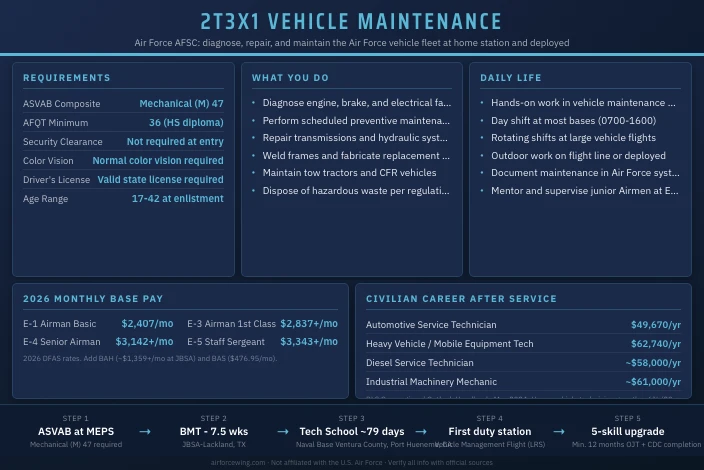
2T3X1 specialists inspect, diagnose, repair, and maintain the full range of Air Force vehicles and vehicular equipment, from pickup trucks and forklifts to aircraft tow tractors and firefighting vehicles. They perform scheduled and unscheduled maintenance, rebuild components and assemblies, fabricate replacement parts, weld metals, and repair vehicle glass. The goal is to keep Air Force vehicle fleets fully mission-capable at all times.
Daily Tasks
The work spans a wide range of vehicle types and technical problems. On any given shift, a 2T3X1 Airman might:
- Run diagnostic tests on engine, fuel, electrical, and brake systems
- Perform scheduled preventive maintenance inspections (PMIs) on the fleet
- Repair or replace components including transmissions, hydraulic systems, and cooling systems
- Weld damaged frame sections or fabricate custom parts when commercial replacements aren’t available
- Dispose of hazardous waste materials, oils, coolants, and solvents, per environmental regulations
- Document all maintenance actions in the Air Force vehicle management information system
- Inspect and validate repair work completed by junior Airmen
The pace depends on the unit’s vehicle fleet size. At a large base, a vehicle management flight may maintain hundreds of assets. At a deployed location, the same Airmen work with fewer vehicles but under higher operational pressure.
Specialty Codes
2T3X1 has two active shredouts, each with a distinct technical focus:
| AFSC Code | Specialty | Focus Area |
|---|---|---|
| 2T3X1 | Mission Generation Vehicular Equipment Maintenance (base) | General purpose and special purpose vehicles, aircraft tow tractors, base maintenance vehicles |
| 2T3X1A | Firefighting and Refueling Vehicle & Equipment Maintenance | ARFF (Aircraft Rescue and Firefighting) apparatus, refueling trucks, specialized emergency vehicles |
| 2T3X1C | Material Handling Equipment / 463L Maintenance | Forklifts, loaders, K-loaders, 463L pallet and net systems used in airlift operations |
Shredout assignment depends on the needs of your gaining unit and available training slots. Recruits don’t always get to choose their shredout at accession.
Mission Contribution
Ground vehicles are the connective tissue between Air Force facilities. Without operational tow tractors, aircraft stay on the ramp. Without serviceable refueling trucks, jets don’t fly. Without working forklifts, cargo doesn’t move. The 2T3X1 specialist maintains the ground-side infrastructure that the flying mission depends on every day, at home station, on deployments, and during contingency operations.
Equipment and Technology
The vehicle fleet spans commercial and military-design equipment. Common assets include:
- General purpose vehicles (Ford F-250s, F-350s, cargo trucks)
- Aircraft maintenance stands and tow tractors
- Caterpillar and John Deere construction and earth-moving equipment
- Crash, Fire, and Rescue (CFR) vehicles (2T3X1A shredout)
- K-loaders, AT-mules, and 463L pallet systems (2T3X1C shredout)
- JCB backhoes, Volvo wheel loaders, and other special-purpose equipment
Diagnostics use both computerized scan tools and physical measurement, pressure gauges, multimeters, and brake testing equipment. Welding tasks require MIG, TIG, and oxy-acetylene capability.
Salary
Base Pay
Pay is set by DFAS and applies across all Air Force specialties at the same grade and years of service. These are 2026 rates.
| Rank | Grade | Monthly Base Pay (Entry) |
|---|---|---|
| Airman Basic | E-1 | $2,407 |
| Airman | E-2 | $2,698 |
| Airman First Class | E-3 | $2,837 |
| Senior Airman | E-4 | $3,142 |
| Staff Sergeant | E-5 | $3,343 |
| Technical Sergeant | E-6 | $3,401 |
| Master Sergeant | E-7 | $3,932 |
Most Airmen arrive at their first duty station as an E-3 or E-4 after Tech School. Base pay is the floor, not the ceiling. Tax-free allowances push total compensation well above the base figure.
Allowances and Additional Benefits
BAH (Basic Allowance for Housing) varies by duty location, pay grade, and dependency status. At Joint Base San Antonio, a single E-4 draws approximately $1,359/month; with dependents, that rises to $1,728/month. Rates at other installations range widely.
BAS (Basic Allowance for Subsistence) is a flat $476.95/month for all enlisted Airmen regardless of location or specialty.
An E-4 at a mid-cost installation takes home roughly $3,142 in base pay plus $476 in BAS plus $1,359+ in BAH, a total compensation package above $4,900/month before any special pays or bonuses.
Healthcare through TRICARE Prime covers medical, dental, vision, prescriptions, and mental health with no enrollment fee, no deductible, and no copays on active duty.
Education benefits include Tuition Assistance (TA), up to $4,500 per year toward college courses while serving, and the Post-9/11 GI Bill after separation, which covers full in-state tuition at public universities or up to $29,920.95 per academic year at private schools.
Retirement under the Blended Retirement System (BRS) includes a 20-year pension worth 40% of your high-36 average basic pay, plus Thrift Savings Plan (TSP) matching of up to 5% of basic pay.
Work-Life Balance
Most 2T3X1 Airmen work standard day shifts (roughly 0700-1600), though shift work is common at larger vehicle management flights that run extended operations. Annual leave accrues at 2.5 days per month, 30 days per year, and you keep standard federal holidays.
Qualifications
Qualification Table
| Requirement | Standard |
|---|---|
| ASVAB Composite | Mechanical (M) 47 |
| AFQT Minimum | 36 (high school diploma) |
| Citizenship | U.S. citizen |
| Age | 17-42 at enlistment |
| Education | High school diploma or equivalent |
| Color Vision | Normal color vision required |
| Driver’s License | Valid state driver’s license required |
| Security Clearance | Not required at entry |
| Physical Profile | Deployable physical profile required |
The ASVAB Mechanical composite draws from the Mechanical Comprehension (MC) and Auto & Shop Information (AS) subtests, areas that reward hands-on mechanical experience or focused study. Recruits who’ve worked on cars, engines, or heavy equipment frequently score well without extensive preparation. A targeted ASVAB study guide with practice tests can close the gap quickly for those starting from scratch.
Normal color vision is a hard requirement for 2T3X1. Color-blind applicants cannot obtain a waiver for this specialty and will need to pursue a different AFSC. Verify your color vision status at MEPS before committing to this job.
Application Process
- Talk to a recruiter and request 2T3X1 as a job preference. Your recruiter checks current accession requirements and open training seats.
- Take the ASVAB at MEPS (Military Entrance Processing Station). You need a Mechanical composite of at least 47.
- Complete a medical evaluation at MEPS, including a color vision test. Ensure your physical profile supports a deployable status.
- Obtain your driver’s license before shipping to Basic Military Training if you don’t already have one.
- Sign your enlistment contract specifying the 2T3X1 AFSC, then await your BMT ship date.
The process from first recruiter meeting to ship date typically runs 30-90 days, depending on background check processing and available training slots. Job availability fluctuates with Air Force manning needs, so confirm current openings with your recruiter.
Selection Competitiveness
The Mechanical composite of 47 is a moderate threshold. Applicants with prior automotive, small engine, or heavy equipment experience often qualify without extensive ASVAB prep. The AFSC is generally available but has shredout-specific constraints, 2T3X1A (firefighting vehicles) and 2T3X1C (material handling equipment) fill on a needs basis and may require waiting for the next training cycle.
Service Obligation
Enlisted Airmen who select 2T3X1 typically sign a four-year initial enlistment. You enter service at E-1 (Airman Basic) and are eligible for promotion to E-2 (Airman) after six months of satisfactory service. Most Airmen reach E-3 (Airman First Class) within the first year.
Work Environment
Setting and Schedule
The job is primarily hands-on in a vehicle maintenance bay, think a large military equivalent of a fleet shop. Bays are typically climate-controlled for major repairs, but field maintenance in outdoor or deployed environments is common. Work includes time under vehicles, in engine compartments, and outdoors on the flight line when supporting aircraft operations.
Standard day-shift hours apply at most bases. Larger vehicle management flights use rotating shifts to cover extended operating hours, so expect some variation depending on your unit’s size and workload.
Leadership and Communication
2T3X1 Airmen work in Vehicle Management Flights, typically organized under a Logistics Readiness Squadron (LRS). The chain of command runs from Flight Chief (usually a TSgt or MSgt) down through section NCOs to apprentice-level Airmen. Work orders drive the daily flow, mechanics receive assigned jobs through the vehicle management information system and report status up the chain.
Performance feedback comes through quarterly feedback sessions with your supervisor and the annual Enlisted Performance Report (EPR). Consistent, high-quality maintenance work gets recognized in EPRs, which directly affects promotion eligibility.
Team Dynamics and Autonomy
Junior Airmen (E-1 through E-3) work under close supervision, learning shop procedures and completing upgrade training tasks. At the E-4 (Senior Airman) level, Airmen increasingly work independently on assigned vehicles and begin helping train junior personnel. By E-5 (Staff Sergeant), you’re supervising a work center and owning outcomes, not just completing tasks.
Job Satisfaction
Vehicle mechanics tend to have high satisfaction with the tangible nature of their work. A fixed vehicle is a clear result. Retention is also driven by the civilian job market, skilled vehicle technicians know they have options after service, which removes some of the pressure that drives early separations in other AFSCs.
Training
Training Pipeline
| Phase | Location | Duration | Focus |
|---|---|---|---|
| Basic Military Training (BMT) | JBSA-Lackland, TX | 7.5 weeks | Military customs, weapons qualification, physical conditioning, Air Force core values |
| Technical School (2T331) | Naval Base Ventura County, Port Hueneme, CA | ~79 days | Vehicle systems, diagnostics, preventive maintenance, welding, hazmat handling |
Advanced Training
After earning the 5-skill level, Airmen can pursue additional technical courses through the Air Force school system. 2T3X1A specialists attend specialized Crash, Fire, and Rescue vehicle maintenance courses. 2T3X1C specialists complete additional K-loader and 463L system maintenance training.
The Air Force also supports college coursework through Tuition Assistance. Vehicle maintenance experience directly maps to community college and university programs in automotive technology, diesel technology, and engineering technology, many of which grant academic credit for military training and experience.
Senior NCOs (E-7 and above) typically attend Airman Leadership School (ALS), the Noncommissioned Officer Academy (NCOA), and Senior NCO Academy (SNCOA) as part of professional military education required for promotion.
Career Progression
Rank Progression
| Rank | Grade | Typical Time at Grade | Key Milestone |
|---|---|---|---|
| Airman Basic | E-1 | 6 months | Entry; in BMT and Tech School |
| Airman | E-2 | 10 months | Post-Tech School first duty station |
| Airman First Class | E-3 | 28 months TIS | Independent on routine maintenance tasks |
| Senior Airman | E-4 | 36 months TIS | 5-skill level earned; works more independently |
| Staff Sergeant | E-5 | 3 years TIG as E-4 | Promotion board; supervises work center |
| Technical Sergeant | E-6 | Competitive board | Section chief or specialist |
| Master Sergeant | E-7 | Competitive board | Flight superintendent candidate |
| Senior Master Sergeant | E-8 | Highly competitive | Senior leadership |
| Chief Master Sergeant | E-9 | Most competitive | Senior Enlisted Advisor |
Promotions through E-4 are largely time-based. E-5 and above require a competitive promotion board score that factors in EPR ratings, education, decorations, fitness scores, and time in service. Strong performers in vehicle management can make Staff Sergeant in 4-6 years.
Specialization Opportunities
SEIs (Special Experience Identifiers) are awarded based on documented experience in specific vehicle systems or operational environments. Shredout training to 2T3X1A or 2T3X1C opens additional duty positions at specialized units. Some experienced 2T3X1 NCOs cross-train into related fields like 2R1X1 (Maintenance Management Analysis) or pursue the First Sergeant (8F000) special duty assignment.
Role Flexibility and Transfers
Retraining is available after the initial service commitment with a competitive application. The Air Force manages retraining centrally through AFPC; availability depends on gaining AFSC manning levels. 2T3X1 experience transfers well to 21-series logistics and materiel management AFSCs.
Performance Evaluation
The Enlisted Performance Report (EPR) is the Air Force’s primary career document. EPRs are written annually by your rater (direct supervisor) and reviewed by an additional rater. The ratings scale runs from 1 to 5, with a 5 being exceptional. A consistent record of 4s and 5s, combined with decoration citations and education completion, positions you for competitive promotion boards.
Success in 2T3X1 means demonstrating technical accuracy, maintaining low deadlined vehicle rates, and growing junior Airmen. Supervisors who let vehicle deadlines pile up or fail to document maintenance properly will see that reflected in their EPRs.
Physical Demands
Daily Physical Requirements
Vehicle maintenance is a physically demanding job. On a typical day:
- Lifting and carrying components weighing up to 50 pounds
- Working in crouched, kneeling, or prone positions under vehicles
- Climbing in and out of engine compartments and cabs on large vehicles
- Standing for extended periods on hard shop floors
- Exposure to grease, solvents, fuel, and exhaust in enclosed bays
Heat and cold exposure are common outdoors. Deployed operations add physical stress from high temperatures, limited facilities, and extended shifts.
Air Force Fitness Assessment
All Airmen, regardless of AFSC, take the Air Force Fitness Assessment on an annual cycle. The assessment is scored on a 100-point scale with a minimum passing score of 75. You must meet minimum thresholds on each individual component, not just the composite.
| Component | Maximum Points |
|---|---|
| 1.5-Mile Run | 60 |
| Push-Ups (1 minute) | 10 |
| Sit-Ups (1 minute) | 10 |
| Waist Circumference / Body Composition | 20 |
| Total | 100 |
Standards are age- and gender-normed. Failing any individual component results in an unsatisfactory score regardless of the overall composite. Failing Airmen may face administrative action including an Unfavorable Information File (UIF) entry or commander referral.
Medical Evaluations
After enlistment, standard periodic medical evaluations through TRICARE Prime maintain fitness for duty status. 2T3X1 has no recurring specialty-specific medical requirements beyond the standard annual occupational health screening for personnel working with hazardous materials (solvents, fuels, exhaust). Normal color vision remains required throughout service in this AFSC.
Deployment
Deployment Details
2T3X1 Airmen deploy with Expeditionary Combat Support (ECS) packages, typically supporting Air Expeditionary Wings at forward operating bases. Deployment lengths commonly run 90-180 days under Air Force Expeditionary Service Commitments (AESCs). The tempo varies by career stage, junior Airmen typically deploy less frequently while units build their experience base; experienced NCOs may see higher deployment frequency as subject matter experts.
Deployed vehicle management flights operate in austere environments with reduced staffing and limited parts supply, which means wider individual responsibility and faster skill development than at home station.
Duty Stations
2T3X1 Airmen serve at virtually every Air Force installation worldwide since every major base runs a vehicle management flight. Common assignment locations include:
- Joint Base San Antonio, TX
- Eglin AFB, FL
- Tinker AFB, OK
- Elmendorf-Richardson, AK
- Ramstein AB, Germany
- Kadena AB, Japan
- Al Udeid AB, Qatar
First-duty-station assignment is managed by AFPC based on Air Force needs, your preference worksheet, and available openings. Overseas assignments typically last 2-3 years; CONUS tours run 3-4 years. Airmen can submit assignment preference worksheets through the vMPF system.
Risk/Safety
Job Hazards
The primary hazards in vehicle maintenance are:
- Chemical exposure: fuels, hydraulic fluids, brake fluid, solvents, and cleaning agents
- Crush and pinch points during component removal on heavy equipment
- Fire risk during fuel system and exhaust repairs
- Noise exposure from engine testing and grinding operations
- Electrical shock risk on hybrid and high-voltage vehicle systems
Deployed operations add blast risk from vehicle-borne IEDs and the general hazards of austere combat support environments.
Safety Protocols
Vehicle management flights operate under AFI 91-203 (Air Force Consolidated Occupational Safety Instruction) and unit-specific safety plans. Personal protective equipment (PPE) requirements cover eye protection, gloves, steel-toed boots, and hearing protection during engine tests. Hazardous material (HAZMAT) handling follows strict documented procedures with required annual training.
Before beginning any repair involving raised vehicles or engine cranking, Airmen must complete lockout/tagout procedures. Ground safety programs track injury rates and brief personnel on emerging risks.
Security and Legal Requirements
2T3X1 does not require a security clearance at entry. All enlisted Airmen undergo a National Agency Check (NAC) as standard background processing. Shredout assignments to restricted areas (flight lines, weapons storage areas) may require an entry authorization list (EAL) update from the local security forces unit, but this is administrative, not a clearance upgrade.
Legal obligations are standard for all enlisted Airmen: the UCMJ governs conduct for the full service commitment. Vehicle operators who damage government equipment through negligence may face Financial Liability Investigations of Property Loss (FLIPLs) or administrative action depending on the circumstances.
Impact on Family
Family Considerations
Vehicle maintenance is a day-shift-dominant job at most installations, which makes it more family-friendly than rotating-shift AFSCs. Your schedule is more predictable than a flight crew member’s or a security forces Airman on a Panama rotation. That said, surge periods, inspections, exercises, and pre-deployment preparations, can extend daily hours significantly.
The Air Force family support infrastructure applies to all Airmen regardless of AFSC: Family Support Centers, on-base childcare through Child Development Centers, and the Air Force Aid Society for emergency financial assistance.
Relocation
PCS (Permanent Change of Station) moves happen every 3-4 years on average. The Air Force covers the cost of household goods shipment and provides a per diem during the move. Spouses of 2T3X1 Airmen can use the Military OneSource employment assistance program, which connects military spouses with job resources in new locations. Overseas assignments come with additional family support including overseas housing and school enrollment assistance for dependents.
Deployment separations of 90-180 days are the most significant family impact. The Air Force family readiness program supports families through Yellow Ribbon events, pre-deployment briefings, and regular rear detachment communication.
Reserve and Air National Guard
The 2T3X1 AFSC is available in both the Air Force Reserve and the Air National Guard. Both components need vehicle maintenance capability to support their local flying wings and tenant units.
Component Comparison
| Factor | Active Duty | Air Force Reserve | Air National Guard |
|---|---|---|---|
| Commitment | Full-time | 1 weekend/mo + 2 wks/yr (minimum) | 1 weekend/mo + 2 wks/yr (minimum) |
| Monthly Pay (E-4, drill) | $3,142 base + BAH + BAS | ~$628 for 4 drill periods | ~$628 for 4 drill periods |
| Healthcare | TRICARE Prime (free) | TRICARE Reserve Select (premium) | TRICARE Reserve Select (premium) |
| Education | TA up to $4,500/yr + GI Bill at separation | Federal TA available; GI Bill after mobilization | State tuition waivers vary; Federal TA available |
| Deployment Tempo | Higher; 90-180 day rotations | Lower; voluntary + involuntary mobilizations | Lower; state activations + federal mobilizations |
| Retirement | 20-year active pension (40% high-36) | Points-based Reserve retirement (typically age 60) | Points-based Reserve retirement (typically age 60) |
| Skill-level ceiling | E-9 (CMSgt) | E-9 at large units | E-9 at well-staffed units |
Reserve drill weekends for 2T3X1 typically involve scheduled vehicle inspections, OJT task completion for upgrading members, and unit readiness exercises. The work mirrors active duty shop operations at a compressed pace.
Civilian Career Integration
2T3X1 Reserve and ANG service pairs extremely well with a civilian fleet maintenance career. Commercial fleet operators, municipal governments, construction companies, and federal government agencies (DoD depots, GSA fleets) actively recruit technicians with military vehicle maintenance backgrounds. Weekend drill keeps skills current and often introduces newer equipment than civilian shops encounter.
USERRA (Uniformed Services Employment and Reemployment Rights Act) protects Reserve and ANG members’ civilian jobs during deployments and annual training. Most employers in vehicle-intensive industries view military maintenance experience as an asset rather than a scheduling inconvenience.
Post-Service
Vehicle maintenance training translates directly to civilian work. The skills are not military-specific, engines, hydraulics, brakes, and electrical systems function the same way on military vehicles and commercial equipment.
Civilian Career Prospects
| Job Title | Median Annual Salary | Job Outlook (2024-2034) |
|---|---|---|
| Automotive Service Technician / Mechanic | $49,670 | +4% (~70,000 openings/yr) |
| Heavy Vehicle and Mobile Equipment Technician | $62,740 | +6% (~21,700 openings/yr) |
| Diesel Service Technician / Mechanic | ~$58,000 | Steady demand |
| Industrial Machinery Mechanic | ~$61,000 | +11% (faster than average) |
The heavy vehicle category, which includes forklifts, construction equipment, and military-equivalent assets, better matches the full scope of 2T3X1 experience than the general automotive category. An E-6 with 10+ years of 2T3X1 service is competitive for senior fleet technician and shop supervisor positions from day one after separation.
Certifications and Licensing
Several civilian certifications map closely to 2T3X1 training:
- ASE (Automotive Service Excellence) certifications in areas including brakes, electrical systems, and engine performance
- OSHA forklift operator certification (relevant for 2T3X1C graduates)
- CDL (Commercial Driver’s License) if operating vehicles over 26,000 lbs, some Airmen obtain this during service
The Community College of the Air Force (CCAF) automatically awards an Associate of Applied Science in Vehicle and Mobile Equipment Technology to 2T3X1 Airmen who complete degree requirements. This credential carries real weight with civilian employers.
Transition Programs
The Air Force’s Transition Assistance Program (TAP) provides pre-separation counseling, resume workshops, and job fair access. The Hiring Our Heroes program hosts career fairs at major installations specifically for transitioning service members. Federal employment through the GS system (Equipment Mechanic series, WG-5801) is available to veterans with preference points.
Is This a Good Job
Ideal Candidate Profile
This AFSC fits people who:
- Prefer working with their hands over working at a desk
- Like systematic problem-solving where there’s a definable correct answer
- Have interest or prior experience in vehicles, engines, or mechanical systems
- Can follow technical procedures precisely and document their work accurately
- Adapt well to physical work environments including heat, cold, and chemical exposure
- Want a clear civilian career path after service in an in-demand trade
Prior experience with automotive work, small engines, or construction equipment is a genuine advantage, both for scoring the ASVAB Mechanical composite and for progressing quickly in upgrade training.
Potential Challenges
This job is physically harder than office-based AFSCs. You spend hours on concrete floors, under vehicles, and handling heavy components. Summer heat in deployed environments can be severe. The work has occasional high-stakes moments, a vehicle that fails during a flight operation or a deployed contingency has real consequences, and Airmen feel that weight.
The job also involves hazardous material exposure that requires discipline and consistent PPE compliance. Airmen who skip safety steps to work faster tend to accumulate injuries and administrative actions.
If you have color vision deficiency, 2T3X1 is not accessible. Check your color vision before committing to this specialty so your recruiter can redirect you to a compatible AFSC.
Career and Lifestyle Alignment
2T3X1 is a strong fit if you want to learn a trade, earn income from day one, and leave military service with credentials that translate directly to civilian employment. It’s less suited to people looking for primarily desk work, information technology, or roles with low physical demands.
The job rewards consistency. Airmen who show up, fix vehicles correctly, document their work, and lead junior Airmen well build strong EPRs and competitive promotion packages. There are no shortcuts, but the path is clear.
More Information
Talk to an Air Force recruiter to confirm current 2T3X1 accession availability, open shredout training seats, and your eligibility based on ASVAB scores. Bring your driver’s license and any documentation of prior mechanical training or work experience. Your recruiter can also tell you whether any current enlistment incentives apply to this specialty. If you haven’t taken the ASVAB yet, use an ASVAB study guide with practice tests to build your Mechanical composite score before your MEPS appointment.
This site is not affiliated with the U.S. Air Force or any government agency. Verify all information with official Air Force sources before making enlistment or career decisions.
Explore more Air Force air transportation careers such as 2T2X1 Air Transportation and 2T0X1 Traffic Management.