2T2X1 Air Transportation
Every military aircraft that takes off with troops, vehicles, or combat supplies has one thing in common: an Air Transportation Airman loaded it. The 2T2X1 AFSC is the Air Force’s aerial port workforce. These Airmen move cargo and passengers across the global airlift network, from domestic aerial ports to forward operating bases in active theaters. The job is physical, fast-paced, and directly connected to real-world Air Force missions every single day.
If you score high enough on the ASVAB’s Administrative composite and want work that puts you in the middle of flight operations without ever leaving the ground, this career field is worth a serious look.
Qualifying requires specific ASVAB line scores. Our ASVAB study guide covers what to target and how to prepare.
Job Role
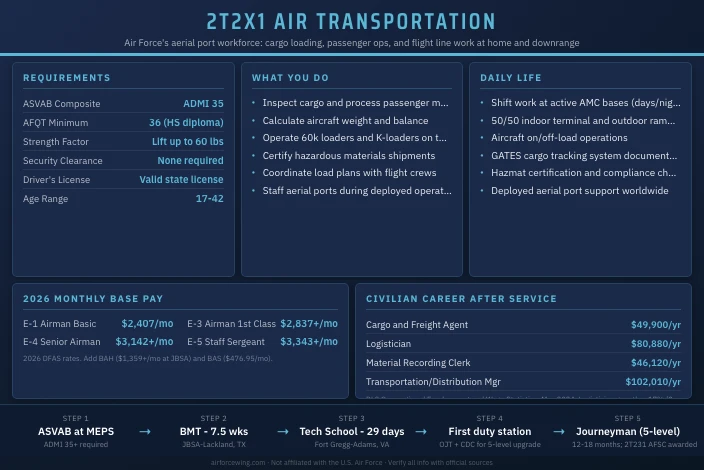
Air Transportation specialists plan, coordinate, and execute the movement of cargo and passengers on military aircraft. They inspect and document freight, calculate aircraft weight and balance, operate specialized loading equipment, and ensure every shipment meets safety and regulatory standards before it leaves the ground. The role spans aerial port ground operations, hazardous materials handling, and direct coordination with flight crews.
Daily Tasks
The daily workload changes with the mission schedule, but the core tasks stay consistent across most assignments:
- Inspect incoming cargo for proper packaging, labeling, and documentation
- Build and verify passenger and cargo manifests
- Calculate weight and balance for aircraft loads
- Operate 60k loaders, aircraft cargo loaders, and other material handling equipment
- Process and certify hazardous material shipments per IATA and DoD regulations
- Coordinate with aircrew on load plans and ramp safety procedures
- Process passengers at aerial port terminals, including check-in and baggage handling
- Conduct aircraft on/off-load operations during contingency and training missions
Specific Roles
The 2T2X1 career uses a skill-level system that reflects increasing responsibility. There are no formal shredouts within the 2T2X1 AFSC, but Special Experience Identifiers (SEIs) are awarded for specific qualifications such as hazardous cargo certification, cargo processing instructor duty, and aerial port controller functions.
| AFSC Code | Title | Description |
|---|---|---|
| 2T211 | Air Transportation Apprentice | Entry-level; completing upgrade training under supervision |
| 2T231 | Air Transportation Journeyman | Independently performs aerial port operations |
| 2T251 | Air Transportation Craftsman | Leads and supervises section-level operations |
| 2T271 | Air Transportation Superintendent | Manages aerial port flight or squadron-level functions |
| 2T291 | Air Transportation Researcher / Instructor | Training and doctrine development billets |
Mission Contribution
Air Transportation Airmen are the link between the ground logistics system and the air mobility network. Air Mobility Command (AMC) moves roughly 98 percent of the Air Force’s airlift cargo, and none of that cargo moves without the 2T2X1 workforce processing it, loading it, and clearing it for flight.
During wartime operations, these Airmen staff bare bases and deployed aerial ports where they handle everything from combat equipment to medical supplies. Peacetime duties include humanitarian airlifts, repatriation missions, and support for joint and coalition exercises worldwide. The mission scope is genuinely global, an Airman assigned to an AMC wing can expect to support operations in Europe, the Pacific, the Middle East, or Africa within a single assignment.
Technology and Equipment
The job combines manual labor with systems-based work. Airmen operate the Global Air Transportation Execution System (GATES) for cargo and passenger tracking, use automated weight and balance tools, and work with DoD hazardous materials routing systems. On the ramp, they operate 60k aircraft cargo loaders, K-loaders, forklifts, and aircraft ground support equipment.
Salary
Base Pay
All pay is set by the 2026 DFAS military pay tables. Airmen receive the same base pay regardless of AFSC. The table below shows representative grades for this career field.
| Grade | Rank | Monthly Base Pay (starting) |
|---|---|---|
| E-1 | Airman Basic (AB) | $2,407 |
| E-2 | Airman (Amn) | $2,698 |
| E-3 | Airman First Class (A1C) | $2,837 |
| E-4 | Senior Airman (SrA) | $3,142 |
| E-5 | Staff Sergeant (SSgt) | $3,343 |
| E-6 | Technical Sergeant (TSgt) | $3,401 |
| E-7 | Master Sergeant (MSgt) | $3,932 |
Base pay is one piece of total compensation. A single E-4 at a mid-cost installation receives $476.95/month in Basic Allowance for Subsistence (BAS) and a tax-free Basic Allowance for Housing (BAH) that varies by duty location. BAH for an E-4 without dependents runs roughly $1,359/month at Joint Base San Antonio and higher at more expensive markets. Both allowances are untaxed, which boosts effective compensation well beyond the base pay figure.
Additional Benefits
Active-duty Airmen receive TRICARE Prime at no cost, covering medical, dental, vision, mental health, and prescriptions with zero copays or deductibles. The education package includes up to $4,500/year in Tuition Assistance while on active duty and the Post-9/11 GI Bill (up to 36 months of education benefits) after separation. The GI Bill covers full in-state tuition at public schools and up to $29,920.95 per academic year at private schools, plus a monthly housing allowance based on the school’s location.
Retirement under the Blended Retirement System (BRS) combines a pension worth 40% of high-36 average basic pay at 20 years with automatic and matching Thrift Savings Plan contributions from the government. Airmen who stay at least two years keep the TSP government contributions even if they don’t reach 20 years.
Work-Life Balance
Most aerial port assignments run shift schedules aligned with flight operations, which can include nights, weekends, and holidays. Airmen earn 30 days of paid leave per year and observe 11 federal holidays. Shift work is the norm rather than the exception at active AMC bases, so this is a real scheduling consideration for anyone weighing this career.
Qualifications
Qualification Table
| Requirement | Standard |
|---|---|
| ASVAB Composite | Administrative (ADMI): 35 |
| AFQT Minimum | 36 (high school diploma); 65 (GED) |
| Citizenship | U.S. citizen |
| Age | 17-42 at enlistment |
| Physical | Strength factor J, must lift up to 60 lbs |
| Driver’s License | Valid state driver’s license required |
| Security Clearance | None required; National Agency Check at accession |
| Vision | No specific color vision requirement |
| Medical | Standard enlistment medical standards (MEPS) |
The Administrative (ADMI) composite combines General Science, Paragraph Comprehension, Word Knowledge, and Arithmetic Reasoning. Strong reading comprehension and basic math skills are the most direct ways to prepare for this score. A PICAT voucher lets you take a pre-enlistment test at home before your official MEPS exam.
Application Process
Enlistment follows the standard Air Force path. After meeting with a recruiter, you’ll take the ASVAB at a Military Entrance Processing Station (MEPS), complete a physical exam, and receive a job offer based on your scores, preferences, and available openings. An ASVAB study guide can help you maximize your Administrative composite before test day. The 2T2X1 AFSC does not require a special program or separate application, it’s a standard enlisted accession.
Selection is primarily score-driven. Strong ADMI scores and a clean background check are the main qualifying factors. The career field has no specific prerequisite certifications, though prior experience in warehouse operations, freight handling, or aviation ground support can strengthen your candidacy in the recruiter conversation.
The process from initial contact to ship date typically runs two to six months depending on availability and enlistment processing time.
Service Obligation and Entry Rank
New enlistees enter as Airman Basic (E-1) and are promoted to Airman (E-2) after six months of satisfactory service. Standard enlistment contracts run four years for active duty. The 2T2X1 AFSC does not currently carry an active-duty enlistment bonus, though bonus availability changes with Air Force manning needs, your recruiter will have current figures.
Work Environment
Setting and Schedule
Aerial port Airmen work in a split environment. A significant portion of time is on the ramp or in the cargo processing facility, physical, outdoor-adjacent work around aircraft and equipment. The rest involves terminal operations and documentation work indoors. Airman Vision reports the indoor/outdoor split at roughly 50/50.
Most AMC bases run 24-hour aerial port operations, which means shift work is standard. You may work a Panama schedule, rotating day and night shifts, or be assigned a fixed shift depending on your unit’s structure. Hours typically run 40-50 per week, with surges during exercises, contingency operations, and heavy airlift periods.
Leadership and Communication
The aerial port operates under the Logistics Readiness Squadron (LRS) or a dedicated Aerial Port Squadron (APS) at major AMC installations. Day-to-day guidance comes from your section NCOIC (Non-Commissioned Officer in Charge), with the chain running through the Flight Commander up to the Squadron Commander. Performance feedback is delivered through the Air Force Enlisted Performance Report (EPR) system annually, with periodic mid-cycle feedback sessions between supervisors and Airmen.
Team Dynamics and Autonomy
Entry-level Airmen work closely supervised during initial upgrade training. Once you earn your 5-skill level (Journeyman), you operate with significant independence during routine missions. Senior Airmen and Staff Sergeants often lead small teams on specific aircraft loads or cargo processing lines. Decision-making authority increases with rank, but the pace of aerial port operations means you’ll make real-time judgment calls well before reaching NCO grades.
Job Satisfaction
The 2T2X1 career field tends to attract people who prefer action over desk work. Airmen who report high satisfaction often cite the direct connection to flight operations, the variety of missions, and the physical nature of the job. Those who find it less appealing often point to shift work, inconsistent schedules, and physical demands as factors that wear on work-life balance over a long career.
Training
Training Pipeline
| Phase | Location | Length | Focus |
|---|---|---|---|
| BMT | JBSA-Lackland, TX | 7.5 weeks | Basic military skills, customs, discipline |
| Tech School | Fort Gregg-Adams, VA | 29 days | Cargo processing, hazmat, weight and balance, passenger ops |
| OJT (5-level upgrade) | First duty station | 12-18 months | Hands-on aerial port operations under supervision |
| CDC completion | Self-study | Concurrent with OJT | Knowledge-based testing for AFSC qualification |
Advanced Training
The Transportation Proficiency Center (TPC) at Dobbins ARB, GA provides advanced 2T2X1 training through in-residence courses, distance learning, and mobile training teams. Advanced courses cover aerial port controller operations, specialized cargo handling, and supervisor development. Airmen selected for instructor duty attend formal instructor training and return to the career field in training billets.
The Air Force also supports civilian credential attainment. The Community College of the Air Force (CCAF) awards an Associate of Applied Science degree in Transportation, which is directly tied to the 2T2X1 AFSC. Tuition Assistance covers coursework toward this degree while on active duty. If your ASVAB score isn’t where it needs to be yet, an ASVAB study guide can help you target the Administrative composite specifically.
Career Progression
Rank Progression
| Skill Level | AFSC Code | Typical Rank | Approximate Timeline |
|---|---|---|---|
| 3-level (Apprentice) | 2T211 | E-1 to E-3 | 0-18 months |
| 5-level (Journeyman) | 2T231 | E-3 to E-5 | 18 months - 4 years |
| 7-level (Craftsman) | 2T251 | E-5 to E-7 | 4-12 years |
| 9-level (Superintendent) | 2T271 | E-8 to E-9 | 12+ years |
Promotion to Senior Airman (E-4) happens automatically at 36 months of service (or earlier with strong performance). Staff Sergeant (E-5) and above require promotion board selection based on EPR scores, time in grade, fitness assessment results, and additional duties.
Specialization
Career-long development in 2T2X1 leads to two natural tracks. One is the operational supervisor path, running the aerial port floor as an NCOIC and eventually managing entire aerial port flights. The other is the training and instructor track, which places experienced Airmen in formal training billets at tech school or TPC.
SEIs allow Airmen to document specific expertise. Common 2T2X1 SEIs include:
- Aerial Port Controller: manages aircraft sequencing and ground movements at busy ports
- Hazardous Materials Inspector: certified to process and certify hazardous cargo shipments
- Cargo Processing Instructor: formally qualified to train other Airmen in cargo operations
Role Flexibility
Retraining into or out of the 2T2X1 career field is possible through the Air Force’s enlisted retraining program. Personnel in grades E-3 through E-6 can apply for retraining into other AFSCs if they meet the new AFSC’s qualifications and career field manning permits a release. Retraining from 2T2X1 into logistics-related fields like 2S0X1 Materiel Management is a common path.
Performance Evaluation
The Air Force EPR system rates Airmen on job performance, leadership, personal achievement, and military bearing. EPR ratings of “Exceeds Standards” or “Clearly Exceeds” are required to remain competitive for promotion to E-5 and above. Your section NCOIC completes your EPR annually, with the rating endorsed up the chain of command. Getting additional duties outside your primary job, physical training leader, unit deployment manager, additional duty NCO positions, strengthens EPR narratives.
Success in this career comes down to reliability and ownership. Aerial port supervisors remember Airmen who show up early, ask to do more, and bring problems to their supervisor instead of ignoring them.
Physical Demands
Daily Physical Requirements
Air Transportation is a physically demanding AFSC. The strength factor requires the ability to lift up to 60 pounds unassisted. A typical shift includes extended periods of standing, walking on concrete ramp surfaces, bending, and operating heavy equipment. Work near flight lines requires compliance with hearing protection requirements due to aircraft noise exposure.
In deployed environments, physical demands increase significantly. Airmen may work extended shifts in extreme heat or cold, move cargo with limited equipment, and operate under time pressure with minimal support.
Air Force Fitness Assessment Standards
All Airmen, regardless of AFSC, take the Air Force Fitness Assessment annually. The FA tests four components on a 100-point scale. The minimum passing composite score is 75 points. Each component also has a minimum score that must be met independently.
| Component | Max Points | Notes |
|---|---|---|
| 1.5-Mile Run | 60 | Timed; accounts for most of the composite score |
| Push-Ups (1 minute) | 10 | Standards are age- and gender-normed |
| Sit-Ups (1 minute) | 10 | Standards are age- and gender-normed |
| Waist Circumference | 20 | Measured in inches; normed by gender |
Scores below 75 result in a “Unsatisfactory” FA rating, which triggers mandatory fitness programs and can affect promotion and reenlistment eligibility. Verify current per-component minimums at af.mil.
Medical Evaluations
Initial enlistment requires passing the standard MEPS medical examination. Ongoing medical requirements are the same as for all Airmen, no AFSC-specific periodic medical evaluations apply to 2T2X1. Airmen with chronic musculoskeletal conditions may find this role challenging over time given the physical demands of daily ramp work.
Deployment
Deployment Details
Air Transportation is a high-deployment AFSC. AMC’s global airlift mission requires deployed aerial port teams across multiple combatant commands, and 2T2X1 Airmen are among the first to fill those billets. Deployment length typically runs 90-120 days for standard Air Expeditionary Force (AEF) rotations, though some contingency deployments extend to 180 days or longer.
The tempo is classified as medium-to-high by most accounts. Airmen at large AMC bases like Travis AFB and Dover AFB deploy more frequently than those at installations with smaller airlift missions. Expect one deployment every 12-18 months at a busy AMC wing during periods of high operational tempo.
Duty Stations
Most 2T2X1 assignments cluster around AMC installations with active airlift missions. Common duty stations include:
- Travis AFB, CA: largest AMC wing on the West Coast
- Dover AFB, DE: primary East Coast strategic airlift hub
- McChord Field (JBLM), WA: major Pacific airlift gateway
- Scott AFB, IL: AMC headquarters
- Ramstein AB, Germany: primary European air hub
- Kadena AB, Japan and Yokota AB, Japan: Pacific theater
- Al Udeid AB, Qatar: central command aerial port
Assignment preferences can be submitted through the Air Force assignment system, and first-term Airmen typically receive one of their top choices, though the Air Force’s needs take priority.
Risk/Safety
Job Hazards
Working around aircraft and heavy equipment introduces real physical risk. The most common hazards include:
- FOD (Foreign Object Debris): any loose material on the ramp that can be ingested by engines
- Aircraft ground power and fuel systems: proximity to fuel vapor during aircraft servicing
- Heavy equipment operations: loader and forklift accidents in compressed spaces
- Hearing damage: sustained exposure to aircraft engine noise without proper PPE
- Hazardous materials: exposure risk when processing improperly packaged chemical or biological cargo
Safety Protocols
The Air Force enforces a tiered safety program on all flight lines. Airmen wear personal protective equipment including hearing protection, high-visibility vests, and steel-toed boots during ramp operations. Ground safety briefings are required before each aircraft loading operation. Hazardous materials handlers must complete formal certification training before touching any regulated cargo.
Security and Legal Requirements
The 2T2X1 AFSC requires a National Agency Check but does not require a security clearance at entry. Specific assignments at classified airlift units may require a clearance, which would be initiated by the gaining unit after assignment.
Standard military legal obligations apply: Airmen serve under the Uniform Code of Military Justice (UCMJ) and are subject to its provisions for the duration of their contract.
Impact on Family
Family Considerations
Shift work and deployment cycles are the biggest factors affecting family life in this career. At active AMC bases, shift schedules rotate regularly, which makes consistent family routines difficult to maintain. During heavy operational periods, off-duty time can be limited even outside formal deployments.
The Air Force provides extensive family support through Military OneSource, the Airman and Family Readiness Center (AFRC), and on-base childcare facilities. Deployment support groups and financial counseling are available at every major installation. Families who thrive in this career typically build strong connections within their unit’s family support network.
Relocation
Permanent Change of Station (PCS) moves occur every 2-4 years on average. The Air Force pays for household goods shipment and provides Dislocation Allowance to offset moving costs. Families with school-age children deal with frequent school transitions, which is a real consideration when evaluating this career long-term.
Overseas tours, including Japan, Germany, and the Middle East, are part of the normal assignment cycle for 2T2X1 Airmen. Accompanied tours (with family) are available at most overseas locations, though family members are not guaranteed positions in local schools or employment.
Reserve and Air National Guard
Component Availability
The 2T2X1 AFSC is available in both the Air Force Reserve Command (AFRC) and the Air National Guard (ANG). Both components operate aerial port squadrons and require trained air transportation specialists to support AMC’s airlift mission. Retraining into the 2T2X1 career field in either component is restricted to grades E-6 and below with fewer than 12 years of Total Federal Military Service.
Drill Schedule and Training Commitment
The standard Reserve/ANG commitment is one weekend per month (Unit Training Assembly, or UTA) plus 15 days of Annual Tour training each year. Air transportation units may schedule additional training days for currency requirements, hazardous materials recertification, or equipment operator recurrency. Expect occasional weekend training beyond the standard UTA schedule.
Part-Time Pay
A drill weekend (four Unit Training Assemblies) pays one day’s base pay per UTA. An E-4 with fewer than two years of service earns $3,142/month on active duty but approximately $419/drill weekend (four UTAs at the daily rate) as a Reserve or ANG member.
Benefits Comparison
| Category | Active Duty | Air Force Reserve | Air National Guard |
|---|---|---|---|
| Commitment | Full-time | 1 wknd/mo + 15 days/yr | 1 wknd/mo + 15 days/yr |
| Monthly Base Pay (E-4) | $3,142+ | ~$419/drill wknd | ~$419/drill wknd |
| Healthcare | TRICARE Prime (free) | TRICARE Reserve Select (premium) | TRICARE Reserve Select (premium) |
| Education | TA ($4,500/yr) + GI Bill | Federal TA; GI Bill (with qualifying service) | State tuition waivers vary; Federal TA available |
| Deployment Tempo | Medium-high | Periodic mobilizations | Periodic mobilizations |
| Retirement | 20-yr pension (BRS) | Points-based at age 60 | Points-based at age 60 |
The ANG offers state-specific tuition waivers at public colleges and universities, benefits vary significantly by state and are worth researching before choosing a component.
Civilian Career Integration
Air transportation pairs well with civilian logistics and freight careers. Reserve and ANG Airmen in this AFSC often work for commercial airlines, freight carriers, or federal transportation agencies in their civilian jobs. The overlap in skills is direct enough that many employers actively seek candidates with military air cargo experience. Federal USERRA protections ensure civilian employers cannot penalize you for Reserve or Guard duty.
Deployment and Mobilization
Reserve and ANG 2T2X1 Airmen are mobilized to support active-duty AMC missions, particularly during surges in airlift demand and overseas contingency operations. Mobilization lengths typically run 90-180 days. The tempo is lower than active duty but not negligible, many ANG aerial port units have deployed multiple times in the past decade in support of operations in the Middle East, Europe, and the Pacific.
Post-Service
Civilian Career Transition
The skills from 2T2X1 transfer directly to civilian aviation ground operations, freight logistics, and supply chain management. The Air Force’s Transition Assistance Program (TAP) provides job search coaching, resume writing, and employer connections before separation. The Hiring Our Heroes program runs fellowships at civilian companies for transitioning service members.
Civilian Career Prospects
| Civilian Job Title | Median Annual Wage | Job Outlook (2024-2034) |
|---|---|---|
| Cargo and Freight Agent | $49,900 | Faster than average (7%+) |
| Logistician | $80,880 | Faster than average (+17%) |
| Material Recording Clerk | $46,120 | Average |
| Transportation/Distribution Manager | $102,010 | Average |
Salary data from BLS Occupational Employment and Wage Statistics, May 2024; O*NET OnLine outlook projections.
Commercial airlines (Delta, United, FedEx, UPS, Southwest), defense contractors (L3 Technologies, AMSEC), and federal agencies including the Transportation Security Administration and U.S. Postal Service actively recruit veterans with aerial port experience. The CCAF Transportation degree helps candidates meet civilian job posting education requirements.
Separation Policies
Airmen who complete their initial contract can separate, reenlist, or apply for retraining. Early separation is rare outside of hardship, medical disqualification, or administrative action. Airmen who separate before completing eight years of service retain a reserve obligation and may be called to service in a national emergency during that window.
Is This a Good Job
The Right Fit
This AFSC works well for people who:
- Want physical work with direct ties to flight operations
- Are comfortable with shift schedules, including nights and weekends
- Want a fast path to a civilian cargo or logistics career
- Can handle frequent deployment and relocation
- Prefer varied, mission-driven days over repetitive desk work
Strong candidates tend to be organized under pressure, physically fit, and comfortable operating in environments where mistakes have real consequences. The job rewards people who take ownership and stay sharp on technical details, a mislabeled hazmat shipment or a bad weight calculation can ground an aircraft.
The Wrong Fit
This AFSC is probably not a good match for someone who:
- Wants predictable hours and consistent weekends off
- Prefers analytical or computer-centric work over physical labor
- Is uncomfortable with frequent relocation
- Has significant physical limitations (this role requires sustained lifting and ramp work)
- Wants to minimize deployment exposure
Shift work at AMC bases is the standard, not the exception. Before committing to 2T2X1, talk to current or former Airmen at an AMC installation to understand what the schedule actually looks like day-to-day.
Career and Lifestyle Alignment
The 2T2X1 career fits people at the start of a logistics or aviation career who want hands-on experience they can’t easily get in a civilian entry-level job. A four-year enlistment produces a candidate with hazardous materials certifications, heavy equipment qualifications, and documented experience managing cargo on active military aircraft, credentials that take years to accumulate in civilian aviation.
Long-term, this AFSC suits Airmen who want to build toward a senior NCO career in aerial port operations or transition to civilian aviation logistics at a level above entry-grade positions. Those who reenlist typically do so because they want the leadership opportunities that come at the 7-level and above.
More Information
Talk to an Air Force recruiter to confirm current ASVAB score requirements, bonus availability, and open training slots for 2T2X1. Recruiter contact information is available through airforce.com. Official AFSC documentation is maintained in the Career Field Education and Training Plan (CFETP) published by the Air Force Personnel Center. Before your recruiter meeting, check your projected ADMI composite with a PICAT practice test to know where you stand.
This site is not affiliated with the U.S. Air Force or any government agency. Verify all information with official Air Force sources before making enlistment or career decisions.
Explore more Air Force air transportation careers such as 2T0X1 Traffic Management to find the role that best fits your goals.