1A2X1 Aircraft Loadmaster
Every C-17 that lifts off with 170,000 pounds of cargo, every C-130 that drops supplies over a combat zone, and every C-5 that hauls armored vehicles across the Pacific has one thing in common: a loadmaster made it possible. The 1A2X1 Aircraft Loadmaster is the aircrew member who owns the cargo deck, calculating weight and balance, rigging loads, managing passengers, and executing airdrops that can shift the outcome of a mission.
This is a flying position. Loadmasters wear flight suits, log flight hours, earn monthly flight pay on top of their base pay, and train alongside pilots and navigators. If you want a hands-on technical role that puts you on the aircraft for every mission, not just on the ground supporting it, this AFSC is worth a serious look. The gateway score is a General composite of 57 on the ASVAB, and how you score will determine your options at MEPS.
Qualifying requires specific ASVAB line scores. Our ASVAB study guide covers what to target and how to prepare.
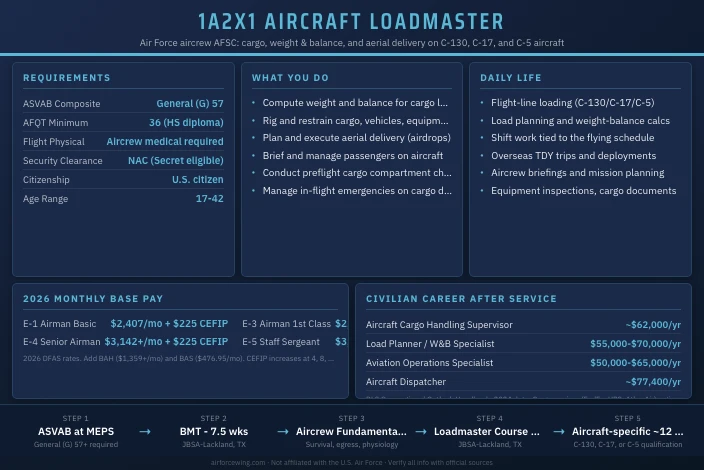
Job Role and Responsibilities
The 1A2X1 Aircraft Loadmaster plans, supervises, and executes the loading and unloading of cargo, vehicles, and passengers on Air Force mobility and special operations aircraft. Loadmasters compute weight and balance calculations, configure the cargo compartment, oversee aerial delivery operations, and perform in-flight duties to maintain aircraft safety and mission integrity throughout each flight.
Daily Tasks
A loadmaster’s day shifts constantly depending on the mission. On the ground, the work involves:
- Inspecting cargo, vehicles, and hazardous materials to verify documentation and compliance
- Computing center-of-gravity calculations and preparing load plans
- Rigging pallets, vehicles, and equipment with restraint systems rated to withstand in-flight forces
- Briefing passengers on emergency procedures and safety requirements
- Coordinating with the aircraft commander on weight, balance, and payload limits
In the air, the role becomes more demanding. Loadmasters monitor the cargo compartment continuously, adjust restraint as needed, manage paratroop door operations during airdrops, operate material handling equipment, and handle in-flight emergencies such as fire, structural damage, or medical situations. On airdrop missions, low-altitude container delivery, heavy equipment drops, or combat airdrops, the loadmaster controls the release sequence.
Specialized Roles and Shredouts
1A2X1 Loadmasters are assigned across several major airframes. Each aircraft has different characteristics, weight limits, and mission profiles that require platform-specific training after initial qualification.
| Aircraft | Mission Profile | Primary Bases |
|---|---|---|
| C-130H/J Hercules | Tactical airlift, airdrop, special ops support | Little Rock AFB, AR; Pope Field, NC; Dyess AFB, TX |
| C-17A Globemaster III | Strategic/tactical lift, large airdrops | Joint Base Lewis-McChord, WA; Dover AFB, DE; Travis AFB, CA |
| C-5M Super Galaxy | Strategic heavy lift | Travis AFB, CA; Dover AFB, DE; Lackland AFB, TX |
Special Experience Identifiers (SEIs) are awarded after completing additional qualifications. Loadmasters can earn SEIs for Combat Delivery, Night Vision Goggle operations, Aeromedical Evacuation, and special operations support missions. Entry into any of these aircraft assignments starts with the ASVAB General composite requirement, a score of 57 or above opens the 1A2X1 slot at MEPS.
Mission Contribution
Loadmaster Airmen sit at the center of the Air Force global mobility mission. Without accurate weight and balance computations, an aircraft can become uncontrollable. Without correct cargo rigging, a 60,000-pound armored vehicle can break free during turbulence. The loadmaster is the person who prevents both from happening. During humanitarian operations, they supervise food and water drops in areas where trucks can’t reach. During combat operations, they execute precision airdrops under fire. The job has direct consequences for every person on the aircraft and everyone waiting for what it carries.
Technology and Equipment
Loadmasters work with aircraft cargo management systems, electronic load planning software, and onboard communication systems. They operate K-loaders (large vehicles used to raise pallets to cargo door height), 463L military pallets and restraint systems, and aerial delivery rigging equipment. On airdrop missions they manage static-line and extraction parachute systems. Newer C-17 and C-130J aircraft use digital avionics and automated weight-and-balance software, though manual backup calculation remains a required skill.
Salary and Benefits
Loadmasters earn basic pay at their grade plus monthly Career Enlisted Flyer Incentive Pay (CEFIP). CEFIP is aviation incentive pay for enlisted aircrew members who maintain flying status, it is paid every month in addition to basic pay and allowances.
Base Pay and Flight Pay
| Rank | Grade | Monthly Base Pay | Monthly CEFIP | Estimated Total (Active Flying) |
|---|---|---|---|---|
| Airman Basic | E-1 | $2,407 | $225 | ~$2,632 |
| Airman First Class | E-3 | $2,837+ | $225 | ~$3,062+ |
| Senior Airman | E-4 | $3,142+ | $225 | ~$3,367+ |
| Staff Sergeant | E-5 | $3,343+ | $350 | ~$3,693+ |
| Technical Sergeant | E-6 | $3,401+ | $500 | ~$3,901+ |
| Master Sergeant | E-7 | $3,932+ | $600 | ~$4,532+ |
Base pay figures are 2026 DFAS rates and increase with years of service. CEFIP rates increase at 4, 8, and 14 years of aviation service. These figures exclude housing allowance (BAH) and BAS.
Allowances and Benefits
Beyond base pay and CEFIP, Loadmasters receive the full suite of military allowances:
- BAH (Basic Allowance for Housing): Varies by duty station and dependency status. At JBSA-Lackland, an E-4 without dependents receives approximately $1,359/month in 2026; an E-4 with dependents receives approximately $1,728/month. Check the official BAH rate lookup for your specific installation.
- BAS (Basic Allowance for Subsistence): $476.95/month for enlisted Airmen (2026 rate).
- TRICARE Prime: Full medical, dental (at military treatment facilities), and pharmacy coverage at zero cost for active duty members.
- Tuition Assistance: Up to $4,500/year for college courses while on active duty.
- Post-9/11 GI Bill: Full in-state tuition at public universities after service, plus a monthly housing allowance. Private school cap is $29,920.95 per academic year.
Retirement and Leave
The Blended Retirement System (BRS) combines a 20-year pension at 40% of your high-36 average basic pay with a Thrift Savings Plan (TSP) account. The Air Force automatically contributes 1% of basic pay to your TSP after 60 days of service and matches up to 4% more when you contribute. Airmen earn 30 days of paid leave per year and 11 federal holidays.
Qualifications and Eligibility
Requirements Table
| Requirement | Standard |
|---|---|
| ASVAB Composite | General (G) 57 minimum |
| AFQT Minimum | 36 (high school diploma) |
| Citizenship | U.S. citizen |
| Age | 17 to 42 |
| Education | High school diploma or equivalent |
| Physical | Must lift 70 lbs; aircrew flight physical required |
| Vision | Aircrew vision standards apply |
| Security | National Agency Check (background investigation) |
The G composite is calculated from Word Knowledge, Paragraph Comprehension, Arithmetic Reasoning, and Mathematics Knowledge subtests. A score of 57 on this composite is moderate, well-prepared applicants typically reach it with focused study on vocabulary and basic math. If you want to understand exactly how the composite is calculated and what to study, review the PiCAT and ASVAB preparation guide.
Application Process
The selection process follows the standard Air Force enlisted pathway:
Competitiveness
Loadmaster slots at MEPS are limited because it is a flying position with specific medical standards and a finite number of aircraft assignments. Candidates who score well above the minimum G-57, maintain strong physical fitness, and have no waivers required tend to have better access to available slots. Demonstrating mechanical aptitude and any prior experience with cargo handling, logistics, or aviation can strengthen your profile, though none is required.
Service Obligation
Enlistment into 1A2X1 carries the standard active duty obligation of four years, with many contracts structured at six years given the training investment. You enter service at E-1 (Airman Basic) and typically reach E-3 (Airman First Class) within 12 months.
Work Environment
Setting and Schedule
Loadmasters split their time between the flight line, the aircraft interior, and operations planning spaces. Ground days involve loading operations, mission planning, inspections, and equipment checks, often outdoors on the ramp in all weather conditions. Flying days can stretch well beyond a standard eight-hour window. Long-range missions on the C-17 or C-5 involve crew rest cycles and layovers at bases around the world, which means a single mission can keep a loadmaster away from home for several days or longer.
Work schedules follow the flying schedule of the unit, which is driven by operational requirements rather than a fixed Monday-through-Friday routine. Most mobility wings operate on shift schedules to maintain around-the-clock airlift capability. Panama and DuPont schedules (rotating 12-hour shifts) are common at high-tempo units.
Leadership and Communication
Loadmasters work within a crew resource management (CRM) framework that makes every crew member responsible for speaking up when they see a safety problem, regardless of rank. On the aircraft, the senior loadmaster holds crew authority over the cargo compartment. On the ground, a Flight Superintendent (typically a Senior NCO) oversees the shop’s manning, training, and readiness. Performance feedback follows the Air Force Enlisted Performance Report (EPR) system, with formal evaluations completed annually and informal feedback typically given each quarter.
Team Dynamics
Most missions involve a crew of two to four loadmasters working together on the same aircraft, with the senior member taking mission lead. Key coordination points during a typical mission:
- Pre-flight: coordinate with aerial port for cargo manifest and load plan
- Loading: direct ground crews, verify weight and balance, secure cargo
- In-flight: monitor loads, execute airdrops, manage passenger needs
- Off-load: direct unloading at destination, account for all cargo
Individual decision-making authority is high in flight, the loadmaster on the deck is the subject matter expert for cargo operations, and the aircraft commander relies on their judgment.
Job Satisfaction
Loadmasters consistently report that flying the mission, rather than supporting it from the ground, is the primary reason people stay. The combination of technical challenge, travel, and direct mission impact keeps retention strong. High deployment tempo and time away from family are the most common sources of stress. The path from junior loadmaster to senior crew member is well defined, which gives people a clear picture of what the next few years look like.
Training and Skill Development
Initial Training Pipeline
| Phase | Location | Length | Focus |
|---|---|---|---|
| Basic Military Training (BMT) | JBSA-Lackland, TX | 7.5 weeks | Military fundamentals, physical training, Air Force culture |
| Aircrew Fundamentals Course | JBSA-Lackland, TX | ~3 weeks | Survival, egress, water survival, parachute basics, physiological training |
| Aircraft Loadmaster Course (Tech School) | JBSA-Lackland, TX | 29 classroom days | Weight and balance, cargo restraint, aerial delivery, hazmat, load planning |
| Aircraft-Specific Training | Aircraft type’s home base or formal training unit | ~12 weeks | Hands-on qualification on assigned airframe (C-130, C-17, or C-5) |
The Aircrew Fundamentals Course is mandatory for all pipeline students entering a flying AFSC. It covers hypoxia awareness (altitude chamber training), ejection seat/emergency egress procedures, water survival, and land survival basics. Students who fail to complete it do not proceed to the Aircraft Loadmaster Course.
The Aircraft Loadmaster Course at Lackland covers the core qualification tasks: load planning software, weight and balance computation, cargo restraint procedures, aerial delivery rigging, passenger management, and emergency procedures. Graduating with AFSC 1A231 (the 3-skill level) requires both the classroom course and completion of on-the-job qualifications.
Advanced Training
After initial qualification, loadmasters pursue upgrade training through the 5-skill level (1A251) and 7-skill level (1A271). Each upgrade requires documented on-the-job training, formal written tests, and evaluator sign-off on core tasks.
Advanced qualifications available to experienced loadmasters include:
- Combat Delivery Qualification: Low-altitude airdrops, container delivery, and heavy equipment delivery in contested or degraded environments
- Night Vision Goggle (NVG) Qualification: Low-level night operations with NVGs
- Aeromedical Evacuation (AE) Qualification: Patient movement integration on configured aircraft
- Special Operations Aviation Support: Working with Air Force Special Operations Command units and SOF-configured aircraft
The Air Force also funds the Community College of the Air Force (CCAF) degree program. Loadmasters earn the Aviation Operations associate degree upon completing technical training and upgrade requirements, with no additional cost. If your G composite needs improvement before MEPS, the PiCAT prep guide walks through exactly what the General composite tests and how to approach each subtest.
Career Progression and Advancement
Rank Progression Table
| Rank | Grade | Typical Time-in-Service | Role |
|---|---|---|---|
| Airman Basic | E-1 | Entry (0-6 months) | Student/trainee |
| Airman | E-2 | 6 months | Completing pipeline training |
| Airman First Class | E-3 | 12-18 months | Junior loadmaster, 3-skill level tasks |
| Senior Airman | E-4 | 3 years | Qualified loadmaster, independent missions |
| Staff Sergeant | E-5 | 5-7 years | Mission lead, evaluator candidate |
| Technical Sergeant | E-6 | 9-12 years | Flight NCO, training supervisor |
| Master Sergeant | E-7 | 14-16 years | Flight Superintendent, unit training manager |
| Senior Master Sergeant | E-8 | 18-21 years | Loadmaster Director, wing-level positions |
| Chief Master Sergeant | E-9 | 22+ years | Senior Enlisted Advisor roles |
Retraining and Transfers
Retraining into or out of 1A2X1 is possible through the voluntary and involuntary retraining programs managed by AFPC. Because loadmaster is a flying position with a dedicated training pipeline, voluntary retraining out is uncommon, most who enter the field stay for a career. Officers can apply for the Enlisted Commissioning Program without leaving the AFSC before their commissioning, and some senior loadmasters pursue 18X Special Operations paths.
Performance Evaluation
The Enlisted Performance Report (EPR) rates Airmen on a 5-tier scale. Ratings directly affect promotion board outcomes. For loadmasters, EPR comments typically reflect evaluator currency (how many crew evaluations you’ve completed), additional duties, mission accomplishments, and professional military education (PME) completion. Promotion to SSgt and above is board-competitive, meaning that strong EPR narratives and PME completion matter as much as time in service.
Physical Demands and Medical Evaluations
Daily Physical Demands
The job is physically demanding on the ground and in the air. A typical ground day involves:
- Lifting cargo, equipment, and 463L pallets, loads up to 70 lbs routinely
- Operating K-loaders and forklifts in an outdoor flight-line environment
- Walking or standing for extended periods during loading operations
- Working in confined spaces within the cargo compartment
In flight, loadmasters stand for extended periods in a moving, often turbulent aircraft. At altitude, the pressurized cargo compartment is colder than the flight deck. On airdrop missions, the rear door opens at low altitude, creating wind blast and noise levels that require hearing protection.
Air Force Fitness Assessment
All Airmen take the Air Force Fitness Assessment annually. Scores are age- and gender-normed, with a minimum passing composite of 75 out of 100.
| Component | Max Points | Minimum to Pass |
|---|---|---|
| 1.5-Mile Run | 60 | Age/gender-normed minimum |
| Waist Circumference | 20 | Age/gender-normed maximum |
| Push-Ups (1 minute) | 10 | Age/gender-normed minimum |
| Sit-Ups (1 minute) | 10 | Age/gender-normed minimum |
Each component must meet its minimum threshold in addition to reaching a composite of 75. Failing any single component fails the assessment regardless of total score. Loadmasters in high-tempo units generally maintain fitness above the minimum because the physical demands of the job require it.
Medical Evaluations
As an aircrew member, a 1A2X1 Loadmaster undergoes a periodic flying physical rather than a standard annual physical. These evaluations are more thorough than the general military physical and assess cardiovascular function, hearing, vision, neurological status, and other aviation-specific criteria. The frequency is typically annual. Any condition that develops during service that could affect flight duty may result in a temporary or permanent medical disqualification from flying status, which would require retraining.
Deployment and Duty Stations
Deployment Details
Loadmaster deployment tempo is among the highest of any Air Force enlisted AFSC. The mobility mission runs continuously, strategic airlift does not pause during peacetime, and it accelerates during crises and combat operations. Most active-duty loadmasters can expect to spend significant portions of each year away from their home station, either on rotational deployments or extended temporary duty (TDY) trips.
Deployments typically range from 90 to 179 days for contingency operations. TDY missions on strategic airlift routes can be shorter but very frequent, a C-17 crew might fly multiple missions per month that involve overseas stops and crew rest before returning. The combination of deployments and mission TDYs means a senior loadmaster with 10+ years in may have spent four to six years of their career away from home station.
Duty Stations
Major installations with 1A2X1 positions include:
- Little Rock AFB, AR: Primary C-130 training base; largest C-130 wing in the Air Force
- Pope Field, NC: C-130J support for XVIII Airborne Corps and Army airborne operations
- Dyess AFB, TX: C-130J and B-1 composite wing; active airdrop mission
- Joint Base Lewis-McChord, WA: C-17; primary Pacific theater airlift
- Dover AFB, DE: C-17 and C-5M; primary East Coast strategic hub
- Travis AFB, CA: C-17 and C-5M; primary Pacific gateway
- Ramstein Air Base, Germany: C-130J; USAFE theater air mobility
Assignments are managed by AFPC. First-duty station preferences are submitted, but needs of the Air Force drive the final assignment. With 1A2X1, most assignments cycle through the major airlift hubs listed above.
Risk, Safety, and Legal Considerations
Job Hazards
Flying is inherently riskier than ground-based work. Loadmasters face several specific hazards:
- Aircraft accidents and mechanical failures in flight
- Hypoxia risk during decompression events
- Injury from shifting cargo or restraint failure during turbulence
- Noise-induced hearing loss from extended exposure to aircraft engines and propellers
- Physical injury during airdrop operations, static lines, extraction systems, and open cargo doors involve moving equipment at altitude
- Combat exposure on missions into hostile or contested airspace
Safety Protocols
Crew Resource Management training, standardized pre-departure briefings, and Operational Risk Management (ORM) processes are mandated before every flight. Aircraft are inspected on a strict maintenance schedule under AFI 21-101. Loadmasters conduct their own pre-departure cargo inspections independently of ground crew. All hazardous cargo must be documented and handled per DoD and ICAO standards. Hearing protection is required in all high-noise environments.
Security and Legal Requirements
1A2X1 does not require a security clearance at entry, a National Agency Check (NAC) background investigation is standard for all enlistees. However, many duty assignments and special operations support missions require a Secret or higher clearance, which is applied for through the unit after assignment. Loadmasters working with classified airlift manifests or special mission aircraft will complete the full personnel security investigation process.
The Air Force Code of Military Justice (UCMJ) governs all conduct, and aircrew members are held to additional standards under AFI 11-202, which covers aircrew qualification standards and flight discipline.
Impact on Family and Personal Life
Family Considerations
The deployment tempo and mission TDY schedule make this one of the more demanding AFSCs for family life. A loadmaster at a strategic airlift base can be away from home for 150 or more days per year in a high-demand cycle. Family support resources available at all major installations:
- Military Family Life Counselors (MFLCs): confidential short-term counseling
- Air Force Aid Society: emergency financial assistance and grants
- Family Readiness Centers: deployment support groups and community events
- EFMP (Exceptional Family Member Program): special needs coordination during PCS
- AFAP (Airman and Family Assistance Program): spouse job search resources
Spouse employment can be challenging given frequent relocations, but these programs help offset the disruption.
Relocation
Permanent Change of Station (PCS) moves occur roughly every two to four years. The Air Force pays for household goods shipment and provides a dislocation allowance (DLA) to offset moving costs. Families receive BAH at the new duty station’s rate immediately upon assignment notification, so the housing budget adjusts before the move. Overseas assignments are possible, with Ramstein and other USAFE/PACAF bases among the options. Unaccompanied tours (short tours without family) are uncommon for loadmasters but can occur at small detachments or forward-deployed locations.
Reserve and Air National Guard
Component Availability
1A2X1 is available in both the Air Force Reserve Command (AFRC) and the Air National Guard (ANG). The Reserve and Guard fly the same aircraft as active duty. C-130s, C-17s, and C-5s, and their loadmasters are trained to the same standards. The ANG operates locations nationwide with Aircraft Loadmaster positions, contact your state Guard recruiter for current availability.
Drill Schedule and Training Commitment
Reserve and Guard loadmasters follow the standard one weekend per month (Unit Training Assembly) plus two weeks per year (Annual Tour) baseline, but the aircrew qualification requirement adds complexity. Maintaining flying currency and completing annual evaluations requires additional flying days beyond the standard UTA schedule. Most Reserve and Guard units schedule additional flying periods each month to keep crew members current, which means actual time commitment typically exceeds the “one weekend” baseline.
Part-Time Pay
An E-4 drilling with a Reserve or Guard unit earns four drill periods per UTA weekend. At the 2026 DFAS rate, an E-4 earns approximately $3,142+ per month on active duty, and four drill periods equal roughly $418+ for the weekend. Reserve component members on orders also earn CEFIP during periods of flying duty.
Benefits Comparison
| Category | Active Duty | Air Force Reserve | Air National Guard |
|---|---|---|---|
| Commitment | Full-time | 1 UTA/month + 2 wks/yr + flying days | 1 UTA/month + 2 wks/yr + flying days |
| Monthly Base Pay (E-4) | $3,142+ | ~$418+/drill weekend | ~$418+/drill weekend |
| Healthcare | TRICARE Prime (free) | TRICARE Reserve Select (premium) | TRICARE Reserve Select (premium) |
| Education | Tuition Assistance ($4,500/yr) + Post-9/11 GI Bill | Federal TA + Post-9/11 GI Bill (with qualifying service) | Federal TA + state tuition waivers vary by state |
| Deployment Tempo | High (150+ days/year possible) | Moderate (mobilization based) | Moderate (mobilization based) |
| Retirement | BRS pension at 20 years + TSP | Points-based Reserve retirement | Points-based Reserve retirement |
Civilian Career Integration
The Guard and Reserve loadmaster role pairs well with civilian aviation careers. Airlines, cargo carriers (FedEx, UPS, Atlas Air), and government contract aviation operators value the weight-and-balance, load planning, and airmanship background. Civilian employers are generally supportive of Guard and Reserve service, and USERRA protections guarantee job reinstatement rights after deployment. Some Guard units are co-located near major cargo hub airports, making the civilian-to-military schedule coordination more practical.
Post-Service Opportunities
Civilian Career Transition
Years of flight experience, weight-and-balance expertise, and airframe knowledge translate directly to the commercial aviation sector and the broader logistics industry.
| Civilian Job Title | Median Annual Salary | Job Outlook |
|---|---|---|
| Aircraft Cargo Handling Supervisor | ~$62,000/yr | Steady demand at commercial cargo hubs |
| Load Planner / Weight and Balance Specialist | ~$55,000-$70,000/yr | Strong at cargo airlines and charter operators |
| Aviation Operations Specialist | ~$50,000-$65,000/yr | Broad demand across aviation sector |
| Transportation Logistics Specialist | ~$48,270/yr | +8% growth (2023-2033) |
| Aircraft Dispatcher | ~$77,400/yr | Growing demand with aviation expansion |
BLS Occupational Outlook Handbook, 2024 data. Salaries vary by employer, location, and experience.
Cargo carriers and charter operators frequently hire experienced military loadmasters directly into weight-and-balance, load planning, and ground operations roles. FedEx, UPS, Atlas Air, and Air Mobility Command contract operators are active military talent pipelines. Some experienced loadmasters pursue FAA certifications to transition into dispatcher or ground instructor roles.
Transition Programs
The Air Force’s Transition Assistance Program (TAP) includes mandatory pre-separation counseling, resume writing support, and employer connections through programs like Hiring Our Heroes. The CCAF Aviation Operations associate degree earned during service satisfies lower-division requirements at many four-year aviation programs, reducing time to a bachelor’s degree for those pursuing further education.
Is This a Good Job for You? The Right (and Wrong) Fit
Ideal Candidate Profile
A good loadmaster candidate is methodical and detail-oriented, off-by-a-few calculations in weight and balance are not acceptable. At the same time, this person thrives in a fast-moving, physical environment where plans change and improvisation matters. If you can stay calm when an airdrop gets complicated or a cargo issue develops at 15,000 feet, you have the right temperament.
People who do well in this AFSC typically:
- Enjoy working with aircraft and want to fly, not just support flight operations from the ground
- Are comfortable with math, logistics, and systematic checklists
- Handle physical labor well and don’t mind working outdoors in harsh conditions
- Accept that deployments and TDYs are a regular part of the job, not exceptions
- Want a clearly defined career path with technical depth and promotion potential
Potential Challenges
The flying schedule and deployment tempo are the biggest adjustment points. Families need to be prepared for extended separations, and the Airman needs to be willing to accept that their schedule is driven by mission requirements. The work is physically demanding in ways that compound over time, years of cargo loading, cold cargo decks, and noise exposure take a toll. Anyone who wants a predictable, office-based routine should look at a different AFSC.
The competition for loadmaster slots at MEPS can also be a challenge. Aircrew AFSCs are popular, and the medical qualification standards add a filter that doesn’t apply to most ground jobs. A disqualifying vision or medical condition can close this path even if every other standard is met.
Career and Lifestyle Alignment
This AFSC suits someone who sees military service as a career-defining chapter that leads somewhere specific, either a long active-duty career or a direct path into commercial aviation and cargo operations. The combination of flight pay, travel, technical qualifications, and a strong civilian credential makes 1A2X1 one of the better-rounded enlisted AFSCs for people who want their service time to translate into long-term career capital.
More Information
Speak with an Air Force recruiter to check current slot availability for 1A2X1, verify the exact ASVAB composite score requirement in effect at the time of your MEPS visit, and confirm aircrew physical requirements. Recruiter contact information is available at airforce.com. Before your recruiter visit, use the ASVAB study guide to prepare your General composite score, a strong score above the minimum gives you more options at MEPS and makes your contract negotiation easier.
This site is not affiliated with the U.S. Air Force or any government agency. Verify all information with official Air Force sources before making enlistment or career decisions.
Explore more Air Force air transportation careers such as 2T2X1 Air Transportation and 2T0X1 Traffic Management.