When Can You Retire From the Air Force
Most people assume military retirement means 20 years and done. That’s the standard path, but it’s not the only one. Medical boards can retire you at 10 years. Early retirement authority has been offered at 15. Mandatory separation rules can push you out before you ever get a choice. Reserve service follows an entirely different timeline with a pension that doesn’t start until age 60.
The path to Air Force retirement depends on your component, rank, health, and year group. This post covers every eligibility scenario in plain terms so you know exactly where you stand.
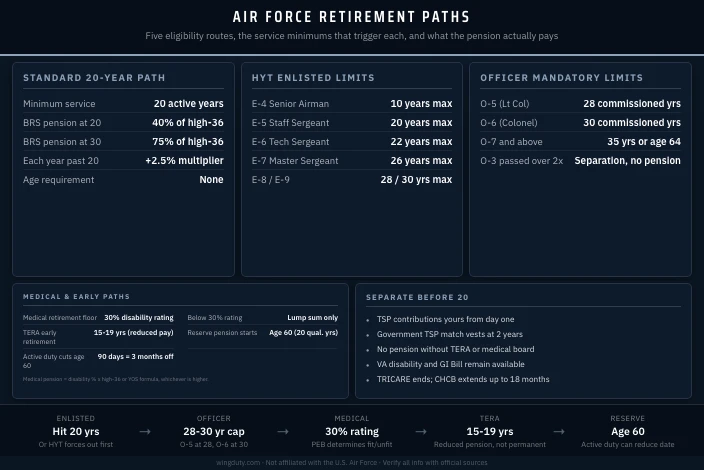
The Standard 20-Year Retirement
Active duty retirement requires a minimum of 20 qualifying years of service. Hit that mark and you’re entitled to a monthly pension for life, TRICARE coverage, and access to base facilities.
The pension formula under the current Blended Retirement System is straightforward:
Pension = years of service x 2% x high-36 average basic pay
At 20 years, that’s 40% of your average basic pay from your highest 36 months. Every year you stay past 20 adds 2.5% to the multiplier. At 30 years, the pension reaches its BRS cap of 75% of high-36.
You don’t have to wait until a specific age. Active duty members who serve 20 years can retire the day they hit that milestone, regardless of how old they are. Enlist at 18 and you could be drawing a pension at 38.
There’s one thing to keep in mind: retirement eligibility doesn’t mean you automatically stay to 20. The Air Force has mandatory separation points that remove members before they get there.
High Year of Tenure: When the Air Force Separates You
High Year of Tenure (HYT) is the maximum number of years an enlisted Airman can serve at a given rank before mandatory separation. If you haven’t been promoted, HYT forces you out.
Current HYT limits per AFI 36-3203:
| Grade | Rank | HYT Limit |
|---|---|---|
| E-4 | Senior Airman (SrA) | 10 years |
| E-5 | Staff Sergeant (SSgt) | 20 years |
| E-6 | Technical Sergeant (TSgt) | 22 years |
| E-7 | Master Sergeant (MSgt) | 26 years |
| E-8 | Senior Master Sergeant (SMSgt) | 28 years |
| E-9 | Chief Master Sergeant (CMSgt) | 30 years |
A Senior Airman who reaches 10 years without promoting to Staff Sergeant receives an honorable discharge, not a retirement. No pension. That’s the hard edge these limits create.
HYT also means that reaching 20 years isn’t automatic just because you keep reenlisting. You have to keep getting promoted, or the clock runs out before the retirement threshold.
Officer Mandatory Retirement Points
Officers have a parallel set of rules built around promotion rather than time. Twice failing promotion to a specific grade triggers involuntary separation or, in some cases, retirement if the officer has enough service.
Key officer mandatory retirement benchmarks per current DoD policy:
- O-3 (Captain) twice passed over for O-4 typically leads to involuntary separation, not retirement, unless the officer has qualifying service under a specific separation authority
- O-5 (Lieutenant Colonel) must retire by 28 years of active commissioned service
- O-6 (Colonel) must retire by 30 years of active commissioned service
- O-7 and above must retire by 35 years of active commissioned service or at age 64, whichever comes first
These timelines mean a colonel who commissions at 22 faces mandatory retirement around age 52. Officers in that window often have a clear pension coming; the question is how much they accumulate in TSP and whether they want to maximize the multiplier by staying to the limit.
The twice-passed-over rule is particularly consequential. An O-3 passed over twice for major has limited options. The Air Force may offer selective continuation in some career fields, but that’s a board decision, not a right.
Temporary Early Retirement Authority (TERA)
TERA is a congressionally authorized program that lets the Air Force offer retirement to members with 15 to 19 years of active service during periods of force drawdown. It is not a permanent program.
When TERA is open, eligible members can retire early with a reduced pension. The calculation uses the same BRS multiplier but with a reduction factor for each year short of 20. A member with 17 years doesn’t receive 34% of high-36; the Air Force applies an additional reduction per year below 20 to account for the longer retirement period the government will fund.
TERA has been offered several times since its creation, most recently during post-war drawdowns. It is not currently active as of the current policy year, but Congress can authorize it again. Members in the 15-to-19-year range should watch for Air Force Personnel Center (AFPC) announcements if force shaping boards are convened.
If you’re in that window, the decision math matters. Taking TERA means a permanent reduction in monthly pension. Staying to 20, if the Air Force allows it, means a higher base and no reduction factor. Run the numbers before committing.
Medical Retirement
Medical retirement can happen at any point in a career, including before 20 years. The process runs through the Military Evaluation Board (MEB) and Physical Evaluation Board (PEB) system.
How the MEB and PEB Work
When a military physician determines a member may not meet retention standards, they refer the case to an MEB. The MEB reviews medical records and determines whether the condition prevents continued service. If it does, the case moves to a PEB.
The PEB makes two decisions:
- Fit or unfit for duty: Can this member perform the duties of their AFSC?
- Disability rating: If unfit, what percentage disability does the condition represent?
The rating determines the outcome.
The 30% Threshold
The 30% disability rating is the dividing line between medical retirement and disability separation.
- Below 30%: The member receives a one-time disability separation payment, not a pension. They leave active duty and may file a separate claim with the VA.
- 30% or higher (or 20+ years of service): The member qualifies for permanent medical retirement with a monthly pension.
Medical retirement pay is calculated one of two ways, and the member receives whichever is higher:
- Disability retirement pay: Disability percentage x high-36 average basic pay
- Length-of-service retirement pay: Years of service x 2% x high-36 average basic pay
A member with 12 years of service and a 40% disability rating who earned an average of $4,500/month in basic pay would calculate $1,800/month under the disability formula. The length-of-service formula on 12 years would yield only 24% of high-36, so disability pay wins here.
Members medically retired also receive TRICARE for Life and base access, the same as standard retirees.
Temporary vs. Permanent Medical Retirement
Some conditions are stabilizing. If the PEB expects the disability to improve or change, they may assign Temporary Disability Retired List (TDRL) status instead of permanent retirement. TDRL members receive retirement pay and benefits but undergo re-evaluation every 18 months. After a maximum of five years, the member is either permanently retired, returned to active duty, or separated.
Reserve and Air National Guard Retirement
Reserve retirement runs on a points system rather than continuous years. The rules differ significantly from active duty.
Qualifying for Reserve Retirement
A reservist needs at least 20 qualifying years, defined as any year in which they earn a minimum of 50 retirement points. Points accumulate from:
- Drill weekends (2 points per day)
- Annual training (1 point per day)
- Active duty periods (1 point per day)
- Base points (15 per year just for being a member)
Qualifying years and total years of membership are not the same thing. A reservist who misses enough training to fall below 50 points in a given year doesn’t earn a qualifying year, even if they’re still technically a member.
When Benefits Begin
This is where reserve retirement diverges most sharply from active duty. Reservists who complete 20 qualifying years become “gray area” retirees upon separation. They hold retirement status but do not receive pension payments or TRICARE until they reach age 60.
That gap between leaving and receiving benefits can be 10 to 20 years, depending on when the member separates. During that period, they have no military health coverage and no pension income.
The age-60 threshold can be reduced. For every 90 days of qualifying active duty served after January 28, 2008, the retirement age drops by three months. Extended mobilizations can push the start date down to as early as age 50.
The pension formula uses total career points divided by 360 as the equivalent years of service, then applies the standard 2% BRS multiplier. A reservist with 3,000 lifetime points calculates as 8.33 equivalent years, yielding about 16.7% of their retired pay base.
What Happens If You Leave Before 20 Years
Voluntary separation before 20 years means no pension. That’s the hard rule, absent TERA or a medical board outcome.
What you keep depends on how long you served:
- TSP balance: You own your contributions from day one. Government contributions vest at two years of service. Leave after two years and the entire TSP account is yours to keep, roll over, or manage.
- VA benefits: Service-connected disability claims, education benefits like the Post-9/11 GI Bill, and VA home loan eligibility all remain available depending on your length of service and discharge characterization.
- No TRICARE: Standard TRICARE coverage ends at separation. The Continued Health Care Benefit Program (CHCB) offers temporary continuation for up to 18 months at full premium.
The pension gap is real. An E-6 who separates at 18 years walks away with no monthly pension for the rest of their life. The TSP balance is theirs, but it requires active management and provides no guaranteed income stream the way a pension does. That’s exactly why the 20-year mark carries so much weight in service member financial planning.
If you’re weighing an early-out offer, the Air Force retirement and BRS guide covers the pension math in detail, including what your 20-year pension would have been worth in comparison.
Side-by-Side: Retirement Paths at a Glance
| Path | Minimum Service | When Benefits Begin | Pension Formula |
|---|---|---|---|
| Standard active duty | 20 years | At separation | 2% x years x high-36 |
| TERA (when authorized) | 15-19 years | At separation | Reduced multiplier |
| Medical retirement (30%+ rated) | Any | At separation | Disability % x high-36 or YOS formula |
| Reserve / Guard | 20 qualifying years | Age 60 (reduced by active duty) | Points/360 x 2% x pay base |
| Disability separation (below 30%) | Any | One-time lump sum only | Not applicable |
Officers and enlisted face different mandatory timelines, but the pension structure works the same way once retirement eligibility is established.
Putting It Together
The biggest mistake service members make is assuming the standard 20-year path is the only one that matters. If a medical board is in your future, understanding the 30% threshold changes how you approach the process. If you’re Guard or Reserve, knowing that benefits don’t start until age 60 changes how aggressively you need to fund your TSP during your service years.
For a full look at Air Force compensation and how retirement fits into the overall picture, the Air Force pay and benefits guide and Air Force benefits overview are good starting points. Career choices that affect your promotion timeline, and therefore your HYT exposure, are covered across the Air Force careers section.
You may also find Air Force Retirement and BRS and Air Force TSP and Thrift Savings Plan helpful for the financial planning side of these decisions.