What Happens at Air Force BMT
Every person who enlists in the Air Force goes through the same front door: 7.5 weeks at Joint Base San Antonio-Lackland in Texas. It’s not a mystery, but most recruits arrive with only a vague picture of what’s actually waiting for them. Knowing the structure ahead of time doesn’t make it easy. It does mean you won’t be caught flat-footed on day one.
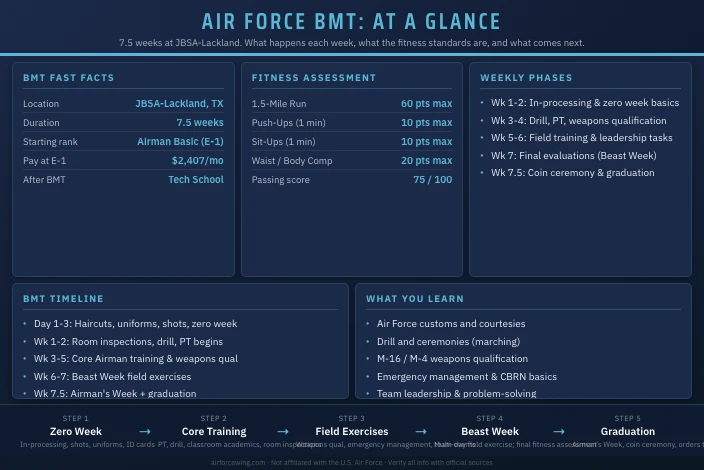
Zero Week: The First 72 Hours
Nothing trains you harder in BMT than the first three days. That’s not because the physical demands are extreme yet. It’s because everything happens at once, and you have no idea how anything works.
You’ll arrive at Lackland and immediately begin in-processing. That means shots, blood draws, ID cards, a dental screening, and getting your head shaved if you’re male. Female trainees get hair regulations explained and must comply from day one.
Here’s what gets issued or completed in the first 72 hours:
- Dress blues and utility uniform issue
- Dog tags and military ID
- Required vaccinations
- Dental and vision screenings
- Assignment to your training flight and MTI (Military Training Instructor)
Your MTI is in charge of your world for the next seven weeks. They are loud, deliberate, and not interested in excuses. The fastest way to adjust is to listen, follow instructions exactly, and stop expecting things to feel normal.
Weeks 1 and 2: Building the Foundation
Once zero week ends, structured training begins. Weeks one and two focus on establishing the basics before anything more demanding gets introduced.
Physical training (PT) starts immediately. You’ll run in formation, do push-ups, and build toward the fitness standards required to graduate. Most recruits find the early PT harder than expected, not because the workouts are extreme, but because you’re also sleep-deprived and adjusting to the schedule.
Room inspections happen daily. Your bunk, locker, and uniform must meet exact standards or your flight gets corrective training. A few flights have lockers inspected at 0500. Others get surprise checks during duty hours. Assume it happens any time.
You’ll also start drill and ceremonies during these weeks. Marching in formation, executing facing movements, and learning how to function as a unit rather than a collection of individuals. This sounds tedious. It teaches you something real: how to execute orders precisely under pressure.
Weeks 3 Through 5: Core Airman Training
The middle block of BMT introduces the substance of what being an Airman means. Academic instruction, weapons qualification, and more physical training.
Weapons qualification is one of the events recruits ask about most. You’ll qualify on the M-16 rifle (or M-4 depending on equipment availability). This includes classroom instruction on weapons safety, disassembly, cleaning, and then live-fire qualification on the range. You don’t need prior shooting experience. The Air Force teaches it from scratch.
Academic classes cover:
- Air Force history and heritage
- Customs, courtesies, and military law
- Uniform Code of Military Justice (UCMJ) basics
- Emergency management and CBRNE (chemical, biological, radiological, nuclear, explosive) awareness
- Sexual assault prevention and response
None of these are optional. Every airman who graduates holds this base level of knowledge. Tests happen throughout, and failing them means remedial instruction.
Week 6 and Beast Week: The Final Push
The last stretch of BMT combines an extended field exercise with the most demanding physical and mental requirements of the program.
Beast Week (sometimes called Warrior Week) is a multi-day field exercise that takes your flight out of the normal barracks environment and puts you in a simulated deployed setting. You sleep in the field, complete tasks as a team, respond to simulated scenarios, and are evaluated on everything you’ve learned.
This is where the training pulls together. You’re expected to apply drill, weapons handling, emergency procedures, and teamwork without someone walking you through each step. Flights that have built cohesion perform well. Flights that haven’t learned to communicate fall apart in the exercises.
The Air Force Fitness Assessment happens here. The graded components are:
| Component | Max Points |
|---|---|
| 1.5-Mile Run | 60 |
| Push-Ups (1 minute) | 10 |
| Sit-Ups (1 minute) | 10 |
| Waist Circumference / Body Comp | 20 |
| Total | 100 |
You need a composite score of 75 or higher to pass, and you must meet the minimum standard on each individual component. The run is worth the most points. Trainees who can comfortably run 1.5 miles in under 12 minutes before shipping are in better shape than most of their peers.
Week 7.5: Airman’s Week and Graduation
After Beast Week, you don’t just get handed orders and sent home. There’s a final structured week called Airman’s Week.
This is a values-based capstone. It covers what it means to be an Airman, the Air Force’s core values (Integrity First, Service Before Self, Excellence in All We Do), and reflection on the previous weeks. The tone shifts from the grinding pace of BMT to something more deliberate. Most trainees find it one of the more meaningful parts of training.
Graduation day includes the Airman’s Coin ceremony, where you receive your coin and are officially recognized as an Airman. Family members can attend. The ceremony is held on the Lackland parade grounds.
Within days of graduation, you ship out to Technical School for your specific AFSC. The location and duration depend entirely on your job. Some technical training is four weeks. Some runs longer than a year. That transition from BMT to Tech School is covered more in day in the life of an Airman if you want a sense of what comes next.
What to Do Before You Ship
BMT is designed to train recruits from scratch. But showing up already capable of running 1.5 miles and knocking out push-ups puts you in a better position than most of your flight on day one.
Run. That single habit pays more dividends in BMT than anything else you can do in advance. Aim to run 1.5 miles in under 13 minutes before you ship. Upper body work helps too, but the run is weighted heaviest in the fitness assessment.
A few other things worth knowing before you arrive:
- Sleep deprivation in zero week is real. Mental preparation matters as much as physical.
- Memorize the Airman’s Creed before you go. MTIs will ask.
- Leave personal electronics and civilian clothes at home. You won’t use them.
- Write your family’s address down on paper. You won’t have your phone to look it up.
If you still need to take the ASVAB before enlisting, the Air Force ASVAB test prep guide covers what scores you need and how to prepare.
After BMT: What Comes Next
Graduating BMT means you’re an Airman, but you’re not yet trained in your career field. Technical School is next, and it’s a different environment entirely. You have more freedom, live in dorm-style housing, and spend your days in classroom and hands-on instruction for your specific job.
The path from there depends on the AFSC you signed for in your enlistment contract. Some jobs send you straight to an operational unit after Tech School. Others require additional training pipelines before you reach your first duty station.
Browse Air Force enlisted career fields to get a clear picture of what different jobs actually involve, both in training and in the day-to-day work that follows.
You may also find What Air Force Life Is Really Like helpful for what comes after the training pipeline ends.
This site is not affiliated with the U.S. Air Force or any government agency. Verify all information with official Air Force sources before making enlistment or career decisions.