What Air Force Life Is Really Like
Most people who join the Air Force don’t have a clear picture of what they’re signing up for. Recruiter conversations cover the highlights. What they skip is the texture of the day-to-day: where you’ll live, what a normal workweek looks like, how much money actually lands in your bank account, and what happens when you have a bad commander or get stationed somewhere you didn’t choose.
This post covers all of it. Not a sales pitch. Just what the Air Force is actually like.
Pay and Total Compensation
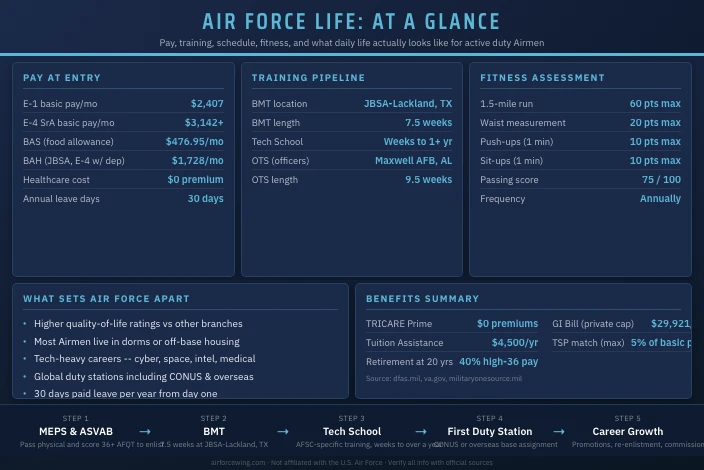
Basic pay gets the most attention, but it’s only part of the picture. An Airman Basic (E-1) earns $2,407 per month in basic pay. A Senior Airman (SrA, E-4) earns $3,142 to $3,816 depending on years of service. Those figures don’t include allowances, which can add significant money on top.
Every Airman receives the Basic Allowance for Subsistence (BAS) of $476.95 per month for food. If you live off base, you also get Basic Allowance for Housing (BAH), which varies by duty location and whether you have dependents. At Joint Base San Antonio, an E-4 without dependents gets $1,359 per month; with dependents, that rises to $1,728.
| Pay Component | Amount |
|---|---|
| E-1 Basic Pay | $2,407/mo |
| E-4 Basic Pay (entry) | $3,142/mo |
| BAS (all enlisted) | $476.95/mo |
| BAH (E-4, JBSA, w/ dependents) | $1,728/mo |
| TRICARE Prime premium | $0 |
Neither BAS nor BAH is taxable income, which effectively increases their value. A Senior Airman at a mid-cost base can easily see total compensation exceeding $5,500 per month before any special pays or bonuses. The Air Force pay and benefits breakdown has the full numbers across all ranks.
Healthcare is one of the most tangible benefits. Active duty members and their families get TRICARE Prime at zero premium cost, with no deductible and no copays at military treatment facilities. That covers medical, dental, vision, mental health, and prescriptions.
How Training Actually Works
Before any career begins, every enlisted Airman goes through Basic Military Training (BMT) at Joint Base San Antonio-Lackland, Texas. It runs 7.5 weeks. BMT is physical and mentally demanding but not elite-selection difficult. The goal is to transform civilians into disciplined Airmen, not to wash people out the way special operations pipelines do.
After BMT, you head directly to your AFSC-specific Technical Training (Tech School). Duration varies widely by job:
- Short tech schools (4-8 weeks): security forces, some logistics roles
- Mid-length (3-6 months): many maintenance and support specialties
- Long pipelines (6-18+ months): medical, intelligence, cyber, some operations jobs
You won’t have much say in when or where your first assignment is. The Air Force matches your AFSC to open billets. Some people get CONUS bases close to home; others land in Okinawa six weeks after finishing tech school.
Officers follow a different path. Commissioned officers attend either AFROTC (college-based), the U.S. Air Force Academy, or Officer Training School (OTS) at Maxwell Air Force Base, Alabama, which runs 9.5 weeks.
The full pipeline breakdown is in What Happens at Air Force BMT.
Daily Life at a Duty Station
Work hours depend on your AFSC and unit tempo. Most Air Force Airmen work a Monday through Friday schedule, typically 0730 to 1630. That’s genuinely different from the Army or Marines, where weekend work and long field exercises are the norm. Shift work exists in operations, medical, and maintenance career fields.
A realistic weekday for a support-career Airman:
- Physical training (PT) in the morning, 3-4 days per week
- Report to duty section by 0730
- Work tasks, briefings, or training until mid-afternoon
- Administrative time, professional development, or personal time
Physical training is mandatory and tied to the Air Force Fitness Assessment (FA). The FA has four scored components: a 1.5-mile run (60 points max), waist circumference (20 points), push-ups in one minute (10 points), and sit-ups in one minute (10 points). The minimum passing composite score is 75 out of 100. Assessments happen annually for most Airmen. Failing puts your career progression at risk, so most units make PT a priority.
A more detailed look at the day-to-day schedule is in A Day in the Life of an Airman.
Where You’ll Live
Junior enlisted Airmen typically live in dormitories on base during their first enlistment. Air Force dorms are significantly better than Army barracks. Most are single-occupancy rooms with a private bathroom and small living area. That’s not marketing. It’s a consistent structural difference.
Once you reach E-4 with a certain time in service, or if you have dependents, you become eligible for off-base housing. BAH covers most or all of the rent, depending on your rank and local housing costs.
Overseas duty stations add another layer of complexity. Bases in Japan, Germany, England, and South Korea are common assignments. Families can usually accompany you on overseas tours, though housing and school options vary. Some Airmen love overseas assignments; others find the distance from family harder than expected.
The full picture of bases and locations is in Air Force Duty Stations: Where Will You Live.
Education and Benefits
The Air Force prioritizes education more than most people expect. While on active duty, you can use Tuition Assistance (TA) to pay for college courses. TA covers $4,500 per year (up to $250 per semester hour), paid directly to the school.
After leaving active duty, the Post-9/11 GI Bill pays tuition, fees, and a monthly housing allowance. It covers full in-state tuition at public universities with no dollar cap. For private schools, the annual cap sits at $29,920.95 for the 2025-2026 academic year. The housing allowance is calculated at the E-5 with dependents BAH rate for the school’s ZIP code.
The Thrift Savings Plan (TSP) is the military’s retirement savings vehicle, similar to a 401(k). Under the Blended Retirement System (BRS), the government automatically contributes 1% of your basic pay after 60 days. Matching contributions kick in after two years: 100% match on your first 3%, and 50% match on the next 2%. The maximum government contribution is 5% of basic pay.
A 20-year career qualifies you for a pension paying 40% of your average highest 36 months of basic pay, for life.
Career Options: Enlisted and Officer
The Air Force has jobs across a wide range of fields. Enlisted careers fall into 18 career groups, from cyber and intelligence to medical, maintenance, and civil engineering. Officer careers require a college degree and cover the same fields plus aviation.
Enlisted tracks include:
- Operations (air traffic control, aircrew flight equipment)
- Cyber and intelligence
- Medical and healthcare support
- Maintenance and munitions
- Civil engineering, communications, logistics
Officer tracks add rated aviation roles (pilot, Combat Systems Officer, Remotely Piloted Aircraft pilot), plus officer versions of every career field above.
Browse the full list of enlisted career paths and officer career fields to see what’s open. If you’re still figuring out which direction fits you, Best Air Force Jobs for 2026 ranks the top picks by category.
Deployments and Temporary Duty
Deployment frequency varies by AFSC and unit type. Fighter and mobility units deploy more regularly than support career fields. Most enlisted Airmen can expect one deployment per four-year enlistment, though some specialties see more. Deployments typically run 4 to 6 months, shorter than Army tours in many cases.
Temporary Duty (TDY) assignments are common outside of deployments. These are short-term trips for training, exercises, or mission support, ranging from a week to a few months. They’re unpaid travel in terms of time lost at home, but per diem covers lodging and food expenses.
Certain career fields deploy or TDY more frequently: special operations support, intelligence, and some medical roles are the main ones. Going in with realistic expectations about tempo matters. The Is the Air Force Worth It? Honest Pros and Cons post addresses this directly.
The Honest Trade-offs
The Air Force offers a quality of life that few other branches match. Better housing, stronger education support, more stable schedules, and a high density of technical careers that transfer directly to civilian employment. The pay comparison isn’t always obvious at first glance. Air Force vs: Civilian Pay: The Real Comparison breaks down the true cost difference when you factor in healthcare, housing, and retirement.
But the Air Force isn’t perfect. You don’t get to pick your duty station on your first assignment. Promotion above E-5 takes years and requires consistent performance evaluations. Some bases have limited off-base amenities. Bad leadership in a unit affects quality of life significantly, and there’s limited recourse when it happens.
The people who do well long-term tend to be the ones who chose a career field they’re genuinely interested in, and who treated the education and certification opportunities as a priority from day one.
See the Air Force careers directory for a full overview of what’s available across both enlisted and officer tracks. The benefits section covers healthcare, GI Bill, retirement, and everything else in detail.
This site is not affiliated with the U.S. Air Force or any government agency. Verify all information with official Air Force sources before making enlistment or career decisions.