TBAS vs ASVAB: What Air Force Officers Need
Most officer candidates know they need the ASVAB. Fewer realize a second test exists, one that can make or break a pilot or combat systems officer application. The TBAS (Test of Basic Aviation Skills) is separate from the ASVAB, scored differently, and required only for rated career fields. Getting these two tests confused costs candidates time and board cycles.
Here’s exactly what each test does, who needs which, and where your prep time should go.
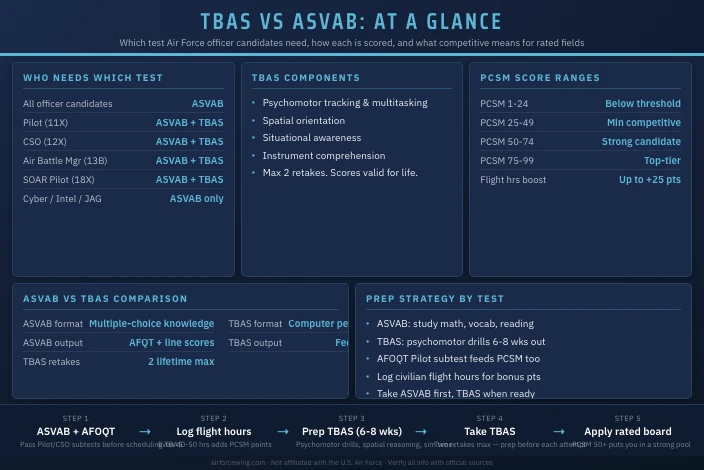
What Each Test Actually Measures
The ASVAB and TBAS serve completely different purposes. Treating them as similar exams is the first mistake candidates make.
The ASVAB (Armed Services Vocational Aptitude Battery) is a knowledge test. It measures what you already know across ten subtests: arithmetic reasoning, word knowledge, paragraph comprehension, mathematics knowledge, and others. Air Force officer candidates going through OTS need a qualifying AFQT score, and some career fields have additional line score requirements. But the ASVAB does not test your ability to fly a plane or operate in a cockpit environment.
The TBAS (Test of Basic Aviation Skills) is a performance test. It doesn’t care what you’ve memorized. It measures real-time cognitive and psychomotor abilities, things that predict whether you’ll succeed in flight training. The four components are:
- Psychomotor tracking and multitasking
- Spatial orientation
- Situational awareness
- Instrument comprehension
You can’t cram your way to a high TBAS score the way you can for an academic test. Your score reflects how well your brain handles multiple moving tasks under time pressure.
Side-by-Side Comparison
| ASVAB | TBAS | |
|---|---|---|
| Format | Multiple-choice knowledge | Computer-based performance tasks |
| What it tests | Academic aptitude | Psychomotor and spatial ability |
| Required for | All Air Force officer applicants | Rated officers only (pilot, CSO, ABM, RPA) |
| Scoring output | AFQT percentile + line scores | Feeds into PCSM score (1-99) |
| Retake limit | Limited per policy | Max 2 retakes, lifetime |
| Score validity | Valid per accession policy | Valid for life |
| Where to prep | Study books, practice tests | Psychomotor drills, flight simulation |
The most important row is retake limit. ASVAB retake rules allow for multiple attempts under specific waiting periods. TBAS gives you two lifetime retakes total. Take it when you’re ready.
Who Needs the TBAS
Not every Air Force officer takes the TBAS. It’s required only for candidates applying to rated career fields: positions that involve operating aircraft or directly controlling airspace.
Rated fields that require TBAS:
- 11X: Pilot (fighter, bomber, mobility, special operations)
- 12X: Combat Systems Officer (CSO)
- 13B: Air Battle Manager (ABM)
- 18X: Special Operations Pilot
If you’re pursuing rated officer careers in Air Force Operations, you’ll need the TBAS before your board application is complete. Non-rated officer candidates, intelligence, cyber, logistics, JAG, and others, take the ASVAB but skip the TBAS entirely.
Start your officer test prep early. With only two lifetime TBAS retakes and two AFOQT retakes allowed, preparation time directly affects your outcome. A structured AFOQT prep course covers the 12 subtests and 6 composites that every rated candidate needs alongside their TBAS scores.
When you purchase through links on our site, we may receive compensation at no extra cost to you.
Understanding Your PCSM Score
The TBAS doesn’t produce a standalone score you submit to a board. It feeds into the PCSM (Pilot Candidate Selection Method) score, which is what selection boards actually see.
PCSM pulls from three inputs:
- TBAS scores: the primary driver
- AFOQT Pilot subtest: a weighted input from the Air Force Officer Qualifying Test
- Civilian flight hours: logged hours can add up to 25 additional points
PCSM scores run from 1 to 99. Here’s what the ranges mean in practice:
| PCSM Range | What It Signals |
|---|---|
| 1-24 | Below competitive threshold |
| 25-49 | Minimum competitive range |
| 50-74 | Strong candidate pool |
| 75-99 | Top-tier applicant |
A score of 25 is the published competitive minimum, but most pilots selected for Undergraduate Pilot Training (UPT) score above 50. The closer you get to the top tier, the better your board position, especially in competitive fiscal years when pilot training slots are limited.
Flight hours matter more than most candidates expect. Even 40-50 hours of civilian flight time adds measurable points to your PCSM. Candidates who log 200 or more hours reach the maximum flight-hour bonus. If becoming a pilot is the goal, start flying now rather than waiting until after commissioning.
How to Prepare for Each Test
ASVAB prep and TBAS prep have almost nothing in common. Mixing strategies wastes time.
For the ASVAB:
The test rewards academic knowledge you can study directly. Focus on the subtests that feed Air Force composite scores: arithmetic reasoning, mathematics knowledge, word knowledge, paragraph comprehension, and general science. If you’re weak in math, that’s where prep hours go first. The ASVAB rewards structured study over raw intelligence, candidates who practice consistently outperform those who cram.
For the TBAS:
You’re training a skill set, not memorizing facts. Effective prep includes:
- Hand-eye coordination drills using flight simulator software or joystick-based games
- Spatial reasoning puzzles (15-20 minutes daily, timed)
- Dual-task exercises that force you to manage two things simultaneously
- Instrument comprehension review using aviation reference materials
- Logging civilian flight hours if you have access to a flight school
The psychomotor component is what most candidates underestimate. It measures how well you track a moving target with a control input while monitoring secondary tasks. That’s a skill that develops over weeks, not a subject you can read about the night before.
Timing your tests:
Take the ASVAB first. The AFOQT Pilot subtest (separate from the ASVAB, but often scheduled around the same preparation cycle) feeds into your PCSM alongside the TBAS. Get those scores locked in, then schedule the TBAS when your psychomotor prep is solid. With only two lifetime retakes available, don’t rush it.
Fitting Both Tests Into Your Timeline
Officer candidates often ask whether to prep for both tests at once. The answer depends on which career fields you’re targeting.
If you’re applying to non-rated fields only (cyber, intelligence, logistics, JAG, medical, etc.), the TBAS is not part of your application. Put all your energy into the ASVAB and AFOQT, and ignore TBAS prep entirely.
If you’re applying to rated fields, build your prep in two phases. Phase one covers academic content for the ASVAB and AFOQT, these share enough overlap that studying together makes sense. Phase two is TBAS-specific: start psychomotor and spatial drills at least six to eight weeks before your test date. The two skill sets don’t cross-train well, so splitting your focus sequentially beats trying to do both simultaneously.
Candidates who prep for rated fields while also targeting a non-rated backup field have the most to manage. That’s a legitimate strategy, but it requires an honest assessment of how much prep time you actually have.
Air Force officer selection tests covers the full picture of every exam in the officer accession process, including the AFOQT. The TBAS test prep guide provides a structured study plan with section-by-section strategies for each component. You may also find how to prepare for Air Force OTS selection useful for building out a full application timeline.