Special Warfare Fitness Requirements: PAST Standards
The Air Force Special Warfare fitness test will end your application before you ever reach a recruiter’s table if you show up unprepared. Most candidates who fail it don’t fail on the run. They fail in the water. The test is officially called the Initial Fitness Test (IFT), the old name, Physical Ability and Stamina Test (PAST), still shows up everywhere, and both refer to the same six-event screening. Knowing the standards is the easy part. Training to exceed them is where selection actually begins.
What the IFT Tests and Why It Matters
The IFT is a pre-enlistment screening test. You take it before you sign a contract, usually administered by a Special Warfare recruiter or at a pre-screening event. All six events must be passed in a single session. Failing one event fails the entire test, there is no averaging across events, and there is no partial credit.
The test covers four calisthenics events plus two swim events:
- Pull-ups (timed window)
- Push-ups (timed window)
- Sit-ups (timed window)
- 1.5-mile run
- Two 25-meter underwater swims (pass/fail, no fins)
- 500-meter surface swim (freestyle, breaststroke, or sidestroke)
The order matters. Candidates typically complete the calisthenics and run first, then move to the pool. This means you enter the water already fatigued. That’s intentional.
A standard Air Force recruiter cannot administer the IFT. You need an Air Force Special Warfare recruiter. Trying to schedule the IFT through a general recruiter wastes time and can lead to errors in your application packet.
Minimum Standards by Event
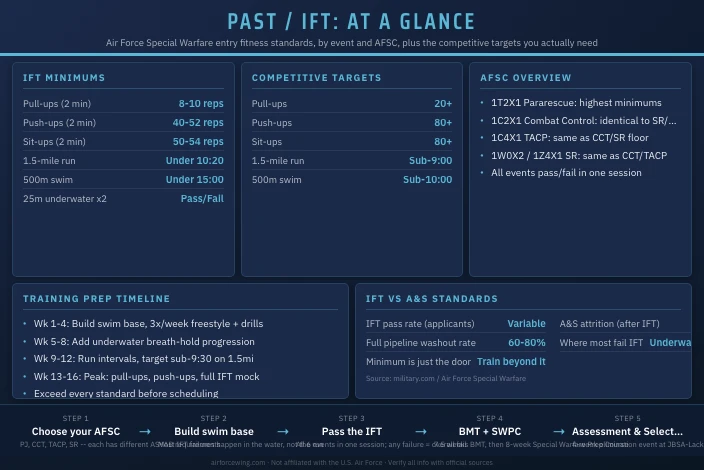
All four special warfare AFSCs share the same base IFT. Pararescue (1T2X1) has slightly higher calisthenics and run minimums than Combat Control (1C2X1), TACP (1C4X1), and Special Reconnaissance.
IFT Minimum Standards
| Event | PJ (1T2X1) | CCT / TACP / SR |
|---|---|---|
| Pull-ups | 10 | 8 |
| Push-ups (2 minutes) | 52 | 40 |
| Sit-ups (2 minutes) | 54 | 50 |
| 1.5-Mile Run | Under 10:10 | Under 10:20 |
| 500m Surface Swim | Under 15:00 | Under 15:00 |
| 25m Underwater Swim x2 | Pass/Fail | Pass/Fail |
The underwater swim events have no time standard, they are pure pass/fail. You must complete each 25-meter length underwater without surfacing. Breaking the surface at any point fails the event.
The Swim Is the Hardest Gate
Every component of the IFT can be improved with consistent training. The underwater swim is the one event where mental preparation matters as much as physical conditioning. Breath-hold swimming requires calm. Panicking at the 15-meter mark when your lungs are burning is how candidates fail something that has no minimum time requirement.
Start swim training before anything else. Candidates who come in as strong runners but weak swimmers routinely fail the IFT. The reverse, swimmers who need more pull-up strength, are much easier to fix.
What “Passing” Actually Gets You
Clearing the IFT floor puts you into the contracting process. It does not get you through the pipeline.
Assessment and Selection (A&S) eliminates roughly 50% of candidates who passed the IFT. The full training pipeline, from Basic Military Training through the Pararescue or Combat Control qualification course, has historically washed out 60-80% of those who enter. The IFT sets a minimum threshold that the training pipeline will exceed on the first day.
Candidates who score at the IFT floor rarely complete A&S. Training programs run by active and former special operations instructors consistently recommend the following targets before you schedule your test:
| Event | Target Before Testing |
|---|---|
| Pull-ups | 20+ |
| Push-ups (2 min) | 80+ |
| Sit-ups (2 min) | 80+ |
| 1.5-Mile Run | Sub-9:00 |
| 500m Surface Swim | Sub-10:00 |
| 25m Underwater x2 | Comfortable, multiple reps |
These aren’t arbitrary higher bars. They reflect what you’ll need to sustain through the Special Warfare training pipeline before A&S even begins.
How to Build Your IFT Preparation
A 16-week preparation block gives most candidates enough time to go from recreational fitness to IFT-ready, assuming they start with a base of general athletic conditioning.
Phase 1: Swim Foundation (Weeks 1-4)
Three swim sessions per week, each 45-60 minutes. Focus on technique before volume. Many candidates fail the underwater events because they haven’t learned to manage their oxygen consumption efficiently. Drill work, kick sets, pull sets, breathing drills, matters more than yardage at this stage.
Add breath-hold practice in a controlled setting. Start at 15 meters and extend gradually. Never train underwater breath-holding alone. Always have a spotter.
Phase 2: Underwater Confidence (Weeks 5-8)
Progressive underwater swim sets. Work up to multiple consecutive 25-meter lengths with 30-60 second rest intervals. The goal is not just physical endurance, you want the underwater swim to feel routine rather than alarming.
Continue building aerobic base with running three to four times per week. A strong aerobic foundation supports the swim events directly.
Phase 3: Calisthenics and Run Integration (Weeks 9-12)
Now add structured pull-up and push-up volume. Max-effort sets followed by submaximal ladder sets are the most effective pull-up protocol for candidates coming from a modest base. Three pull-up sessions per week is sufficient. Doing them every day without recovery slows progress.
For the run, add one interval session per week targeting 400-meter and 800-meter repeats at faster than goal pace. The 1.5-mile test at under 10:20 is an accessible standard for most candidates once they have 8-10 weeks of running base. Sub-9:00 requires specific speed work, not just more miles.
Phase 4: Full IFT Simulation (Weeks 13-16)
Run complete mock IFTs at least twice before your test date. The sequence matters: calisthenics first, pool second, everything in one session. Fatigue compounds across events. Candidates who train each event separately in isolation are often surprised by how the pool feels after the run.
Schedule your actual IFT with a Special Warfare recruiter only when you are consistently clearing competitive targets, not IFT minimums, in practice sessions. There is no benefit to testing early and failing.
AFSC-Specific Physical Context
Each special warfare career field builds on the IFT foundation with its own downstream physical demands.
Pararescue (1T2X1): PJs face the highest combined physical and medical training load in the pipeline. The 18-month pipeline includes combat dive school, military freefall, and a 34-week paramedic certification program. Physical standards don’t drop after selection, operational PJ units train two to three hours every duty day.
Combat Control (1C2X1): CCTs share the same IFT floor as TACP and SR but face identical dive and freefall requirements to PJs. The FAA air traffic control certification phase at Keesler AFB is academically demanding after months of physical training.
TACP (1C4X1): TACP candidates pass the same IFT as CCTs. The pipeline runs about 60 weeks total. Deployed TACPs embed with Army units and operate as the sole Air Force representative with ground maneuver forces, which creates its own physical and operational demand set distinct from other special warfare fields.
Special Reconnaissance (SR/1Z4X1, previously 1W0X2): SR candidates have the same IFT floor as CCTs and TACPs. The SR pipeline mirrors the PJ pipeline in its combat dive and freefall phases. The technical intelligence-collection training that follows is demanding in a different way. SR Airmen carry surveillance and communications equipment over long distances in austere terrain.
After the IFT: What to Expect
Passing the IFT and contracting for a special warfare AFSC puts you on a path that includes two major physical environments before the first specialty training phase begins.
Basic Military Training (BMT) runs 7.5 weeks at Joint Base San Antonio-Lackland, TX. BMT physical training is not special warfare prep, it’s a general conditioning program for all enlistees. Special warfare candidates arrive at BMT already well above the standard.
Special Warfare Preparatory Course (SWPC) runs 8 weeks, also at Lackland. This is where the real conditioning work begins. The SWPC is run by special warfare instructors and focuses on swimming, rucking, calisthenics, and run volume at a pace that begins the mental and physical sorting process before A&S.
Assessment and Selection (A&S) is the primary attrition point for every special warfare AFSC. Four weeks. Roughly 50% of candidates who arrive do not complete it. The events at A&S are not published in advance. They are harder than the IFT. Candidates who arrive having only trained to IFT minimums will not make it through the first week.
The Air Force Fitness Test (FA) that all Airmen take annually is a completely separate assessment from the IFT. Special warfare candidates should understand both, but for pipeline entry the IFT is what matters.
Common Preparation Mistakes
Testing too early. There is no advantage to taking the IFT before you’re ready. A failed IFT does not disqualify you permanently, but it delays your application and signals to recruiters that your preparation was inadequate.
Ignoring the water. Candidates who run fast and do 80 push-ups but have never trained underwater breath-holding fail a pass/fail event. No amount of pull-up strength compensates for surfacing at 12 meters.
Training events in isolation. Mock IFT sessions that combine all six events in sequence teach your body and your mental state what the actual test feels like. Single-event training misses that.
Misjudging the timeline. Sixteen weeks of structured preparation is a reasonable minimum for an athlete starting from a solid general fitness base. Coming from no training base, six months is more realistic. Starting three weeks before your recruiter appointment is not a plan.
Building a strong aerobic base takes time. Pull-up strength takes time. Underwater confidence especially takes time. The candidates who show up competitive started training months before their first recruiter contact.
You may also find Air Force BMT physical training and how to train for the 1.5-mile run helpful. The enlistment process guide explains how the PAST fits into the broader contracting timeline for special warfare candidates.
For a broader look at the standard Air Force fitness requirements that apply alongside the PAST, see our Air Force physical fitness guide.
This site is not affiliated with the U.S. Air Force or any government agency. Verify all information with official Air Force sources before making enlistment or career decisions.