Special Warfare ASVAB and Fitness Requirements
The ASVAB score required to contract for an Air Force special warfare job is not the hard part. GEND 49: the baseline composite for Pararescue and TACP, is a number most qualified enlistees already hit. The hard part is the swim test that follows it. Most candidates who wash out of this process never make it to Assessment and Selection. They fail the physical screening before they ever board a plane to Basic. Understanding which gate actually eliminates people, and how to prepare for it, is what this post covers.
This site is not affiliated with the U.S. Air Force or any government agency. Verify all information with official Air Force sources before making enlistment or career decisions.
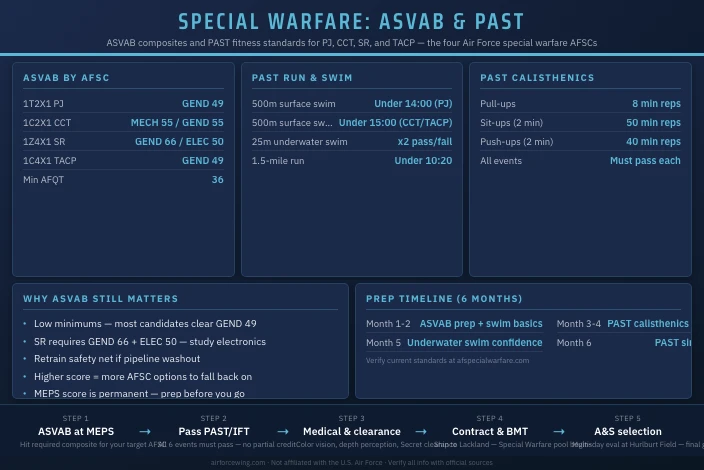
ASVAB Requirements by AFSC
The four enlisted Air Force special warfare career fields each require a General composite (GEND) score as their primary qualifier. GEND combines four subtests: Word Knowledge, Paragraph Comprehension, Arithmetic Reasoning, and Mathematics Knowledge. Two of the four AFSCs have higher thresholds.
| AFSC | Title | ASVAB Composite | Minimum Score |
|---|---|---|---|
| 1T2X1 | Pararescue (PJ) | GEND | 49 |
| 1C2X1 | Combat Control (CCT) | MECH + GEND | 55 / 55 |
| 1Z4X1 | Special Reconnaissance (SR) | GEND + ELEC | 66 / 50 |
| 1C4X1 | Tactical Air Control Party (TACP) | GEND | 49 |
The minimum AFQT to enlist in the Air Force is 36, but every special warfare candidate also needs to clear the composite shown above for their specific AFSC.
1C2X1 Combat Control requires both MECH 55 and GEND 55 because the FAA air traffic control certification, a mandatory part of the pipeline, demands solid comprehension and mechanical reasoning. 1Z4X1 Special Reconnaissance has the highest bar: GEND 66 and ELEC 50. The SR mission requires environmental data analysis and the ability to operate specialized electronic instrumentation, which is why the electronics subtest matters here.
What the GEND Composite Actually Tests
The GEND composite doesn’t test anything exotic. Two of its four subtests. Word Knowledge and Paragraph Comprehension, reflect reading habits built over years. The other two. Arithmetic Reasoning and Mathematics Knowledge, respond to focused study.
Most candidates who fail to hit GEND 49 are underperforming on AR (word problems, ratios, rates) and MK (algebra, geometry). Both subtests are fixable with three to six weeks of targeted practice. If you’re short of 49, those two are where to start.
Candidates pursuing SR who need ELEC 50 should add electronics fundamentals to their study plan. The ELEC composite pulls from General Science and Electronics subtests, so circuit basics, Ohm’s law, and electrical principles are fair game.
The PAST: What Actually Eliminates Candidates
Before you can receive a special warfare enlistment contract, you must pass the Physical Ability and Stamina Test (PAST): also called the Initial Fitness Test (IFT). This is a six-event screening administered by a recruiter before you ship to BMT. Fail any single event, and you cannot contract for a special warfare AFSC.
The PAST has two swim events. Most candidates who fail do so here, not on the run.
PAST Standards by AFSC
The run standard is identical across all four career fields. Swim times vary slightly between PJ and the others.
| Event | PJ (1T2X1) | CCT (1C2X1) | SR (1Z4X1) | TACP (1C4X1) |
|---|---|---|---|---|
| 500m surface swim | Under 14:00 | Under 15:00 | Under 15:00 | Under 15:00 |
| 25m underwater swims | 2x pass/fail | 2x pass/fail | 2x pass/fail | 2x pass/fail |
| 1.5-mile run | Under 10:20 | Under 10:20 | Under 10:20 | Under 10:20 |
| Pull-ups (no time limit) | 10 min reps | 8 min reps | 8 min reps | 8 min reps |
| Sit-ups (2 minutes) | 50 min reps | 50 min reps | 50 min reps | 50 min reps |
| Push-ups (2 minutes) | 45 min reps | 40 min reps | 40 min reps | 40 min reps |
PJ has the most demanding standards across every event. That reflects pipeline reality, the Pararescue pipeline is the longest enlisted training program in any branch of the U.S. military, running roughly 109 weeks.
These are minimum standards, not targets. Recruiter data consistently shows that candidates who score near the cutoff on any PAST event tend to wash out during the Preparatory Course or Assessment and Selection. Come in at 120% of every standard, not 100%.
The Underwater Swim Events
Two 25-meter underwater swims (pass/fail) eliminate more candidates than any other PAST event. The test requires you to submerge at one end of a 25-meter pool and swim to the other without surfacing. No fins, no snorkel. Rest between the two attempts is minimal.
Most people who fail this event have never practiced underwater swimming before. It’s not about lung capacity, it’s about controlling the urge to surface when your body gives the first signal. That reflex is trainable, but it takes weeks of pool work, not days.
Start underwater swim training early. Get comfortable holding your breath at the bottom of a pool, then progress to underwater laps. Candidates who train in open water or who competed in swimming sports have a strong advantage here.
The Surface Swim
A 500-meter surface swim in under 14 or 15 minutes sounds manageable until you account for the clothing and the conditions. PAST swims are done in BDUs and boots, not a swimsuit. Your clothing adds drag. The stroke choice matters, a combat sidearm stroke in BDUs is harder to sustain than a freestyle lap.
Practice your swim in clothes. It sounds obvious but most candidates train in a swimsuit and find themselves significantly slower when it counts.
Why ASVAB Still Matters Even If You Clear the Minimum
The low GEND 49 threshold creates a false sense of security. Many candidates assume they’ll contract for their target AFSC, and if things don’t work out, they’ll cross-train later. That math only holds if your ASVAB score gives you real options.
Pipeline Washout Rates
Attrition across special warfare pipelines runs between 70% and 80%. Most people who start a special warfare pipeline do not finish it. When that happens, you get reclassified to another AFSC, but only AFSCs your existing ASVAB line scores qualify you for.
A candidate who scored GEND 49 and nothing else on the ASVAB has limited retraining options. Someone who scored GEND 65, MECH 58, and ELEC 54 has a much larger pool of career fields available if they wash out at A&S. Higher composite scores mean more flexibility when you need it.
Score Validity and Retesting
Your MEPS ASVAB score is permanent in the sense that you can’t retroactively improve it after you ship. Retesting requires a waiting period and recruiter approval. The time to build your score is before your MEPS appointment, not after you’ve already been classified.
If you’re targeting special warfare but concerned about washout risk, take your ASVAB seriously even if you could clear GEND 49 in your sleep. Score high enough that the fallback career fields, intelligence, cyber, communications, operations, are actually available to you.
Training Recommendations Before You Enlist
Six to twelve months of deliberate physical preparation is what separates the candidates who complete the PAST from those who fail it. This is not a fitness test you can cram for in four weeks.
Minimum Preparation Timeline
| Phase | Duration | Priority Focus |
|---|---|---|
| Foundation | Months 1-2 | Build swim base, reach run sub-12:00 |
| Development | Months 3-4 | Calisthenics to 150% of PAST minimums |
| Specificity | Month 5 | Underwater swim practice, clothed swim sets |
| Simulation | Month 6 | Full PAST rehearsal under test conditions |
The run standard of 10:20 for 1.5 miles is not demanding by special operations standards, but running it after a swim and calisthenics session is different from running it fresh. Train your events in sequence, not in isolation. Swim, then do pull-ups, then run.
Program Priorities
Swimming is the non-negotiable. If you don’t swim regularly, find a pool and start tomorrow. Aim for three swim sessions per week. Progress from 200-meter sets to 500-meter continuous swims. Add underwater work after your cardiovascular base is solid.
Calisthenics volume matters. Fifty sit-ups in two minutes and forty push-ups in two minutes are achievable standards, but they require muscular endurance, not just max-effort strength. Train with time limits from the beginning. Set a timer and do not stop until it expires.
Pull-ups need dedicated work. Eight pull-ups with no time limit is the CCT/TACP/SR minimum. Ten is the PJ minimum. Many male applicants arrive at MEPS unable to meet this standard despite months of other training. Add pull-up ladders and weighted assistance work to your weekly routine.
Before your MEPS date, take a complete ASVAB practice test under timed conditions. The General composite is coachable, a few weeks of focused study on Arithmetic Reasoning and Mathematics Knowledge will move most candidates comfortably above 49. For SR, add Electronics review.
Assessment and Selection: After the PAST
Passing the PAST gets you a contract. Passing Assessment and Selection gets you into a pipeline. These are not the same thing.
A&S is a multi-day evaluation held at Hurlburt Field, FL before each specific pipeline. It tests physical fitness under sustained stress, mental resilience, and team integration. Roughly 30% of SR candidates are eliminated at A&S. CCT and PJ historically see even higher attrition at this stage.
The PAST sets a floor. A&S evaluates whether you can perform at or above that floor while sleep-deprived, under social stress, and without a clear finish line in sight. Candidates who arrive at A&S with fitness well above PAST minimums, and who have exposure to sustained uncomfortable physical events, handle it better than those who arrived at exactly the minimum.
There is no formal preparation course for A&S. The Air Force Special Warfare website publishes preparation guidelines. The practical advice: train longer than you think you need to, practice operating after you’re already tired, and get comfortable not knowing how much time is left.
The ASVAB Score as a Long-Term Asset
Recruiter conversations about special warfare focus on the PAST, and rightfully so. But the ASVAB score you earn at MEPS follows you for your entire military career. It determines what AFSCs you can apply for if you retrain, what special duty assignments you qualify for, and, for some candidates who later pursue commissioning, how competitive you look on an officer application packet.
A GEND score of 55 instead of 49 may not change which special warfare AFSC you can contract for. But it opens significantly more doors if your career path changes. Take the test seriously, prep for it properly, and score as high as you reasonably can.
Air Force ASVAB test prep and the full breakdown of Air Force special warfare careers are good next reads as you build your approach to the selection process. Explore the Air Force special warfare career group for individual AFSC profiles and training pipeline details.