Should I Go Officer or Enlisted After College
You have a college degree. The Air Force wants you, on both sides of the officer/enlisted line. Recruiters will pitch each path based on what they have available, which isn’t always what fits you best. This guide cuts through the recruiting pitch and lays out what each track actually means for your first year, your pay, and the next decade.
What a Degree Gets You on Each Path
A bachelor’s degree is required to commission as an officer. Without one, the officer track is closed. But a degree doesn’t disqualify you from enlisting, and for some people, that’s the smarter move.
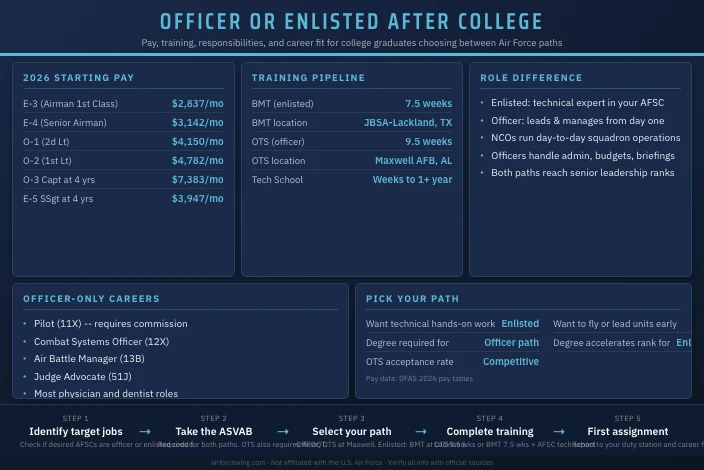
Enlisting with a degree means you come in at an accelerated rank. Most college graduates enlist at E-3 (Airman First Class) or even E-4 (Senior Airman) depending on credits and AFSC negotiations. You skip the bottom pay grades and move toward promotion faster than someone who enlisted at 18.
Commissioning as an officer means starting at O-1 (Second Lieutenant) with immediate supervisory responsibility. You’ll lead Airmen from day one, often before you fully understand what they do.
Neither option is automatically better. The right answer depends on which jobs interest you, how you handle authority, and what you want your career to look like at the 10-year mark.
Pay: The Real Numbers
This is where most comparisons go wrong. People compare starting pay without accounting for the full picture.
Starting monthly basic pay (2026):
| Rank | Grade | Base Pay/Month |
|---|---|---|
| Airman First Class | E-3 | $2,837 |
| Senior Airman | E-4 | $3,142 |
| Second Lieutenant | O-1 | $4,150 |
| First Lieutenant | O-2 | $4,782 |
Officers earn more from the start, around $1,300/month more than an E-3 at entry. That gap widens with time. A Captain (O-3) at 4 years earns $7,383/month. A Staff Sergeant (E-5) at the same point earns $3,947/month.
But base pay isn’t total compensation. Both paths get the same BAH (varies by location and dependent status), TRICARE at no cost, 30 days paid leave, and access to the same retirement system. The lifestyle difference between an E-5 and an O-3 is real, but the gap in take-home isn’t as wide as the base pay tables suggest when you factor in housing allowances for junior enlisted members who live on base.
The long-term pay gap is substantial. At 20 years, officers retire on a higher high-36 average, which means a bigger pension check for life. If you’re thinking about a full military career, that compounding matters.
Responsibilities: What Each Role Actually Looks Like
Pay aside, the bigger difference is what you do every day.
Enlisted roles are technical and hands-on. You’re the expert in your AFSC. A 2W1X1 (Weapons Specialist) knows the munitions systems better than any officer in the unit. A 1B4X1 (Cyber Operations) spends shifts running actual network defense operations. The work is concrete and skill-based. Advancement depends on your technical expertise and your ability to manage people as you move up the NCO ranks.
Officer roles are supervisory and administrative from the start. A new 2d Lt manages Airmen, briefs commanders, coordinates resources, and handles administrative tasks. You won’t be operating the systems, you’ll be responsible for the people who do. As an O-3 and above, you’re writing performance reports, managing unit budgets, and handling personnel issues.
Some people with degrees thrive in technical enlisted work. If you want to actually build things, fix aircraft, run cyber operations, or provide medical care, enlisting might put you closer to that work for longer than commissioning would.
Training: How You Get There
Both paths start with service-specific training, but the routes are different.
Enlisted path with a degree:
Officer path with a degree:
OTS is faster than the enlisted pipeline for most AFSCs. A new enlisted member in a long tech school can spend 6-12 months in training before arriving at their first duty station. An OTS graduate typically arrives faster, depending on follow-on training.
Which Jobs Are Available to Each Path
This is often the deciding factor.
Some Air Force careers only exist at the officer level. Pilots (11X), Combat Systems Officers (12X), Air Battle Managers (13B), and most doctor or lawyer roles require a commission. You can’t fly an F-35 or argue a court-martial as an enlisted member.
Some careers are much better suited to the enlisted track. Special Warfare jobs like Combat Control (1C2X1) and Pararescue (1T2X1) are enlisted. The most advanced cyber operations work happens at the enlisted level. Medical technicians perform clinical work that officer counterparts manage but don’t always do.
A useful exercise: look at the specific jobs you’re interested in. Go through Air Force enlisted careers and Air Force officer careers and find the roles that match your interests. If the jobs you want are officer-coded, commission. If they’re enlisted-coded, enlisting isn’t settling, it’s getting the job done.
The Leadership Question
Officers are expected to lead from day one. That’s not just a responsibility, it’s a pressure. You’ll be managing Airmen who have more experience than you, know their jobs better than you, and will notice immediately if you act like the degree makes you their superior.
Good officers spend their first 12-18 months listening, learning from their NCOs, and earning credibility. The ones who struggle are the ones who assume the commission grants expertise they haven’t earned yet.
Enlisted leaders. Staff Sergeants through Chief Master Sergeants, earn their authority through technical mastery and time. The NCO corps is where day-to-day Air Force operations actually run. A Chief Master Sergeant (E-9) has more institutional influence in a squadron than most majors.
If you’re drawn to leading through expertise and mentorship over time, the enlisted path to senior NCO is a legitimate and respected leadership career. If you want organizational authority earlier and you’re comfortable with administrative responsibility, commission.
Reserve and Guard Considerations
A degree also opens the door to commissioning in the Air Force Reserve or Air National Guard as an officer, which is a different calculus than active duty. You’d serve part-time, keep a civilian career, and commission into a specific unit that has a vacancy.
Enlisting in the Reserve or Guard with a degree works the same way, you’d still go through BMT and tech school, but you’d serve one weekend a month and two weeks per year unless activated.
The key difference: Reserve and Guard officer slots are competitive and unit-specific. If your local unit doesn’t have an opening in your preferred career field, you may wait months or years. Enlisted slots tend to be more available. Full details on commissioning paths are covered in the paths-to-serve guide.
Making the Call
Most people asking this question already lean one way. The following questions will help you confirm it:
- Do you want to be the technical expert doing the work, or the person responsible for the people doing the work?
- Are the specific jobs you want officer-coded or enlisted-coded?
- Are you comfortable with administrative responsibility and personnel management from your first assignment?
- Does the higher starting pay and long-term pay trajectory matter more than getting your hands on the technical work?
There’s no universally correct answer. Officers who would have thrived as senior NCOs exist, and enlisted members who had the credentials for OTS and made the better choice for themselves exist in equal numbers.
The Air Force officer vs: enlisted comparison guide covers the full breakdown across every category if you want more depth before you decide. For what the officer selection process actually involves, Air Force officer selection tests walks through the ASVAB for OTS, AFOQT, and TBAS requirements.
This site is not affiliated with the U.S. Air Force or any government agency. Verify all information with official Air Force sources before making enlistment or career decisions.