Should I Go Active Duty or Reserve After ROTC
You’ve finished ROTC and earned your commission. Now the Air Force asks you to make one of the biggest decisions of your early career: go active duty, or take a Reserve slot. Both options are real officer careers. But they look completely different on paper and in daily life, and picking the wrong one for your situation costs you years.
This breakdown covers what each path actually means for your pay, schedule, career options, and life outside the military.
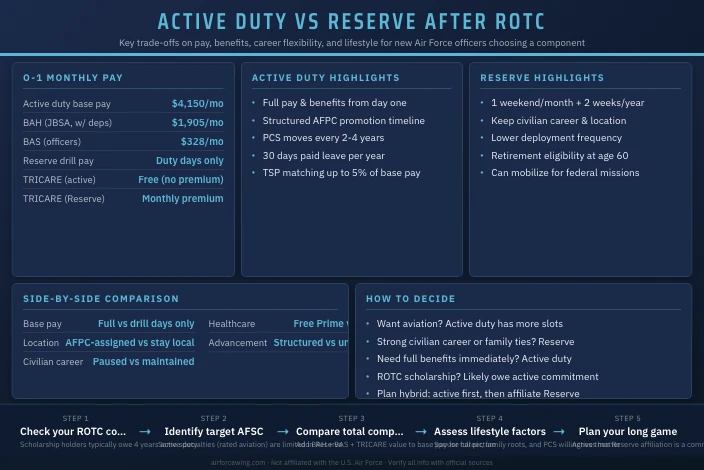
What ROTC Graduates Actually Get to Choose
Most ROTC cadets compete for active duty slots during their final year. The Air Force allocates a set number of active component positions, and they go to cadets ranked highest on the Order of Merit List (OML). Cadets who don’t get active duty slots, or who prefer more flexibility, can pursue a Reserve commission instead.
A few things to understand before comparing the two:
- Active duty means a full-time military career from day one. You’ll receive base pay, housing allowance, and full benefits while working standard duty hours on an Air Force installation.
- Reserve means a part-time commitment. You’ll typically drill one weekend per month and complete a two-week annual training period. The rest of the time you work a civilian job.
- Air National Guard is a third option that functions similarly to the Reserve but falls under each state’s governor during peacetime. This post focuses on the Reserve comparison, but the trade-offs with Guard are similar.
Not every AFSC is available in both components. If your goal is to fly active duty jets or work in certain intelligence assignments, active duty is the only path. Reserve units often have specific mission sets and limited specialties at any given installation.
The Pay Difference Is Significant
Active duty officers earn full military pay from their first day at their first assignment. An O-1 (Second Lieutenant) with under two years of service earns $4,150 per month in base pay. That doesn’t include BAH, which adds several hundred to over $1,900 per month depending on your duty station and dependent status, or BAS at $328.48 per month.
Reserve officers earn base pay only for days they perform military duty. During a standard drill weekend, that’s typically four days of pay per month at the O-1 daily rate. Annual training adds another 14 days. Unless you’re on active duty orders for a deployment or school, you won’t earn military pay the rest of the year.
The math gets more complicated when you factor in civilian salary. Many Reserve officers in high-paying civilian fields earn significantly more than active duty base pay. But they also lose the full benefits package.
Active duty full compensation includes:
- Monthly base pay
- BAH (varies by location and dependency status)
- BAS ($328.48/month for officers)
- Free healthcare via TRICARE Prime (no premiums, no copays)
- TSP matching up to 5% of base pay under BRS
- 30 days paid leave per year
Reserve compensation includes:
- Drill pay for duty days only
- TRICARE Reserve Select (available at a monthly premium)
- TSP access (no matching unless on qualifying active duty orders)
- GI Bill eligibility after sufficient active service
- Reserve retirement eligibility at age 60 with enough qualifying years
The full-benefit package on active duty is worth tens of thousands of dollars annually beyond the base pay figure. That’s often the deciding factor for new officers without established civilian careers.
Career Development Looks Different in Each Component
Active duty officers build their career through continuous assignments. You’ll change duty stations every two to four years, moving through progressively responsible roles. Promotions happen on a structured timeline managed by Air Force Personnel Center (AFPC). The downside is that you don’t control where you live.
Reserve officers advance more slowly and often stay in the same unit for years. That stability has real value if you have family roots or a civilian career in a specific city. But you’ll have fewer opportunities for joint assignments, deployments, and the command time that drives active duty promotion.
Career field access also differs. Pilots, combat systems officers, and most special warfare officers typically pursue active duty. Reserve units do have rated positions, but competition is intense and slots are limited. If aviation is your goal, active duty gives you more runway early in your career.
Some officers do both. It’s not uncommon to serve four to six years on active duty, build a civilian career, and then affiliate with a Reserve unit to maintain flight currency, benefits eligibility, and eventual retirement points. That hybrid approach is worth planning for even if you commit to active duty first.
Lifestyle Trade-Offs Are Real
Active duty means the Air Force controls your location. You will move. Most active duty officers PCS (permanent change of station) at least three to five times in a 20-year career. If your spouse has a career, if you have aging parents nearby, or if you’ve built deep roots somewhere, frequent moves create genuine hardship.
Reserve life keeps you in one place. Your civilian employer, your neighborhood, your family relationships stay intact. The flip side is that you carry two professional identities simultaneously. Balancing civilian career demands with military training weekends and occasional long activations requires more management than either path alone.
Deployment is a factor for both. Active duty officers deploy on the Air Force’s schedule. Reserve officers can be mobilized involuntarily for federal missions, sometimes for months at a time. The frequency is lower for Reserve members, but it’s not zero.
A few honest comparisons:
| Factor | Active Duty | Reserve |
|---|---|---|
| Monthly base pay | Full (O-1: $4,150) | Drill days only |
| Healthcare | TRICARE Prime (free) | TRICARE Reserve Select (premium) |
| Housing | BAH + on-base options | Civilian housing only |
| Location control | AFPC-driven assignments | Stay in your current city |
| Deployments | Regular rotation | Mobilization when activated |
| Career advancement | Structured promotion timeline | Slower, unit-dependent |
| Civilian career | Not available during service | Maintained alongside military |
What ROTC Scholarship Holders Need to Know
If you received an ROTC scholarship, you already have an active duty service commitment. Most scholarship recipients owe four years of active duty service after commissioning. You can’t simply choose the Reserve to skip that obligation.
Non-scholarship ROTC graduates and those who receive Reserve commissions directly have more flexibility, but they should still verify their specific service agreement with their ROTC detachment before making any assumptions.
Officers who complete their active duty commitment and then affiliate with the Reserve can count prior active service toward retirement eligibility. That’s worth understanding early, because it affects long-term financial planning even if your immediate goal is getting out of active duty after your initial commitment.
How to Decide
There’s no universal right answer. The decision comes down to four factors most new officers weigh:
- Do you want to fly or pursue a field with limited Reserve availability? Active duty.
- Do you have an established civilian career or strong geographic ties? Reserve may work better.
- Do you need the full benefits package immediately? Active duty provides it from day one.
- Are you on an ROTC scholarship? You likely have an active duty commitment already.
The Air Force officer career fields page breaks down which specialties are available, which have active duty versus Reserve presence, and what the typical career path looks like for each designator. If you haven’t narrowed down your AFSC yet, that’s a useful next step before making this call.
For a wider look at how active duty, Reserve, and Guard compare across all service members (not just officers), Active Duty vs Air Force Reserve vs Air National Guard covers the full picture. The commissioning paths guide covers OTS, ROTC, and USAFA in detail if you want to understand how your entry route affects your options. And if you’re still working out the larger officer-versus-enlisted question, Air Force Officer vs Enlisted is the right place to start.
This site is not affiliated with the U.S. Air Force or any government agency. Verify all information with official Air Force sources before making enlistment or career decisions.