Post-9/11 GI Bill: What It Covers and How to Use It
Most people know the GI Bill pays for school. Far fewer know exactly what it covers, what it doesn’t, and how to stretch 36 months of benefits across an education plan that actually makes financial sense.
The Post-9/11 GI Bill (Chapter 33) is the most valuable education benefit the Air Force offers separated members. At a public university, it can cover every dollar of in-state tuition with money left over for housing and books. At a private school, it pays up to a fixed annual cap. Either way, the monthly housing allowance alone changes the math on attending full-time versus part-time.
Here’s what the benefit actually covers, how the calculations work, and where the gaps are.
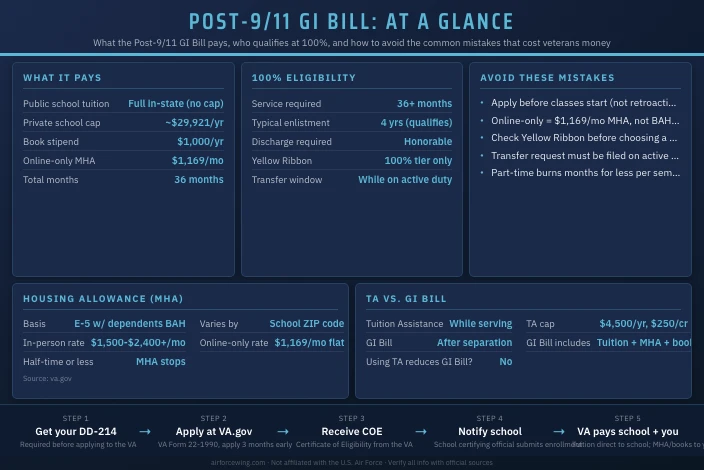
What the GI Bill Pays For
The benefit has four components. Each one works independently, so understanding the full picture matters before you enroll anywhere.
Tuition and Fees
At a public school, the GI Bill pays full in-state tuition and all mandatory fees with no dollar cap. Out-of-state students at public universities can use the Yellow Ribbon Program to close the gap between in-state and out-of-state rates (more on that below).
At a private or foreign school, annual payments are capped at the current rate:
$29,920.95This cap applies per academic year (not per calendar year) and covers both tuition and fees combined. If your private school costs more than the cap, you pay the difference out of pocket unless Yellow Ribbon applies.
Monthly Housing Allowance (MHA)
The housing allowance is where the GI Bill’s value becomes easy to underestimate. The VA pays MHA based on the E-5 with dependents BAH rate at your school’s ZIP code, not where you live. That’s roughly $1,500 to $2,400 per month at most major universities depending on the city.
A few rules that trip people up:
- MHA is only paid at the full-time rate while enrolled full-time. Drop below half-time and it stops entirely.
- Purely online students receive a flat national rate of $1,169/month regardless of school location.
- MHA is paid monthly in arrears, so your first deposit arrives roughly a month into the semester.
The E-5 with dependents BAH benchmark means an Airman who served five years as an enlisted member and then attends a school in a city like Austin, TX or Colorado Springs, CO may receive well over $1,800/month just for housing. That covers rent in most mid-size cities.
Book and Supply Stipend
The VA pays a $1,000 annual book stipend, disbursed at the start of each semester or term, prorated based on your enrollment rate. At full-time enrollment, the first $500 arrives in the fall, the remaining $500 in the spring.
This does not cover a laptop, a parking pass, or activity fees charged by the school. It covers textbooks and required course supplies.
Total Months Available
The GI Bill provides up to 36 months of benefits, which typically maps to four academic years. Those 36 months are not calendar months, they’re months of enrollment. A semester counts as about 4.5 months. That’s important if you take a gap semester or attend part-time, because your clock doesn’t run during breaks.
Eligibility: How Much Service You Need
Benefits are tiered by how long you served on active duty after September 10, 2001. Discharge type matters, the benefit requires an honorable or general under honorable conditions discharge.
| Active Duty Service | Benefit Level |
|---|---|
| 90 days to 6 months | 40% of the benefit |
| 6 months to 1 year | 50% |
| 1 to 18 months | 60% |
| 18 to 24 months | 70% |
| 24 to 30 months | 80% |
| 30 to 36 months | 90% |
| 36 months or more | 100% |
Most Air Force enlistments are four years (48 months), which means the vast majority of enlisted veterans exit at 100% benefit level. Officers commissioned after a four-year ROTC or OTS pipeline typically qualify at 100% as well, provided they meet the active duty service requirement.
Time served includes deployment to a combat zone, activation under Title 10, and other qualifying service. The VA determines your exact entitlement at application.
Yellow Ribbon Program
The Yellow Ribbon Program bridges the cost gap when private school tuition exceeds the annual cap. It’s a partnership between the VA and participating schools, the school contributes up to a set dollar amount per student, and the VA matches it dollar for dollar.
To qualify, you need:
- 100% benefit level (36+ months of active duty)
- Enrollment at a school that participates in Yellow Ribbon
Not every school participates, and those that do set their own contribution caps. A school contributing $10,000 per year gets matched by the VA for another $10,000, reducing your out-of-pocket cost by $20,000. Some schools cover the full gap. Check the VA Yellow Ribbon Program school finder before applying anywhere expensive.
Transferring Benefits to Dependents
If you want to pass your GI Bill benefits to a spouse or child, the rules are strict.
- You must have completed at least 6 years of active duty service at the time of the request.
- You must commit to 4 additional years of service from the approval date.
- The transfer request must be submitted and approved while you’re still on active duty. You cannot transfer after separation.
This is one of the most commonly missed requirements. Airmen who leave after four years and assume they can transfer later lose the option entirely. If transferability is part of your plan, you need to think about it before you separate and make sure you meet the service obligation.
Once approved, the dependent uses the benefits under the same rules as the veteran, same caps, same housing allowance calculation, same 36-month limit (minus whatever the veteran has already used).
Tuition Assistance vs. GI Bill: Don’t Confuse Them
These are separate programs designed for different phases of your career.
Tuition Assistance (TA) is used while on active duty. The Air Force pays up to $250 per semester credit hour, capped at $4,500 per fiscal year. TA covers tuition costs at most community colleges and many four-year schools. It does not come with a housing allowance.
Post-9/11 GI Bill is used after you separate. It pays tuition, housing, and books, a much bigger package. Using TA while serving doesn’t reduce your GI Bill entitlement. Most Airmen who plan ahead use TA to complete coursework during service, then use the GI Bill for a degree program after separation.
The smart play: start a degree with TA, finish it with the GI Bill. That approach can stretch your total education benefit well beyond what either program offers alone.
How to Apply
The application goes through the VA, not the Air Force. Steps are straightforward:
- Gather your DD-214 (Certificate of Release or Discharge from Active Duty).
- Apply at va.gov/education/apply-for-education-benefits/ using VA Form 22-1990.
- Notify your school’s certifying official once you receive your Certificate of Eligibility (COE). The school certifies your enrollment to the VA each semester.
- The VA then pays tuition directly to the school and MHA/books directly to you.
Processing times vary. Apply at least three months before your first semester begins. Some schools have their own advance-payment arrangements with the VA, but don’t count on it.
Common Mistakes That Cost Veterans Money
A few patterns come up repeatedly:
Attending school before applying. Benefits aren’t retroactive. If you start classes before your application is approved, you’ll pay out of pocket for that period.
Choosing online-only enrollment without accounting for the MHA difference. A veteran attending a school in San Antonio in person might receive $1,800/month in MHA. The same veteran taking only online classes receives $1,169/month. That’s a real difference over 36 months.
Not checking Yellow Ribbon before choosing a private school. Two otherwise identical programs at different private schools can leave you with wildly different out-of-pocket costs depending on each school’s Yellow Ribbon contribution level.
Burning months on part-time enrollment. You’re entitled to 36 months. Part-time enrollment still counts toward that total but delivers less benefit per semester. If you can attend full-time, it’s almost always the better financial move.
For a full picture of how the GI Bill fits alongside other Air Force compensation, the complete Air Force pay and benefits guide covers active-duty pay, BAH, TRICARE, and TSP in one place. If you’re also weighing how housing allowance factors into your base assignment, Air Force BAH Rates: How Housing Allowance Works explains the calculation and what changes when you PCS.
Explore Air Force enlisted career fields to see which AFSC paths lead to the strongest education benefit eligibility at the four-year mark. The education benefits guide covers the GI Bill alongside Tuition Assistance, CCAF, and other programs in one place.
This site is not affiliated with the U.S. Air Force or any government agency. Verify all information with official Air Force and VA sources before making separation or education benefit decisions.