PiCAT vs ASVAB at MEPS: Which Should You Take
Most recruits show up to MEPS expecting to sit down at a computer and take the ASVAB. What they don’t know is that there’s another option, one that lets you take a version of the test at home, on your own schedule, before you ever walk through those doors. It’s called the PiCAT, and whether it’s the right move depends entirely on your situation.
Prepare Before You Test
When you purchase through links on our site, we may receive compensation at no extra cost to you.
- PiCAT and ASVAB prep guide with practice tests, covers all subtests with answer explanations
- PiCAT and ASVAB online prep course, self-paced instruction organized by subtest
What the PiCAT Actually Is
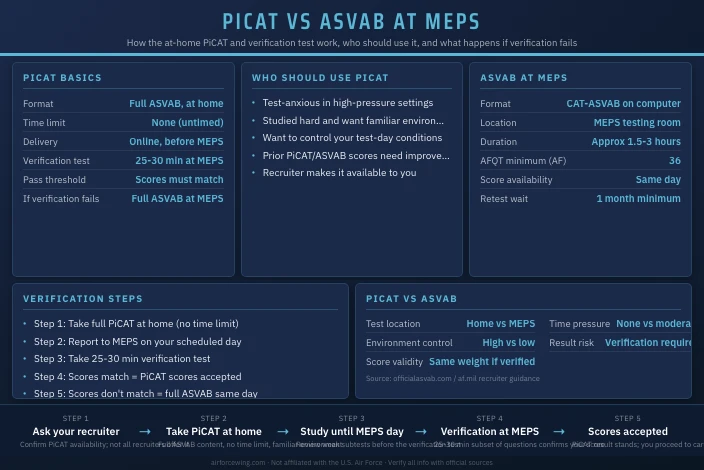
The PiCAT stands for Pre-screening internet-delivered Computer Adaptive Test. It covers the same content as the full ASVAB, all nine subtests, same question formats, same scoring, but you take it at home through a secure online portal instead of in a testing room at a Military Entrance Processing Station.
Two things make it different from the standard MEPS experience:
- No time pressure from the day itself. You test in your own space, not in a room full of strangers after a 5 a.m. wake-up call and a medical exam.
- No proctored environment. Because the test is unmonitored, the military requires a follow-up verification test before your scores count.
The PiCAT is not a shortcut and it’s not easier. It covers the same material. What it gives you is control over the testing environment.
How the Verification Test Works
Taking the PiCAT doesn’t mean you skip the ASVAB at MEPS. It means you take a shorter version instead.
When you arrive at MEPS, you’ll sit for a verification test that runs roughly 25 to 30 minutes. It’s a targeted subset of questions designed to confirm that your PiCAT scores accurately reflect your ability. If your verification answers are consistent with your PiCAT performance, your PiCAT scores are accepted and you move on to career counseling.
What happens if verification fails? You take the full ASVAB at MEPS that same day. Your PiCAT score is set aside, and the MEPS score becomes your official result. It’s not the end of the world, but it does mean your MEPS day gets longer, and you may not have mentally prepared for a full test session.
The verification threshold is not publicly defined. The system flags statistical inconsistencies, not specific question mismatches. Study like you’re taking the full test either way.
The Case for Taking the PiCAT
The PiCAT tends to help people who underperform when the environment is working against them. Here’s when it makes sense:
You’re a test-anxious applicant. MEPS is a stressful environment by design. You wake up early, move through an unfamiliar building, go through a physical, and then sit down to test. Some people do their worst work under those conditions. Taking the PiCAT at home, where you control the lighting, the noise level, and the pacing, can produce a meaningfully better result.
You’ve prepared and want to lock it in. If you’ve spent four to six weeks working through practice material, the PiCAT lets you test when your preparation is freshest. You can study the morning of if that’s how you perform best.
Your goal is a specific AFSC with a demanding line score. If you’re aiming for an AFSC that requires a high score in a particular composite, say, a cyber role requiring a strong ELEC score, every point counts. The PiCAT gives you the best environment to show what you actually know. The Air Force enlisted career paths include dozens of AFSCs where line scores are the deciding factor.
Targeting a High-Score AFSC?
- PiCAT prep guide with subtest drills, includes section-by-section review for each ASVAB composite
- PiCAT prep course, video lessons and timed practice for the subtests that drive Air Force line scores
The Case Against the PiCAT
The PiCAT isn’t the right choice for everyone. Consider skipping it if:
- Your recruiter hasn’t offered it. Not every recruiter provides PiCAT access, and the process varies by district. If it’s not on the table, this decision is made for you.
- You want to get to MEPS and move on. The PiCAT adds a step. You test at home, then still go to MEPS and take the verification test. If your timeline is tight, the standard MEPS ASVAB is faster from start to finish.
- You perform best under pressure. Some applicants actually do better in a structured, time-limited environment. If that’s you, the MEPS testing room isn’t a disadvantage.
- You haven’t studied. The PiCAT offers no scoring advantage on its own, it just changes the environment. If you’re walking in underprepared, taking it at home doesn’t fix the problem. Spend the time studying instead.
PiCAT vs Full ASVAB at MEPS: Side by Side
| Factor | PiCAT | ASVAB at MEPS |
|---|---|---|
| Where you test | At home | MEPS testing room |
| Time pressure | None (untimed) | Moderate (timed subtests) |
| Environment control | High | Low |
| Test length | Full ASVAB content | Full ASVAB content |
| Verification required | Yes, at MEPS | No |
| If verification fails | Full ASVAB at MEPS | N/A |
| Score weight | Same if verified | Standard |
| Retest option | Subject to normal ASVAB retest rules | 1-month minimum wait |
One thing that doesn’t change: the Air Force AFQT minimum is 36 for active duty enlistment. Whether you score it on the PiCAT (verified) or the MEPS ASVAB, the threshold is the same.
What Happens at MEPS Either Way
Whether you take the PiCAT or the standard ASVAB, your MEPS day includes more than the test. Expect a physical examination, a hearing and vision screening, a review of your medical history, and a meeting with a career counselor to discuss AFSC options based on your scores.
The ASVAB or verified PiCAT result drives the career counseling conversation. A recruiter previews your line scores and career options before your MEPS visit, but the official conversation happens on-site. Going in with a strong score, and understanding which composites matter for the careers you want, puts you in a better negotiating position.
If your MEPS ASVAB score comes in below what you need, Air Force ASVAB retesting rules govern how long you wait and how many retakes you can take.
Prepare for the Test You’re Taking
The preparation strategy is the same for both paths. The PiCAT covers identical content to the ASVAB, there’s no special PiCAT study guide that works where an ASVAB guide doesn’t.
Fix your weakest subtest first. Take a diagnostic practice test before studying anything. If Arithmetic Reasoning is pulling down your score, two focused weeks on math gets you further than reviewing every subtest at once. This “fix your weakest first” framework applies whether you’re aiming for a specific line score or just trying to clear the AFQT floor.
The Air Force ASVAB test prep guide walks through the full study method, including 30- and 60-day plans and section-by-section score strategies.
Ready to Prep?
- ASVAB online prep course, full subtest coverage with practice tests and lessons
- PiCAT prep guide, covers all nine subtests with answer explanations
The complete picture of officer selection tests. AFOQT, TBAS, and PCSM, is covered in the Air Force Officer Selection Tests pillar. You may also find Air Force ASVAB Retesting Rules and Air Force ASVAB test prep useful as you plan your prep timeline.