The Judge Advocate General of the Air Force
When you purchase through links on our site, we may receive compensation at no extra cost to you.
The Air Force has a general officer whose job is to keep the entire service inside the law. That officer is The Judge Advocate General, known by the initials TJAG. Most people who look into Air Force legal careers find the 51J Judge Advocate AFSC profile and stop there. But understanding the institution behind that career field, who runs it, how it’s organized, and what the three lines of legal practice actually involve, makes the career decision clearer for any attorney considering the uniform.
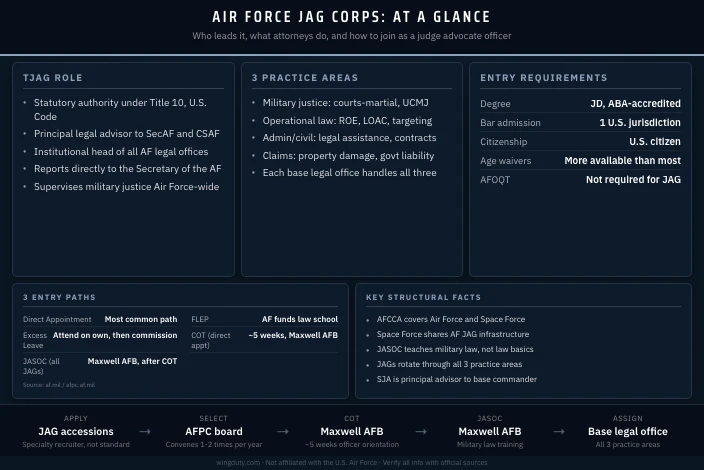
Who Is The Judge Advocate General?
The Judge Advocate General of the Air Force is the senior general officer leading the Air Force JAG Corps. This officer serves as the principal statutory legal advisor to the Secretary of the Air Force and the Air Force Chief of Staff on all matters of military law. The position reports directly to the Secretary of the Air Force and carries responsibility for the legal health of the entire service, from day-to-day Airman legal assistance to the rules governing combat operations.
The Judge Advocate General serves as the institutional head of every Air Force legal office worldwide, shapes military justice policy, and represents the Air Force legal community before Congress and senior Pentagon leadership. The position has existed in some form since the Army Air Forces became an independent service, and it functions as the Air Force’s equivalent of the top partner in a very large, very specialized law firm.
Unlike most general officer positions, the TJAG role carries statutory authority under federal law. Title 10 of the United States Code specifically designates the TJAG as the legal officer responsible for supervising the administration of military justice throughout the Air Force. That statutory basis gives the position both independence and direct accountability that line general officers don’t have in the same way.
The JAG Corps: Structure and Reach
The Air Force JAG Corps operates through a layered structure that reaches every installation where Airmen serve.
Office of the Judge Advocate General (OTJAG) sits at the top and functions as the headquarters element. OTJAG sets policy, manages the careers of JAG officers, runs the professional development system, and provides legal oversight across the entire service.
Air Force Legal Operations Agency (AFLOA) handles the operational management of JAG resources across major commands. AFLOA oversees centralized functions including appellate courts, contract litigation, and labor law, and it manages the pipeline of legal officers across assignments.
Major Command (MAJCOM) legal offices provide staff legal support to commanders at each major command. These offices advise MAJCOM commanders on large-scale legal questions involving thousands of Airmen and often handle the more complex litigation and policy matters.
Wing and base legal offices are where most JAG officers spend their early careers. A base legal office handles military justice, legal assistance, civil law, and claims for the Airmen and families on that installation. Every significant Air Force installation has one.
The JAG Corps also extends to Air Force legal officer careers in both the active duty and reserve components, with reserve JAG officers holding the same credentials and performing the same legal advisory mission for their units.
Three Lines of Practice
Air Force JAG work falls into three distinct practice areas. Every legal office handles all three to some degree, and most JAG officers rotate through each during their career.
Military Justice
This is the courts-martial work: prosecuting and defending Airmen accused of crimes under the Uniform Code of Military Justice (UCMJ). A JAG officer serving as a trial counsel (prosecutor) handles everything from charging decisions through sentencing. An Area Defense Counsel (ADC) represents accused Airmen as an independent defense attorney, separate from the command legal office to avoid conflicts.
Military justice experience is considered the most development-dense assignment in early JAG careers. An Air Force captain who has tried contested courts-martial has courtroom experience that most civilian attorneys of the same age simply don’t have.
Operational Law
Operational law covers the legal framework around military operations themselves. Rules of engagement, targeting decisions, law of armed conflict (LOAC) compliance, and treaty interpretation all fall here. JAG officers assigned to operational units and combatant command staffs advise commanders in real time on what actions are lawful under international law and standing orders.
This practice area is the one that puts a JAG officer in the room when a commander is making decisions with lethal consequences. It requires fast, accurate legal reasoning under operational pressure, and it’s the part of the job that most closely resembles what people imagine when they think of “military law.”
Administrative and Civil Law
This is the broadest category and covers a wide range of matters:
- Legal assistance: wills, powers of attorney, landlord-tenant disputes, family law advice for Airmen and their families
- Contract and fiscal law: reviewing government contracts, advising on appropriations law, supporting base procurement actions
- Claims: processing claims by and against the government, including property damage claims from Airmen and third-party claims against the Air Force
- Environmental law: compliance with federal environmental statutes affecting Air Force installations
- Labor and employment law: advising on civilian employee matters, adverse actions, and equal employment obligation
A wing legal office may handle legal assistance appointments in the morning, review a contract action at noon, and brief the wing commander on an administrative separation case in the afternoon.
Air Force Court of Criminal Appeals
One structural fact that surprises many people: the Air Force Court of Criminal Appeals (AFCCA) has jurisdiction over cases from both the Air Force and the Space Force. When a Space Force Guardian faces a court-martial, the Air Force JAG Corps handles appellate review. The two services share this judicial infrastructure, which reflects the Space Force’s deliberate decision to lean on Air Force institutional frameworks during its early years rather than build entirely parallel systems from scratch.
AFCCA sits above the trial courts and below the Court of Appeals for the Armed Forces (CAAF), which is a federal appellate court with jurisdiction over all service branches.
Comparison Across the Services
Each military branch runs its own JAG corps. They are separate organizations with separate senior leadership, though they share the same statutory framework under Title 10.
| Service | Senior Legal Officer | Appellate Court |
|---|---|---|
| Air Force | The Judge Advocate General of the Air Force | Air Force Court of Criminal Appeals (AFCCA) |
| Army | The Judge Advocate General of the Army | Army Court of Criminal Appeals |
| Navy | Judge Advocate General of the Navy | Navy-Marine Corps Court of Criminal Appeals |
| Marine Corps | Staff Judge Advocate to the Commandant | Shares Navy court |
| Space Force | Shares Air Force JAG Corps | Shares AFCCA |
The Army JAG School at the University of Virginia is a separate institution from the Air Force’s JASOC. Army JAG officers attend Charlottesville; Air Force JAG officers train at Maxwell AFB, Alabama. Navy JAG officers train at Newport, Rhode Island. The legal training pipelines are parallel but distinct.
Each corps has its own culture, career management system, and promotion board. An attorney who prefers Air Force culture over Army culture can apply to only one and not the other.
How Attorneys Become Air Force JAG Officers
The path into the Air Force JAG Corps differs from nearly every other commissioning route because credentials drive selection, not test scores. There’s no ASVAB for JAG. There’s no AFOQT requirement for legal officers either, though JAG candidates should review AFOQT preparation for general officer candidate context.
Three main entry paths exist:
Funded Legal Education Program (FLEP) allows active-duty enlisted Airmen and officers in other career fields to apply for Air Force-funded law school. Recipients attend law school as active-duty members, commission as JAG officers upon graduation and bar passage, and owe service proportional to the funding received. FLEP is competitive and limited in seats.
Excess Leave Program applies to active-duty members who are already accepted to law school and granted leave without pay to attend on their own. They commission as JAG officers after graduating and passing the bar, with a shorter government obligation than FLEP recipients.
Direct Appointment is the most common path and covers attorneys who already hold a JD from an ABA-accredited law school and are licensed in at least one U.S. jurisdiction. They apply through the JAG accessions office, compete in a selection board, and if selected, attend Commissioned Officer Training (COT) at Maxwell, then the Judge Advocate Staff Officer Course (JASOC). This path is open to new attorneys and those who have been in private practice or government work for years.
Entry Requirements for Direct Appointment
| Requirement | Standard |
|---|---|
| Law degree | JD from ABA-accredited school |
| Bar admission | Licensed in at least one U.S. state or territory, in good standing |
| Citizenship | U.S. citizen |
| Age | Varies by accession year; age waivers available through the JAG accessions office |
| Physical | Standard officer accession medical examination |
| Security screening | Background investigation required |
Age waivers for JAG accession tend to be more available than for most officer categories because the credential itself is the primary qualification. Policies change year to year, and the JAG accessions office publishes current guidance. Attorneys in their late 30s or early 40s who hold the right credentials are not automatically disqualified.
Training at Maxwell
JAG officers attending as direct appointees go through Commissioned Officer Training (COT), not the standard nine-week OTS that most Air Force officers complete. COT runs approximately five weeks and covers officer fundamentals, Air Force customs, and the fitness assessment. It’s designed for mid-career professionals who are already competent in their field.
After COT, new JAG officers attend the Judge Advocate Staff Officer Course (JASOC), also at Maxwell AFB, Alabama. JASOC is the JAG-specific training: military justice under the UCMJ, the Manual for Courts-Martial, legal assistance practice, claims, contract law, and operational law fundamentals. The course doesn’t teach students how to be lawyers. It teaches lawyers how to apply that skill in a military legal office from day one.
Career Progression for a JAG Officer
Entry grade depends on accession path and any constructive service credit for prior legal experience. Most direct appointment candidates enter at O-1 or O-2. An attorney with several years of post-bar practice may receive constructive credit that places them at O-2 or O-3 at entry.
Early career (O-1 through O-3): Core legal practice at a base legal office. Military justice, legal assistance, and civil law. Defense counsel assignments as an ADC are considered high-development billets here. A Captain serving as Chief of Military Justice for a wing manages courts-martial and advises the wing commander on discipline matters.
Mid-career (O-4): Practice area depth, joint assignments, and staff roles. MAJCOM legal offices and combatant command legal billets appear at this stage. Joint professional military education becomes important for senior promotion.
Senior career (O-5 through O-6): Staff Judge Advocate positions at wings and major commands. The SJA serves as the principal legal advisor to a commander with authority over thousands of Airmen. These are the most demanding and most visible assignments in the career field.
Flag officer: A small number of JAG officers reach O-7 and above, eventually competing for the TJAG position itself. The path is long and requires an exceptional record across all three practice areas, command advisory experience at senior levels, and joint duty credit.
Civilian Outlook After JAG Service
JAG service translates to civilian legal careers in ways that most law school career advisors don’t fully explain. Military attorneys who have tried contested courts-martial enter civilian practice with more courtroom hours than most associates at large firms accumulate in their first several years.
Strong post-service paths include:
- Department of Justice, U.S. Attorney’s Offices, and federal agencies where government-law experience and security clearances are direct advantages
- Federal judicial clerkships, where JAG service is viewed as genuine legal experience rather than a gap year
- Defense contractors and aerospace firms that need cleared attorneys with operational legal backgrounds
- State and federal public defender or prosecutor offices for those who want to stay in criminal practice
- Corporate and contract counsel at companies with significant government contracting business
Federal hiring programs, including veterans’ preference, also give JAG veterans a competitive edge in civil service legal positions. An attorney who served as an SJA and then wants a senior GS-14 or GS-15 position at a federal agency has a profile that few civilian-track applicants can match at the same career stage.
You may also find Air Force direct commission programs explained and Air Force officer vs. enlisted helpful for understanding how the JAG path fits into the broader officer accession picture.