Is the Air Force Worth It? Honest Pros and Cons
Every year, thousands of people sign the enlistment contract after a 30-minute recruiter visit. Some find it was the best decision of their lives. Others spend four years counting down the days. The difference usually comes down to what they knew going in.
This is the honest version. Not the recruiting brochure.
What You Actually Get Paid
The pay conversation starts in the wrong place almost every time. Basic pay is only part of your compensation, and for many airmen it’s not even the biggest part.
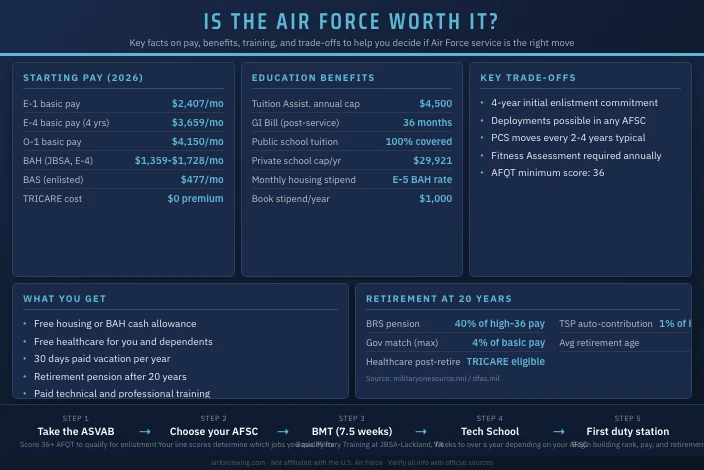
An E-1 Airman Basic starts at $2,407 per month in base pay. That sounds modest until you add the tax-free allowances that come with it. Housing (BAH) and food (BAS) are on top of that figure, and neither is taxable.
Here’s what total compensation looks like for a typical E-4 Senior Airman at a mid-cost installation:
| Component | Monthly Amount |
|---|---|
| Basic pay (E-4, 4 years) | $3,659 |
| BAH (JBSA-Lackland, with dependents) | $1,728 |
| BAS (enlisted flat rate) | $477 |
| Estimated gross | $5,864 |
That’s not counting any special pays for certain jobs, deployment zones, or reenlistment bonuses. A 22-year-old in a comparable civilian job with no degree rarely clears $5,800 per month after paying rent, health insurance, and groceries out of pocket.
Officers start higher. A new Second Lieutenant (O-1) earns $4,150 per month in base pay before BAH and BAS, and most officer positions require a four-year degree you’d have already paid for elsewhere.
Benefits That Actually Matter
Pay is one number. Benefits are where the math gets harder to replicate on the outside.
Healthcare is the biggest one. Active-duty airmen and their families get TRICARE Prime at zero cost. No enrollment fee, no deductible, no copay for most care. A family of four pays nothing for doctor visits, prescriptions, dental, and vision. That’s worth $15,000-$25,000 per year in the civilian market, depending on the employer plan.
30 days of paid vacation per year from day one. Most entry-level civilian jobs offer 10-15 days if you’re lucky. The Air Force also observes 11 federal holidays. You can carry up to 60 days of unused leave.
Education benefits come in two layers:
- While serving: Tuition Assistance covers up to $4,500 per year toward college courses. Many airmen finish a bachelor’s degree before they leave active duty.
- After serving: The Post-9/11 GI Bill gives you up to 36 months of education benefits. It pays 100% of in-state tuition at public schools, up to $29,921 per year at private schools, a monthly housing allowance, and a $1,000 annual book stipend.
The GI Bill alone is worth $100,000-plus in tuition and living expenses depending on the school you choose.
Retirement kicks in at 20 years under the Blended Retirement System (BRS). The pension pays 40% of your average highest-36-month basic pay for the rest of your life, starting at whatever age you hit 20 years. Most people retire in their late 30s or early 40s. The government also contributes up to 5% of your basic pay to your Thrift Savings Plan (TSP) account.
The Real Costs
No list of pros is honest without the other side.
You give up four years minimum. The standard enlisted contract is four years of active duty. You go where the Air Force sends you, not where you want to live. You work the hours the mission requires. A deployment can happen in nearly any career field, not just combat jobs.
Permanent Change of Station (PCS) moves happen every two to four years on average. If you have a spouse with a career, a kid in school, or roots in one place, moving every few years has real costs. Some families thrive with it. Others find it genuinely hard.
The fitness standard is ongoing. The Air Force Fitness Assessment scores you on a 100-point scale each year. You need a 75 to pass, and you have to meet minimums on the 1.5-mile run, push-ups, sit-ups, and waist measurement. Fail it enough times and it affects promotions and retention. This is not an idle threat.
Advancement is competitive, not guaranteed. Promotion to Staff Sergeant (E-5) and above requires testing, performance reports, and sometimes waiting years for a slot to open in your career field. The Air Force promotes from within a point system, not purely on time-in-grade.
Here’s what people describe as the hardest parts:
- Being separated from family during deployments or remote tours
- Limited control over assignment locations
- Bureaucracy that moves slowly even when you can see a better way
- Transition back to civilian life is harder than most expect
Job Training You Keep Forever
One of the most practical reasons to join is what you walk out with after your contract.
The Air Force trains you in a specific career field called an Air Force Specialty Code (AFSC) before you ever report to your first duty station. Tech school runs anywhere from a few weeks to over a year depending on the job. Many of those skills translate directly to civilian employment.
Cyber and intelligence jobs in particular tend to produce airmen with security clearances and technical skills that civilian employers actively compete to hire. Medical, aviation maintenance, and logistics AFSCs have similar civilian demand. Some training programs are equivalent to two-year associate degrees in their fields.
The pipeline looks like this for enlisted:
- ASVAB: score 36+ AFQT to qualify; your line scores determine which jobs you’re eligible for
- BMT: 7.5 weeks at Joint Base San Antonio-Lackland, TX
- Tech School: duration and location vary by AFSC
- First duty station: start building rank, pay, and time toward retirement
Officers follow a different path through Officer Training School (OTS) at Maxwell AFB, AL, which runs 9.5 weeks.
The Lifestyle Question
Two things surprise most new airmen: how much the quality of life varies by base, and how much the Air Force culture differs from the other branches.
The Air Force has a reputation for better-than-average facilities, base housing, and overall quality of life compared to the Army and Marine Corps. That’s a generalization with plenty of exceptions, but installations like JBSA-Lackland, Eglin AFB, and Andrews AFB have extensive on-base amenities. Smaller remote bases tell a different story.
The culture leans more structured and professional than some other services. Uniformity and process matter. People who thrive tend to be detail-oriented, organized, and comfortable working in hierarchical systems. People who struggle tend to want more autonomy than the military generally allows early in a career.
Deployment tempo has shifted over the years. The Air Force has reduced individual augmentee deployments from their Iraq and Afghanistan peaks. But deployments still happen, and some AFSCs deploy more than others. Security forces, explosive ordnance disposal, special warfare, and certain medical roles see more than the average.
Who Should Seriously Consider It
No branch is right for everyone. The Air Force tends to be a strong fit if:
- You want paid technical training with real civilian value
- You can handle relocating every 2-4 years
- You want to finish college without six-figure debt
- You’re looking for a career path rather than just a job
- You want job security, health coverage, and a pension that most private employers can’t match
It’s a harder fit if you need geographic stability, if you have dependents who can’t handle frequent moves, or if you want day-to-day independence over how you work.
The Air Force Reserve and Air National Guard are worth considering if you want part-time service. Many of the same education and healthcare benefits apply, and you stay close to home.
What to Do Next
The decision comes down to whether the trade-offs fit your actual situation. Talk to veterans who served in the career field you’re considering, not just recruiters. Read the profiles for the jobs that interest you, and check the ASVAB scores you’d need to qualify.
Explore Air Force career profiles to see which AFSCs match your background, or read more about Air Force pay and benefits before you commit to anything. You might also find what Air Force life is really like, the best Air Force jobs, and the Air Force officer vs: enlisted comparison useful before you decide which path to pursue.
This site is not affiliated with the U.S. Air Force or any government agency. Verify all information with official Air Force sources before making enlistment or career decisions.