How a TS/SCI Clearance Boosts Your Civilian Salary
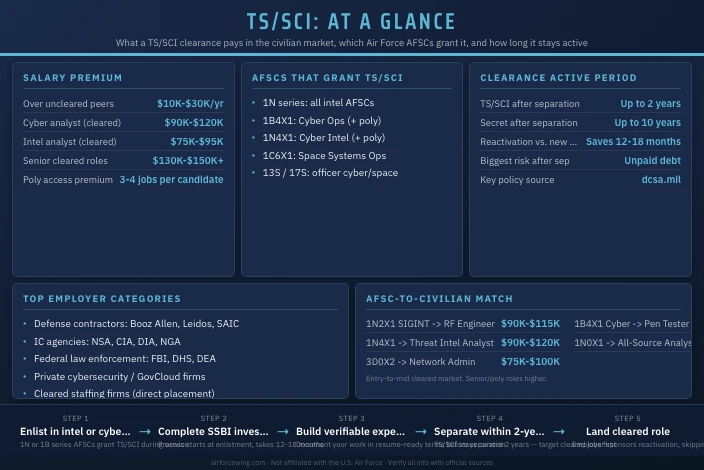
A Top Secret/Sensitive Compartmented Information clearance is one of the most valuable assets a service member can carry into the civilian job market. Defense contractors and federal agencies pay cleared workers anywhere from $10,000 to $30,000 more per year than their uncleared counterparts doing similar work. For Air Force veterans who spent years in intelligence or cyber AFSCs, that premium starts on day one of civilian employment.
What Employers Actually Pay for a TS/SCI
The salary gap between cleared and uncleared workers isn’t a rumor, it shows up consistently across federal pay scales, contractor salary surveys, and job postings. The premium exists for a simple reason: cleared candidates are rare, the investigation pipeline is long, and most employers can’t afford to wait 12 to 18 months for a new hire to finish their background check.
What the market looks like by role type:
| Role Type | Uncleared Salary Range | TS/SCI Cleared Range | Premium |
|---|---|---|---|
| Intelligence Analyst (junior) | $55,000 - $70,000 | $75,000 - $95,000 | ~$20K-$25K |
| Cybersecurity Analyst | $70,000 - $90,000 | $90,000 - $120,000 | ~$20K-$30K |
| Systems Administrator | $60,000 - $80,000 | $75,000 - $100,000 | ~$15K-$20K |
| Software Developer | $85,000 - $115,000 | $110,000 - $145,000 | ~$25K-$30K |
| All-Source Analyst (mid) | $75,000 - $95,000 | $95,000 - $130,000 | ~$20K-$35K |
Salary ranges reflect the broader cleared workforce market based on contractor and federal job postings. Specific offers vary by location, employer, and years of experience.
The premium is highest in the Washington D.C. metro, Northern Virginia, and Maryland corridors, where most intelligence agencies and their contractors are concentrated. But cleared jobs exist at military installations across the country, so geography doesn’t lock you out of the market.
Which Air Force AFSCs Come with TS/SCI Access
Not every Air Force job requires a Top Secret clearance. The intelligence and cyber career fields are where TS/SCI is standard, and many of these AFSCs add polygraph requirements on top.
Intelligence AFSCs (1N series). TS/SCI standard:
- 1N0X1 All Source Intelligence Analyst
- 1N1X1 Geospatial Intelligence Specialist
- 1N2X1 Signals Intelligence Analyst
- 1N3X1 Cryptologic Language Analyst
- 1N4X1 Cyber Intelligence Analyst (often adds polygraph)
- 1N8X1 Targeting Analyst
Cyber AFSCs, clearance varies by specialty:
- 1B4X1 Cyber Operations Specialist (TS/SCI + Counterintelligence polygraph)
- 3D0X2 Cyber Systems Operations (Secret to TS depending on assignment)
- 17S Cyberspace Operations Officer (TS/SCI)
Space operations:
- 1C6X1 Space Systems Operations (TS/SCI common at operational assignments)
- 13S Space Operations Officer (TS/SCI required)
Full AFSC profiles with confirmed clearance requirements are at Air Force Intelligence careers and Air Force Cyber careers.
Where the Jobs Are: Employers Who Hire Cleared Veterans
Three distinct employer categories compete for cleared Air Force veterans. Each has a different hiring process, pay structure, and career ceiling.
Defense Contractors
Defense contractors are typically the fastest-hiring option for separating service members. They recruit directly from the military, often showing up at transition assistance programs and military job fairs. Cleared workers are their core product, they charge agencies for cleared-personnel hours, so a TS/SCI holder with verifiable experience has immediate billable value.
Major contractors that recruit heavily from Air Force intelligence and cyber pipelines:
- Booz Allen Hamilton: intelligence analysis, cyber operations
- Leidos: signals intelligence, data analysis, systems integration
- SAIC: classified IT infrastructure, analytics
- Raytheon Intelligence & Space: SIGINT systems, cyber defense
- ManTech: DOD cyber, intelligence community support
- Perspecta / DXC Technology: federal IT, network operations
Mid-career cleared analysts and cyber specialists at these firms commonly earn $95,000 to $140,000 depending on role and location. Senior cleared positions and those requiring polygraph access regularly exceed $150,000.
Intelligence Community Agencies
NSA, CIA, DIA, and NGA are the direct employers in the intelligence community. Federal hiring moves slower than contractors, often three to six months from application to start date, but the long-term benefits are strong: federal retirement, FEHB health coverage, and a career ceiling that scales with performance rather than contract cycles.
Entry grade for cleared veterans with technical experience:
- GS-7 through GS-9 for most junior hires with 4-year service records
- GS-11 through GS-12 for veterans with six or more years and specialized technical skills
- GS-13 and above for senior technical leads with demonstrated mission experience
A GS-12 in the Washington area earns roughly $95,000 to $110,000 before locality pay adjustments. GS-13 runs $113,000 to $147,000 with D.C. locality.
Cybersecurity and Private Tech Firms
Private-sector cybersecurity has grown its cleared workforce significantly as defense contractors have pushed into commercial cloud infrastructure. Firms working on cleared cloud environments (AWS GovCloud, Azure Government) actively seek veterans with both technical credentials and clearance status.
Roles that translate directly from Air Force service:
- Security Operations Center (SOC) Analyst, maps to 1B4X1, 3D0X2 experience
- Threat Intelligence Analyst, maps to 1N4X1, 1N0X1 experience
- Penetration Tester, maps to 1B4X1 offensive cyber background
- Intelligence Analyst (commercial), maps to any 1N series AFSC
How Long Your Clearance Stays Active After Separation
A TS/SCI clearance doesn’t expire the moment you walk off base. Once granted, it remains in a “current” status for a defined period after separation, as long as you don’t enter a new cleared position within that window, it moves to “inactive.”
Key timelines:
- Top Secret/SCI: considered current for up to 2 years after separation
- Secret: considered current for up to 10 years
- Inactive status: the clearance can be reactivated by a new employer without a full reinvestigation, as long as the gap hasn’t exceeded the applicable period and there are no new disqualifying issues
The practical result: if you find a cleared position within two years of leaving the Air Force, your new employer can sponsor reactivation instead of initiating a brand-new Single Scope Background Investigation (SSBI). That saves the employer 12 to 18 months of waiting and makes you significantly more attractive than an uncleared applicant.
Clearance timelines and reactivation rules are subject to change by the Defense Counterintelligence and Security Agency (DCSA). Verify current policies at DCSA’s official site before making separation or job-search decisions.
How to Keep Your Clearance Active
Separation doesn’t put your clearance at risk by itself. What erodes or kills a clearance are behavioral and financial issues that surface after you leave service.
Clearance-positive habits after separation:
- Keep your financial picture clean. Unpaid debt and collection accounts are the most common reason cleared veterans run into problems at their next investigation.
- Avoid foreign entanglements. Significant new foreign contacts, foreign financial accounts, or foreign travel to adversary nations should be documented carefully.
- Stay honest on any new SF-86 or SF-85P. Adjudicators review prior clearance records, inconsistency between old and new questionnaires raises immediate flags.
- Report any arrests, even minor ones. Most incidents are survivable if disclosed honestly.
The DCSA uses a whole-person standard. A single mistake doesn’t automatically mean disqualification. Patterns of behavior, the severity of the issue, and how openly you disclosed it all factor into the outcome.
What doesn’t affect your clearance:
- Ordinary job changes between cleared employers
- Moving to a new state
- Marriage (unless your spouse is a foreign national, which requires reporting but isn’t automatically disqualifying)
Using Your Clearance to Accelerate the Job Search
The cleared job market has its own dedicated hiring infrastructure. It doesn’t work exactly like civilian job boards.
Where to find cleared jobs:
- ClearanceJobs.com, the largest cleared-specific job board; employers post roles requiring active clearances
- USAJOBS (usajobs.gov), federal agency postings, many of which specify clearance requirements in the announcement
- Contractor career portals (Booz Allen, Leidos, SAIC, Raytheon, ManTech), post jobs directly on their own sites with clearance filters
- LinkedIn, search “TS/SCI” or “active clearance” in the job filters; many contractor recruiters search LinkedIn directly
Veterans who hold a TS/SCI with polygraph are in a separate hiring tier. Cleared workforce industry reporting puts roughly three to four open positions for every candidate with polygraph access. That ratio gives you real negotiating power on salary.
Don’t undersell your clearance status. List it clearly on your resume: “Active TS/SCI (SCI access granted [year], polygraph completed [year]).” Recruiters search for these terms specifically.
The AFSC-to-Career Transition Path
The most direct transition path runs from Air Force AFSC to a cleared role that uses the same skills.
| Air Force AFSC | Civilian Role | Typical Entry Salary (Cleared) |
|---|---|---|
| 1N0X1 All Source Analyst | All-Source / Intelligence Analyst | $75,000 - $95,000 |
| 1N1X1 Geospatial Intel | GEOINT Analyst | $80,000 - $100,000 |
| 1N2X1 Signals Intel | SIGINT Analyst / RF Engineer | $90,000 - $115,000 |
| 1N3X1 Cryptologic Language | Language Analyst / Translator | $80,000 - $105,000 |
| 1N4X1 Cyber Intel | Threat Intelligence Analyst | $90,000 - $120,000 |
| 1B4X1 Cyber Ops | Penetration Tester / Red Team | $95,000 - $130,000 |
| 3D0X2 Cyber Systems Ops | Systems / Network Administrator | $75,000 - $100,000 |
These figures reflect entry-to-mid range for cleared positions and are based on cleared workforce salary reporting. Senior roles and those with polygraph access command higher rates.
Certifications accelerate this transition. CompTIA Security+ is a baseline credential that many contractors require. CompTIA CySA+, CEH, and OSCP strengthen cyber candidate profiles. Intelligence analysts benefit from formal training in tools like ArcGIS (geospatial), Palantir, or tradecraft certifications through contractor training programs. Many employers pay for these once you’re hired.
The Air Force intelligence and cyber AFSC jobs guide covers the full scope of which enlisted roles build this foundation during service.
You may also find Air Force jobs that require a security clearance and Air Force cyber vs: communications AFSC helpful for understanding which path to target before you enlist. The enlistment process guide explains how the security clearance investigation fits into the timeline from MEPS through tech school.
This site is not affiliated with the U.S. Air Force or any government agency. Verify all information with official Air Force sources before making enlistment or career decisions.