How to Train for the 1.5-Mile Run
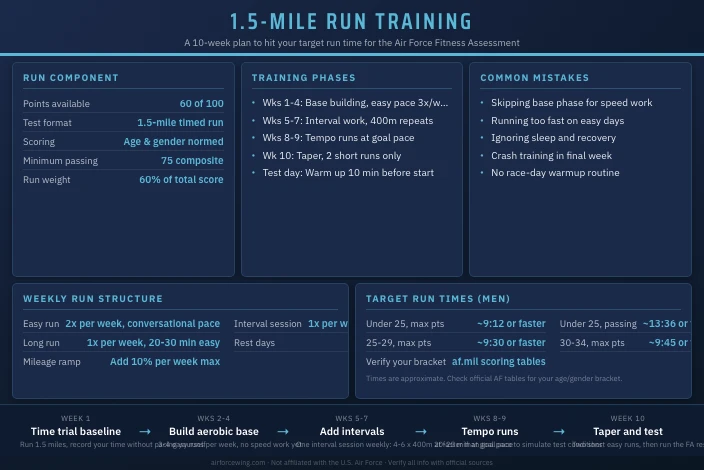
The 1.5-mile run is worth 60 of the 100 points on the Air Force Fitness Assessment. That number matters more than any other single fact about the test. A 30-second improvement in your run time can swing your composite score by 6 to 8 points, which is more than you can gain by maxing out both push-ups and sit-ups combined. If you have a limited amount of time to train, put most of it here.
Why the Run Dominates
Most airmen who fail the Fitness Assessment (FA) don’t fail because of push-ups. They fail because their run time drops their composite below 75, even with solid scores on the other events.
The math is straightforward. A mediocre run performance (say, 38 of 60 possible points) paired with decent scores on everything else can still produce a failing composite. The run is the variable with the most impact, and it’s the one that responds most to consistent training.
The other three components pull roughly 40 points between them. But improving your push-up count by 5 reps might add 1 to 2 points. Dropping your run time by 60 seconds can add 8 to 10 points in many age brackets. Train accordingly.
Understanding Your Target Time
Run scoring is age- and gender-normed, meaning your target time depends on your specific demographic bracket. A 23-year-old man and a 38-year-old woman are not held to the same standard, and they shouldn’t be.
Before starting any training plan, you need two numbers:
- Your current run time (from a baseline time trial)
- Your target run time (from the official AF scoring tables for your age and gender)
The gap between those two numbers tells you how much work you have to do. A gap of 30 seconds is a 4-week problem. A gap of 3 minutes is a 12-week problem. Don’t start training without knowing where you stand.
As a rough reference, men under 25 typically need times around 9:12 or faster for maximum points, with the passing threshold near 13:36. But these numbers shift meaningfully across age brackets. Pull the current tables for your group from af.mil and use those specific figures as your targets.
The 10-Week Plan
This plan is built for someone who can run but needs to improve their time. If you’re starting from zero fitness, add 3 to 4 weeks of walking and easy running before beginning Week 1.
The plan has four phases: baseline, base building, speed work, and taper.
Phase 1: Baseline (Week 1)
Run a timed 1.5-mile trial. Don’t pace for it strategically. Just run at whatever effort feels hard but sustainable and record your time. That’s your starting point.
Also note how you feel at different points in the run. If you’re gasping at the half-mile mark, your aerobic base needs work before you add interval training. If you fade in the final quarter mile, pacing and lactate threshold training are your priorities.
Phase 2: Base Building (Weeks 2-5)
This is the part most people skip, and it’s why most people plateau or get hurt.
Three to four runs per week at easy conversational pace, meaning you can hold a full sentence without gasping. Total weekly mileage should start at about 10 to 12 miles and increase by no more than 10% per week. Your heart rate should stay under roughly 75% of your maximum for most of these runs.
Easy days feel too easy. That’s correct. You’re building capillary density, improving fat oxidation, and teaching your body to run efficiently at lower intensities. The speed comes later.
| Week | Easy Runs | Mileage Target |
|---|---|---|
| 2 | 3 runs, 20-25 min each | ~10 miles |
| 3 | 3-4 runs, 25-30 min each | ~12 miles |
| 4 | 4 runs, 25-30 min each | ~13 miles |
| 5 | 4 runs, 30 min each | ~14 miles |
Don’t add a long run longer than 30 minutes during this phase. The 1.5-mile test is short and fast. Long slow distance matters less than aerobic efficiency at moderate speeds.
Phase 3: Speed Work (Weeks 6-9)
Once you’ve built your base, two types of faster running improve your test time: intervals and tempo runs.
Interval sessions (Weeks 6-8, one session per week):
- Warm up with 10 minutes of easy jogging
- Run 4 to 6 repeats of 400 meters at a pace faster than your goal test pace
- Rest 90 seconds between repeats (walk or very slow jog)
- Cool down with 10 minutes of easy jogging
The goal is to run each interval at roughly 10 to 15 seconds per mile faster than your target test pace. If your target is a 10:00 finish (roughly 6:40 per mile), each 400-meter interval should take about 95 to 98 seconds.
Tempo runs (Weeks 8-9, one session per week):
- 20 to 25 minutes at your goal test pace or just slightly faster
- This teaches your body what it feels like to sustain that effort
Keep two to three easy runs per week during this phase. Speed sessions stress the body more, so recovery between them matters. Running hard every day is how you get injured the week before your test.
Phase 4: Taper (Week 10)
Two easy runs of 15 to 20 minutes each, nothing more. Your fitness is built. Adding hard training now only creates fatigue without providing gains, since fitness adaptations take 10 to 14 days to appear.
Rest, sleep, and hydration matter more in the final week than any workout you could squeeze in.
Pacing on Test Day
The most common pacing mistake is going out too fast. You feel fresh, the adrenaline is running, and the first quarter mile feels easy at a pace you can’t sustain for the full distance.
A better approach: split the run into three segments.
- First half mile: 10 to 15 seconds per mile slower than your goal pace
- Middle half mile: Settle into goal pace
- Final half mile: Push to whatever you have left
This approach builds in a buffer for the natural fatigue that accumulates in the back half. Most people have more left at the end running this way than they would if they burned out early.
Practice this pacing strategy in your tempo runs during Weeks 8 and 9. Running at test conditions before the test removes the guesswork on the day itself.
Recovery and Injury Prevention
Training for the run means managing two variables that can derail everything: overtraining and injury.
The 10% weekly mileage rule (never increase total weekly miles by more than 10% from the previous week) exists because soft tissue adaptation lags behind cardiovascular adaptation. Your heart can handle more load long before your tendons and joints can. Pushing mileage too fast is the root cause of most training injuries.
A few other practices that reduce injury risk:
- Sleep 7 to 9 hours. Muscle repair and adaptation happen during sleep, not during the run itself.
- Run on varied surfaces. Concrete is harder on joints than asphalt or packed dirt. Mixing surfaces reduces cumulative impact stress.
- Address pain early. Soreness in major muscle groups is normal. Sharp or persistent pain in a specific joint or tendon is not. Training through actual injury makes it worse.
Push-Ups and Sit-Ups: Maintenance Mode
During a 10-week run training block, push-ups and sit-ups don’t need their own dedicated program. Ten minutes, three times per week is enough to maintain and gradually improve both.
A simple rotation works:
- Day A: 3 sets of push-ups to near failure, 2-minute rest between sets
- Day B: 3 sets of sit-ups to near failure, 2-minute rest between sets
- Alternate days, never on the same day as a hard run
Your push-up and sit-up numbers will improve over 10 weeks on this schedule. The gains are smaller than your run improvement, but each component has its own minimum threshold on the FA. Meeting those minimums isn’t optional.
What to Expect at BMT
If you’re preparing for enlistment rather than an active-duty FA, the same training approach applies. Basic Military Training at Joint Base San Antonio-Lackland includes organized PT sessions, group runs, and a fitness evaluation before graduation.
Arriving at BMT with a baseline run time under 13 minutes (men) or 15 minutes (women) puts you ahead of most recruits. Those who arrive out of shape are at risk of being held back or placed in a Physical Reconditioning Course (PRC), which can delay your graduation timeline.
The standard is the same across enlisted career fields. Whether you’re training for a medical AFSC or a cyber role, the FA applies. A full overview of the Fitness Assessment scoring, standards, and consequences is at the Air Force Fitness Assessment guide.
Before You Enlist
Physical fitness is one part of meeting Air Force enlistment standards. ASVAB scores, medical screening, and career availability are the others. Starting your fitness training early puts you in the best position to choose the AFSC that fits you, rather than taking what’s available.
A full list of Air Force enlisted careers, including ASVAB line score requirements for each AFSC, is at Air Force enlisted careers. The enlistment process guide covers every step from MEPS to shipping, including how fitness testing fits into the timeline.
For run training in the context of every other fitness component, our Air Force physical fitness guide ties scoring, body composition, and preparation together.
This site is not affiliated with the U.S. Air Force or any government agency. Verify all information with official Air Force sources before making enlistment or career decisions.