How to Raise Your ASVAB Line Scores for Air Force Jobs
The AFQT score gets you in the door. But the five Air Force composite scores. MAGE, ELEC, MECH, ADMI, and GEND, determine which jobs you can actually choose. If your composite came in five or ten points short of the AFSC you want, the fix is more targeted than most people think. You don’t need to ace every subtest. You need to raise the two or three subtests that feed your specific composite.
Know Which Composite Your Target AFSC Uses
Every Air Force job specifies one composite and a minimum score for that composite. Studying for the wrong one wastes time.
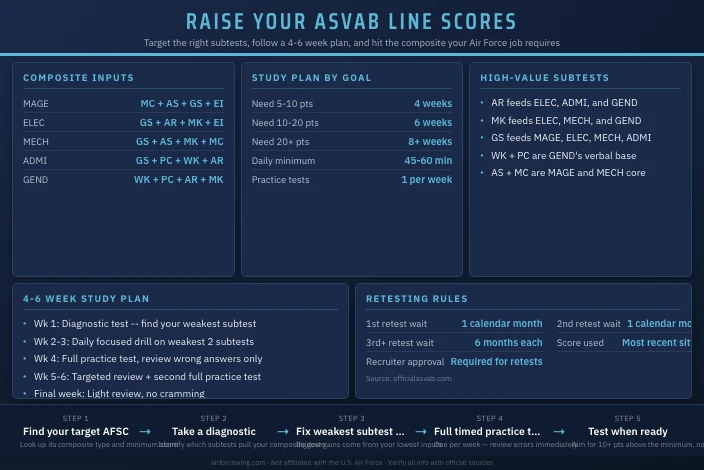
The five composites and their subtest inputs are:
| Composite | Subtest Inputs |
|---|---|
| MAGE | Mechanical Comprehension + Auto & Shop + General Science + Electronics |
| ELEC | General Science + Arithmetic Reasoning + Mathematics Knowledge + Electronics |
| MECH | General Science + Auto & Shop + Mathematics Knowledge + Mechanical Comprehension |
| ADMI | General Science + Paragraph Comprehension + Word Knowledge + Arithmetic Reasoning |
| GEND | Word Knowledge + Paragraph Comprehension + Arithmetic Reasoning + Mathematics Knowledge |
Before you open a study guide, look up your target AFSC and confirm which composite it uses. The ASVAB Scores for Every Air Force AFSC post has the full chart by career group.
Notice that some subtests feed multiple composites. Arithmetic Reasoning (AR) appears in ELEC, ADMI, and GEND. General Science (GS) feeds all five. Improving these two subtests lifts your score across more career options than improving any other single section.
Fix Your Weakest Subtest First
The composite formula adds up your raw subtest scores. A composite of 55 means the four inputs averaged about 14 points each. If one subtest is dragging, say you scored 8 on Mechanical Comprehension while scoring 16 on the others, that one subtest is costing you roughly 6 composite points on its own.
The highest-impact move is always to fix your worst input first.
How to find your weak spots:
- Pull your score report and look at individual subtest scores, not just the composite total.
- Rank your inputs from lowest to highest.
- The bottom one or two subtests are where your study time goes.
Most enlistees focus on the wrong things because they study the sections they find interesting rather than the sections where they’re weakest. A 10-point gain on your worst subtest beats a 3-point gain on each of four subtests, and takes less total time.
Subtest Study Strategies by Composite
GEND: Word Knowledge, Paragraph Comprehension, Arithmetic Reasoning, Mathematics Knowledge
GEND is the most common composite across Air Force jobs, covering everything from Security Forces to Finance to Intelligence. Two of its four inputs are pure verbal skills.
Word Knowledge (WK) responds well to consistent vocabulary drilling. A daily flashcard habit of 20-30 words, practiced in context rather than memorized in isolation, builds vocabulary faster than reading lists. Start with the 1,000 most common SAT-level words and work down.
Paragraph Comprehension (PC) is mostly a pacing and attention issue. Most test-takers lose points by rushing. Practice reading dense paragraphs slowly, identifying the main idea before answering, and ignoring answer choices that are factually true but not supported by the specific passage.
Arithmetic Reasoning (AR) and Mathematics Knowledge (MK) require working math, not recognition. Use practice problems with full written-out solutions. Khan Academy’s arithmetic and pre-algebra modules cover every skill the ASVAB AR and MK sections test. Budget at least 20 minutes daily on math if either score is weak.
ELEC: General Science, Arithmetic Reasoning, Mathematics Knowledge, Electronics Information
ELEC is the primary composite for cyber, avionics, radar, and electronics maintenance jobs. The math component is heavy. AR and MK together make up half the inputs.
Electronics Information (EI) is the section most people ignore. It covers basic circuits, Ohm’s Law, series and parallel circuits, and common electrical terms. If you haven’t studied electricity since high school, the vocabulary alone can sink your score. Spend one dedicated week on EI fundamentals before your test.
General Science (GS) covers biology, chemistry, physics, and earth science at a high school survey level. For ELEC specifically, the physics and basic chemistry portions matter most. Work through any GS practice set and note which topic areas (life science vs. physical science vs. earth science) cause the most errors.
MAGE and MECH: Mechanical Comprehension, Auto & Shop, General Science
These two composites dominate maintenance, civil engineering, and some space operations jobs. Both pull from the mechanical and scientific knowledge subtests.
Mechanical Comprehension (MC) tests physics principles applied to gears, pulleys, levers, and fluid systems. The best prep is working through illustrated mechanics problems. Visual problem sets, not text explanations, are more effective here because the test itself is diagram-based.
Auto & Shop (AS) covers vehicle systems, hand tools, and basic shop procedures. This is the most memorization-heavy subtest on the ASVAB. If you didn’t grow up working on cars or in a shop, budget extra time. Flashcard sets that group terms by system (engine, brakes, electrical, suspension) work better than random drilling.
ADMI: General Science, Paragraph Comprehension, Word Knowledge, Arithmetic Reasoning
ADMI appears in administrative, personnel, and health services roles. Three of its four inputs (PC, WK, AR) overlap with GEND, so prep strategies from the GEND section apply directly. The GS component is the unique piece. Focus on the GS sections covering health, biology, and basic chemistry, since those topics align most closely with the administrative and medical AFSCs that use ADMI.
4 to 6 Week Study Plan
How much time you need depends on how far you are from your target composite. A rough guide:
| Gap to Close | Recommended Prep Time |
|---|---|
| 5-10 composite points | 4 weeks |
| 10-20 composite points | 6 weeks |
| 20+ composite points | 8 or more weeks |
Week 1: Diagnose. Take a full-length timed practice test under real conditions. Score each subtest individually. Identify your two weakest inputs for your target composite.
Weeks 2-3: Fix the weak spots. Study your two weakest subtests daily, 45 to 60 minutes per session. Use practice problems, not passive reading. Every wrong answer gets written in an error log with the correct explanation.
Week 4: Full test + review. Take another full-length timed practice test. Compare subtest scores to Week 1. Review only the categories where you’re still missing problems. Don’t re-study sections you’ve already improved.
Weeks 5-6 (if needed): Target remaining gaps. If one subtest is still dragging the composite, continue focused drilling on that section. Take a third practice test in the final week.
The error log method matters. After each practice test, write down every wrong answer, the correct answer, and a one-sentence explanation of why the correct answer is right. Reviewing errors is more effective than re-reading content sections.
Practice Test Strategy
A practice test is only useful if you treat it like the real test. Timed, full-length, no looking things up. Taking untimed practice in a comfortable environment doesn’t prepare you for test-day conditions.
Schedule your practice tests for the same time of day as your actual ASVAB appointment. Most testing appointments happen in the morning. If you’ve been studying at night, morning performance often comes in 5 to 10 points lower simply from circadian timing.
After the test, review errors the same day. Don’t let wrong answers sit unaddressed. The error log is your actual study material, the practice test is just a tool to generate it.
Retesting Rules
If you’ve already tested and need a higher score, the Air Force follows standard ASVAB retesting policy. The wait times are:
- 1st retest: 1 calendar month after the initial test
- 2nd retest: 1 calendar month after the first retest
- 3rd and subsequent retests: 6 months between each sitting
Your most recent score is the one that counts, not your highest. This matters. If you retest and score lower, the lower score stands. Only retest when you have genuinely prepared more than you did the last time. A test taken out of impatience usually produces the same score or worse.
Your recruiter must approve retests. Have a specific AFSC target and a clear study plan ready before you ask. Recruiters are more likely to facilitate a retest when you can explain what changed in your preparation.
Aim Higher Than the Minimum
Recruiting is competitive. If the job you want requires GEND 44, hitting 45 does not put you in a strong position, it just technically qualifies you. Recruiters match candidates to open job slots based on who scores highest in each composite, not just who cleared the floor.
Aim for at least 10 points above the posted minimum for your target AFSC. That buffer also protects you if you want to change your job preference later in the process.
The Air Force ASVAB test prep guide covers the full study pipeline, resource options, and how to structure your final weeks before test day.
You may also find ASVAB Line Scores Explained and Best ASVAB Scores for Air Force Medical AFSC Jobs helpful as you map out your target composite and career options. Browse Air Force enlisted careers to see which career groups match your strongest composites.