How to Prepare for Air Force OTS Selection
Most OTS applicants spend months preparing for the AFOQT, then submit packages with weak leadership records and thin fitness scores. The selection board sees all of it. A 90th-percentile test score does not rescue a mediocre package, and a strong whole-person file can push a decent test score over the line. Knowing what the board actually weighs, and how early to start building each piece, is the real preparation strategy.
AFOQT and Academic Foundation Prep
When you purchase through links on our site, we may receive compensation at no extra cost to you.
- ASVAB study guide with full practice tests, builds the math and verbal foundation that the AFOQT Verbal and Quantitative composites draw from
- ASVAB online course with video lessons, structured instruction across every subtest section
What OTS Selection Actually Evaluates
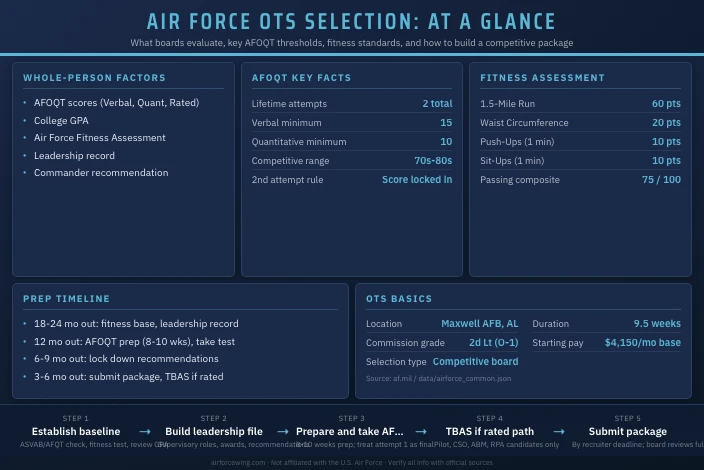
Officer Training School runs 9.5 weeks at Maxwell AFB, Alabama. Graduates commission as Second Lieutenants (O-1). Getting selected requires clearing a competitive board, not just meeting minimum standards.
The board uses a whole-person evaluation. Every factor below gets weighted:
| Factor | What the Board Reviews |
|---|---|
| AFOQT scores | Verbal, Quantitative, Academic Aptitude; rated composites (Pilot, CSO, ABM) for aviation candidates |
| College GPA | Cumulative; STEM degrees carry more weight but are not required |
| Fitness | Candidates must demonstrate they can pass the Air Force Fitness Assessment from day one |
| Leadership record | Supervisory roles, community involvement, awards, EPRs for prior-enlisted applicants |
| Commander recommendation | Required for current and prior enlisted members |
| Letters of recommendation | Typically 3-4; quality of the recommender and specificity of the letter matter |
Test scores determine whether your package clears the academic floor. Leadership record and GPA drive the actual selection ranking. A candidate who scores an 85 on every AFOQT composite but has never held a supervisory role is competing against candidates who have done both.
AFOQT Preparation: Which Composites to Prioritize
The Air Force Officer Qualifying Test is the primary selection exam. It produces six composite scores from 12 subtests. Minimum eligibility thresholds are Verbal 15 and Quantitative 10, but those are floors, not targets. Competitive packages from recent boards typically show scores in the 70s and 80s across composites.
The AFOQT allows only two lifetime attempts. The Air Force records your second attempt as your official score regardless of whether it’s higher or lower. There is no going back to a better first attempt. That single rule makes first-attempt preparation the highest-priority item in your prep timeline.
For non-rated candidates (intelligence, logistics, finance, public affairs, legal, civil engineering):
- Focus on Academic Aptitude, Verbal, and Quantitative
- Math and verbal foundations built through ASVAB prep transfer directly to these composites
- The Arithmetic Reasoning, Mathematics Knowledge, Paragraph Comprehension, and Word Knowledge subtests on the ASVAB are the same skills the AFOQT’s Verbal and Quantitative sections test
For rated candidates (pilot, CSO, ABM, RPA):
- Prioritize Pilot and CSO composites
- Add AFOQT-specific spatial sections: Instrument Comprehension, Block Counting, Rotated Blocks, Table Reading, and Aviation Information, none of these appear on the ASVAB
- Budget at least 8 to 10 weeks of dedicated prep before attempt one
Foundation Work Before the AFOQT
Candidates who score below 50 on the ASVAB’s AFQT percentile typically struggle with the AFOQT’s math and verbal sections. Building that base first is more efficient than going straight to AFOQT prep.
- ASVAB study guide, full review of Arithmetic Reasoning, Math Knowledge, Paragraph Comprehension, and Word Knowledge
- ASVAB online course, video instruction with timed practice by subtest
Fitness: Standards and What Boards Expect
The Air Force Fitness Assessment scores candidates on a 100-point scale across four components. The minimum passing composite is 75, and each component has its own minimum. Scoring:
| Component | Points Available |
|---|---|
| 1.5-Mile Run | 60 |
| Waist Circumference | 20 |
| Push-Ups (1 minute) | 10 |
| Sit-Ups (1 minute) | 10 |
Standards are age- and gender-normed. The run is worth 60% of your total score, which means a poor run time is almost impossible to recover from on other components.
OTS selection boards do not see Fitness Assessment scores directly, they see your fitness record and any documented failures. A candidate with a failed FA in their history needs to explain it. More practically, OTS physical training starts on day one. Candidates who arrive unprepared for the aerobic demands wash out or struggle enough to affect their performance in other areas.
Minimum targets before applying:
- Run your 1.5 miles in the Excellent range for your age and gender bracket, not just the passing range
- Pass push-ups and sit-ups with room to spare
- Body composition in compliance well before your application submission date
The run is the one component with the most room for deliberate improvement. A 12-week aerobic training plan adds significant time to most candidates who start from a passing-but-not-competitive baseline.
Building the Leadership Package
Test scores and GPA are table stakes. What separates competitive packages is the quality of the leadership record. Boards are evaluating whether you can be trusted with Airmen, not just whether you can pass a test.
What counts as meaningful leadership experience:
- Supervisory roles at work, managing direct reports, not just being senior on a team
- Military experience: prior enlisted service, ROTC, or national guard time
- Community involvement: coaching, nonprofit leadership, veteran service organizations
- Professional awards or recognition: civilian or military
- Documented performance: EPRs with leadership narratives for prior enlisted applicants
The recommendation letters carry weight here too. A letter from a supervisor who describes specific situations where you led, made decisions under pressure, or developed others is worth more than a general statement about your character. Recommenders who know you professionally rather than personally write the letters that actually help.
Start building this record at least 12 to 18 months before your target application window. You cannot manufacture leadership experience in the 60 days before you apply.
Application Timeline
OTS selection boards meet on a set schedule. Applications are due several months before the board date. Building backward from your target commission date, a realistic preparation timeline looks like this:
18 to 24 months out:
- Begin fitness training to hit competitive run times
- Take the ASVAB or establish your academic baseline
- Start building or deepening your leadership record
12 months out:
- Begin AFOQT preparation (at least 8-10 weeks before your scheduled test date)
- Take the AFOQT, allow at least 6 months before the board date in case you need to retake it
- Log civilian flight hours if pursuing a rated career field
6 to 9 months out:
- Finalize letters of recommendation
- Complete or update your ROTC/USAFA alternative if applicable
- Confirm your commander recommendation is secured (prior enlisted)
- Have your fitness record clean and current
3 to 6 months out:
- Submit application package by the recruiter’s stated deadline
- Ensure all transcripts, test scores, and supporting documents are complete
- TBAS scheduled and completed for rated applicants
Boards are competitive for every career field. Flying positions are the most competitive. Intelligence and cyber officer fields run close behind. There are no guaranteed selections even for candidates who meet every threshold.
Common Mistakes That Sink Applications
Knowing what goes wrong with unsuccessful packages is as useful as knowing what makes a strong one.
Taking the AFOQT without preparation. Some candidates assume their GPA signals academic readiness and test cold. The spatial and aviation-specific subtests have no real civilian analog. Cold attempts that produce a second-attempt liability are a common and avoidable outcome.
Waiting too long to start fitness training. Fitness isn’t just about passing standards. Boards see any documented failures. Candidates who roll into OTS with a marginal fitness record signal a problem that has nothing to do with their test scores.
Thin recommendation letters. Three letters from professors who knew you in a classroom setting 4 years ago do not give a board anything to evaluate. Get at least one letter from a professional supervisor and ensure all recommenders can speak to your leadership specifically.
Applying before the leadership record is ready. One shot at a board with a thin package can be more damaging than waiting a cycle to strengthen it. Boards record application history.
GPA that doesn’t match the rest of the package. A 3.8 GPA with zero leadership experience and no community involvement is a different candidate than a 3.2 with 3 years of supervisory work and a strong commander endorsement. The board sees the full picture.
After Selection: What OTS Looks Like
Candidates who receive a conditional selection notice begin a pre-OTS process that includes a medical examination, security screening, and final confirmation. Not everyone who gets selected ends up at OTS, medical or background issues discovered in processing can delay or remove a selection.
At Maxwell AFB, the 9.5-week course covers military fundamentals, leadership labs, and academic instruction. OTS is not as physically demanding as enlisted BMT, but candidates who arrive without a solid aerobic base will feel it. Academic washouts also occur, particularly among candidates who did not take their AFOQT preparation seriously enough.
Commissioned graduates enter active duty as Second Lieutenants and move directly to their first duty assignment or follow-on training based on their career field.
The Air Force officer careers hub has full career field breakdowns by specialty, including the rated paths that require TBAS in addition to the AFOQT.
For the academic preparation side, the AFOQT study guide covers the AFOQT composites in detail with study schedules and section-specific strategies.
This site is not affiliated with the U.S. Air Force or any government agency. Verify all information with official Air Force sources before making enlistment or career decisions.
You may also find Air Force Officer Selection Tests and TBAS vs ASVAB helpful as you plan your preparation timeline.