How to Negotiate Your Air Force Enlistment Contract
Most people walk into the recruiter’s office thinking they have zero say in what happens next. That’s not accurate. The Air Force does make certain things non-negotiable, but your AFSC, your ship date, and whether you leave with a bonus are all influenced by what you bring to the table and what you ask for.
This post breaks down exactly what’s on the table, what isn’t, and how to put yourself in a stronger position before you sign.
What You Can Actually Influence
Your enlistment contract covers several key variables. Not all of them are flexible, but more of them are than most recruits realize.
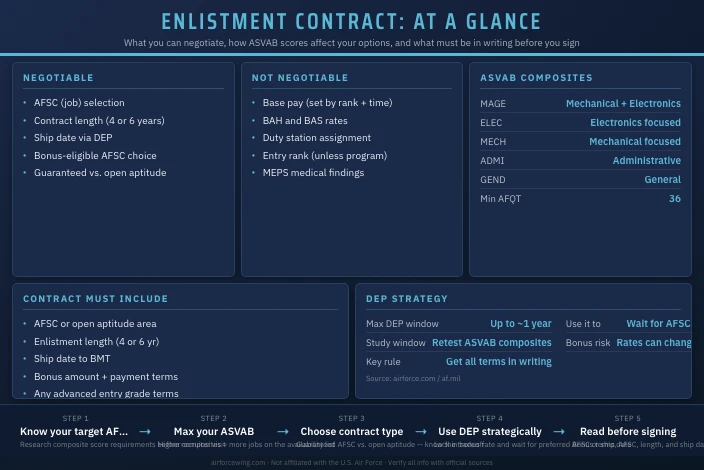
AFSC selection is the biggest lever most recruits have. The Air Force lists available jobs based on what’s currently open in the needs-of-the-Air-Force (NOAF) pool. Your recruiter pulls that list and shows you what’s available. If the job you want isn’t on it, you can wait for it to open or take something else. You don’t have to accept the first list you see.
Contract length is negotiable in some cases. Most active duty enlisted contracts run four or six years. Certain bonus-eligible AFSCs require a longer commitment to receive the full payout. If you’re choosing between two jobs and one offers a six-year contract with a larger bonus, you’re weighing money against flexibility.
Ship date matters more than people think. Requesting a later ship date buys time to prepare for tech school, settle personal obligations, or wait for a preferred AFSC to open. The Delayed Entry Program (DEP) exists specifically for this.
Bonuses are tied to specific AFSCs and are set by Air Force policy, not individual negotiation. You can’t ask for more than what’s posted. But you can choose an AFSC that carries a bonus versus one that doesn’t, and you can time your enlistment to catch a bonus that’s active for a particular career field.
What you cannot negotiate includes base pay, BAH, BAS, duty station assignment, and rank at enlistment (unless you qualify for one of the specific programs that grant advanced entry grade).
How ASVAB Scores Change Your Options
The higher your ASVAB line scores, the more AFSCs appear on your available jobs list. That’s the core of how bargaining power works at this stage.
The Air Force doesn’t use a single ASVAB score. It uses five composite scores built from subtest combinations:
| Composite | Subtests |
|---|---|
| MAGE | Mechanical, Auto/Shop, General Science, Electronics |
| ELEC | General Science, Arithmetic Reasoning, Math Knowledge, Electronics |
| MECH | General Science, Auto/Shop, Math Knowledge, Mechanical |
| ADMI | General Science, Paragraph Comprehension, Word Knowledge, Arithmetic Reasoning |
| GEND | Word Knowledge, Paragraph Comprehension, Arithmetic Reasoning, Math Knowledge |
Each AFSC requires a minimum score on one or more of these composites. A recruit with average scores might qualify for 40 jobs. A recruit with strong scores across all composites might qualify for 150. More qualifying jobs means more options to choose from, a better shot at high-demand AFSCs, and access to the roles that currently carry enlistment bonuses.
If your scores are borderline on the composites that matter for your target career field, retesting is an option. The Air Force allows one retest with a mandatory wait period. A meaningful score increase can open up AFSCs that weren’t previously available.
When you purchase through links on our site, we may receive compensation at no extra cost to you.
Before you test at MEPS, a structured study plan makes a measurable difference. An ASVAB prep course walks you through all nine subtests with practice tests and score-building drills. If you prefer to study at your own pace, an ASVAB study guide covers every composite area with targeted exercises.
Guaranteed AFSC vs. Open Aptitude Contracts
This is one of the most important decisions in the enlistment process, and many recruits don’t understand the difference until it’s too late.
A guaranteed AFSC contract means your specific job code is written into the contract before you ship to Basic Military Training. You leave for BMT knowing exactly what tech school you’re headed to afterward. If the Air Force can’t deliver that job, they have to offer you an alternative or release you from the contract.
An open aptitude contract (sometimes called an “open general” or similar) means you agree to enlist into a broad aptitude area. Your actual AFSC gets assigned after BMT based on Air Force needs at that time. You’ll generally be placed in a job you qualify for, but you don’t get to pick it.
Open contracts sometimes come with higher sign-on bonuses or faster ship dates because the Air Force gets more flexibility in how it uses you. Whether that tradeoff makes sense depends on how strongly you feel about a particular career field.
The general rule: if a specific AFSC matters to you, hold out for a guaranteed contract. If you’re flexible and the bonus or ship date is more important, an open contract may be worth it.
The DEP Window and How to Use It
The Delayed Entry Program lets you enlist now and ship to BMT later, sometimes months down the road. Most recruits spend somewhere between a few weeks and a year in DEP.
DEP serves a few purposes worth knowing:
- It locks in your AFSC and bonus eligibility at current rates while you wait for your preferred ship date
- It gives you time to study for ASVAB retesting if your scores were marginal
- It lets you wait for a specific AFSC to open in the job pool
- It gives you time to handle personal obligations before leaving
One important caveat: bonus rates and job availability can change while you’re in DEP. If a bonus for your AFSC gets reduced or eliminated before you ship, you generally won’t be grandfathered in unless it was specifically written into your contract at enlistment. Get the terms in writing.
You can also request a DEP discharge if your situation changes significantly before you ship, though the process and consequences vary.
Working With Your Recruiter
Recruiters are not adversaries. They have quotas, but they also have real incentive to place you in an AFSC you’ll succeed in. A recruit who washes out of tech school doesn’t help anyone.
That said, some things are worth understanding about how the process works:
- Recruiters can only offer jobs from the current NOAF availability list. They can’t manufacture openings.
- They can advocate for a specific ship date or monitor the job board for an AFSC you’re waiting on.
- They can explain exactly what each composite score threshold you’d need to qualify for your target AFSC.
- They cannot override Medical, Security, or MEPS findings.
Come in prepared. Know your target AFSC, know its composite requirements, and know what bonus is currently attached to it if any. That lets you have a direct conversation about whether the path is realistic and what would need to change if it isn’t.
If a job you want isn’t currently available and you’re willing to wait, ask the recruiter to keep your file active and notify you when it opens. That’s a reasonable request and most recruiters will honor it.
What Goes Into the Signed Contract
Before you sign, your enlistment contract should clearly state:
- Your AFSC (if you have a guaranteed contract) or aptitude area (if open)
- Your enlistment length (typically 4 or 6 years active duty)
- Your ship date to BMT
- Any bonus amount and the terms for receiving it (AFSC-specific service requirements, completion of tech school, etc.)
- Any special programs you qualified for (college credit, advanced entry grade, etc.)
Read every line. Ask questions about anything that’s unclear. The document is legally binding once signed, and verbal promises from any stage of the process don’t count if they’re not in writing.
Security Clearances and Their Effect on Options
Some of the most desirable AFSCs, particularly in intelligence, cyber, and space, require a security clearance. This doesn’t change what’s written in the contract at enlistment, but it does introduce a conditional element worth understanding.
If your AFSC requires a clearance, your assignment to that job depends on successfully adjudicating that clearance. The investigation starts after enlistment. If the clearance is denied, the Air Force will place you in a different AFSC that doesn’t require one.
If clearance access is important to you, ask your recruiter directly which AFSCs require one and what the typical disqualifying factors are. Financial history, prior drug use, and foreign contacts are among the most common issues. Getting ahead of any potential concerns before enlistment is better than finding out after you’ve committed to a clearance-dependent job.
This site is not affiliated with the U.S. Air Force or any government agency. Verify all information with official Air Force sources before making enlistment or career decisions.
For more on this topic, read the full guide to Air Force enlistment bonuses and the breakdowns of bonuses for high ASVAB scores and AFSCs with the biggest signing bonuses. Browse Air Force enlisted careers to compare AFSC options and their composite requirements before you sit down with your recruiter. When you’re ready to maximize your scores, Air Force ASVAB test prep is the place to start.