How to Become an Air Force Pilot (11X)
The Air Force produces fewer than 1,400 new pilots a year. Every one of them passed through the same sequence: a commission, two competitive tests, a Class I flight physical, and roughly a year of Undergraduate Pilot Training. None of it is easy, and every step is a gate. Miss one and you’re out of the pipeline. Clear all of them and you earn wings on one of the most capable air forces on the planet.
This guide walks the full path from application to graduation, every requirement, every test, every timeline.
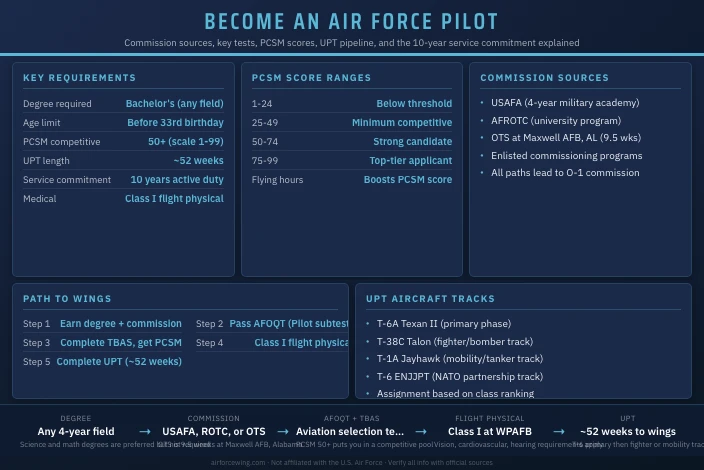
Commission First: Your Three Paths
You cannot become an Air Force pilot without an officer commission. A commission requires a bachelor’s degree at minimum. The field of study is technically open, but science and math-heavy backgrounds build the academic foundation that the selection tests demand.
Three commissioning sources feed the rated pipeline:
United States Air Force Academy (USAFA) in Colorado Springs. A four-year military college with a highly competitive admissions process. Graduates commission directly as Second Lieutenants (O-1). USAFA graduates enter the rated pipeline with a significant advantage: class standing and demonstrated performance, both of which matter to selection boards.
Air Force Reserve Officer Training Corps (AFROTC) at universities across the country. The largest commissioning source for rated officers. Cadets complete a four-year program alongside their college degree, earning a commission at graduation. AFROTC detachments can recommend cadets for rated slots based on their AFOQT scores, physical fitness, and academic record.
Officer Training School (OTS) at Maxwell AFB, Alabama. A 9.5-week program for college graduates who did not attend USAFA or ROTC. OTS is the path for prior-enlisted airmen pursuing a commission through the Enlisted Commissioning Program and for civilian college graduates who apply directly. Selection for OTS is competitive, the Air Force receives more applications than it accepts.
Regardless of which path you take, you commission as an O-1 Second Lieutenant. From there, the rated selection process is the same.
Age Limit
The Air Force requires pilot candidates to begin Undergraduate Pilot Training before their 33rd birthday. That cutoff applies to all commissioning sources. If you’re commissioning through OTS, factor in the processing time between application and class start when calculating your timeline.
The AFOQT: Your First Aviation Test
The Air Force Officer Qualifying Test is the primary officer selection exam. Every officer candidate takes it, but pilot candidates must score competitively on the Pilot composite: a subtest cluster that measures aviation knowledge, instrument comprehension, table reading, and spatial reasoning.
The AFOQT produces six composite scores. For rated positions, two matter most:
| Composite | Used For |
|---|---|
| Pilot | Primary score for pilot (11X) boards |
| CSO | Combat Systems Officer selection |
| Verbal | General officer eligibility baseline |
| Quantitative | General officer eligibility baseline |
Eligibility minimums for commissioning are Verbal 15 and Quantitative 10. Those floors will not make you competitive. Most Undergraduate Pilot Training selectees score in the 70s and 80s on the Pilot composite. Treat anything below 70 as something to address before your application goes to a board.
The AFOQT has two lifetime attempts. The Air Force records your second score regardless of whether it’s higher or lower than your first. That rule removes the safety net of treating attempt one as a practice run. Prepare thoroughly before you sit down for the first time.
The Air Force uses your second AFOQT attempt as the official score, even if it’s lower than your first. There is no third attempt.
TBAS and the PCSM Score
After the AFOQT, pilot candidates complete the Test of Basic Aviation Skills (TBAS). Unlike the AFOQT, the TBAS is not a knowledge test. It measures the cognitive and psychomotor skills that predict success in flight training: hand-eye coordination under divided attention, spatial orientation, situational awareness, and instrument comprehension.
TBAS results don’t stand alone. They combine with your AFOQT Pilot subtest score and any documented civilian flying hours to produce your Pilot Candidate Selection Method (PCSM) score. PCSM runs from 1 to 99.
| PCSM Range | What It Means |
|---|---|
| 1-24 | Below competitive threshold |
| 25-49 | Minimum range; every other factor must be strong |
| 50-74 | Strong candidate |
| 75-99 | Top-tier applicant |
Boards use the PCSM score to rank candidates. A score of 25 is the minimum to get your package reviewed. Most UPT selections come from candidates in the 50+ range.
How Civilian Flight Hours Affect Your PCSM
Civilian flight time is the only PCSM input you can improve after taking the tests. The Air Force Personnel Center applies a measurable bonus for documented hours:
| Logged Hours | Effect |
|---|---|
| 0 hours | No bonus |
| 1-20 hours | Small improvement |
| 21-100 hours | Meaningful gain |
| 101-200 hours | Substantial improvement |
| 200+ hours | Maximum bonus |
A private pilot certificate requires roughly 40 hours of flight time. That’s not the goal here, even 20 hours of dual instruction moves your PCSM. University flight programs and flying clubs sometimes offer rates below what a standard Part 141 school charges. If you’re within two years of an application window, logging flight hours is one of the most direct investments you can make.
The TBAS allows a maximum of two retakes (three total attempts). Scores never expire. A poor score from five years ago still counts today. Prepare before your first attempt.
Medical Requirements: Class I Flight Physical
Every pilot candidate must pass a Class I aviation flight physical at Wright-Patterson AFB, Ohio, through the Air Force School of Aerospace Medicine. This is the most rigorous aviation medical exam the Air Force administers.
Key standards include:
- Vision: Distant visual acuity correctable to 20/20 in each eye. Uncorrected acuity limits apply. LASIK is generally waiverable but must meet specific post-surgical stability criteria.
- Near vision: Required correctable to J1 at near range.
- Color vision: Normal color vision required. Some waivers exist for certain aircraft, but the fighter track typically requires full color discrimination.
- Cardiovascular: Resting ECG, blood pressure within limits, no significant cardiac history.
- Hearing: Pure tone audiogram must meet standards at each tested frequency.
- Height and weight: Sitting height requirements exist for ejection seat aircraft (primarily 34-40 inches sitting height for F-16 and similar platforms). Standing height limits vary by airframe.
Many pilot candidates discover disqualifying conditions during the flight physical that were never caught in a standard physical. Get examined early if you have any known vision, cardiovascular, or orthopedic history. Waivers are possible for some conditions but are not guaranteed and add time to your timeline.
Undergraduate Pilot Training
UPT runs approximately 52 weeks at one of several Air Force bases: Columbus AFB (Mississippi), Laughlin AFB (Texas), Vance AFB (Oklahoma), Sheppard AFB (Texas), and Randolph AFB (Texas). The NATO Euro-NATO Joint Jet Pilot Training (ENJJPT) program at Sheppard trains pilots alongside 13 allied nations.
Training moves through two phases:
Primary phase uses the T-6A Texan II turboprop trainer. Students learn fundamental flying skills, navigation, aerobatics, and instrument procedures. Most students spend the first several months in the T-6 before advancing.
Advanced phase splits into two tracks based on class standing, instructor recommendations, and Air Force needs:
- T-38C Talon track leads to fighter, bomber, and reconnaissance aircraft assignments.
- T-1A Jayhawk track leads to mobility, tanker, and special mission assignments.
Aircraft assignment happens at drop night: a ceremony at the end of UPT where graduates learn what aircraft they’ll fly next. Class ranking matters. Graduates at the top of the class get first pick among available assignments. A strong PCSM and competitive AFOQT scores help get you into a competitive class, but performance during UPT itself determines your aircraft.
Graduation from UPT earns your wings as an Air Force pilot.
The 10-Year Service Commitment
Completing UPT triggers a 10-year active duty service commitment from the date you earn your wings. That commitment is non-negotiable. Pilots who separate before fulfilling it may owe recoupment of training costs.
For most pilots, the 10-year mark falls around O-4 Major, which puts you in a strong position for either continued service or a transition to airline or defense aviation careers. The commitment is long, but the career investment the Air Force makes in each pilot, over $1 million in training costs, explains why it exists.
Beyond the commitment, pilots receive Aviation Career Incentive Pay (AVIP) on top of base pay, with rates increasing with aviation service time. Experienced pilots with 10+ years of rated time can also qualify for significant retention bonuses. Monthly base pay for a new O-1 Second Lieutenant starts at $4,150. A Captain (O-3) with four to six years of service earns $7,383 per month in base pay before allowances and incentive pay are added.
The Full Path, Step by Step
What Boards Actually Weigh
Test scores open the door. They don’t guarantee selection. A rated selection board evaluates a whole package, and a candidate with a PCSM of 55 and a strong leadership record will often beat a candidate with a PCSM of 70 and nothing else.
Factors that carry weight beyond test scores:
- GPA: especially in math and science coursework
- Physical fitness: candidates should exceed Air Force Fitness Assessment standards, not just meet them
- Leadership record: ROTC cadet rankings, job history, community involvement, and EPRs for prior-enlisted applicants
- Commander recommendation: required for prior-enlisted and current service members
- Flying hours: signals genuine aviation interest and moves your PCSM
Boards also look at the totality of the application. A candidate who shows a clear, consistent pattern of preparing for this career, flight hours, strong academics, fitness, and leadership, tells a story that a bare-minimum package does not.
This site is not affiliated with the U.S. Air Force or any government agency. Verify all requirements with your recruiter and official Air Force sources before making any career decisions.
The Air Force operations officer career hub has AFSC-level profiles for every rated career field. For deep coverage of the TBAS and how to prepare, the Air Force TBAS test prep guide covers study strategy, practice resources, and what each subtest measures. To understand how this path fits alongside the broader officer selection process, Air Force officer selection tests covers the full range of officer tests. The cluster pillar, Air Force aviation jobs, maps every officer and enlisted aviation career from pilots to maintainers.