How to Become an Air Force Pararescueman (PJ)
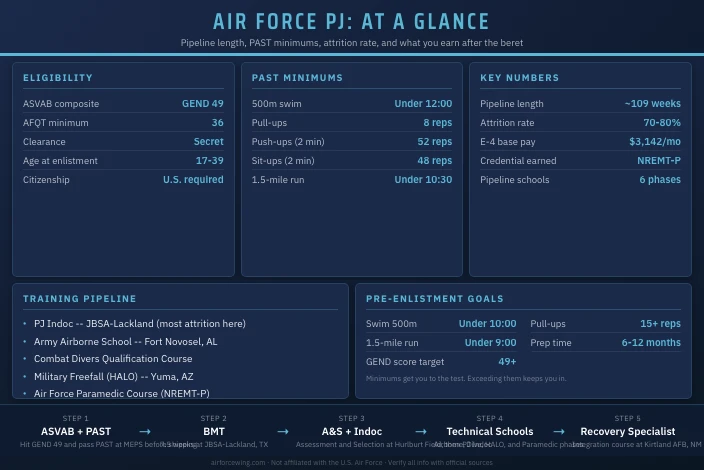
The motto is “That Others May Live.” Pararescuemen. PJs, exist to recover isolated, downed, or captured personnel from environments where no one else can reach them. They freefall in, dive in, and fight their way to the objective, then provide emergency medical care on the spot. It is the longest enlisted training pipeline in the U.S. military. More than 70% of candidates who start it don’t finish.
If you’re considering this path, here is a plain account of what it takes.
This site is not affiliated with the U.S. Air Force or any government agency. Verify all information with official Air Force sources before making enlistment or career decisions.
What Pararescuemen Actually Do
PJs are the Air Force’s combat search and rescue (CSAR) force. Their primary mission is personnel recovery, locating and extracting downed aircrew, special operations soldiers, or isolated civilians from denied or hostile territory. They work in small teams, often embedded with Army Special Forces or Navy SEAL units, and operate independently once on the ground.
The medical side is not secondary. PJs hold a National Registry EMT-Paramedic (NREMT-P) certification, the highest pre-hospital emergency care credential short of a nursing or physician degree. At the objective, they provide trauma care, initiate IV lines, administer controlled medications, and stabilize casualties for evacuation. The combination of combat capability and paramedic-level medicine makes the AFSC unlike anything else in the enlisted force.
AFSC 1T2X1 falls under Air Force Special Warfare (AFSPECWAR). Assignments are concentrated at Hurlburt Field, FL, and at Special Tactics Squadrons at locations including Pope AAF, NC, and Joint Base Lewis-McChord, WA.
ASVAB and Basic Eligibility
The ASVAB requirement for PJ is GEND 49. The GEND composite combines Word Knowledge, Paragraph Comprehension, Arithmetic Reasoning, and Mathematics Knowledge. Most candidates hit this score without difficulty, it is not the filter that keeps people out.
Additional baseline eligibility requirements:
- U.S. citizen, 17-39 years old at enlistment
- AFQT minimum of 36
- Secret security clearance (granted after background investigation)
- Normal color vision and depth perception
- No history of certain medical conditions affecting pressure tolerance (dive-related)
- Eligible for airborne and SCUBA training per medical standards
The ASVAB score is the first gate. Medical qualification is the second. Physical preparation is everything after that.
PAST Standards for PJ
Before A&S, every candidate must pass the Physical Ability and Stamina Test (PAST). The PJ PAST standards are the most demanding of the four special warfare AFSCs. The test is administered at MEPS, again before shipping, and again during the pipeline. Letting fitness slip between any of those checkpoints means going home.
| Event | PJ Minimum Standard |
|---|---|
| 500m surface swim (side or breast stroke) | 12:00 |
| Underwater kneel | 1 breath hold on bottom of pool |
| Pull-ups | 8 reps |
| Sit-ups (2 min) | 48 reps |
| Push-ups (2 min) | 52 reps |
| 1.5-mile run | 10:30 |
These are minimums. Candidates who arrive at A&S performing at minimums face a hard few weeks. The ones who finish tend to exceed these standards before they ever set foot on a military installation.
Assessment and Selection (A&S)
A&S is a multi-day evaluation held at Hurlburt Field, FL. Every AFSPECWAR candidate. PJ, CCT, SR, and TACP alike, goes through the same A&S gate before entering their AFSC-specific pipeline. It is not a training course. It is a selection event.
A&S evaluates physical output, mental endurance, and team cohesion under sustained stress. Candidates who do not pass A&S do not proceed, regardless of ASVAB score, recruiter endorsement, or prior military service. The event is designed to find out who performs when conditions are bad and no one is watching.
The GEND 49 minimum is straightforward to reach with structured preparation. Air Force ASVAB test prep covers the four subtests in detail with practice questions and timed drills.
The Training Pipeline
From BMT to beret, the PJ pipeline runs approximately 109 weeks, or roughly two years. No other enlisted pipeline in any U.S. military branch is longer. Each school builds on the last, and failure at any point restarts the candidate’s future, most who wash out do not get a second pipeline slot.
Attrition
The dropout rate through the PJ pipeline consistently runs between 70% and 80%. Most candidates wash out during PJ Indoc, not at the technical schools. The early phase is intentionally front-loaded with psychological and physical stress to identify candidates who will not survive the full pipeline.
The candidates who finish share two characteristics that are visible before they enlist: they arrived physically prepared, and they can endure discomfort without quitting when quitting is the easiest option. Neither trait can be built in a few weeks. Physical preparation should start 6 to 12 months before a recruiter conversation.
Life After the Beret
A newly badged PJ joins a Special Tactics Squadron as a journeyman operator. The first years involve unit integration, currency maintenance on jump and dive qualifications, and building deployment experience. Senior operators mentor junior ones in an apprenticeship model common to all special operations communities.
A typical week at a stateside STS unit includes:
- Physical training sessions (2+ hours, daily)
- Medical skills maintenance, trauma drills, medication refreshers
- Jump and dive currency operations
- Mission planning and tactical exercises
- Unit-level PT events and cross-training with other AFSPECWAR assets
Deployments vary by unit cycle. Some STS units rotate through multiple downrange assignments per year. PJs have operated in every major U.S. combat theater since Vietnam. The operational tempo is high and largely unpredictable.
Pay at entry level: A new PJ reaching the rank of Senior Airman (E-4) after completing the pipeline earns $3,142/month base pay, plus hazardous duty incentive pay for jump and dive duties, plus BAH based on duty station. Military pay scales are published each January. Total cash compensation at mid-career (E-5 with four years) exceeds $5,400/month before tax-free allowances are included.
The NREMT-P Credential After Service
PJs who separate carry a nationally recognized paramedic certification. Flight paramedic, search and rescue specialist, offshore oil platform medic, and tactical paramedic roles in law enforcement are common civilian transitions. The credential takes years and real-world trauma experience to earn in the civilian world. The pipeline hands it to you, along with jump wings, a dive card, and a freefall rating.
Some PJs continue into federal contracting supporting SOCOM training programs. Others pursue nursing or physician assistant degrees, where their paramedic background accelerates the academic track significantly. O*NET lists current civilian paramedic salary ranges and employer demand data for those planning a transition.
What to Do Before You Enlist
Physical preparation is the only variable you fully control before the pipeline. Here is what that preparation looks like in practice:
- Swim: Work toward 500m in under 10 minutes before MEPS. Butterfly and freestyle build the conditioning; the PAST allows side or breast stroke, but raw water comfort matters more than technique.
- Pull-ups: Build to 15+ before the PAST. Minimums get you through the test; real-world STS standards run higher.
- Run: 1.5 miles under 9:00 puts you in competitive territory. Sub-9:30 is the floor for candidates who want to finish, not just start.
- Ruck: Begin load-bearing marches at 45+ pounds, building to 10+ miles. Pipeline phases include long-duration rucks that expose conditioning gaps early.
- Cold water: Deliberate exposure to cold water, open water swims, cold showers, builds the psychological tolerance that Indoc’s pool evolutions test.
Start now. The candidates who fail Indoc are almost always the ones who prepared for three months instead of twelve.
Explore the full Air Force special warfare career group for individual AFSC profiles and training pipeline details. You may also find the Air Force special warfare careers overview and the special warfare ASVAB and fitness requirements guide helpful as you plan your preparation.