Day in the Life of an Airman
Most people picture the Air Force as planes and pilots. But over 300,000 active-duty Airmen wake up every day doing jobs that have nothing to do with flying, fixing engines, reading satellite imagery, managing bases, treating patients, and writing code. Here’s what a real workday looks like.
Wake Up and Physical Training
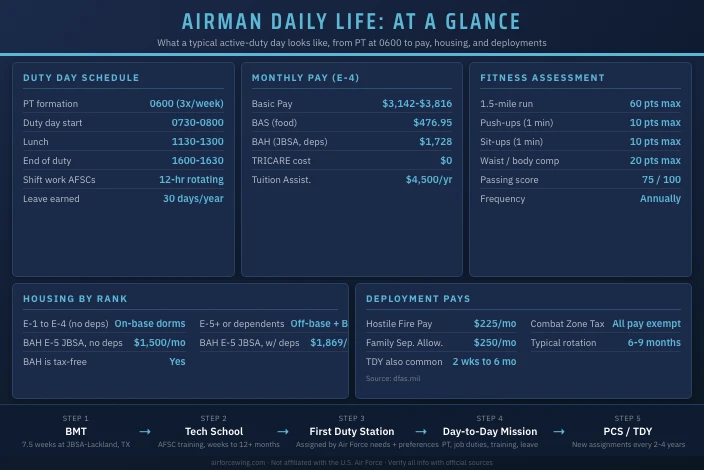
Most units run Physical Training (PT) three days a week, typically on Monday, Wednesday, and Friday. The formation call is usually 0600, which means reveille for most Airmen falls somewhere between 0430 and 0500.
PT lasts about an hour. Runs, calisthenics, group exercises, the exact format depends on your unit and your commander’s preferences. The Air Force Fitness Assessment is scored annually on a 100-point scale, with a minimum passing score of 75. Failing means mandatory remedial PT and restrictions on reenlistment eligibility, so most Airmen take it seriously.
After PT wraps, there’s usually time to shower and eat at the chow hall before the duty day begins.
The Duty Day
Work begins around 0730 to 0800 for most day-shift Airmen. Your shift structure depends almost entirely on your AFSC.
Some jobs run a clean Monday-Friday, 0730-1630 schedule. Others, maintenance, medical, security forces, communications, run rotating 12-hour shifts with duty on weekends. If you’re on a flight line, your schedule follows the jets, not a calendar.
A typical duty day for a standard-hours Airman looks like this:
- 0730: Report for duty, check emails and taskers from supervisors
- 0800-1130: Primary job duties (maintenance inspections, patient care, network monitoring, etc.)
- 1130-1300: Lunch; most Airmen eat at the Dining Facility (DFAC) on base
- 1300-1600: Continue mission work; often includes additional training, CBTs, or professional development
- 1600-1630: End of duty, debrief or handoff if on shift work
Units also have recurring mandatory events: commander’s calls, readiness training, chemical/biological defense refreshers, and annual qualification renewals. These eat into the schedule unpredictably.
Housing and Base Life
Where you live depends on your rank and whether you have dependents. Airman Basic through Senior Airman (E-1 to E-4) without dependents typically live in the dorms on base. The Air Force maintains some of the better enlisted dorms in the U.S. military, most are single-occupancy rooms with a private bathroom, refrigerator, and internet access.
Once you make Staff Sergeant (E-5) or gain dependents, you’re eligible to live off base and receive Basic Allowance for Housing (BAH). At Joint Base San Antonio, an E-5 without dependents receives $1,500 per month; with dependents, it’s $1,869. BAH is tax-free and adjusts by duty location, so the figure changes if you PCS (permanent change of station).
On-base amenities are part of daily life for most Airmen:
- Dining facilities (DFAC) and food courts
- Base Exchange (BX), discounted retail shopping
- Commissary, discounted groceries
- Fitness center
- Medical and dental clinics
- Chapel, legal assistance office, and Family Support Center
The installation varies a lot. A large base like Nellis AFB or Joint Base Pearl Harbor-Hickam offers far more than a small support installation.
Pay in Your Pocket
Basic pay is the starting number, but it’s not what most Airmen take home in total. An Airman Basic (E-1) earns $2,407 per month in basic pay. A Senior Airman (E-4) earns between $3,142 and $3,816 depending on years of service.
On top of that, all enlisted Airmen receive Basic Allowance for Subsistence (BAS) of $476.95 per month, which covers food costs whether you eat in the DFAC or cook for yourself. If you live off base, BAH adds to that total tax-free.
The combination matters. An E-4 living off-base at JBSA with dependents is looking at roughly $3,659 in base pay, $476.95 in BAS, and $1,728 in BAH, about $5,864 per month before taxes and with military-specific tax advantages.
TRICARE covers medical, dental, vision, mental health, and prescriptions for active-duty Airmen at no cost.
Free Time, Leave, and Off-Duty Hours
Active-duty Airmen earn 30 days of paid leave per year (2.5 days per month). Most supervisors require leave requests in advance, and leave timing is subject to mission needs. During high-operational periods or exercises, leave may be denied.
Most Airmen get their evenings and weekends free when not deployed or on shift work. What you do with that time is personal, but the base provides infrastructure: gyms, recreation centers, outdoor gear rental programs, and organized Morale, Welfare, and Recreation (MWR) activities.
Weekend life at a stateside base near a city is fairly normal. Weekend life at a remote installation, think Minot AFB, ND in January, is a different experience. Location is one of the biggest factors in quality of life.
Deployments and TDY
Not every AFSC deploys regularly, but most Airmen should expect temporary duty (TDY) assignments. TDY might mean a two-week training exercise at another base, a six-month rotation overseas, or a 30-day support deployment somewhere unglamorous.
Deployment frequency depends on your AFSC and the current operational tempo. Maintenance and medical AFSCs have historically been among the more frequently deployed career fields. Intelligence and cyber roles often deploy in shorter rotations but to austere locations.
When deployed, Airmen receive additional pay and allowances:
| Allowance | Amount |
|---|---|
| Hostile Fire Pay / Imminent Danger Pay | $225/mo (designated areas) |
| Combat Zone Tax Exclusion | All basic pay exempt from federal income tax |
| Hardship Duty Pay | Varies by location |
| Family Separation Allowance | $250/mo when separated from dependents |
Deployments typically run six to nine months for Air Expeditionary Force (AEF) rotations, though this varies by mission.
The Social Reality
Military culture varies by unit, base, and AFSC. Some units are tight-knit and support-oriented. Others have toxic leadership or high operational stress. There’s no universal experience.
A few consistent patterns:
- Rank matters. An E-4 and an E-7 live in different social worlds even in the same unit.
- First-term Airmen often feel the most friction. You’re learning the culture, building credibility, and dealing with the least desirable work assignments.
- The people you work with are the biggest variable. A bad commander or first sergeant makes any duty station difficult. A good one can make even a remote installation tolerable.
Most Airmen describe the first year as an adjustment period. By the second or third year, most have settled into a rhythm and have enough autonomy to shape their experience.
This site is not affiliated with the U.S. Air Force or any government agency. Verify all information with official Air Force sources before making enlistment or career decisions.
You may also find what Air Force life is really like and the full Air Force benefits guide useful context before you decide. If you’re ready to look at specific jobs, browse enlisted career groups to see what’s available.