CCT vs TACP vs SOWT: Which Special Warfare AFSC
Three special warfare AFSCs. One shared selection process. Completely different careers on the other side of it. Combat Control (CCT), Tactical Air Control Party (TACP), and Special Operations Weather Technician (SOWT) all demand the same physical baseline, pull candidates through the same Assessment and Selection (A&S) gate, and deploy into the same hostile environments. But what you’ll actually do on a mission, where you’ll be assigned, and what your career looks like at year ten are different in every meaningful way.
This site is not affiliated with the U.S. Air Force or any government agency. Verify all information with official Air Force sources before making enlistment or career decisions.
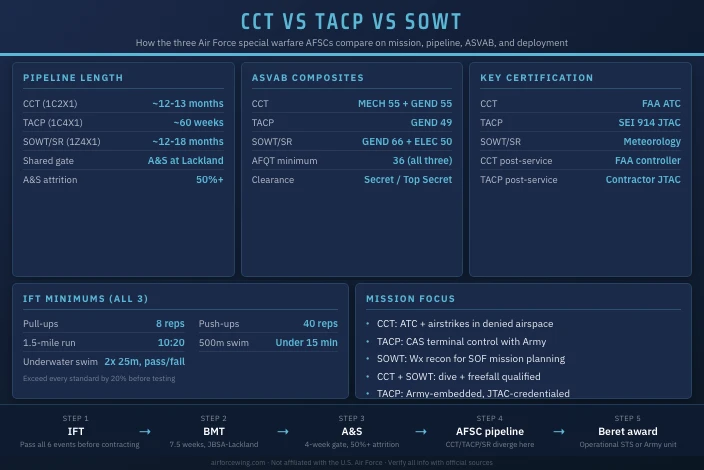
Side-by-Side: CCT, TACP, and SOWT at a Glance
| Factor | 1C2X1 CCT | 1C4X1 TACP | 1W0X2 SOWT (1Z4X1 SR) |
|---|---|---|---|
| Core mission | ATC in denied airspace | Close air support with Army | Weather recon in denied areas |
| Pipeline length | ~12-13 months | ~60 weeks | ~12-18 months |
| ASVAB composite | MECH 55 and GEND 55 | GEND 49 | GEND 66 and ELEC 50 |
| Key certification | FAA ATC | SEI 914 JTAC | Meteorological forecasting |
| Security clearance | Secret | Secret | Top Secret |
| Typical team size | 1-2 per mission element | 1-2 per battalion | 2-4 per element |
| Assignment host | Air Force STS | Army brigade/battalion | Air Force STS |
| Deployment pattern | Frequent, JSOC-aligned | Army rotation cycle | High tempo, SOCOM-aligned |
| Post-service path | FAA controller | Defense contractor (JTAC) | Intel analyst, federal contractor |
One number stands out: SOWT requires a Top Secret clearance where the other two start at Secret. That investigation takes longer, affects the contracting timeline, and reflects how sensitive the intelligence collection mission actually is.
1C2X1 Combat Control: ATC in Denied Airspace
Combat Controllers are FAA-certified air traffic controllers who operate where no tower, radar, or conventional ATC infrastructure exists. They embed with Army Special Forces, Navy SEAL teams, and Ranger battalions to direct air assets into denied airspace, calling airstrikes, coordinating airdrops, and managing assault landing zones.
The FAA certification is the defining feature. No other combat arms role in any branch produces a fully certified ATC professional. You’re simultaneously a credentialed aviation authority and a special operations ground operator. That combination creates a post-service path that most veterans don’t have access to.
Pipeline overview:
- Special Warfare Preparatory Course, 8 weeks, JBSA-Lackland
- Assessment and Selection, 4 weeks, high attrition
- Combat Dive School, 8 weeks, Panama City, FL
- Army Airborne School, 3 weeks, Fort Moore, GA
- Military Freefall School, 4 weeks, Yuma, AZ
- SERE, 2.5 weeks, Fairchild AFB, WA
- Combat Control Operator Course (CCOC), 15.5 weeks, Keesler AFB, MS
- Combat Control School, variable, Pope Field, NC
The CCOC at Keesler is where the ATC certification happens. It’s an academic course, not a physical one. Candidates who outperformed on the physical phases have washed out here because the air traffic control curriculum demands rigorous technical study. Both sides of the equation, physical and academic, must perform.
The ASVAB gates for CCT are the highest of the three: MECH 55 and GEND 55. Candidates who clear GEND 49 for TACP may not qualify for CCT. Check both composites early.
CCTs are assigned to Special Tactics Squadrons (STS) at Pope Field, NC; Hurlburt Field, FL; Cannon AFB, NM; JBLM, WA; and overseas locations. Deployments are JSOC-aligned and frequent, 6 to 9 months per rotation is common in operational squadrons.
1C4X1 TACP: Close Air Support with the Army
Tactical Air Control Party specialists are the Air Force’s presence inside Army units. A TACP is typically the only Airman assigned to an Army battalion or brigade, carrying the responsibility for all terminal attack control of air assets in that unit’s area of operations. When the ground commander needs air support, the TACP is who makes it happen.
The defining credential is SEI 914 JTAC: Joint Terminal Attack Controller. It’s a joint DoD certification recognized across all services and with allied forces. Earning it takes roughly 60 weeks of training and authorizes the Airman to clear weapons releases onto targets in proximity to friendly forces.
Pipeline overview:
- Special Warfare Candidate Course, 7 weeks, JBSA-Lackland
- TACP Apprentice Course, 21 weeks, JBSA-Lackland
- Army Airborne School, 3 weeks
- SERE, 3 weeks, Fairchild AFB, WA
- ICC Phase 1 (fires integration), 16 weeks, Camp Bullis, TX
- ICC Phase 2 (air phase, JTAC qual), 5 weeks, Nellis AFB, NV
The 60-week pipeline is the shortest of the three, but don’t read that as easier. The same IFT gates apply. What’s different is that TACP training spends more time on fires integration and terminal attack control and less time on dive and freefall qualification than CCT or SOWT.
TACP duty assignments reflect Army unit locations, not Air Force wings. Fort Cavazos, TX; Fort Stewart, GA; Fort Campbell, KY; Fort Drum, NY; and Fort Wainwright, AK are common. You’ll live on Army posts, eat in Army chow halls, and train on the Army’s schedule. Some Airmen find this a feature. Others find it an adjustment they never fully make.
Deployment tempo is tied to the Army unit’s rotation cycle, typically one deployment every 18 to 36 months for conventional units, more frequently for TACP Airmen assigned to Ranger Regiment or Special Forces.
1W0X2 SOWT (Now 1Z4X1 SR): Weather Recon in Denied Areas
The 1W0X2 Special Operations Weather code was retired April 30, 2019. The career field now operates under 1Z4X1 Special Reconnaissance. Most people still use “SOWT” in casual reference. All entry requirements below reflect the current 1Z4X1 designation.
Special Reconnaissance Airmen collect meteorological, hydrological, and environmental data in denied or hostile territory. Small clandestine elements infiltrate the target area, often by HALO, combat dive, or overland movement, to produce precision forecasts that no satellite or remote sensor can replicate. Commanders use that data to decide whether a mission launches, when it launches, and what route it takes.
The analytical demand here is real. SOWT draws candidates who are genuinely interested in atmospheric science, not just tolerant of it. The forecasting work is technically rigorous, and the operators you’re supporting are making life-or-death decisions based on your output.
The ASVAB requirement is significantly higher than the other two: GEND 66 AND ELEC 50. This reflects the meteorological and technical curriculum that follows selection.
Pipeline overview:
- Special Warfare Prep Pool, 8 weeks, JBSA-Lackland
- Assessment and Selection, 4 weeks
- Pre-Dive and Combat Dive School, 9-10 weeks
- Army Airborne School, 3 weeks
- Military Freefall School, 4 weeks
- SERE, 2.5 to 3 weeks
- SR Technical Course (meteorology), 8 weeks, Keesler AFB, MS
- SR Apprentice Course, approx. 6 months, Pope Air Field, NC
- Special Tactics Advanced Skills, 6-12 months, Hurlburt Field, FL
The total pipeline runs 12 to 18 months post-BMT, making it comparable to or longer than CCT when the advanced skills phase is included. Both the dive and freefall qualifications match CCT. What SOWT adds is the technical meteorology curriculum at Keesler, which requires strong academic performance in atmospheric science subjects.
SOWT Airmen are assigned to Special Tactics Squadrons, primarily at Hurlburt Field, Pope Air Field, and JBLM. The Top Secret clearance is required at accession, this investigation takes longer than the Secret clearance process and needs to be initiated early.
PAST Standards: What You Need Before A&S
All three AFSCs share the Special Warfare Operator Enlistment Initial Fitness Test (IFT). These are the minimum standards to contract, not what you need to complete the pipeline.
| Event | Minimum Standard |
|---|---|
| Pull-ups | 8 (within 2 minutes) |
| Sit-ups | 50 (within 2 minutes) |
| Push-ups | 40 (within 2 minutes) |
| 1.5-mile run | 10:20 |
| 500m surface swim | Under 15 minutes |
| 25m underwater swim | 2 repetitions, pass/fail |
Clearing minimums is not the goal. Assessment and Selection eliminates roughly 30% of candidates who passed the IFT cleanly. Recruiters consistently say the same thing: exceed every standard by at least 20% before testing. A candidate who runs the 1.5 miles in 8:30 and swims 500m in 12 minutes is in a meaningfully different position than one who barely clears the cutoffs.
The IFT is not a one-time event. It’s administered before contracting, before shipping, and again during the pipeline. Fitness that deteriorates between contracting and shipping has sent candidates home.
The A&S Gate: Shared Selection, Different Pipelines After
All three AFSCs go through Assessment and Selection at JBSA-Lackland before branching into their specific pipelines. A&S lasts roughly four weeks and evaluates physical fitness, mental toughness, and team dynamics. The Air Force does not publish official pass rates, but historical attrition at A&S alone is consistently reported above 50%.
Candidates who fail A&S are reclassified to another Air Force AFSC and serve out their enlistment contract in that role. There is no second attempt in the same enlistment.
After A&S, the pipelines diverge:
- CCT goes to dive school, then freefall, then the 15.5-week ATC course at Keesler
- TACP goes to the TACP Apprentice Course, then ICC fire integration training
- SOWT/SR goes to dive school, then freefall, then meteorology training at Keesler
CCT and SOWT share more pipeline overlap than either shares with TACP. Both require combat dive and military freefall qualifications. Both have a technical academic phase at Keesler. TACP skips dive and freefall and goes directly into fires integration and terminal attack training.
Deployment Profiles: What Downrange Actually Looks Like
The three AFSCs deploy on different cycles with different force structures.
CCT deploys with Special Tactics Squadrons in JSOC-aligned task forces. Rotations run 6 to 9 months and can include multiple downrange periods per year. CCTs operate as 1-2 person elements attached to joint SOF teams at the objective level.
TACP deploys on the Army’s rotation cycle. Conventional units cycle on an 18-to-36-month deployment rotation. TACP Airmen assigned to Ranger Regiment or Special Forces units deploy more frequently at shorter intervals. The Army battlespace means more time in forward operating bases and patrol bases than an Air Force wing.
SOWT/SR deploys in small clandestine elements, often 2-4 personnel, executing independent collection missions ahead of assault forces. Deployment tempo is high and SOCOM-aligned. Individual missions may be shorter in duration but more frequent and more sensitive than conventional SOF deployments.
ASVAB Scores and AFQT: What Each Role Requires
| AFSC | AFQT Minimum | Composite Requirement |
|---|---|---|
| 1C2X1 CCT | 36 | MECH 55 AND GEND 55 |
| 1C4X1 TACP | 36 | GEND 49 |
| 1Z4X1 SR (SOWT) | 36 (65 with GED) | GEND 66 AND ELEC 50 |
TACP has the lowest composite threshold. SOWT has the highest, driven by the meteorology curriculum. CCT sits between the two but requires two composites to qualify, not just one.
If your GEND score falls between 49 and 54, TACP is your only option of the three. GEND 55 to 65 opens CCT. GEND 66 or higher with ELEC 50 gives you all three. Know your scores before you walk into a recruiter’s office.
Which One Fits You
The mission is the right starting point. Physical standards are identical across all three, so that comparison doesn’t help you differentiate.
Choose CCT if you want the FAA air traffic control certification, are comfortable with heavy academic coursework alongside physical demands, and want a direct post-service path into civilian ATC. The credential is hard to earn and immediately marketable.
Choose TACP if you want to embed with Army ground forces, carry the JTAC credential, and spend your career at the tactical edge of joint fires integration. The pipeline is the shortest of the three, and the Army-embedded lifestyle suits people who prefer operating in a ground combat culture.
Choose SOWT/SR if you have genuine interest in atmospheric science and intelligence collection, score high on both the GEND and ELEC composites, and want the clandestine reconnaissance mission. The combination of elite operator and technical forecaster is a narrow skill set that commands strong pay on both sides of the fence.
None of these is the “easier” choice. The shared A&S selection and IFT standards mean any of the three will test you at the same level before you ever see the job-specific training. The divergence is in the mission, the assignment, and what you do with the credential after.
Air Force special warfare careers has full ASVAB scores, pipeline breakdowns, and pay tables for every special warfare AFSC. For test prep before you talk to a recruiter, the Air Force ASVAB study guide covers all three composite areas. GEND, MECH, and ELEC, in one place.