Can You Be a 4N0X1 in the Air Force Reserve
The short answer is yes. The 4N0X1 Aerospace Medical Technician AFSC exists in the Air Force Reserve, and it’s one of the more actively recruited healthcare specialties in the reserve component. Most states also have 4N0X1 billets in their Air National Guard wings.
What’s less obvious is how the reserve version of this job actually works. The training pipeline is identical to active duty. The clinical duties are the same. But the schedule, pay structure, healthcare access, and civilian career overlap look completely different once you’re past initial training. This post covers all of it.
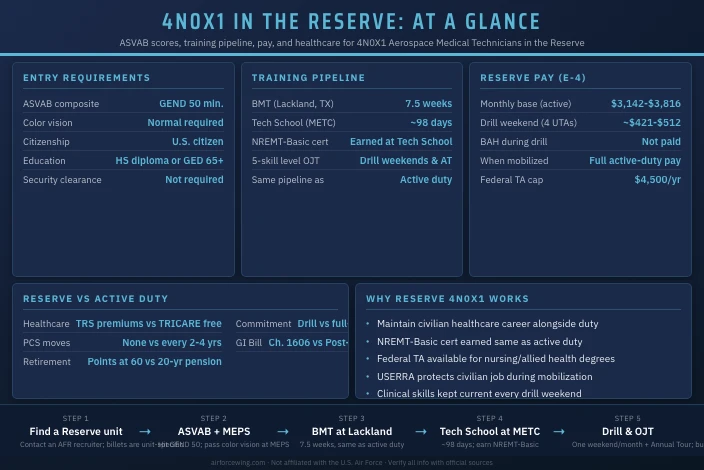
What “Reserve” Means for a Medical AFSC
The Air Force Reserve assigns 4N0X1 Airmen to Medical Readiness Squadrons, Medical Groups, or Aeromedical Evacuation Squadrons at reserve installations and joint bases nationwide. The units drill on the standard reserve schedule: one weekend per month (a Unit Training Assembly, or UTA) plus two weeks per year of Annual Tour training.
That baseline commitment is lower than it looks on paper. Medical units regularly schedule additional training events throughout the year, including clinical recertification days, readiness exercises, and equipment familiarization events. Most reserve 4N0X1 Airmen end up committing 30 to 40 days per year when additional training is factored in, not just the minimum 39 days.
There is no separate Reserve-only ASVAB score. The GEND 50 composite minimum that applies to active duty 4N0X1 candidates applies equally to reserve applicants. If your Word Knowledge, Paragraph Comprehension, Arithmetic Reasoning, and Mathematics Knowledge scores hit that threshold, you qualify.
Training: Identical to Active Duty
Reserve and Guard 4N0X1 Airmen go through the same initial training pipeline as their active-duty counterparts. There is no abbreviated reserve version.
The pipeline runs in two phases:
- BMT at JBSA-Lackland, TX: 7.5 weeks. Same basic military training all enlisted Airmen attend, regardless of component.
- Tech School at METC, Fort Sam Houston, TX: Approximately 98 days (14 weeks). Clinical nursing skills, anatomy, pharmacology, phlebotomy, IV placement, wound care, medication administration, and aeromedical evacuation concepts. You train alongside Army and Navy medical students at the joint-service Medical Education and Training Campus.
Tech School graduation includes a Nationally Registered Emergency Medical Technician (NREMT-Basic) certification. That credential is valid in most states and transfers directly to civilian EMS employment. Reserve Airmen who pass the same training as active duty Airmen leave with the same EMT certification.
After training, you report to your home unit and begin working toward your 5-skill level through on-the-job training during drill weekends and Annual Tour periods. The 5-skill level upgrade process takes longer in the reserve component than on active duty, simply because you’re accumulating training hours at a slower pace.
What Reserve 4N0X1 Airmen Actually Do
During drill weekends, reserve 4N0X1 Airmen maintain clinical readiness, complete required recurring training, and support unit missions. Tasks mirror active duty clinic work:
- Patient assessments and vital signs documentation
- Phlebotomy, immunizations, and medication administration
- Wound care and minor procedure support
- Aeromedical evacuation team training (for units with that mission)
- Mass casualty drill participation
- Maintaining NREMT and other certification currency
The work keeps your clinical skills sharp, which directly benefits civilian healthcare employment. Most reserve medical Airmen work in healthcare or emergency services as their civilian job and report that the two roles reinforce each other.
Pay for Reserve 4N0X1 Airmen
Reserve pay works on a per-assembly basis. A single drill weekend counts as four Unit Training Assemblies (UTAs). You’re paid for each UTA at a daily rate derived from the active-duty monthly pay table for your grade and years of service.
At the E-4 Senior Airman level, the 2026 monthly basic pay rate runs from $3,142 to $3,816 depending on years of service. A single drill weekend (4 UTAs) pays approximately $421 to $512 in basic pay. Annual Tour pays at the full daily active-duty rate for each day served.
A few things are not paid during standard drill weekends:
- BAH is not paid unless you’re on orders and traveling to a location requiring overnight lodging
- BAS is not paid for standard drill
- Healthcare premiums apply (more on this below)
When mobilized on federal orders for a deployment or extended activation, reserve Airmen receive the full active-duty pay and allowances package, including BAH, BAS, and TRICARE Prime at no cost for the duration of the orders.
Healthcare: The Key Difference
This is where active duty and reserve service diverge most significantly.
Active-duty 4N0X1 Airmen receive TRICARE Prime at zero cost. No premiums, no deductibles, no copays. Coverage includes medical, dental, vision, mental health, prescriptions, and hospitalization.
Reserve 4N0X1 Airmen who are not on active-duty orders are eligible for TRICARE Reserve Select (TRS), a premium-based plan. Coverage is good, but it requires monthly premium payments. You’ll want to compare TRS costs against your civilian employer’s health insurance before relying on it as your primary coverage.
| Situation | Healthcare |
|---|---|
| Standard drill status | TRICARE Reserve Select (premiums apply) |
| Mobilized on orders | TRICARE Prime (free, same as active duty) |
| Active-duty tour (30+ days) | TRICARE Prime (free) |
If you already have solid employer-sponsored healthcare, TRS becomes supplemental or redundant. If you’re self-employed or work a job with poor benefits, TRS may fill a genuine gap.
Education Benefits: Where Reserve Service Wins
Reserve service unlocks several education pathways that make the part-time commitment pay off beyond the paycheck.
Federal Tuition Assistance is available to reserve component members. The annual cap is $4,500 at $250 per semester credit hour, the same as active duty TA. You can use it to work toward a nursing degree, pre-medicine coursework, or any related program while drilling one weekend a month.
Montgomery GI Bill Selected Reserve (Chapter 1606) provides monthly payments while enrolled in college or vocational training, though the benefit amount is less than the Post-9/11 GI Bill available after active-duty service.
Air National Guard members often qualify for state-specific tuition waivers on top of federal TA. Benefits vary significantly by state. In several states, Guard members receive free in-state tuition at public universities. Check with your state’s adjutant general office for current rates.
For 4N0X1 Airmen pursuing nursing, physician assistant, or paramedic programs, these benefits stack meaningfully over a four-year period.
Mobilization: What to Expect
Reserve 4N0X1 Airmen can be involuntarily mobilized for federal missions. Historically, medical AFSCs see mobilization when the Air Force needs to surge medical capacity for overseas operations, humanitarian missions, or domestic emergencies.
Typical mobilization lengths run 90 to 180 days, though they can extend depending on mission requirements. Most reserve 4N0X1 Airmen can expect at least one mobilization over a six-year participation window, though frequency varies widely depending on the unit and operational tempo.
USERRA (Uniformed Services Employment and Reemployment Rights Act) protects your civilian job during mobilization. Your employer must hold your position, and you return to the same or equivalent role when you come back. Most civilian healthcare employers are familiar with USERRA because their workforces often include Guard and Reserve members.
Reserve vs. Active Duty: Which Makes More Sense for 4N0X1
Neither path is universally better. The right choice depends on where you are in life and what you want to get out of military service.
| Factor | Active Duty | Air Force Reserve |
|---|---|---|
| Pay | Full monthly pay + BAH + BAS | Drill pay only; full pay when mobilized |
| Healthcare | TRICARE Prime, free | TRICARE Reserve Select, premiums apply |
| Clinical exposure | Daily, high volume | One weekend/month + training events |
| Civilian career | Delayed until separation | Maintained throughout service |
| PCS moves | Every 2-4 years | None (you stay at your home unit) |
| NREMT/certifications | Maintained through active duty | Must maintain independently |
| Post-service GI Bill | Full Post-9/11 GI Bill | Chapter 1606 (lower benefit) |
| Retirement | 20-year active-duty pension at BRS rates | Points-based reserve retirement at age 60 |
Active duty makes sense if you want maximum clinical volume, full benefits from day one, and are willing to move where the Air Force sends you. The reserve path makes sense if you have a civilian healthcare career you want to keep building, prefer to stay in one location, or want to serve without a full-time military commitment.
For someone already working as an EMT, paramedic, or CNA, the reserve path lets you maintain civilian employment while adding military training and credentialing on weekends. That combination can strengthen both your military and civilian career simultaneously. If you’re still choosing between active duty, reserve, and Guard more broadly, the active duty vs Reserve vs Guard comparison covers every major difference across all components.
How to Apply for Reserve 4N0X1
The process is similar to active duty enlistment, with a few differences.
- Contact an Air Force Reserve recruiter (not an active-duty recruiter). Reserve and Guard recruiters are separate from the active-duty recruiting command.
- Find a unit near you with an open 4N0X1 billet. Reserve jobs are tied to specific units and locations, unlike active-duty assignments where the Air Force places you anywhere.
- Take the ASVAB and clear MEPS with a GEND score of 50 or higher.
- Complete the physical at MEPS, including the color vision screening required for 4N0X1.
- Sign your enlistment contract for the specific unit, then ship to BMT and Tech School exactly as an active-duty Airman would.
One practical note: reserve billets fill and empty based on unit needs. A unit may have an open 4N0X1 position this month and none available three months from now. Talk to a recruiter early in the process and confirm billet availability before investing time in the application.
Preparing your ASVAB scores before you approach a recruiter speeds up the process. The 4N0X1 Aerospace Medical Technician profile covers exactly what the GEND composite requires and how the training pipeline runs. For score preparation, Air Force ASVAB test prep covers the math and reading sections that drive your GEND composite.
This site is not affiliated with the U.S. Air Force or any government agency. Verify all information with official Air Force sources before making enlistment or career decisions.
Explore all Air Force medical AFSC careers or read Air Force Reserve benefits and best Air Force Reserve AFSC jobs for civilian careers to keep building out your reserve component research.