Best Operations AFSC Jobs for Civilian Career
The Air Force operations career group produces some of the cleanest civilian transitions in the enlisted force. One AFSC hands you an FAA certification before you ever leave active duty. Another puts you on a path to the National Weather Service. A third opens the door to airport operations management at major commercial airports. The difference between a $45,000 civilian job and a $130,000 one often comes down to which AFSC you chose at the recruiter’s office.
Four of the five enlisted operations AFSCs have a direct civilian counterpart. This post breaks down the career math behind each one, what credential or experience you leave with, what the civilian job market looks like, and how to use military education benefits to close any gaps.
This site is not affiliated with the U.S. Air Force or any government agency. Verify all information with official Air Force sources before making enlistment or career decisions.
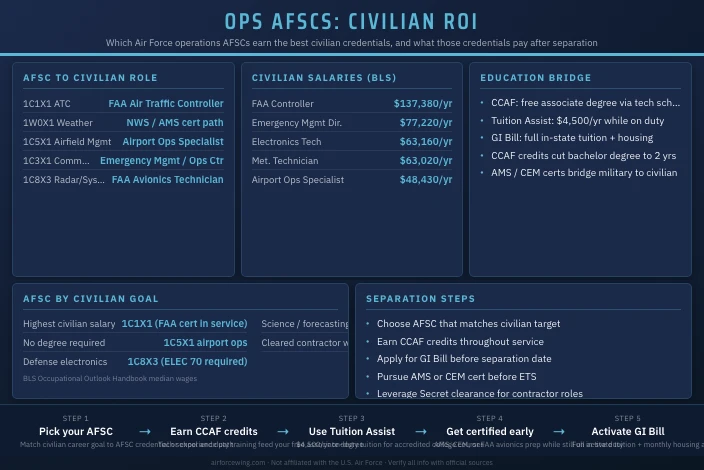
How the Operations Group Compares to Other Career Fields
Most enlisted career fields require significant retraining after separation. A crew chief’s mechanical skills transfer to aircraft maintenance, but the FAA A&P license is a separate process. A security forces veteran has transferable skills in law enforcement, but must complete a police academy. The operations group is different because two of its AFSCs produce federally recognized credentials during military service rather than requiring post-separation certification.
That distinction matters when you’re comparing 20-year career paths, not just first civilian jobs.
| AFSC | Civilian Destination | Credential Earned in Service | BLS Median Wage |
|---|---|---|---|
| 1C1X1 | FAA Air Traffic Controller | FAA certification | $137,380/yr |
| 1W0X1 | Meteorological Technician / NWS | Military weather training + AMS path | $63,020/yr |
| 1C5X1 | Airport Operations Specialist | FAA Part 139 experience | $48,430/yr |
| 1C3X1 | Emergency Management / Ops Center | Command and control experience | $77,220/yr |
| 1C8X3 | Electronics/Radar Technician | Defense electronics training | $63,160/yr |
BLS figures are median annual wages for the closest civilian occupational category. Individual earnings vary by location, employer, and experience level.
1C1X1 Air Traffic Control: The $130K Path
1C1X1 is the strongest civilian transition in the entire enlisted operations group. The FAA certification you earn during tech school at Keesler AFB, Mississippi carries full legal weight in the civilian hiring process. When you walk out of active duty, you are already a credentialed FAA controller, not someone who needs to go train for that credential.
The FAA consistently hires military controllers through its direct hire authority. Civilian FAA controllers working Terminal Radar Approach Control (TRACON) and en route facilities earn some of the highest median wages for any federally licensed occupation. The BLS reports $137,380 per year as the median for air traffic controllers.
A few realities about this path:
- The FAA has a mandatory hiring age of 30 or below for most control facility hires (previously 31 at some facilities). Military veterans can receive an exemption up to age 35 under certain circumstances, but you should verify current policy with the FAA.
- The higher-paying en route facilities (like ARTCC centers) require a separate qualification process after FAA hire. Starting pay at a terminal facility is still well above median national wages.
- Controllers who separate before age 56 can work a full second career. The FAA’s mandatory retirement age is 56 for certified controllers working active positions.
If your goal is maximum civilian earning potential from a single enlistment decision, 1C1X1 is the clearest answer in this career group.
1W0X1 Weather: Path to the National Weather Service
1W0X1 Weather Airmen leave active duty with rigorous atmospheric science training and, for some, a Top Secret clearance from space weather assignments. The National Weather Service, private meteorology firms, and federal agencies that run weather support operations all value that background.
The civilian job title that aligns most directly is meteorological technician or atmospheric science technician. The BLS separates that category from degreed meteorologists, and the median for technicians sits around $63,020 per year. Veterans who go on to complete a bachelor’s degree in meteorology or atmospheric science can qualify for forecaster positions at the NWS, which pay higher.
The American Meteorological Society (AMS) offers professional certifications that bridge military training to civilian credentialing. The Certified Broadcast Meteorologist and Certified Consulting Meteorologist designations are recognized by commercial employers. Neither requires a degree as a strict prerequisite, military training hours can contribute to the experience requirement.
The GI Bill is a strong tool here. The Post-9/11 GI Bill covers full in-state tuition at public universities, plus a monthly housing allowance based on the E-5 with dependents BAH rate at your school’s ZIP code. For 1W0X1 veterans who want to finish a degree in atmospheric science, that benefit can cover most or all of the cost at a state school.
Assignments in space weather support, which may require a Top Secret clearance, open a third path: federal contractor work for agencies and commands that need classified atmospheric analysis. Those positions often pay at or above the private-sector meteorology median.
1C5X1 Airfield Management: Airport Operations Without a Degree
1C5X1 Airfield Management Airmen spend their careers managing the operational and administrative infrastructure of active military airfields. They process flight plans, conduct runway inspections, maintain airfield safety programs, and coordinate between flying units and base operations. That experience maps directly onto airport operations specialist roles at commercial airports.
The FAA’s Part 139 airport certification program governs commercial service airports in the United States. Airfield management veterans already understand runway inspection protocols, NOTAM processing, and the documentation standards that Part 139 compliance requires. That background shortens the hiring and on-boarding process significantly compared to candidates without military airfield experience.
Civilian compensation in this field varies widely by airport size and location:
- Small regional airports: $40,000 to $55,000/yr for operations coordinator roles
- Medium hub airports: $55,000 to $75,000/yr for operations supervisor or safety officer roles
- Large hub airports and international airports: $70,000 to $95,000/yr for senior operations manager positions
Fixed Base Operator (FBO) management is a second path. FBOs handle general aviation services at airports, and experienced airfield management veterans often move into FBO general manager roles. The job involves fewer Part 139 compliance obligations but more direct business operations, including fuel, hangar leases, and charter scheduling.
This is not the highest-paying path in the operations group, but it is one of the most accessible. A bachelor’s degree is not required for most airport operations specialist roles. Military training, a GEND 55 ASVAB composite, and four to six years of airfield management experience are sufficient to compete for mid-level positions at commercial airports.
1C3X1 Command Post: Emergency Management and Ops Centers
1C3X1 Command Post operators run the wing’s 24-hour command and control center. They track aircraft, handle emergency action messages, manage classified communications, and serve as the direct link between senior leadership and subordinate units during contingencies. The civilian parallel to that work sits inside emergency management, public safety communications, and government contractor operations centers.
Emergency management directors and coordinators at county and state emergency management agencies often come from military operations or public safety backgrounds. The BLS reports a median annual wage of $77,220 for emergency management directors. Below director level, emergency management specialists and coordinators typically earn $50,000 to $65,000, depending on jurisdiction.
The Department of Homeland Security, FEMA, and state emergency management agencies actively recruit veterans with command and control experience. FEMA’s Emergency Management Institute offers professional certifications that translate command post experience into civilian credentials. The Certified Emergency Manager (CEM) designation, offered by the International Association of Emergency Managers, is the most recognized credential in the field.
A second path is less visible but financially stronger: government contractor operations centers. Defense contractors supporting combatant commands, intelligence agencies, and federal law enforcement run operations centers that look and function similarly to military command posts. These positions often require a Secret clearance, which command post veterans already hold. Pay for cleared operations center analysts and watch officers typically ranges from $70,000 to $110,000 depending on clearance level, contractor, and location.
1C8X3 Radar and Systems: Electronics Credentials
1C8X3 requires the highest ASVAB electronics score in the operations group (ELEC 70) and produces technicians trained on precision approach radar, instrument landing systems, airfield lighting controls, and meteorological equipment. Six months of technical school at Keesler AFB provides a depth of electronics training that civilian employers value.
The closest civilian occupational match is electronic systems and avionics technician. FAA-certified avionics technicians working at commercial repair stations earn $63,160 per year at the median. Veterans with 1C8X3 training in radar and navigation aids are a strong match for avionics contractor positions at airports, defense contractors who maintain ATC systems, and federal agencies like the FAA that employ radar systems specialists directly.
The FAA’s Airman Certificate for Avionics (formerly the A&P powerplant with avionics endorsement) is not automatically earned through military service, but 1C8X3 training provides substantial documented experience toward the required hours. Telecommunications infrastructure companies and federal contractors who maintain air traffic control systems also recruit from this career field directly.
Using Military Education Benefits to Close the Gap
Military experience and training get you in the door. A degree or professional certification often determines how far you advance from there. The Air Force offers two primary tools for education while serving and one major benefit after separation.
While on active duty:
- Tuition Assistance (TA): covers up to $4,500 per year in tuition (up to $250 per semester hour) for courses taken off-duty. TA does not cover fees or books but covers tuition costs at accredited colleges. You can accumulate transferable college credits while serving.
- Community College of the Air Force (CCAF): every enlisted Airman is automatically enrolled. Tech school credits count toward an associate degree in applied science tied to your career field. A CCAF degree is a free associate degree earned largely through military training.
After separation:
- Post-9/11 GI Bill: covers full in-state tuition at public universities (no dollar cap), a monthly housing allowance at the E-5 with dependents BAH rate at your school ZIP code, and up to $1,000 per year in book stipends. The benefit covers up to 36 months of education. For operations veterans targeting a bachelor’s degree in meteorology, aviation management, or emergency management, this benefit typically covers two to three years of a four-year program if you enter with CCAF credits.
The combination of CCAF credits and GI Bill coverage means an operations veteran can complete a bachelor’s degree in two years or less at many state schools, often at no out-of-pocket cost.
How to Pick the Right AFSC for Your Civilian Goals
The right choice depends on what you want your life to look like after the Air Force, not just during it.
If you want the highest possible civilian salary and can handle the pressure of controlling live aircraft, 1C1X1 is the answer. The FAA certification and strong job market for controllers are unmatched in the operations group.
If you want a career in atmospheric science or forecasting and are willing to use the GI Bill to complete a degree, 1W0X1 sets up that path well. The military training is rigorous, and the NWS regularly hires veterans.
If you want to work in airport operations without a degree requirement, 1C5X1 is accessible and produces steady career progression at regional and medium-hub airports.
If you want the flexibility of cleared contractor work or a career in emergency management, 1C3X1 is the better fit. The Secret clearance and command and control experience open doors that most civilian applicants don’t have.
Operations AFSCs produce better civilian outcomes when you choose the AFSC that matches the civilian job you actually want, not the one with the best military quality of life. The two don’t always overlap.
Learn more about individual job profiles and entry requirements at the Air Force operations career group, or strengthen your ASVAB composites before your recruiter appointment with the Air Force ASVAB test prep guide.