Best Enlisted AFSC Jobs for Working on Aircraft
If you want to spend your Air Force career working on aircraft, you have more options than most people realize. The maintenance career group gets the most attention, but airborne crew AFSCs put you inside the aircraft on every mission. Together, these jobs represent the enlisted backbone of Air Force aviation, and several of them open direct paths to six-figure civilian careers after service.
Here’s a close look at seven AFSCs built around aircraft, what each one actually requires, and how they compare.
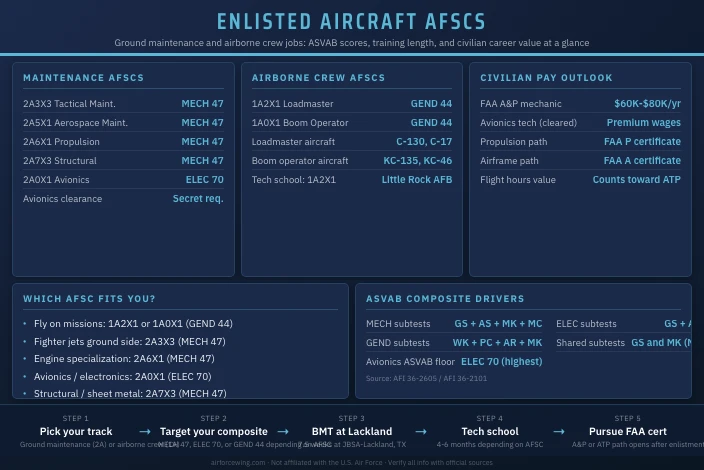
The Two Tracks: Ground Maintenance vs. Airborne Crew
Aircraft-focused enlisted jobs split into two distinct tracks. Ground maintenance Airmen keep jets airworthy on the flight line or in the hangar. Airborne crew members fly as part of the aircraft’s mission team.
Both tracks require mechanical or technical aptitude on the ASVAB. The composites differ by job, but the MECH and ELEC scores are what open maintenance doors, while GEND (General) composite scores are the typical gateway to airborne crew positions. Pay and rank progression follow the same enlisted scale regardless of which track you choose.
The ground path offers a wider range of platform options and more predictable schedules during peacetime. The airborne path means accumulating significant flight time and operating in demanding environments on every deployment. Neither is better, they just suit different personalities.
Ground Maintenance AFSCs
Five AFSCs in the 2A career group cover the core of aircraft maintenance work. All five require at minimum a MECH 47 composite score, and two avionics jobs in the same group require ELEC 70.
AFSC Comparison: Ground Maintenance
| AFSC | Title | ASVAB Composite | Min Score | Clearance | Tech School |
|---|---|---|---|---|---|
| 2A3X3 | Tactical Aircraft Maintenance | MECH | 47 | None | ~5 months |
| 2A5X1 | Aerospace Maintenance | MECH | 47 | None | ~5 months |
| 2A6X1 | Aerospace Propulsion | MECH | 47 | None | ~4 months |
| 2A7X3 | Aircraft Structural Maintenance | MECH | 47 | None | ~4 months |
| 2A0X1 | Avionics Test Station & Component | ELEC | 70 | Secret | ~6 months |
2A3X3: Tactical Aircraft Maintenance
This AFSC is the broadest crew chief role in the fighter world. 2A3X3 Airmen own their assigned aircraft from nose to tail. Every preflight inspection, discrepancy fix, and post-flight check runs through you, and you sign off the aircraft as airworthy before each mission.
The scope crosses multiple tactical airframes, which means over a career you may work on different jet types as assignments change. Fighter maintenance runs at a high operational tempo during exercises and deployments, but the work is hands-on in a way that few civilian jobs can match early in a career.
MECH 47 is the ASVAB floor. Tech school runs roughly five months and covers aircraft systems, tools and equipment, flight line safety, and inspection procedures. Most graduates go to bases that operate tactical jets, including F-16 and F-22 units.
2A5X1: Aerospace Maintenance
2A5X1 broadens the airframe scope beyond fighters to include mobility aircraft and tankers. If C-17 heavy lift, KC-46 tankers, or C-130 tactical cargo operations appeal to you more than fighter jets, this is the more natural fit than 2A3X3.
The maintenance principles are the same, but the aircraft are physically larger, the missions differ, and the base assignment set is different. Airmen in this AFSC often serve at installations with large mobility wings, such as Travis AFB, Dover AFB, and McChord Field.
2A6X1: Aerospace Propulsion
2A6X1 Airmen focus entirely on jet engines. You remove, install, troubleshoot, and test powerplant systems across the aircraft’s full maintenance cycle. Test cell operations, where an engine is run at full power in a controlled ground facility, are a regular part of the job.
This specialization maps directly to the FAA Powerplant certificate. After a standard enlistment, most 2A6X1 Airmen have documented enough hands-on hours to apply for FAA certification testing immediately after separation. Civilian powerplant mechanics at airline MRO facilities earn median wages well above the national average.
2A7X3: Aircraft Structural Maintenance
Sheet metal, welding, and corrosion control are the core skills in 2A7X3. Structural maintainers repair the physical airframe itself: skin panels, control surfaces, frames, and fasteners. The work is precise and carries direct airworthiness implications, since structural repairs have to meet strict engineering tolerances.
This AFSC doesn’t require electronics aptitude. It rewards steady hands, attention to detail, and the ability to read engineering drawings. Structural technicians with military backgrounds are consistently in demand at MRO shops and aircraft modification centers.
2A0X1: Avionics Test Station and Component
The avionics job in this group has the highest ASVAB requirement: ELEC 70, paired with a Secret security clearance. 2A0X1 Airmen work in the avionics shop rather than on the flight line, using automated test equipment to diagnose and repair avionics components pulled from aircraft.
You’ll interpret circuit schematics, run diagnostic sequences, and repair or replace faulty black boxes that make modern aircraft systems function. The work is more laboratory-like than the physical trades, but the precision demand is just as high. Defense contractor avionics roles actively recruit this background, and the clearance adds significant salary weight in the civilian market.
Airborne Crew AFSCs
Two enlisted AFSCs put you on the aircraft for every mission. These jobs require ASVAB qualification but add physical standards and medical requirements specific to flight duty.
Airborne Crew Comparison
| AFSC | Title | ASVAB Composite | Min Score | Aircraft |
|---|---|---|---|---|
| 1A2X1 | Aircraft Loadmaster | GEND | 44 | C-130, C-17 |
| 1A0X1 | In-Flight Refueling Specialist | GEND | 44 | KC-135, KC-46 |
1A2X1: Aircraft Loadmaster
Loadmasters fly on cargo aircraft and own every load from planning to delivery. Before the aircraft takes off, you calculate weight and balance for the cargo manifest and inspect the rigging. In flight, you manage the load, communicate with the crew, and execute aerial delivery operations including airdrop of equipment and personnel.
Every cargo mission depends on a loadmaster’s math being correct. A miscalculated load can shift the aircraft’s center of gravity to the point where the aircraft becomes unsafe to fly. That responsibility is real, and it’s part of what makes the job satisfying for people drawn to high-stakes precision work.
Tech school for 1A2X1 is at Little Rock AFB, Arkansas, running roughly four months. The GEND composite draws on Word Knowledge, Paragraph Comprehension, Arithmetic Reasoning, and Mathematics Knowledge. After qualifying, loadmasters accumulate flight hours on every mission, which has direct value toward FAA certificates.
1A0X1: In-Flight Refueling Specialist
Boom operators fly tanker missions on the KC-135 and KC-46 and transfer fuel to receiver aircraft in flight. The boom operator controls a rigid refueling boom from a prone position in the rear of the tanker, guiding the contact while receiver aircraft fly tight formation. A failed contact or a hard disconnect can damage both aircraft, so precision under pressure is the daily requirement.
Tech school is at Altus AFB, Oklahoma. Like loadmasters, boom operators build significant flight hours and deploy regularly with tanker units. The mission directly enables strike aircraft, surveillance platforms, and helicopter rescue operations that couldn’t reach their targets without aerial refueling.
ASVAB Composites for Aircraft AFSCs
Understanding which subtests drive your composites tells you where to focus your prep time. Aircraft AFSCs use three composites:
MECH (General Science + Auto & Shop Information + Mathematics Knowledge + Mechanical Comprehension)
- Minimum needed: 47 for 2A maintenance jobs
- Priority subtests: Mechanical Comprehension, Auto & Shop Information, General Science
ELEC (General Science + Arithmetic Reasoning + Mathematics Knowledge + Electronics Information)
- Minimum needed: 70 for avionics (2A0X1)
- Priority subtests: Electronics Information, Arithmetic Reasoning, Mathematics Knowledge
GEND (Word Knowledge + Paragraph Comprehension + Arithmetic Reasoning + Mathematics Knowledge)
- Minimum needed: 44 for airborne crew (1A2X1, 1A0X1)
- Priority subtests: Arithmetic Reasoning, Mathematics Knowledge
General Science and Mathematics Knowledge appear in both MECH and ELEC. If you’re undecided between a maintenance job and an avionics role, building those two first gives you flexibility on test day.
Civilian Career Value
Aircraft experience from the Air Force translates into some of the strongest post-service earning potential in the enlisted world.
2A maintenance Airmen can qualify for the FAA Airframe and Powerplant (A&P) certificate. Most finish their first enlistment with enough documented hands-on hours to sit for the FAA practical exam directly. The A&P opens doors to airline maintenance jobs, MRO facilities, corporate flight departments, and defense contractors. FAA A&P mechanics at major airlines typically earn $60,000 to $80,000 per year, with experienced specialists at hub facilities earning more.
2A7X3 structural specialists feed into aircraft modification centers and MRO shops that constantly need qualified sheet metal and composite repair technicians. 2A0X1 avionics technicians with an active Secret clearance often move directly into defense contractor roles where that combination commands a salary premium.
Loadmasters and boom operators accumulate flight hours that count toward ATP certificate requirements. The logbook from a full enlistment can meaningfully shorten the time needed to qualify for civilian cargo or charter aviation jobs. Defense contractors and government agencies running similar cargo or tanker missions also recruit this background directly.
Which AFSC Should You Target?
The right job depends on your ASVAB scores, your interest in flying versus ground work, and what you want after service.
- Want to fly on missions? Look at 1A2X1 and 1A0X1. The GEND requirement is the lowest barrier in this group, and the flight time is real.
- Want fighter jets on the ground? 2A3X3 is the most direct entry point. High tempo, direct aircraft ownership, strong civilian A&P path.
- Want engine specialization? 2A6X1 maps the most cleanly to the FAA Powerplant certificate and civilian MRO demand.
- Have strong electronics aptitude? 2A0X1 requires the highest ASVAB score, but the avionics technician career path and clearance value justify the investment in prep time.
- Prefer structural or fabrication work? 2A7X3 doesn’t require ELEC scores and rewards precision craftsmanship over electronics knowledge.
This site is not affiliated with the U.S. Air Force or any government agency. Verify all information with official Air Force sources before making enlistment or career decisions.
Learn more about Air Force maintenance and aircraft careers for AFSC-level details on each job, or visit the ASVAB test prep guide to start building the MECH and ELEC scores these roles require. For the full picture of how enlisted aircraft jobs fit into Air Force aviation, Air Force aviation jobs covers both officer and enlisted paths in one place.