Best ASVAB Scores for Special Warfare AFSC Jobs
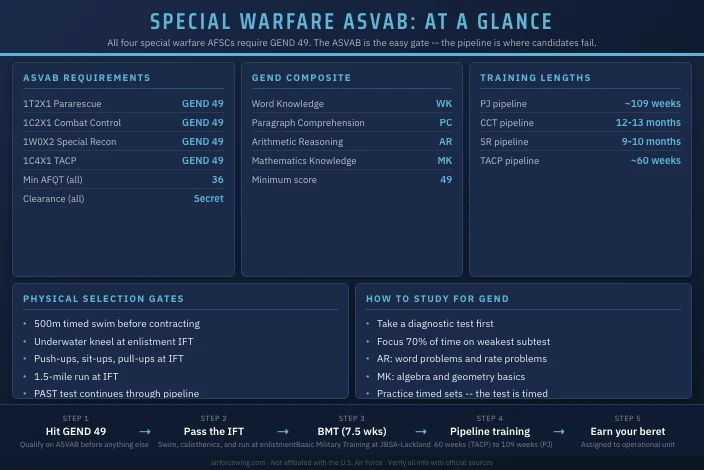
Every Air Force special warfare AFSC requires the same ASVAB composite: GEND 49. That number is low enough that most candidates hit it without a second attempt. The real barrier is not the test, it’s the physical fitness requirement at the enlistment stage and the training pipeline that follows it. Still, hitting that GEND score is the first gate, and failing it keeps you out before you ever get to the hard part.
Preparing for the ASVAB? An ASVAB prep course walks you through every tested subtest with practice questions, and a dedicated ASVAB study guide gives you the structured review the General composite specifically rewards.
When you purchase through links on our site, we may receive compensation at no extra cost to you.
What GEND Measures, and Why Special Warfare Uses It
The GEND composite combines four ASVAB subtests:
- Word Knowledge (WK)
- Paragraph Comprehension (PC)
- Arithmetic Reasoning (AR)
- Mathematics Knowledge (MK)
It measures verbal reasoning and basic math, not mechanical aptitude or electronics knowledge. Special warfare AFSCs use GEND because the job demands rapid communication, briefing, and on-the-spot problem solving, not wrench-turning. A candidate who can read a map, absorb a complex briefing, and calculate a load or distance under pressure is worth more than one who can wire a circuit board.
A GEND score of 49 is a moderate threshold. The Air Force’s average AFQT score hovers around 60, meaning most qualified enlistees already clear 49 without focused study. If you’re below it, the gap is usually Arithmetic Reasoning and Mathematics Knowledge, the two subtests that respond best to targeted practice.
ASVAB Requirements by Special Warfare AFSC
All four career fields share the same composite minimum. What differs is the length of the training pipeline and the technical complexity of the role.
| AFSC | Title | ASVAB Composite | Minimum Score |
|---|---|---|---|
| 1T2X1 | Pararescue (PJ) | GEND | 49 |
| 1C2X1 | Combat Control (CCT) | GEND | 49 |
| 1W0X2 | Special Reconnaissance (SR) | GEND | 49 |
| 1C4X1 | Tactical Air Control Party (TACP) | GEND | 49 |
Every candidate also needs a minimum AFQT of 36 to enlist, but the GEND composite is the qualifying line score for all four roles.
AFSC-by-AFSC Breakdown
1T2X1 Pararescue (PJ)
Pararescue is the most demanding enlisted pipeline in the Air Force, roughly 109 weeks from BMT to beret. PJs are trained combat rescue operators and paramedics. They freefall, dive, and fight their way to isolated personnel behind enemy lines to provide emergency care and extract them.
The ASVAB minimum is a low bar for this career. Candidates who make it to the physical screening test (PST) and pass it still face a two-year training pipeline with attrition rates that regularly exceed 75%. The score requirement exists to confirm basic cognitive ability; the pipeline determines whether you can actually do the job.
1C2X1 Combat Control (CCT)
Combat controllers are FAA-certified air traffic controllers who work embedded with Army Special Forces, Navy SEALs, and other special operations units. They direct air assets into denied airspace, calling strikes, coordinating airdrops, and managing landing zones where no tower or radar exists.
The pipeline runs roughly 12 to 13 months after BMT. The FAA certification adds a technical dimension that most combat arms roles don’t have. GEND 49 is sufficient, though candidates with stronger verbal scores will find the academic portions of the pipeline easier to absorb.
1W0X2 Special Reconnaissance (SR)
Formerly known as Special Operations Weather Technician (SOWT), the 1W0X2 collects meteorological, hydrological, and environmental data in hostile territory to support special operations mission planning. Small teams, clandestine environments, high analytical demand.
Training runs 9 to 10 months post-BMT. The role rewards candidates who are comfortable with data interpretation and report writing under pressure. GEND 49 is the minimum, and a higher score here correlates with easier performance through the technical instruction phases.
1C4X1 Tactical Air Control Party (TACP)
TACP specialists embed with Army units as the Air Force’s direct link for close air support. They spend most of their careers assigned to Army brigades and battalions, living on the Army’s training schedule and deploying with ground combat units.
The pipeline is the shortest in the group at roughly 60 weeks. TACP offers the most frequent deployment opportunities of any special warfare AFSC, with consistent embedding in Army operational cycles. Same GEND 49 requirement as the other three roles.
What the Score Doesn’t Tell You
Hitting GEND 49 does not guarantee selection for any of these roles. The selection process has multiple gates beyond the ASVAB:
- Initial Fitness Test (IFT): Underwater swim, push-ups, sit-ups, pull-ups, 1.5-mile run. This is a hard cutoff. Fail it and you cannot contract for a special warfare AFSC.
- Medical screening: Normal color vision and depth perception required for all four roles.
- Security clearance: Every AFSC here requires the ability to obtain a Secret clearance.
- PAST (Physical Ability and Stamina Test): Used during pipeline training to screen candidates. It’s harder than the IFT.
The ASVAB score is a floor, not a finish line. Recruiters know this. If you walk in with GEND 49 and no swim training, you’re not competitive, regardless of what the score sheet says.
How to Build Your GEND Score
GEND draws on four subtests. Two of them. Word Knowledge and Paragraph Comprehension, test skills built over years of reading. The other two. Arithmetic Reasoning and Mathematics Knowledge, respond well to focused study over weeks.
Where most candidates need work:
- AR (Arithmetic Reasoning): Word problems, rates, ratios, percentages. Practice solving them without a calculator.
- MK (Mathematics Knowledge): Algebra, geometry basics, number properties. Many candidates haven’t touched this since high school.
What to prioritize:
- Do a diagnostic practice test first. Find out which of the four GEND subtests is dragging your score.
- Spend 70% of study time on your weakest subtest.
- Run timed practice sets, the actual ASVAB is timed and many candidates are well-prepared but slow.
Physical Fitness and the Pipeline
No other enlisted career group in the Air Force has attrition rates like special warfare. Most candidates who fail do so physically, not academically. Knowing your ASVAB scores before you start training is the easy win, the real work starts in the pool and on the track months before you ever talk to a recruiter.
If you’re seriously pursuing 1T2X1, 1C2X1, 1W0X2, or 1C4X1, start a swim program now. Get comfortable with timed laps and underwater breath holds. Build your pull-up and push-up numbers to well above the IFT minimums. Recruiters who work the special warfare pipeline see a lot of motivated candidates. The ones who ship to BMT are the ones who can demonstrate physical readiness, not just test scores.
The full profile for each role is at Air Force Special Warfare careers.
You may also find ASVAB scores for Air Force operations AFSCs and the Air Force ASVAB test prep guide helpful as you prepare.