Best ASVAB Scores for Space Operations AFSC Jobs
Space operations AFSCs carry some of the most demanding ASVAB requirements in the enlisted world. The ELEC composite drives qualification for both major space ops jobs, and the minimum scores of 60 to 64 push well past what most other career fields require. If satellites, missile warning systems, or space surveillance interest you, here is exactly what you need to hit on test day.
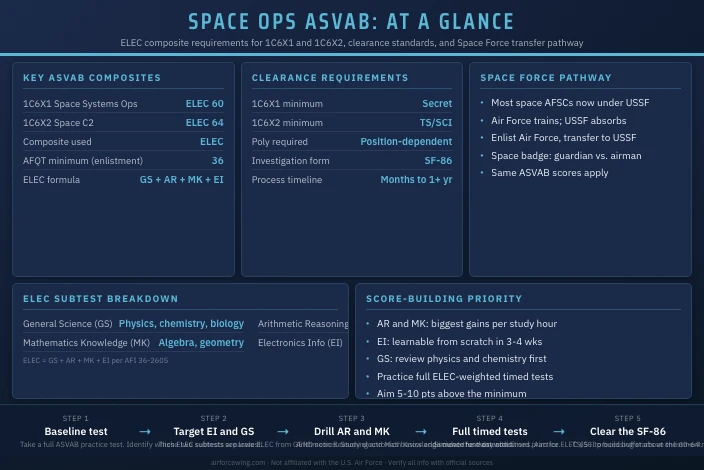
Why Space Jobs Use the ELEC Composite
The Air Force assigns each AFSC a qualifying composite built from specific ASVAB subtests. Space operations jobs draw from ELEC, which combines four subtests:
| Subtest | What It Measures |
|---|---|
| General Science (GS) | Physics, chemistry, biology, earth science |
| Arithmetic Reasoning (AR) | Word problems and applied math logic |
| Mathematics Knowledge (MK) | Algebra, geometry, number theory |
| Electronics Information (EI) | Circuits, voltage, current, basic components |
That mix reflects the work itself. Space systems operators track satellites, monitor ground support equipment, and interface with command-and-control software that runs on physics and math. The EI requirement in particular filters for candidates who can grasp electrical and signal concepts quickly, since orbital mechanics and space surveillance systems are built on them.
Your overall AFQT score of 36 gets you in the door for enlistment. After that, composite scores are what matter for job selection.
Space Operations AFSC Score Requirements
The two primary enlisted space operations AFSCs and their ASVAB minimums are listed below.
| AFSC | Title | Composite | Minimum Score |
|---|---|---|---|
| 1C6X1 | Space Systems Operations | ELEC | 60 |
| 1C6X2 | Space Command & Control | ELEC | 64 |
1C6X1 is the broader of the two. Airmen operate, maintain, and troubleshoot space systems including satellite tracking and telemetry stations. 1C6X2 focuses specifically on space situational awareness and command and control operations, coordinating space assets in support of joint military operations. The four-point gap in ELEC minimum reflects that 1C6X2 involves more analytical and command-level responsibilities.
A score of ELEC 64 puts you in approximately the 62nd percentile across all four contributing subtests. That’s not elite, but it requires deliberate preparation.
What These Jobs Actually Do
Both AFSCs sit under the Space career field and are closely tied to the U.S. Space Force (USSF).
1C6X1 Space Systems Operations airmen work at ground stations controlling satellites, processing orbital data, and executing mission tasking from space operations centers. Duties include telemetry monitoring, anomaly response, and maintaining the link between ground assets and orbiting systems.
1C6X2 Space Command and Control operators manage the space situational awareness picture. They track objects in orbit, detect potential threats to space assets, and pass relevant data to commanders. This AFSC works closely with the 18th Space Control Squadron and similar units that run space surveillance networks.
Both roles involve classified information daily. Clearance requirements follow directly from the mission.
Security Clearance Requirements
ASVAB scores are only part of the qualification. Both space AFSCs require a security clearance, and 1C6X2 sets a higher bar.
- 1C6X1 requires a minimum Secret clearance to enter training. Many follow-on assignments require Top Secret.
- 1C6X2 requires a Top Secret/SCI clearance from the start. Some positions require an additional polygraph depending on the unit and mission.
The clearance investigation begins after enlistment and can take several months to more than a year. Factors that delay or disqualify include foreign national contacts, significant financial problems, substance history, and criminal record. Complete the SF-86 honestly. Adjudicators treat voluntary disclosure far better than discovered omissions.
The Space Force Transfer Pathway
Most space operations billets have shifted from the Air Force to the U.S. Space Force since the USSF stood up in December 2019. Understanding how this affects enlistment matters.
Recruits still enlist into the Air Force, complete Basic Military Training at Joint Base San Antonio-Lackland, TX, and then attend tech school for their AFSC. After tech school, airmen in space AFSCs are typically transferred into the Space Force, where they serve as Guardians rather than Airmen.
The ASVAB score requirements remain the same regardless of which service you ultimately serve in. AFI 36-2101 still governs AFSC qualification during the enlistment and training pipeline, and your recruiter will process your enlistment as an Air Force enlistment. The USSF absorption happens administratively after training.
Speak with your recruiter about the current process and expected duty station. Space Force assignments concentrate at installations like Schriever SFB, Colorado; Peterson SFB, Colorado; Vandenberg SFB, California; and Patrick SFB, Florida.
How to Build Your ELEC Score
The ELEC composite is movable with the right preparation. Most candidates who fall short do so on General Science and Electronics Information, the two subtests that don’t appear in the more common GEND composite. Focus there first.
General Science covers a wide range of topics, but Air Force ASVAB prep should prioritize:
- Basic physics: force, motion, energy, electricity
- Chemistry: atomic structure, periodic table basics, chemical reactions
- Earth and space science: atmosphere layers, gravity, orbital concepts
Electronics Information is the one subtest most enlistees haven’t studied since high school, if at all. The good news is that it’s learnable in three to four weeks of focused review.
- Ohm’s Law and basic circuit calculations
- Series vs. parallel circuits
- Capacitors, resistors, and inductors
- AC vs. DC current
Arithmetic Reasoning and Mathematics Knowledge make up the other half of the ELEC formula. These subtests respond well to timed practice drills.
The table below shows which subtests to prioritize based on your starting point.
| Starting Gap | Priority Subtests |
|---|---|
| Low on EI and GS | Electronics Info, then General Science |
| Low on AR and MK | Arithmetic Reasoning, then Math Knowledge |
| Strong on math, weak on science | General Science and Electronics Info only |
| Close to minimum | All four in parallel, timed full practice tests |
Set a target of five to ten points above the minimum. A buffer matters because composite scores can shift slightly between practice tests and the real exam.
How Space Ops Compares to Other High-Score Fields
Space isn’t the only career field that demands strong ELEC scores. Knowing what’s around the same threshold can help if your scores land in a range that opens multiple options.
| Career Field | AFSC | Composite | Minimum |
|---|---|---|---|
| Space Systems Operations | 1C6X1 | ELEC | 60 |
| Cyber Transport Systems | 3D1X2 | ELEC | 60 |
| Space Command & Control | 1C6X2 | ELEC | 64 |
| Ground Radar Systems | 2E1X1 | ELEC | 64 |
If you hit ELEC 64, you’re qualified for four technically demanding fields. That score also positions you well above the ELEC 60 threshold, giving you flexibility at the MEPS job selection table.
The full list of every AFSC score requirement is in ASVAB Scores for Every Air Force AFSC.
You may also find Best ASVAB Scores for Logistics AFSC Jobs and Best ASVAB Scores for Officer Careers helpful if you’re weighing your options across fields.
The Air Force ASVAB test prep guide lays out a complete study plan from diagnostic testing to timed full-length practice. Browse the Air Force space career group for full AFSC profiles, training details, and duty station information.