Best ASVAB Scores for Security Forces AFSC Jobs
Security Forces has one of the lowest ASVAB minimums in the entire Air Force. That draws a lot of applicants who treat the bar as the finish line, and then wonder why they have fewer choices than expected. Scoring above the minimum changes the conversation entirely: more shred-outs, stronger retraining options, and a leg up on promotion boards that weigh test scores alongside performance reports.
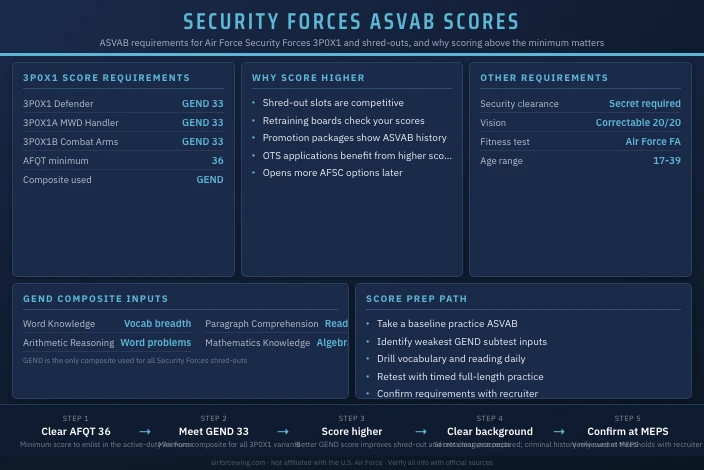
How the Air Force Measures Security Forces Aptitude
The Air Force uses five composite scores, not raw ASVAB subtest scores, to determine AFSC qualification. Security Forces jobs draw primarily from one:
GEND (General): Word Knowledge + Paragraph Comprehension + Arithmetic Reasoning + Mathematics Knowledge
This composite measures the broad reasoning and reading skills that Security Forces work requires: following procedures, writing incident reports, interpreting regulations, and making fast decisions under pressure. It’s a verbal and math composite, so strong readers and anyone solid in basic algebra are naturally positioned well.
Your AFQT score: the overall qualification number, must hit at least 36 for active-duty enlistment. That opens the door. Your GEND composite is what assigns you the job.
ASVAB Requirements for Security Forces Jobs
All Security Forces AFSCs fall under the 3P0X1 base designator. Shred-outs are specializations recruits can pursue after qualifying for the base AFSC. The table below covers the full group.
| AFSC | Title | Composite | Minimum Score |
|---|---|---|---|
| 3P0X1 | Security Forces (Defender) | GEND | 33 |
| 3P0X1A | Military Working Dog Handler | GEND | 33 |
| 3P0X1B | Combat Arms | GEND | 33 |
GEND 33 is the minimum across every 3P0X1 variant. That’s the second-lowest ASVAB bar in the enlisted inventory, sitting below most other career groups. A candidate who barely qualifies under the AFQT minimum of 36 could technically meet the Security Forces line score requirement at the same time.
Why Scoring Higher Still Matters
Meeting the GEND 33 minimum qualifies you for Security Forces. But the minimum score doesn’t help you inside the career field, and it creates real limitations outside it.
Shred-out competition. Military Working Dog Handler and Combat Arms slots are limited. Recruiters and assignment officers typically favor candidates with stronger overall profiles when slots are competitive. A higher GEND score, combined with a clean background and strong fitness scores, builds that profile.
Retraining eligibility. Security Forces is a gateway career for many airmen who plan to retrain later. The catch: retraining boards look at your ASVAB line scores for your target AFSC, not just your past job. If you score at the floor for Security Forces, you may not qualify for the AFSC you actually want. Scoring higher the first time preserves your options.
Promotion competitiveness. The Enlisted Evaluation System factors in Education and Training scores, which include ASVAB performance. Senior NCOs reviewing promotion packages can see the full picture. A higher score doesn’t guarantee promotion, but it removes a potential weakness from your record.
Officer commissioning. Airmen who pursue Officer Training School after enlistment need an ASVAB-based baseline score for OTS packages. Stronger academic testing history supports a stronger commissioning application.
The Three Shred-Outs Explained
Every new Security Forces trainee enters as a 3P0X1 Defender. After qualifying for the base AFSC, you can apply or be selected for one of two shred-outs.
3P0X1A. Military Working Dog Handler pairs airmen with patrol or detection dogs for base security, drug and explosive detection, and deployed patrol missions. This is one of the most sought-after shred-outs in Security Forces. Physical demands are higher, and the bond with a working dog is a major draw for many recruits. Selection depends on aptitude, temperament screening, and available dog handler slots at training.
3P0X1B. Combat Arms covers small arms training and qualification. Combat Arms instructors run weapons qualification courses for the base, manage armories, and deploy with combat support units. This shred-out is common for airmen with a strong interest in marksmanship and weapons maintenance.
The base 3P0X1 Defender role covers patrol, law enforcement on the installation, entry control, and force protection. Most Security Forces airmen graduate tech school as Defenders and serve in that capacity for their first assignment.
Which Subtests to Prioritize
Since GEND is the key composite for Security Forces, these four subtests determine your score:
- Word Knowledge: vocabulary breadth. This responds well to daily reading and targeted word lists. Aim for 15-20 minutes of dedicated vocabulary study per day.
- Paragraph Comprehension: reading for main ideas, inference, and detail. Short practice passages with timed answers build this score efficiently.
- Arithmetic Reasoning: word problems covering ratios, rates, percentages, and basic algebra. This is the most impactful math subtest to improve.
- Mathematics Knowledge: algebra, geometry, and number properties. Structured review from a study guide covers this well in 2-4 weeks.
All four subtests also feed into other line scores. Strong performance on these inputs improves your AFQT and makes you competitive for AFSC retraining later.
What Else Security Forces Requires
ASVAB line scores open the door, but Security Forces has additional entry requirements worth knowing before you commit.
- Physical standards: Security Forces requires above-average physical fitness. You’ll need to pass the Air Force Fitness Assessment and meet law enforcement physical standards at MEPS.
- Security clearance: A Secret clearance is required. The background investigation will screen criminal history, drug use, and financial records.
- Law enforcement restrictions: Applicants with certain misdemeanor or felony convictions are disqualifying under federal law enforcement suitability standards. This is separate from the AFQT requirement.
- Vision: Correctable to 20/20 is required. Standards are verified at MEPS.
- Age: Must be 17-39 for active-duty enlistment (varies by component).
The clearance requirement is the factor that catches the most applicants off guard. A recruiter can give you a preliminary read on your eligibility before you invest time in ASVAB prep.
Full career details, training pipeline, and assignment patterns are at the Air Force Security Forces career group.
You may also find Best ASVAB Scores for Air Force Communications AFSC Jobs and the Air Force ASVAB test prep guide useful as you build your study plan. The complete line score reference across every AFSC is at ASVAB Scores for Every Air Force AFSC.