Best ASVAB Scores for Air Force Rated Officer Positions
Rated officer positions, pilot, Combat Systems Officer, Air Battle Manager, RPA pilot, are the most competitive officer career fields in the Air Force. Getting there requires three separate tests, and the ASVAB is the one most candidates underestimate. It’s not the primary selection tool, but a weak ASVAB score reveals the same math and verbal gaps that will hurt you on the AFOQT. Fix them early, and every downstream test gets easier.
The Four Rated Positions
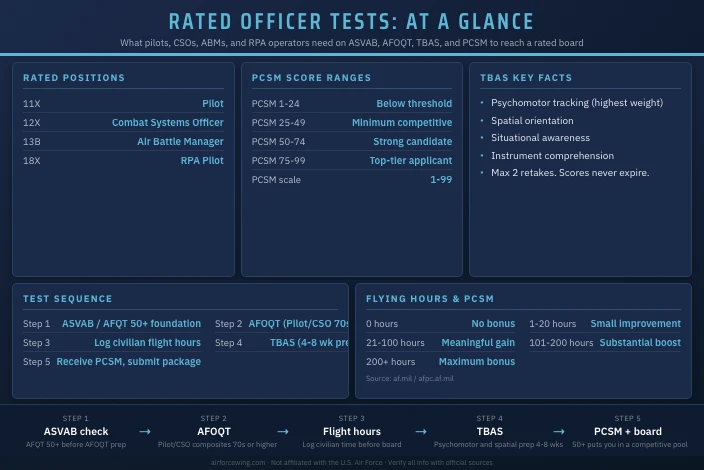
The Air Force designates four career fields as “rated”, positions that require aviation aptitude testing beyond the standard AFOQT.
| AFSC | Title | Primary Mission |
|---|---|---|
| 11X | Pilot | Fixed-wing and rotary aircraft |
| 12X | Combat Systems Officer (CSO) | Weapons, navigation, and sensor systems in crewed aircraft |
| 13B | Air Battle Manager (ABM) | Airborne command and control |
| 18X | Remotely Piloted Aircraft (RPA) Pilot | MQ-9 and other unmanned systems |
All four require the TBAS (Test of Basic Aviation Skills) in addition to the AFOQT. Non-rated officer fields, intelligence, logistics, finance, legal, civil engineering, do not take the TBAS. Their boards rely on AFOQT composites, GPA, and leadership record alone.
The rated path runs through three tests in sequence. Understanding what each one measures and how they connect is the first step in building a preparation plan.
How the ASVAB Connects to Rated Selection
The ASVAB is not a rated selection test. The Air Force does not use your ASVAB line scores to evaluate officer candidates. But the ASVAB still matters to rated candidates in two ways.
Prior enlisted applicants applying through the Enlisted Commissioning Program have ASVAB scores in their service record. Those scores aren’t part of the board review, but a recruiter may use them informally during early screening conversations.
Civilian applicants sometimes take the ASVAB as a readiness check before committing to AFOQT preparation. The minimum AFQT to enlist is 36. That threshold has no bearing on officer candidacy. A practical floor for rated candidates is AFQT 50 or higher: not an official requirement, but a signal that your math and verbal foundations are solid enough to support AFOQT work.
Why the AFQT Baseline Matters
The AFQT pulls from four subtests: Arithmetic Reasoning, Mathematics Knowledge, Paragraph Comprehension, and Word Knowledge. Those exact four subtests feed the AFOQT’s Verbal and Quantitative composites. Rated boards look hard at the Pilot and CSO composites, both of which draw from the same math and spatial reasoning skills. A weak AFQT is often the first visible sign of gaps that will compound on the AFOQT.
The AFOQT: Primary Rated Selection Test
The Air Force Officer Qualifying Test is where rated selection begins in earnest. It produces six composite scores, and rated candidates need strong performance on specific ones.
| AFOQT Composite | Used For |
|---|---|
| Pilot | Pilot (11X) selection |
| CSO | Combat Systems Officer (12X) selection |
| ABM | Air Battle Manager (13B) selection |
| Academic Aptitude | General officer eligibility |
| Verbal | All officer programs |
| Quantitative | All officer programs |
The minimum eligibility thresholds are Verbal 15 and Quantitative 10. Those minimums will not get you into a competitive board. Most UPT (Undergraduate Pilot Training) selectees score in the 70s and 80s on the Pilot composite. ABM and CSO boards are slightly less competitive, but strong scores still distinguish packages.
The AFOQT allows two lifetime attempts. If you take it twice, the Air Force records your second score regardless of direction. A score drop on attempt two is permanent. Prepare as if you only get one shot.
AFOQT prep resources for rated officer candidates.
- AFOQT study guide with practice tests, covers all 12 subtests including the Pilot and CSO composites that feed your rated board package
- AFOQT online preparation course, video instruction and practice for every section of the officer qualifying test
TBAS: The Aviation Aptitude Test
The Test of Basic Aviation Skills is the most misunderstood test in the rated pipeline. It’s not a knowledge exam. You won’t be tested on aviation regulations, aerodynamics theory, or Air Force procedures. The TBAS measures cognitive and motor skills that predict success in flight training.
Four components make up the test:
- Psychomotor tracking and multitasking: You use a joystick to hold a crosshair on a moving target while responding to secondary tasks on screen. This component carries the most weight in the final score. It simulates divided-attention demands that every aviator faces.
- Spatial orientation: Mental rotation tasks and position-relative-to-reference-frame problems. Aircraft attitude questions appear in this section.
- Situational awareness: Pattern recognition under time pressure. You process multiple changing data streams and identify what needs attention first.
- Instrument comprehension: Cockpit instrument displays. You identify aircraft attitude from analog gauges. Candidates with even basic flight instrument familiarity have an advantage here.
TBAS Retake Policy
The TBAS allows a maximum of two retakes: three total attempts across your lifetime. Scores don’t expire. A score from five years ago is still on the books today. That permanence makes preparation before every attempt non-negotiable.
PCSM: How the Scores Combine
TBAS results don’t stand alone. They feed into the Pilot Candidate Selection Method (PCSM) score, the composite that rated boards use to rank candidates. PCSM runs from 1 to 99.
Three inputs build your PCSM:
| Input | Role in PCSM |
|---|---|
| TBAS scores | Primary driver |
| AFOQT Pilot subtest | Weighted input |
| Civilian flying hours | Up to a substantial bonus |
The Air Force Personnel Center calculates your PCSM after you complete both the AFOQT and TBAS. You don’t receive it on test day.
PCSM Competitive Ranges
| PCSM Range | What It Signals |
|---|---|
| 1-24 | Below competitive threshold |
| 25-49 | Minimum range; every other factor must be outstanding |
| 50-74 | Strong candidate |
| 75-99 | Top-tier applicant |
The floor to get a package reviewed is PCSM 25. Most UPT board selections come from candidates in the 50+ range. Getting from minimum to competitive isn’t just about retaking the TBAS, flying hours are often the faster path.
Flying Hours and PCSM
Civilian flight time is the only PCSM input you can improve after taking the tests. Documented hours receive measurable credit in the scoring formula.
| Logged Flight Hours | PCSM Effect |
|---|---|
| 0 hours | No bonus |
| 1-20 hours | Small improvement |
| 21-100 hours | Meaningful gain |
| 101-200 hours | Substantial improvement |
| 200+ hours | Maximum bonus |
A private pilot certificate requires roughly 40 hours of flight time, typically costing $8,000 to $15,000 depending on location. Even 20 to 30 hours short of a full certificate still moves your PCSM. If a university flight program or flying club offers reduced rates, the investment has direct selection value before your application window closes.
The Test Sequence for Rated Candidates
Each test builds on the last. Getting the order wrong wastes time and risks scoring on an unprepared attempt.
Rated vs. Non-Rated: Test Requirements Side by Side
Non-rated officer candidates skip the TBAS and PCSM entirely. This table shows the full difference in what each path requires.
| Test | Rated (11X, 12X, 13B, 18X) | Non-Rated |
|---|---|---|
| ASVAB | Informal foundation check | Informal foundation check |
| AFOQT | Required (Pilot, CSO, or ABM composites) | Required (Verbal, Quantitative, Academic Aptitude) |
| TBAS | Required | Not required |
| PCSM | Required for board | Not applicable |
Both paths run through OTS at Maxwell AFB, Alabama, a 9.5-week program that commissions graduates as Second Lieutenants. The difference is what gets you to the board and what gets you selected.
What ASVAB Prep Does for Rated Candidates
Rated candidates often ask whether ASVAB prep is worth their time given that the AFOQT is the primary exam. The answer depends on your current baseline.
If your AFQT is already above 60, ASVAB-specific prep adds little marginal value. Move directly to AFOQT material and TBAS preparation.
If your AFQT is between 36 and 55, spending two to four weeks on Arithmetic Reasoning and Mathematics Knowledge builds the exact foundation that the AFOQT’s Quantitative composite tests. That time is not wasted, it’s front-loading work you’d have to do anyway.
The GEND composite (General: Word Knowledge + Paragraph Comprehension + Arithmetic Reasoning + Mathematics Knowledge) is the same cluster of skills that feeds AFOQT Verbal and Quantitative. A candidate who pushes their GEND score from 50 to 65 is not just hitting an arbitrary benchmark. They’re demonstrating that the gaps are closed.
For a complete view of Air Force ASVAB score requirements by career field, see ASVAB Scores for Every Air Force AFSC. The rated officer career field hub is at Air Force Operations Officer Careers.
You may also find Air Force Officer Selection Tests and TBAS vs ASVAB useful as you map out the full preparation sequence. The Air Force TBAS test prep guide covers the complete study pipeline from scheduling through test day.