Best ASVAB Scores for Operations AFSC Jobs
Air traffic control, weather, command post, radar systems, the operations career group covers some of the most demanding work in the enlisted Air Force. These jobs keep aircraft moving, missions coordinated, and airspace safe. They also carry some of the steepest ASVAB line score requirements outside of cyber and intelligence. If you’re aiming for one of these AFSCs, knowing which composite to target before test day matters.
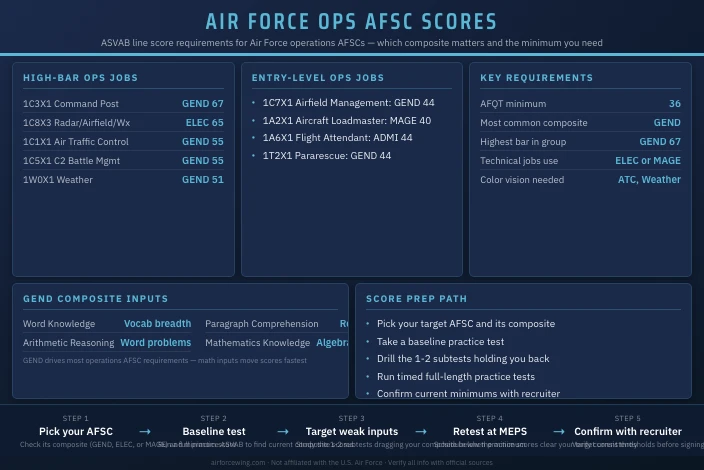
How the Air Force Scores Operations Aptitude
The Air Force doesn’t post a single “line score” the way the Army does. Instead, it combines ASVAB subtest raw scores into five composites called Qualified Mental Aptitude Area (QMAA) scores. Each AFSC specifies one (or two) composites and a minimum threshold. Operations AFSCs draw from three of the five:
| Composite | Subtest Inputs |
|---|---|
| GEND | Word Knowledge + Paragraph Comprehension + Arithmetic Reasoning + Mathematics Knowledge |
| ELEC | General Science + Arithmetic Reasoning + Mathematics Knowledge + Electronics Information |
| MAGE | Mechanical Comprehension + Auto & Shop + General Science + Electronics Information |
GEND is by far the most common. Most operations AFSCs require verbal and analytical strength, not mechanical knowledge. ELEC appears for radar and technical systems roles. MAGE applies to a handful of aircraft-support jobs in the group.
Your AFQT score: the overall enlistment qualifying number, must be at least 36 to join the active-duty Air Force on a high school diploma. Passing that gets you into MEPS. Your QMAA composite scores determine which specific jobs you can access from there.
ASVAB Line Score Requirements: Operations AFSCs
The table below covers the major operations AFSCs with verified composite and minimum score requirements. Scores are sourced from AFI 36-2101 and cross-referenced against the complete line score chart at ASVAB Scores for Every Air Force AFSC.
| AFSC | Title | Composite | Minimum Score |
|---|---|---|---|
| 1C1X1 | Air Traffic Control | GEND | 55 |
| 1C3X1 | Command Post | ADMI / GEND | 55 / 67 |
| 1C5X1 | Command and Control Battle Management | GEND | 55 |
| 1C7X1 | Airfield Management | GEND | 44 |
| 1C8X3 | Radar, Airfield, and Weather Systems | ELEC / MECH | 65 / 50 |
| 1W0X1 | Weather | GEND | 51 |
| 1A2X1 | Aircraft Loadmaster | MAGE | 40 |
| 1A3X1 | Airborne Mission Systems | ELEC | 60 |
| 1A6X1 | Flight Attendant | ADMI | 44 |
| 1T2X1 | Pararescue | GEND | 44 |
1C3X1 Command Post stands out with a dual requirement: ADMI 55 and GEND 67. You must clear both thresholds. That GEND 67 is the highest GEND floor in the entire operations group and places it close to intelligence-level verbal demands.
1C8X3 Radar, Airfield, and Weather Systems is the only operations AFSC requiring both an ELEC and a MECH composite, reflecting the breadth of its technical scope, these airmen maintain precision radar equipment, airfield lighting systems, and weather sensors.
The High-Score Operations AFSCs
Three AFSCs set the bar well above the group average. Each rewards serious prep.
1C3X1 Command Post operators manage the communications hub of an Air Force installation, relaying orders, tracking mission status, and maintaining direct communication links between commanders and aircraft. The GEND 67 requirement reflects the verbal precision the job demands. Command Post airmen deal in exact language under pressure, and the ASVAB bar reflects that.
1C8X3 Radar, Airfield, and Weather Systems technicians maintain some of the most complex ground equipment on any Air Force base. The dual-composite requirement (ELEC 65 and MECH 50) means the Air Force wants candidates with both electrical theory knowledge and mechanical aptitude. This is one of the more technically specialized jobs in the enlisted operations career field.
1W0X1 Weather specialists need GEND 51: moderate compared to Command Post, but this AFSC also requires normal color vision. The GEND bar reflects the nature of the work: reading atmospheric data, writing forecasts, and communicating conditions to aircrew in precise technical terms.
Most Accessible Operations Jobs
If you’re still building toward a higher score, these roles open at a lower GEND threshold:
- 1C7X1 Airfield Management (GEND 44), manages airfield operations, coordinates ground movement, and ensures safe aircraft flow on the flight line
- 1T2X1 Pararescue (GEND 44), the ASVAB bar here is modest, but the physical screening is among the most demanding in the enlisted Air Force; many candidates wash out in selection, not at MEPS
- 1A6X1 Flight Attendant (ADMI 44), supports distinguished visitor and special airlift missions; the ADMI composite draws from verbal and science subtests
- 1A2X1 Aircraft Loadmaster (MAGE 40), plans and supervises aircraft cargo loading; uses the MAGE composite instead of GEND
These four don’t require the same verbal horsepower as ATC or Command Post, but each carries its own physical standards, clearance requirements, or specialized training.
Which Subtests Drive Operations Scores
The right study strategy depends on which composite you’re chasing.
For GEND improvement (1C1X1, 1C3X1, 1C5X1, 1C7X1, 1W0X1, 1T2X1):
- Word Knowledge: the fastest subtest to move with daily vocabulary drilling. Reading broadly and using word lists accelerates this quickly.
- Paragraph Comprehension: timed reading practice for main idea and inference questions. Short, focused daily sessions work better than long study blocks.
- Arithmetic Reasoning: word problems and applied math reasoning. Timed practice sets are the most effective approach.
- Mathematics Knowledge: algebra, geometry, and number theory. This is the most study-intensive input in the GEND composite, but it also has the highest ceiling for improvement.
For ELEC improvement (1C8X3, 1A3X1):
- Electronics Information: basic electrical theory: circuits, voltage, resistance, and Ohm’s Law. This subtest is highly coachable with structured review.
- General Science: physics and chemistry fundamentals. ELEC pulls from this heavily, especially for radar-related roles.
- Arithmetic Reasoning and Mathematics Knowledge: overlap with GEND prep; strong math work benefits both composites.
For MAGE improvement (1C8X3, 1A2X1):
- Mechanical Comprehension: pulleys, gears, levers, and applied physics. Practice with diagrams and worked examples.
- Auto and Shop: automotive systems and basic tool use. Candidates with hands-on mechanical experience often find this the most intuitive section.
If you’re targeting 1C3X1 at GEND 67 and currently sitting around 55, you’re looking at roughly a 22% gap on that composite. Focus almost entirely on Arithmetic Reasoning and Mathematics Knowledge, those two inputs have the most room for gains with structured study.
Other Requirements for Operations AFSCs
Line scores open the door, but they’re not the only gate. Several operations AFSCs carry additional qualifications:
- Color vision: Required for 1C1X1 (Air Traffic Control), 1W0X1 (Weather), and 1C8X3. MEPS will screen for this. It can disqualify candidates before the ASVAB score even matters.
- Security clearance: 1C3X1 and 1C5X1 both require at minimum a Secret clearance. The background investigation process adds time before you can work in either role.
- Physical standards: 1T2X1 Pararescue requires passing a rigorous physical screening battery before selection training. Meeting the GEND 44 minimum is the easy part.
- FAA coordination: 1C1X1 airmen work under Federal Aviation Administration coordination requirements at joint-use airfields. The ASVAB bar reflects the precision and decision-making the job demands.
- AFQT minimum: 36 for high school diploma holders, 65 for GED holders, applies to all AFSCs.
Confirm every requirement directly with your recruiter and at MEPS. AFI 36-2101 is updated periodically, and thresholds do shift.
Building Your Study Plan
Operations AFSCs skew heavily toward GEND, so most candidates will spend the bulk of their prep time on verbal and math inputs. A few practical steps to structure your approach:
- Take a full baseline practice test before committing to a study schedule. You need to know your current composite scores, not just your AFQT.
- Identify your target AFSC and pull its specific composite and minimum from the table above.
- Calculate your gap. If your GEND is 48 and you need 55, you need roughly a 15% gain on that composite.
- Study the weakest inputs first. For most people that’s either Arithmetic Reasoning or Mathematics Knowledge, both respond well to structured daily practice.
- Run timed full-length practice tests every two weeks to measure composite progress, not just individual subtest performance.
Full career profiles for every operations AFSC are at the Air Force Operations career group. For a complete study roadmap from baseline test to test day, the Air Force ASVAB test prep guide covers the full pipeline.
You may also find Best ASVAB Scores for Maintenance AFSC Jobs and Best ASVAB Scores for Special Warfare AFSC Jobs helpful if you’re comparing career groups before committing to a study target.