Best ASVAB Scores for Air Force Officer Careers
Most officer candidates know the AFOQT is the primary selection test. What catches people off guard is that the ASVAB still plays a role, and the skills you build studying for one test directly feed the other. Getting clear on how these two tests connect before you sit for either can save you months of wasted prep time.
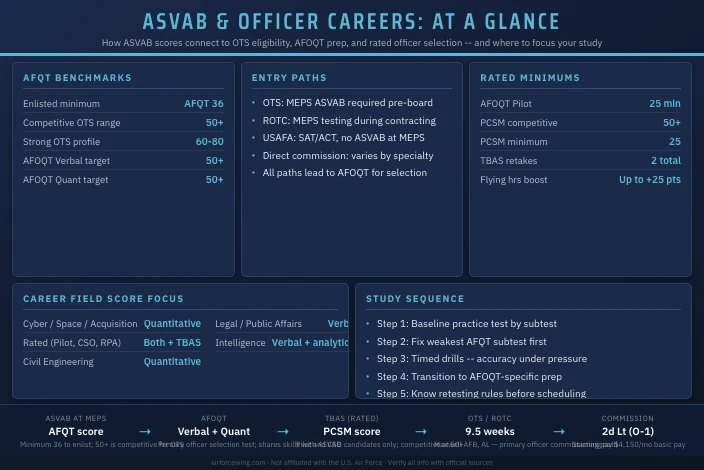
How the ASVAB Applies to Officer Candidates
The ASVAB is not the Air Force officer selection test. That role belongs to the AFOQT: the Air Force Officer Qualifying Test. But the ASVAB is still relevant, and not just as a formality.
The AFQT is the enlistment qualification score drawn from four ASVAB subtests: Arithmetic Reasoning, Mathematics Knowledge, Word Knowledge, and Paragraph Comprehension. For standard enlisted entry, the Air Force requires a minimum AFQT of 36. That number was set for enlisted applicants, not officers.
For competitive OTS selection, most applicants carry AFQT scores well above that floor. Recruiting data suggests competitive OTS applicants typically score 50 or higher on the AFQT, and many board-selected candidates are in the 60-80 range. The Air Force does not publish a hard OTS AFQT cutoff, but recruiters and board history make clear that a marginal AFQT score signals weak verbal and math skills, the same skills the AFOQT tests directly.
This is the real connection between the two exams. Study for the ASVAB with discipline and your AFOQT prep is already underway.
Officer Entry Paths and When the ASVAB Comes In
Air Force officers commission through four main paths, and each one has a different relationship with the ASVAB:
| Path | ASVAB Required? | When You Test |
|---|---|---|
| Officer Training School (OTS) | Yes, at MEPS | Before selection board |
| Air Force ROTC | Yes, at MEPS | During college contracting process |
| U.S. Air Force Academy (USAFA) | No | Replaces MEPS testing |
| Direct Commission | Case by case | Depends on career field |
OTS candidates commission after college. They visit MEPS, take the ASVAB, and their AFQT score goes into their application package alongside GPA, AFOQT scores, and leadership history. A low AFQT won’t automatically disqualify an OTS applicant, but it gives a selection board an easy reason to pass.
ROTC cadets typically test at MEPS when they contract into the scholarship or non-scholarship program. The ASVAB score is part of their record, but AFOQT performance and grade point average carry more weight in ROTC commissioning decisions.
USAFA candidates go through a different process and do not take the ASVAB at MEPS. SAT and ACT scores substitute for standardized testing in that pipeline.
Direct commission officers: attorneys, chaplains, physicians, and certain medical specialists, may or may not test at MEPS depending on their specialty. Many enter under special programs with different qualification procedures.
AFQT vs AFOQT: What Each Test Measures
Understanding the difference clarifies why prepping for one benefits the other.
AFQT pulls from four ASVAB subtests and produces a percentile score. It measures foundational verbal and quantitative reasoning. A score of 60 means you scored higher than 60% of the reference population, a standardized group of Americans ages 18-23 who took the test in a prior norming period.
AFOQT is longer, more technical, and covers more ground. It has 12 subtests including:
- Verbal Analogies
- Arithmetic Reasoning
- Word Knowledge
- Math Knowledge
- Reading Comprehension
- Situational Judgment
- Self-Description Inventory (personality)
- Table Reading
- Instrument Comprehension
- Block Counting
- Aviation Information (for rated candidates)
The AFOQT produces two scores that matter most for selection: the Verbal composite and the Quantitative composite. For rated candidates (pilots, combat systems officers, air battle managers, RPA pilots), the Pilot and CSO subtests also feed into the PCSM selection score.
The Verbal AFOQT composite draws on the same reading and vocabulary work as ASVAB Word Knowledge and Paragraph Comprehension. The Quantitative composite overlaps heavily with ASVAB Arithmetic Reasoning and Mathematics Knowledge. You can’t study for the AFOQT from scratch, you need a solid foundation first, and the ASVAB subtests provide that structure.
ASVAB Scores by Officer Career Field
Non-rated officer positions don’t have published ASVAB line score cutoffs the way enlisted AFSCs do. Selection is based on AFOQT scores, GPA, commissioning source performance, and board review. But different career fields attract candidates with different ASVAB strength profiles, and this matters for how you focus your prep.
| Career Field | Primary Test | Key Academic Strengths |
|---|---|---|
| Rated Operations (Pilot, CSO, ABM, RPA) | AFOQT + TBAS/PCSM | Quantitative, spatial reasoning |
| Intelligence | AFOQT | Verbal, analytical |
| Cyber Operations | AFOQT | Quantitative, technical reasoning |
| Space Operations | AFOQT | Quantitative, technical reasoning |
| Acquisitions | AFOQT | Quantitative, business reasoning |
| Logistics Readiness | AFOQT | Verbal, quantitative |
| Medical (Officer) | Specialty credentials + AFOQT | Varies by specialty |
| Legal (JAG) | AFOQT + LSAT | Verbal reasoning |
| Civil Engineering | AFOQT | Quantitative, technical |
| Public Affairs | AFOQT | Verbal reasoning |
| Finance & Contracting | AFOQT | Quantitative, verbal |
Cyber, space, acquisitions, and civil engineering lean quantitative. Legal and public affairs lean verbal. Rated operations demands both, plus the spatial and psychomotor skills tested by the TBAS.
The practical implication: figure out which career field you’re targeting, then weight your ASVAB subtest prep accordingly. Aiming for cyber means pushing Math Knowledge and Arithmetic Reasoning hard. Aiming for JAG means prioritizing Word Knowledge and Paragraph Comprehension.
Rated Officer Positions: The ASVAB Is Just Step One
Pilot, combat systems officer, air battle manager, and RPA pilot are the Air Force’s rated officer positions. These are the most competitive officer career fields and have the most complex selection process.
Rated candidates need:
- AFOQT Pilot score of 25 or higher (minimum; competitive applicants score significantly higher)
- AFOQT CSO score for combat systems officer candidates
- TBAS (Test of Basic Aviation Skills) for pilot and CSO candidates, feeds the PCSM score
- PCSM score of 25 is the minimum; a score of 50+ is competitive at most selection boards
The ASVAB AFQT is the earliest signal. A strong AFQT score in the 70s or 80s is consistent with the quantitative ability needed to score well on the AFOQT Pilot subtest. A marginal AFQT in the 40s is a warning sign worth addressing before sitting for the AFOQT.
For a full breakdown of rated position requirements, see Best ASVAB Scores for Air Force Rated Officer Positions.
What Competitive OTS Applicants Actually Score
Selection boards review complete packages, not individual test scores in isolation. GPA, letters of recommendation, leadership history, and interview performance all factor in. But AFOQT scores are visible to every board member, and a weak score draws scrutiny to everything else in the package.
The Air Force does not publish official cutoffs or board statistics. Based on recruiting guidance and community-reported data, competitive OTS applicants typically see:
- AFOQT Verbal: 50 or higher
- AFOQT Quantitative: 50 or higher
- AFQT: 50 or higher
These are guidance ranges, not hard gates. Candidates with exceptional records have commissioned with lower scores. Candidates with unremarkable records have been passed over with higher scores. But if your AFQT is below 50, that’s worth addressing before you apply, both because of what it signals directly and because improving it means your AFOQT verbal and quantitative prep is already further along.
Building the Right Study Plan
The ASVAB and AFOQT share a significant portion of their tested skills. A disciplined ASVAB prep sequence, verbal, arithmetic, and math, puts you in a better position for the AFOQT than attempting the AFOQT cold.
A practical sequence:
An ASVAB prep course with section-level diagnostics helps you skip the guesswork on step one and move directly into targeted practice.
The full officer careers directory is at Air Force Officer Careers. For a complete guide to officer selection tests including the AFOQT and TBAS, see Air Force Officer Selection Tests and AFOQT study guide.